Fastener Guide
Scroll straight through all 223 documents, or jump to any one from the list on the left. New to fastener standards? Start with How to Read This Guide.
Technical Reference
Grades, specifications, bolts, screws, nuts, washers, stainless, metric classes, torque and proof-load tables.
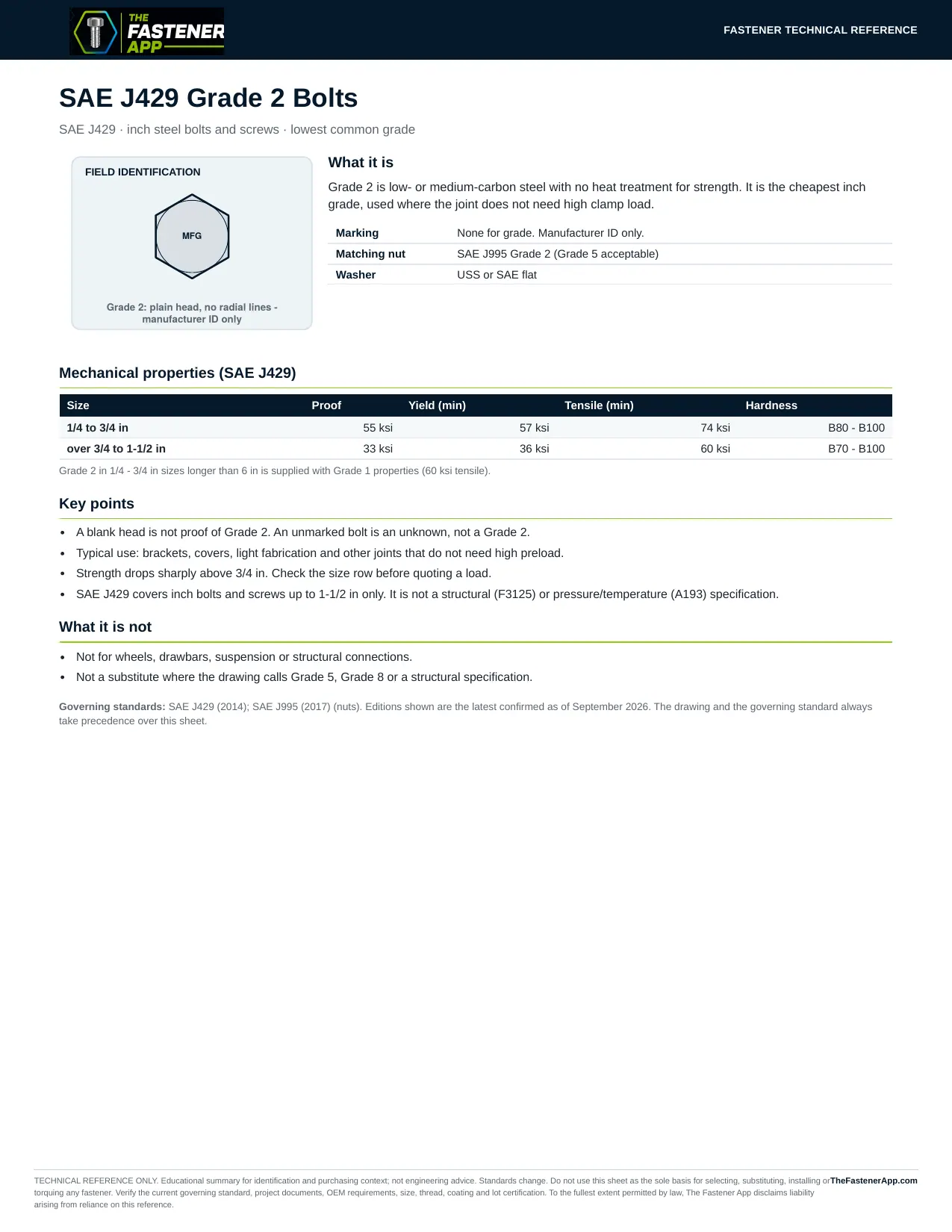
SAE J429 Grade 2 Bolts
Grade 2 is low- or medium-carbon steel with no heat treatment for strength. It is the cheapest inch grade, used where the joint does not need high clamp load.
 Report an error on this sheet
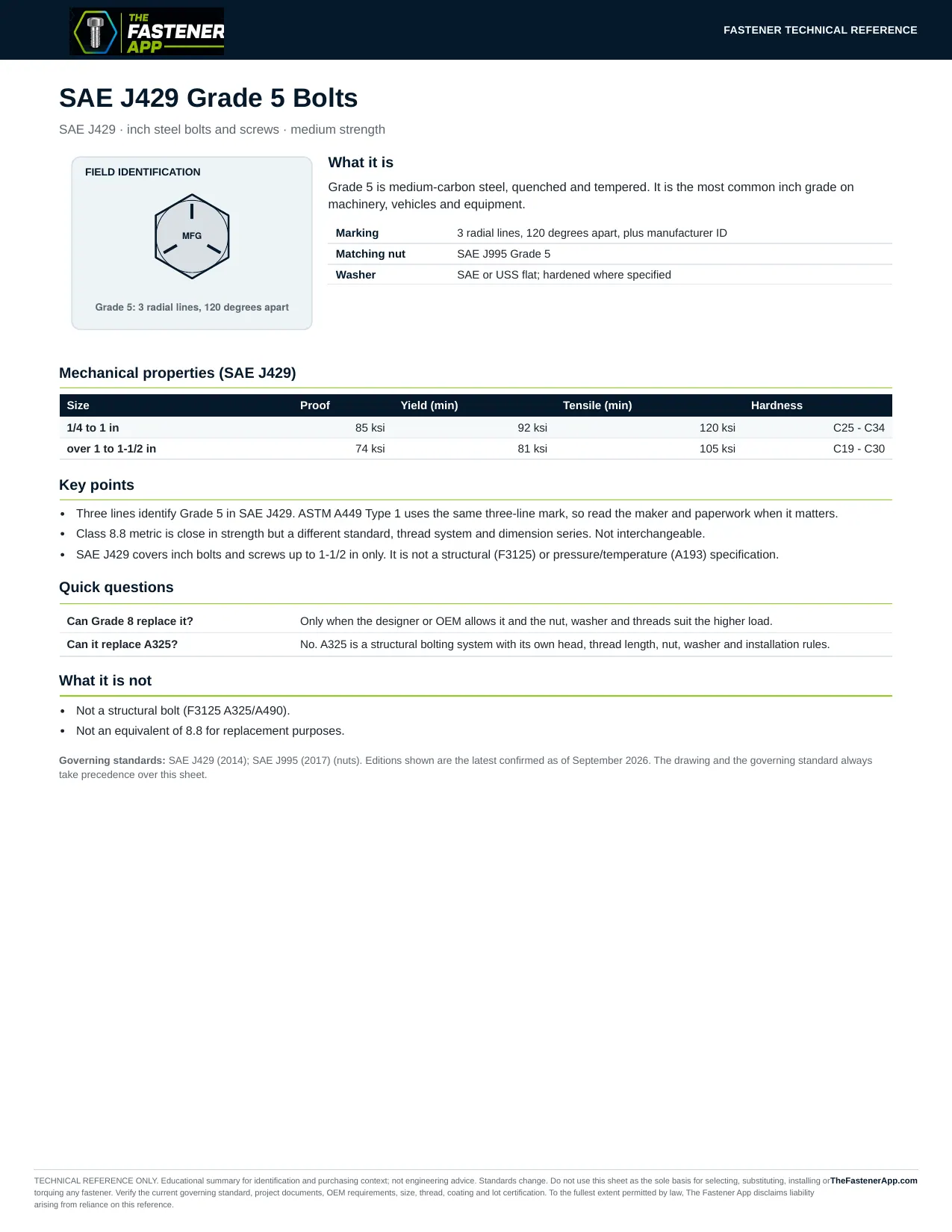
SAE J429 Grade 5 Bolts
Grade 5 is medium-carbon steel, quenched and tempered. It is the most common inch grade on machinery, vehicles and equipment.
 Report an error on this sheet
SAE J429 Grade 8 Bolts
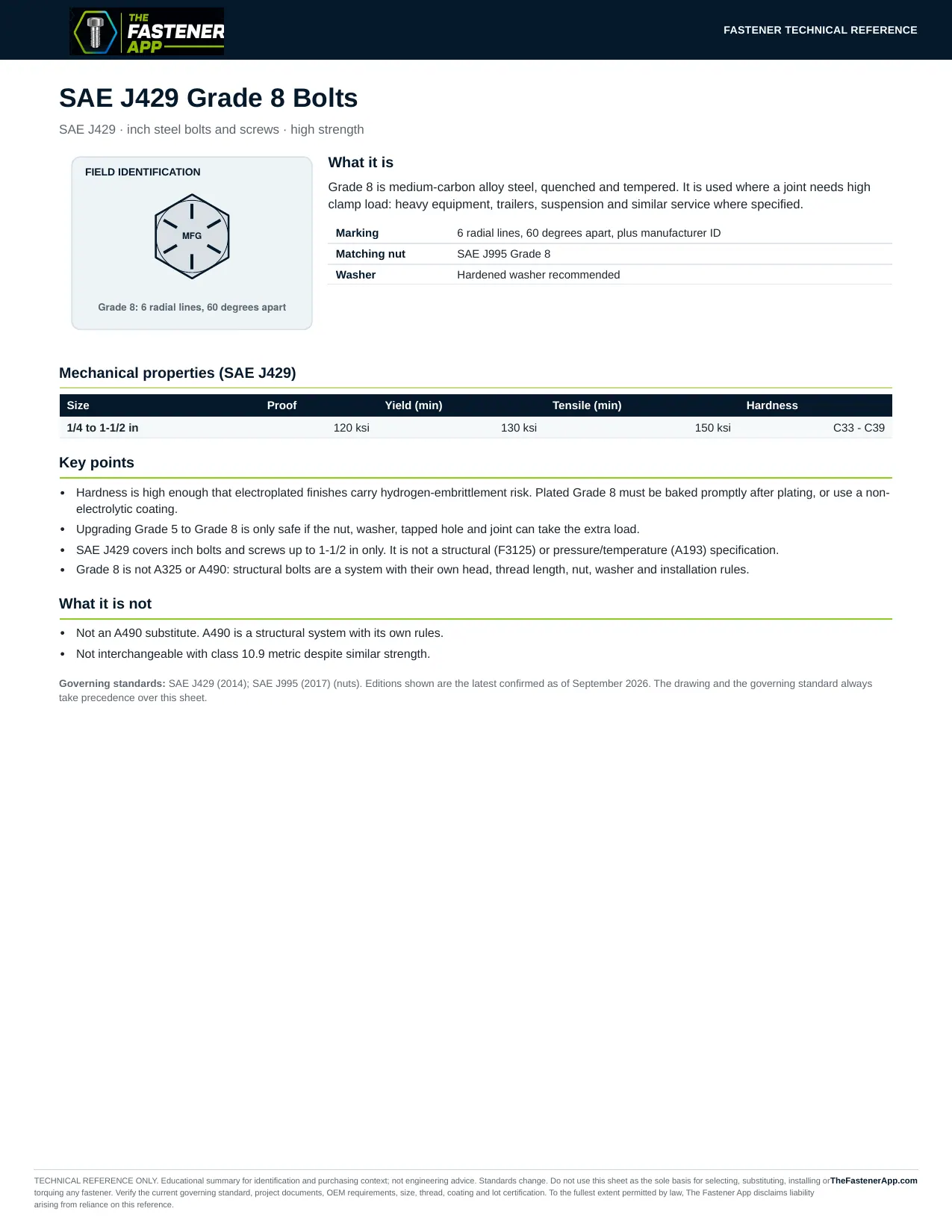
Grade 8 is medium-carbon alloy steel, quenched and tempered. It is used where a joint needs high clamp load: heavy equipment, trailers, suspension and similar service where specified.
 Report an error on this sheet
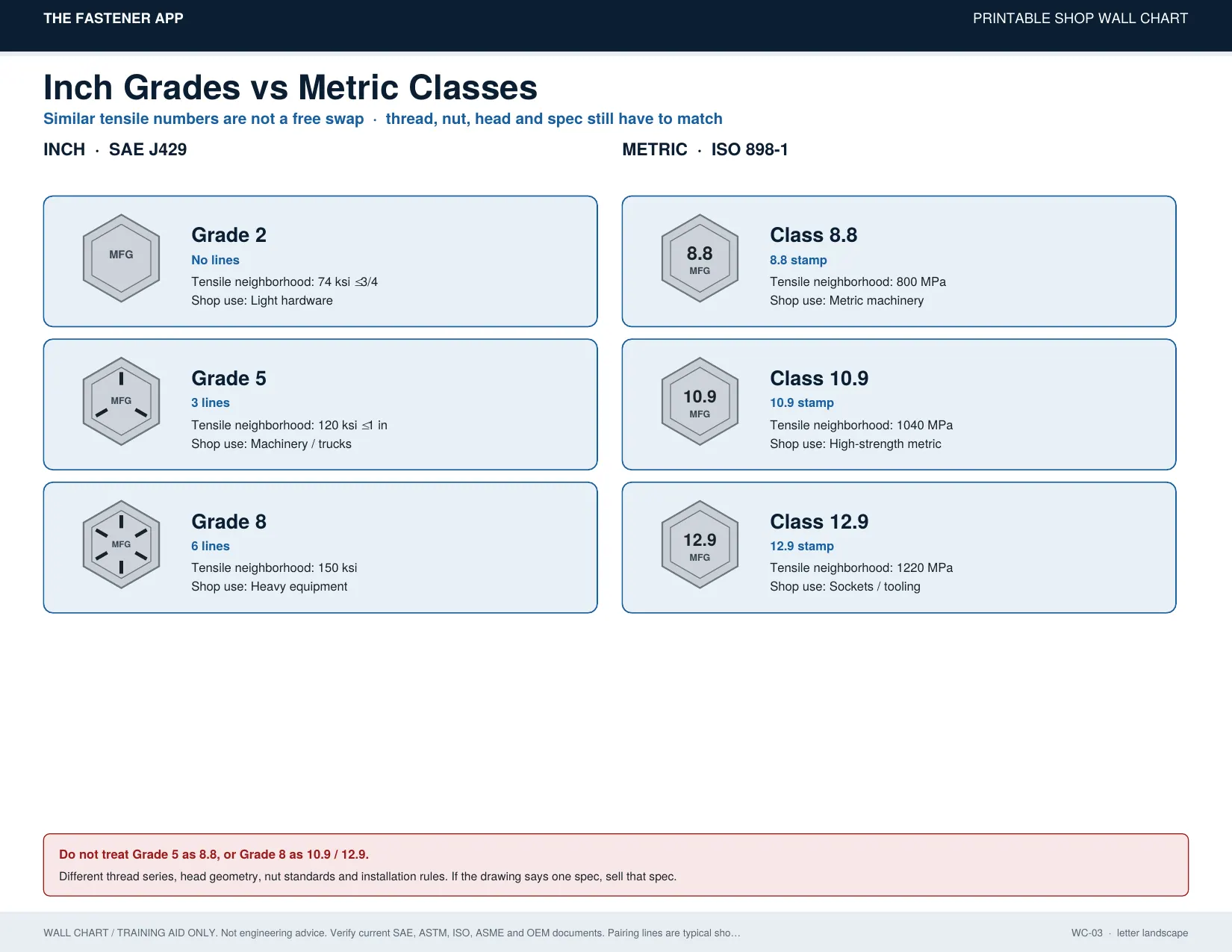
SAE Grade 2 vs 5 vs 8
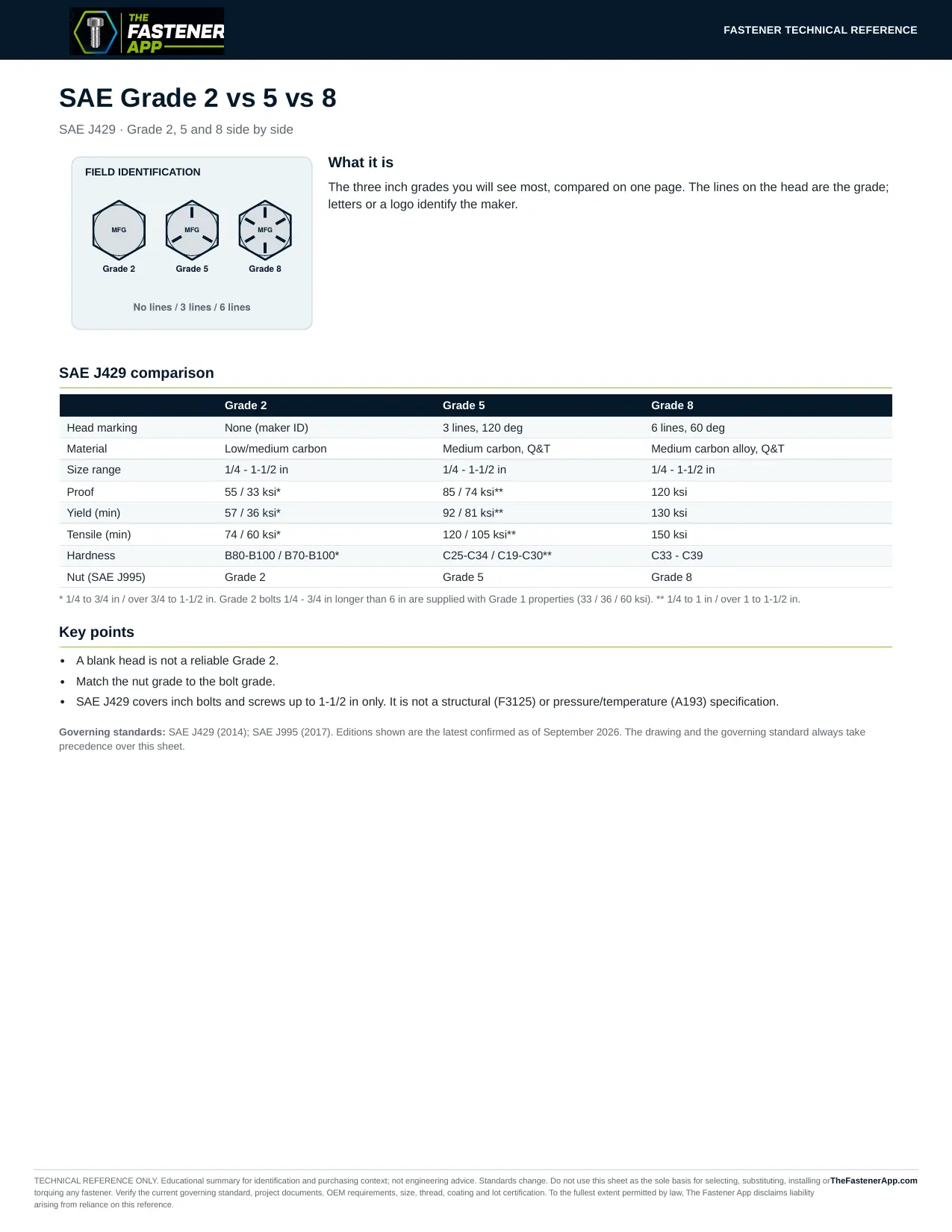
The three inch grades you will see most, compared on one page. The lines on the head are the grade; letters or a logo identify the maker.
 Report an error on this sheet
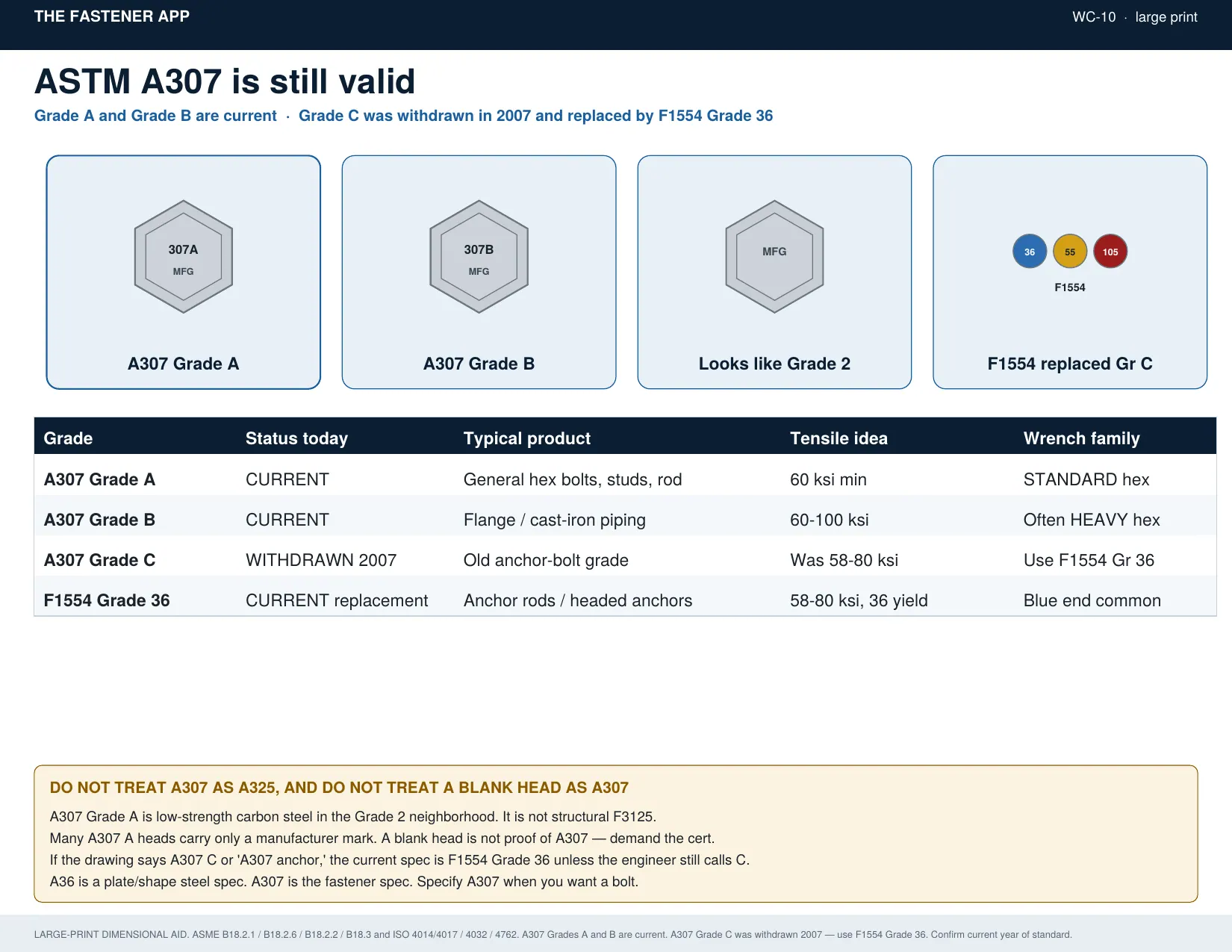
ASTM A307 Grade A Bolts
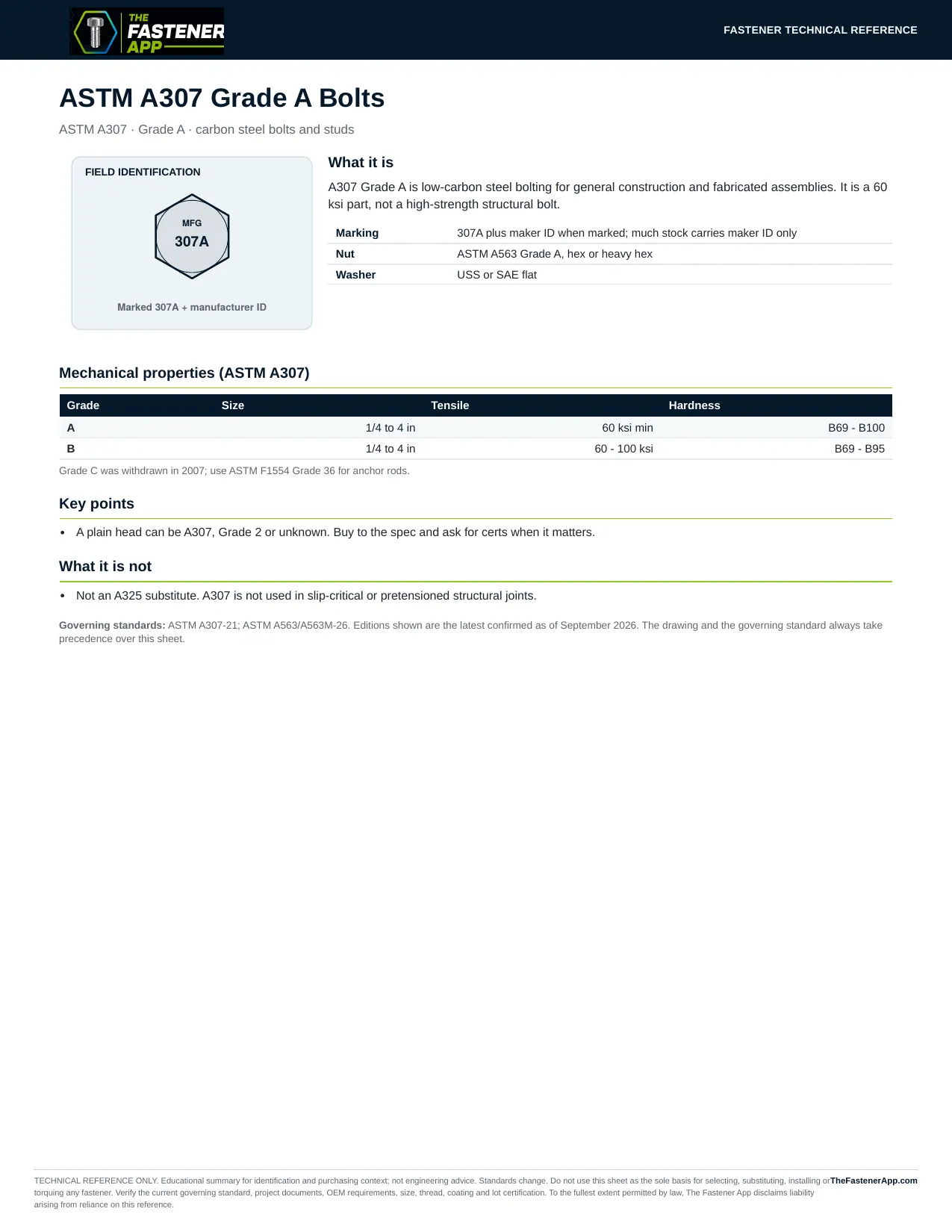
A307 Grade A is low-carbon steel bolting for general construction and fabricated assemblies. It is a 60 ksi part, not a high-strength structural bolt.
 Report an error on this sheet
ASTM A307 Grade B Bolts
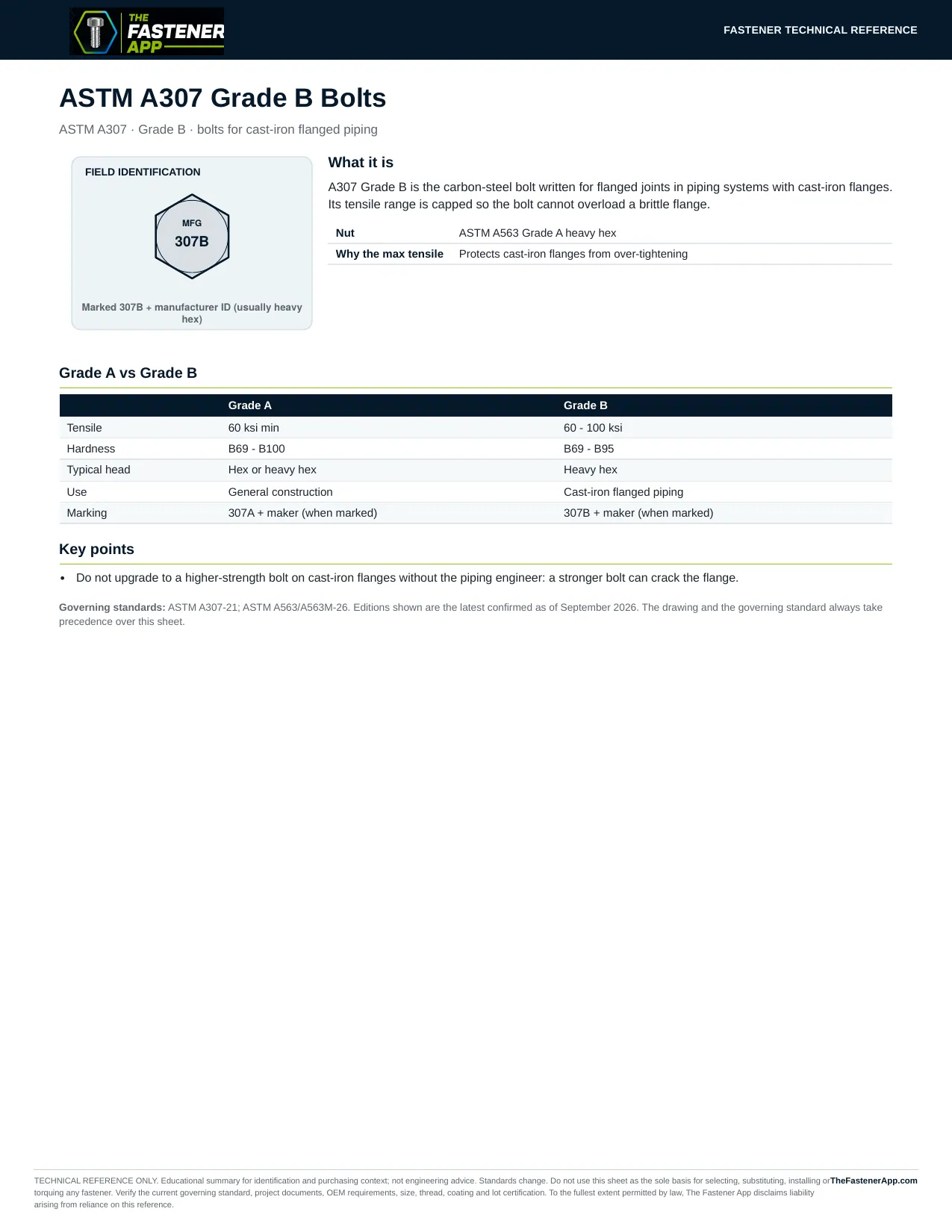
A307 Grade B is the carbon-steel bolt written for flanged joints in piping systems with cast-iron flanges. Its tensile range is capped so the bolt cannot overload a brittle flange.
 Report an error on this sheet
ASTM A354 Grade BC
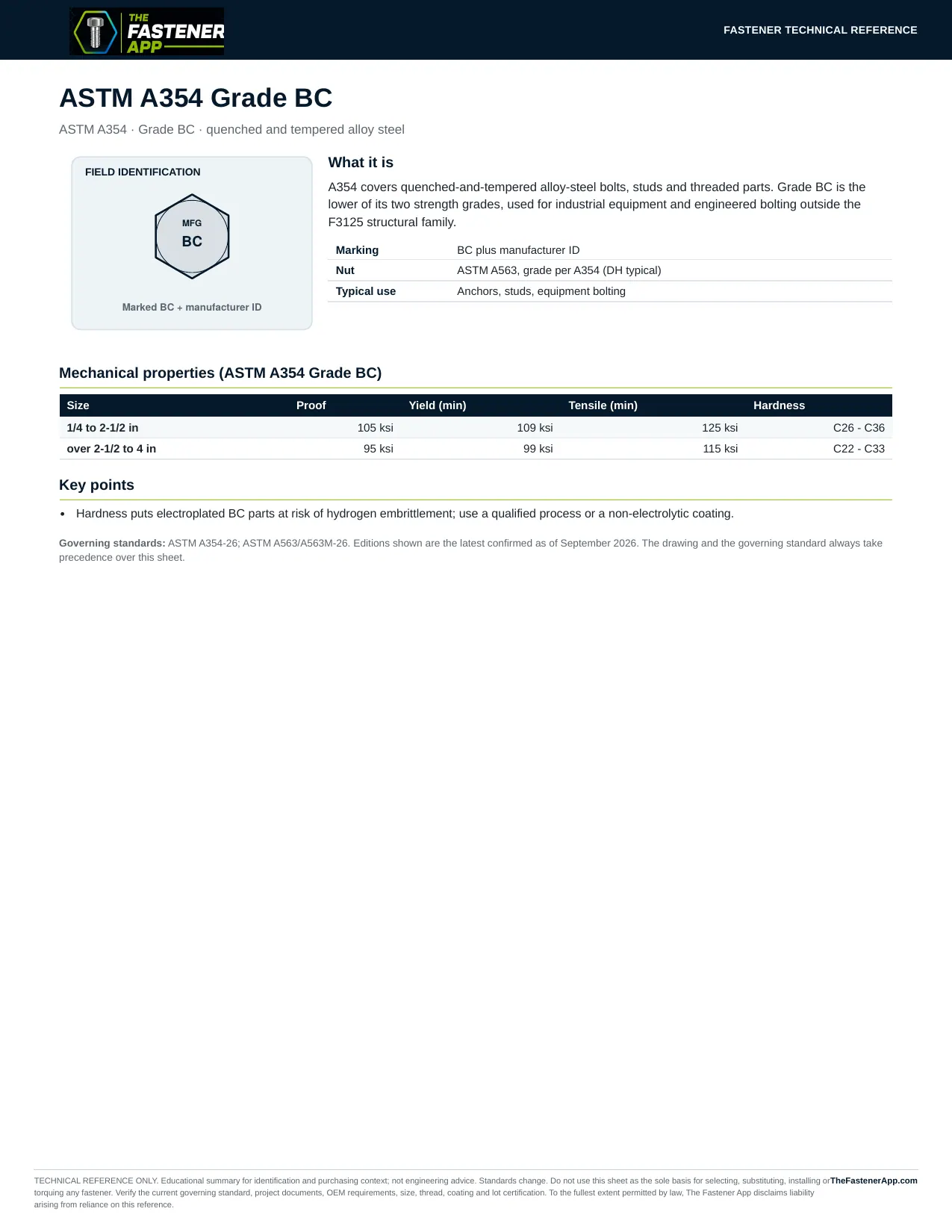
A354 covers quenched-and-tempered alloy-steel bolts, studs and threaded parts. Grade BC is the lower of its two strength grades, used for industrial equipment and engineered bolting outside the F3125 structural family.
 Report an error on this sheet
ASTM A354 Grade BD
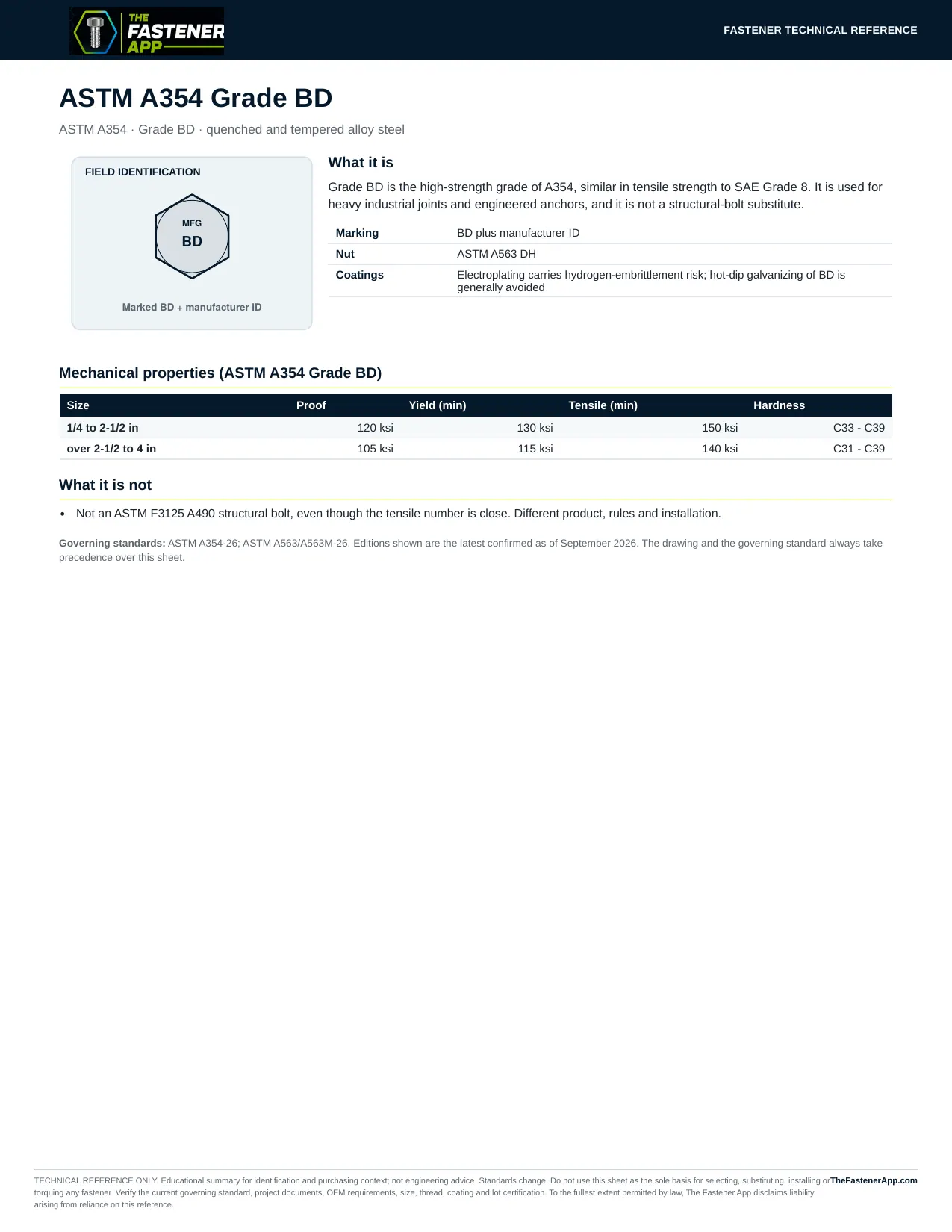
Grade BD is the high-strength grade of A354, similar in tensile strength to SAE Grade 8. It is used for heavy industrial joints and engineered anchors, and it is not a structural-bolt substitute.
 Report an error on this sheet
ASTM A449 Bolts
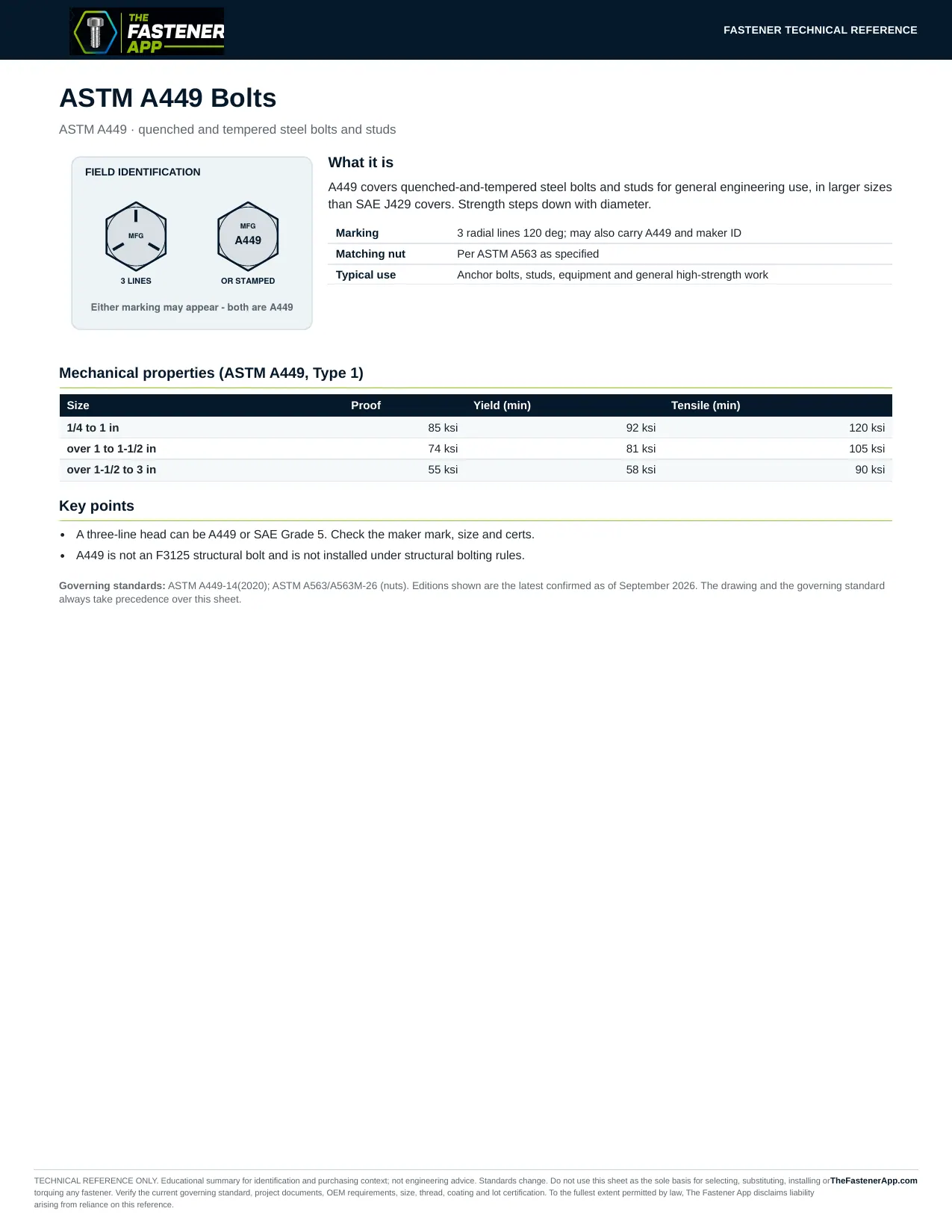
A449 covers quenched-and-tempered steel bolts and studs for general engineering use, in larger sizes than SAE J429 covers. Strength steps down with diameter.
 Report an error on this sheet
ASTM F3125 Grade A325
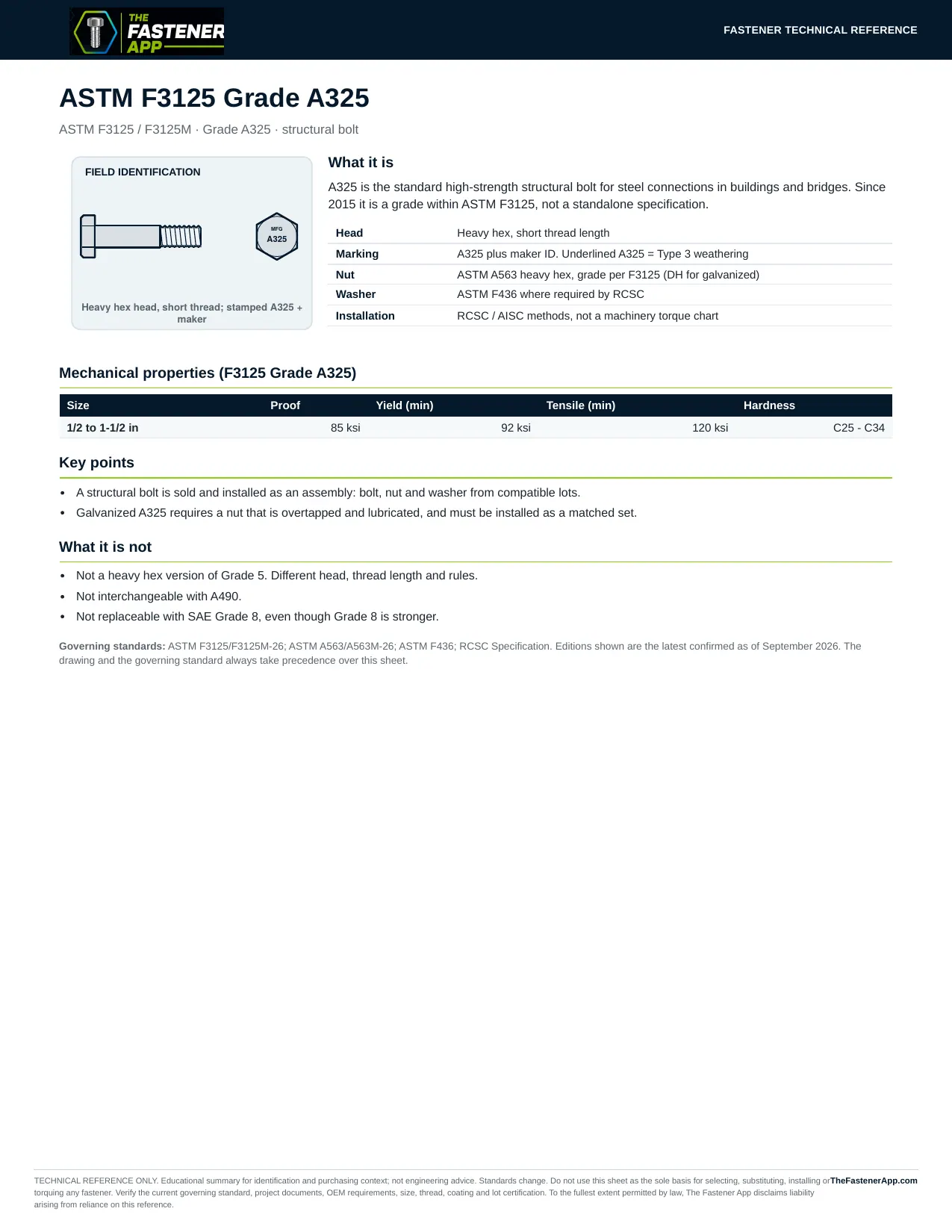
A325 is the standard high-strength structural bolt for steel connections in buildings and bridges. Since 2015 it is a grade within ASTM F3125, not a standalone specification.
 Report an error on this sheet
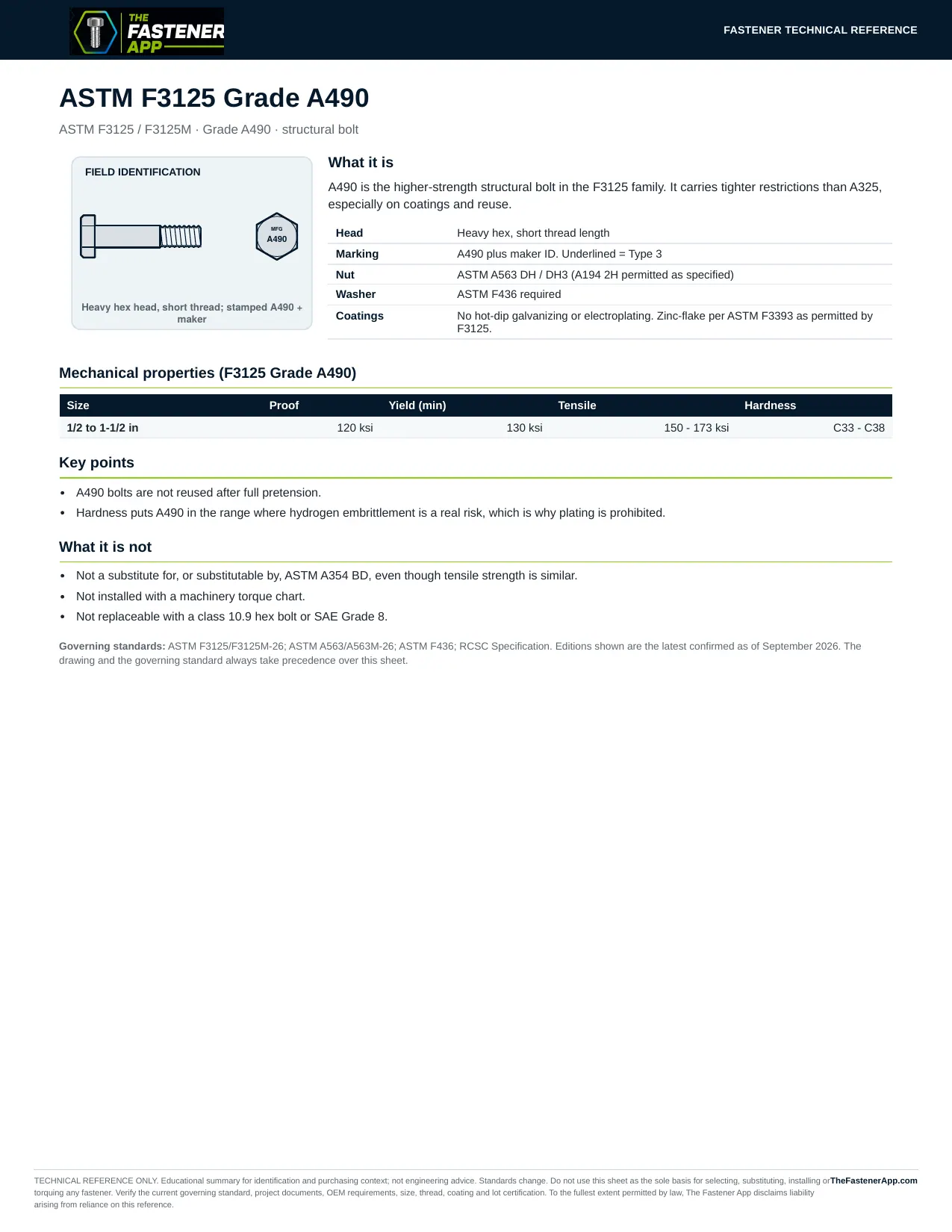
ASTM F3125 Grade A490
A490 is the higher-strength structural bolt in the F3125 family. It carries tighter restrictions than A325, especially on coatings and reuse.
 Report an error on this sheet
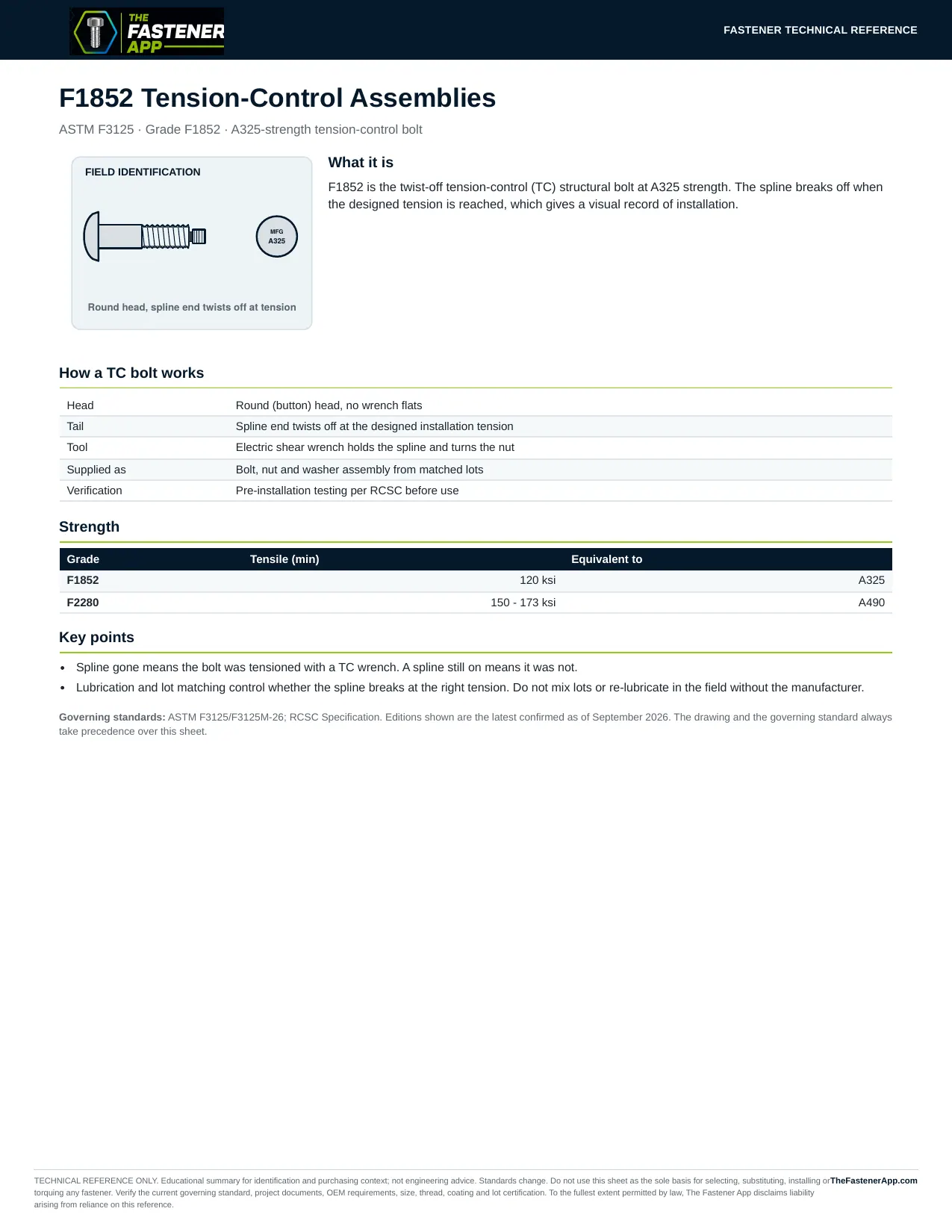
F1852 Tension-Control Assemblies
F1852 is the twist-off tension-control (TC) structural bolt at A325 strength. The spline breaks off when the designed tension is reached, which gives a visual record of installation.
 Report an error on this sheet
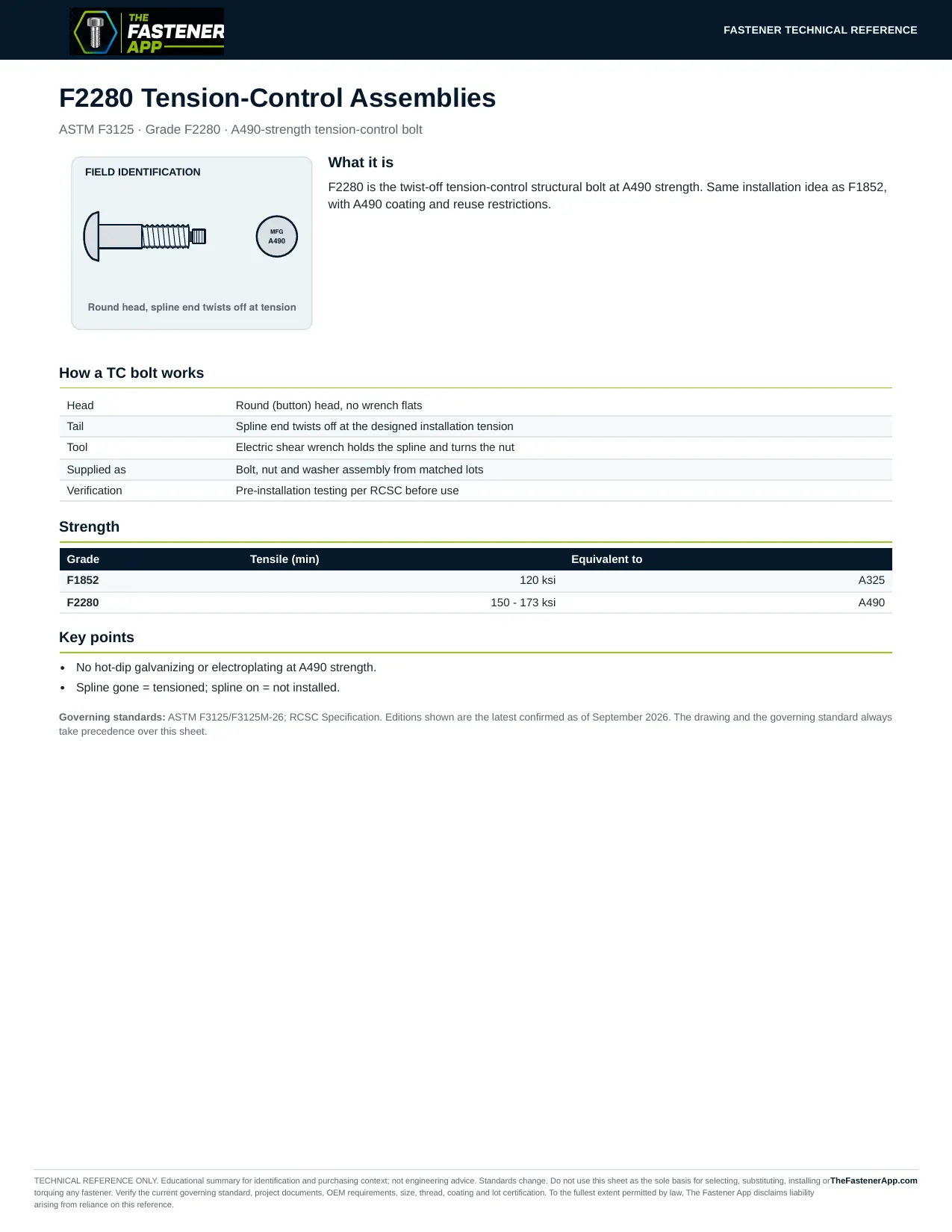
F2280 Tension-Control Assemblies
F2280 is the twist-off tension-control structural bolt at A490 strength. Same installation idea as F1852, with A490 coating and reuse restrictions.
 Report an error on this sheet
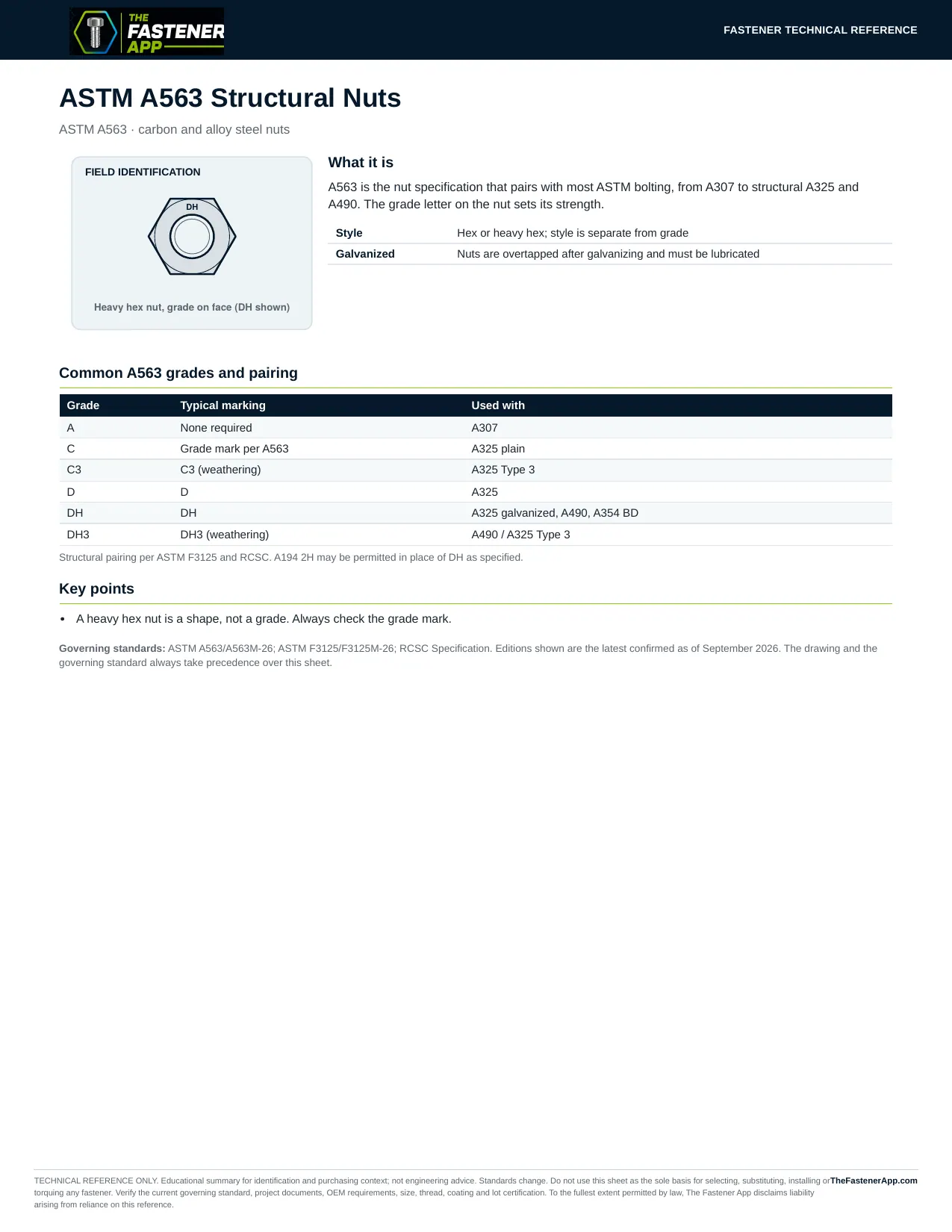
ASTM A563 Structural Nuts
A563 is the nut specification that pairs with most ASTM bolting, from A307 to structural A325 and A490. The grade letter on the nut sets its strength.
 Report an error on this sheet
ASTM F436 Hardened Washers
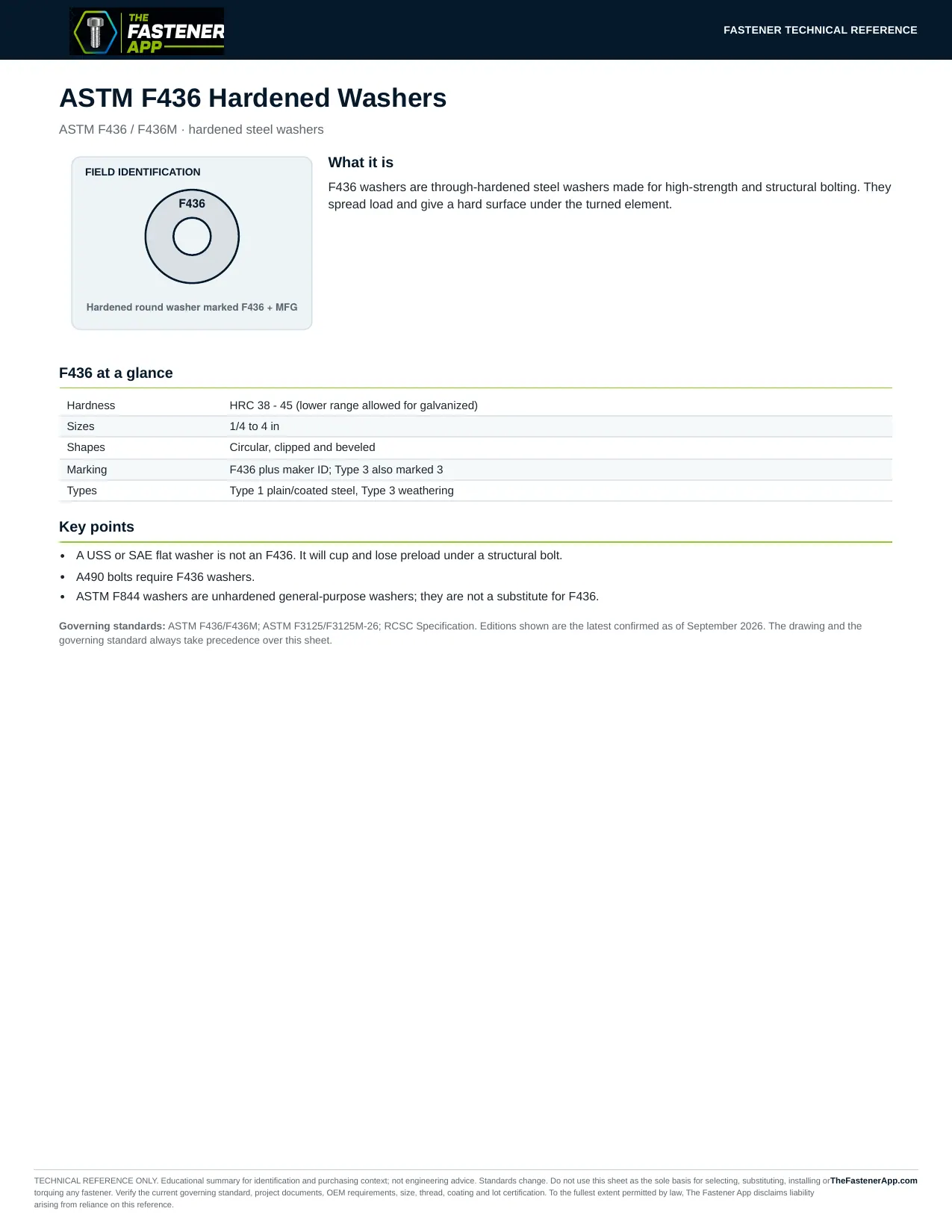
F436 washers are through-hardened steel washers made for high-strength and structural bolting. They spread load and give a hard surface under the turned element.
 Report an error on this sheet
304 Stainless Fasteners
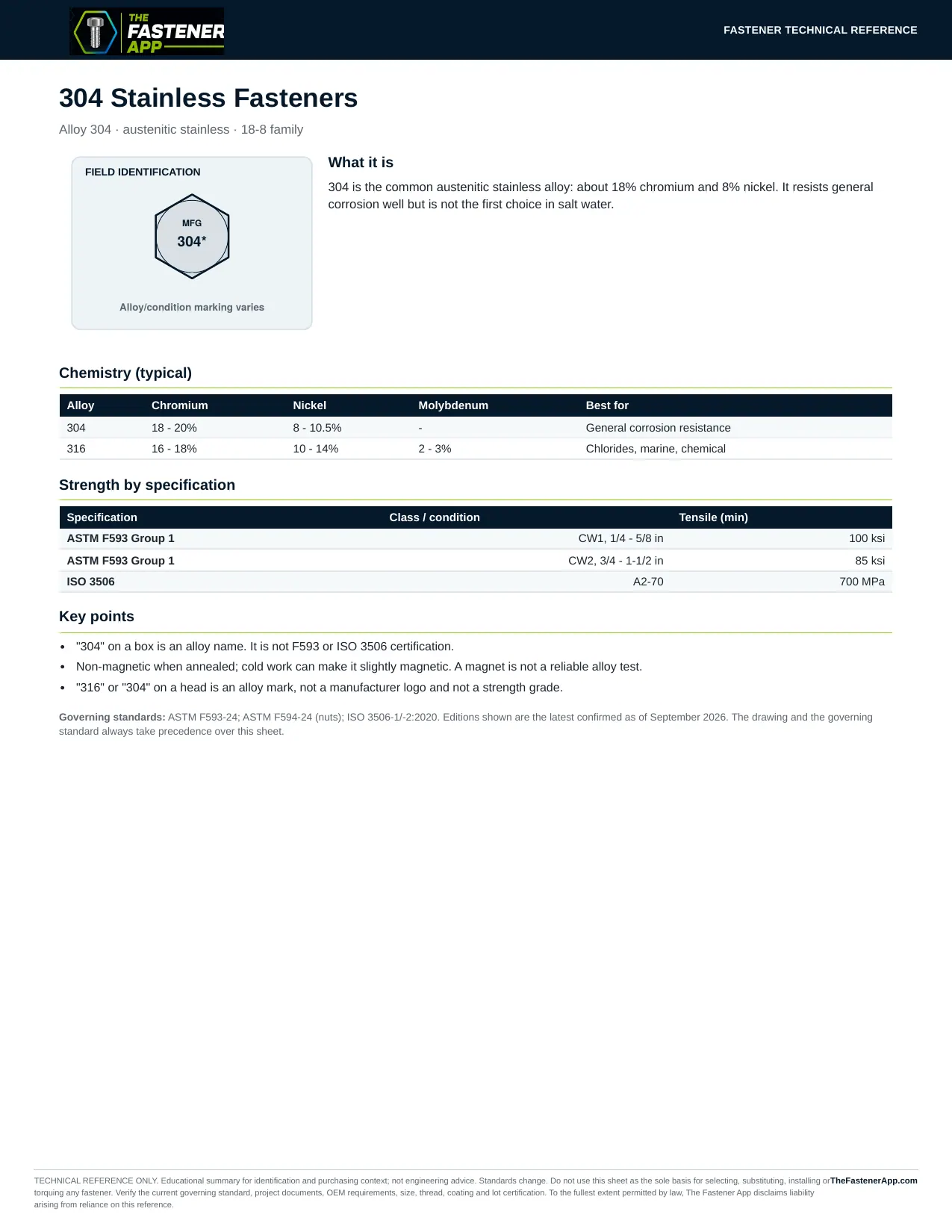
304 is the common austenitic stainless alloy: about 18% chromium and 8% nickel. It resists general corrosion well but is not the first choice in salt water.
 Report an error on this sheet
316 Stainless Fasteners
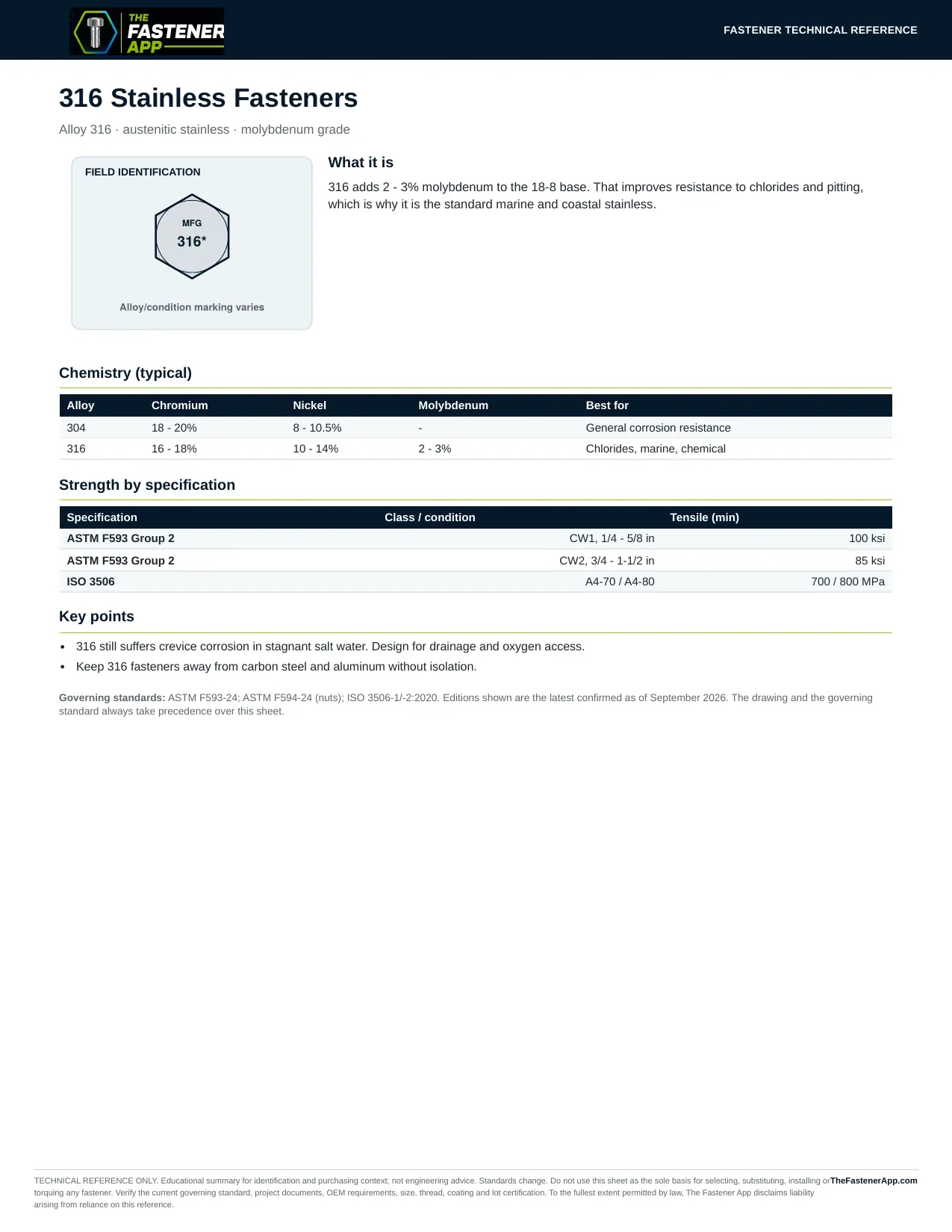
316 adds 2 - 3% molybdenum to the 18-8 base. That improves resistance to chlorides and pitting, which is why it is the standard marine and coastal stainless.
 Report an error on this sheet
ASTM F593 Group 1 — 304 Family
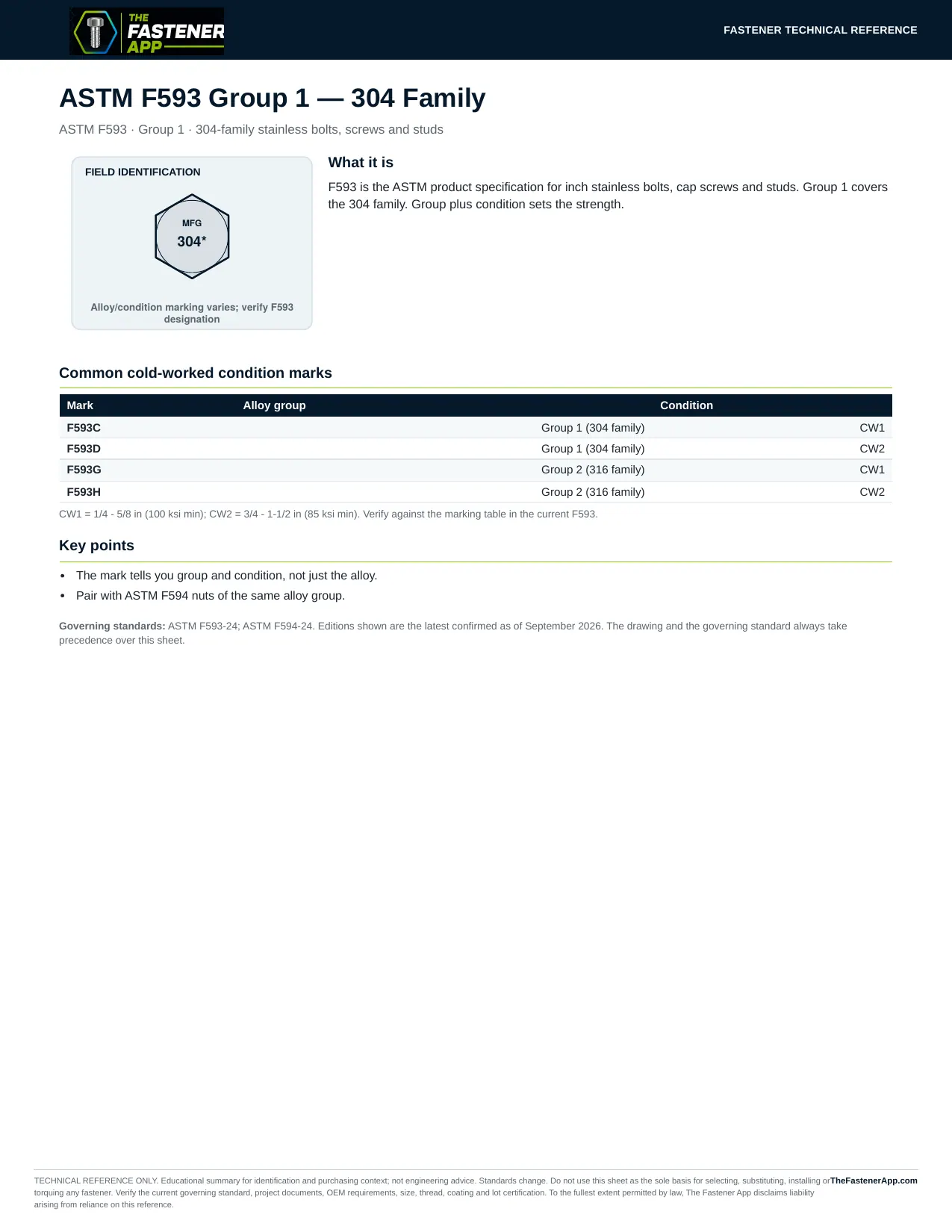
F593 is the ASTM product specification for inch stainless bolts, cap screws and studs. Group 1 covers the 304 family. Group plus condition sets the strength.
 Report an error on this sheet
ASTM F593 Group 2 — 316 Family
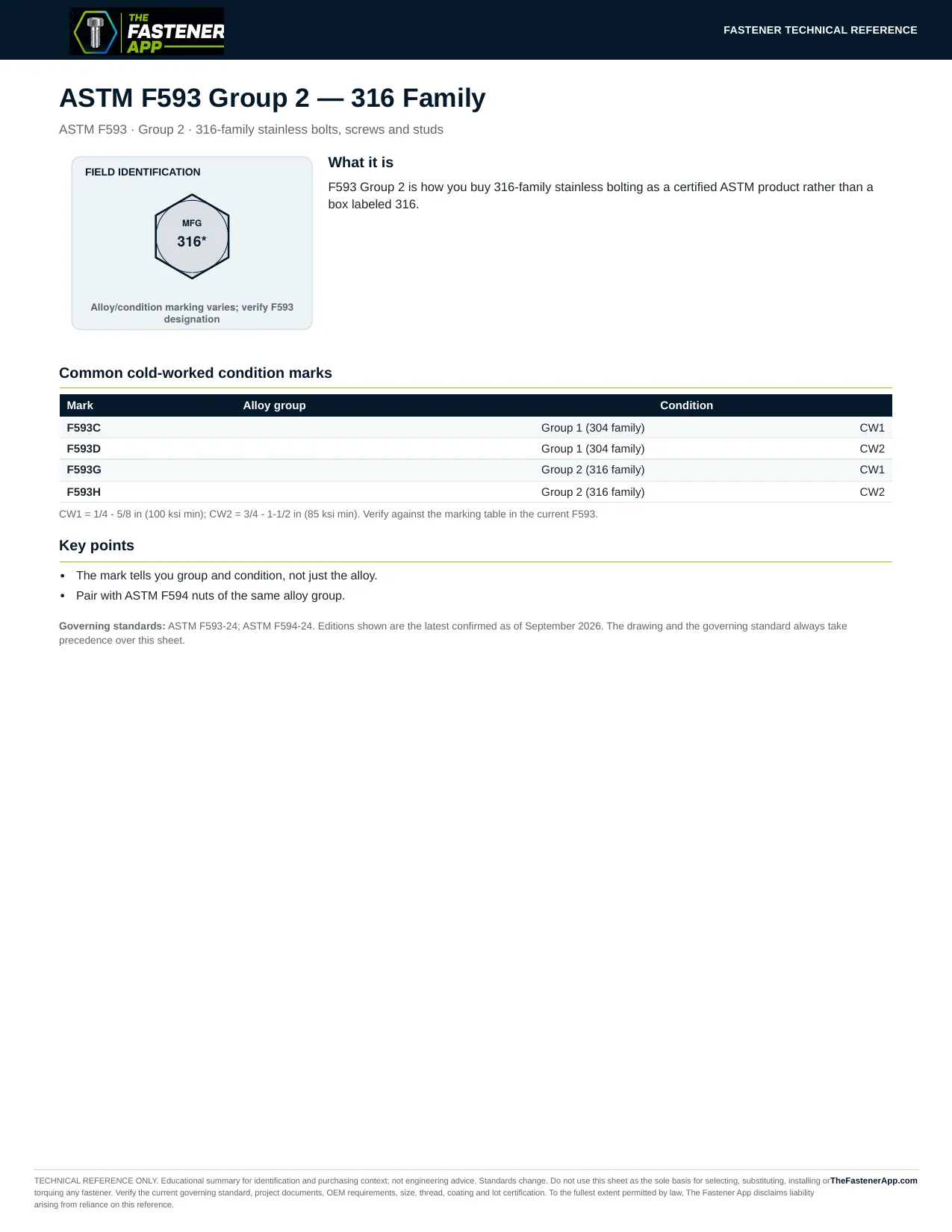
F593 Group 2 is how you buy 316-family stainless bolting as a certified ASTM product rather than a box labeled 316.
 Report an error on this sheet
ASTM F594 Stainless Nuts
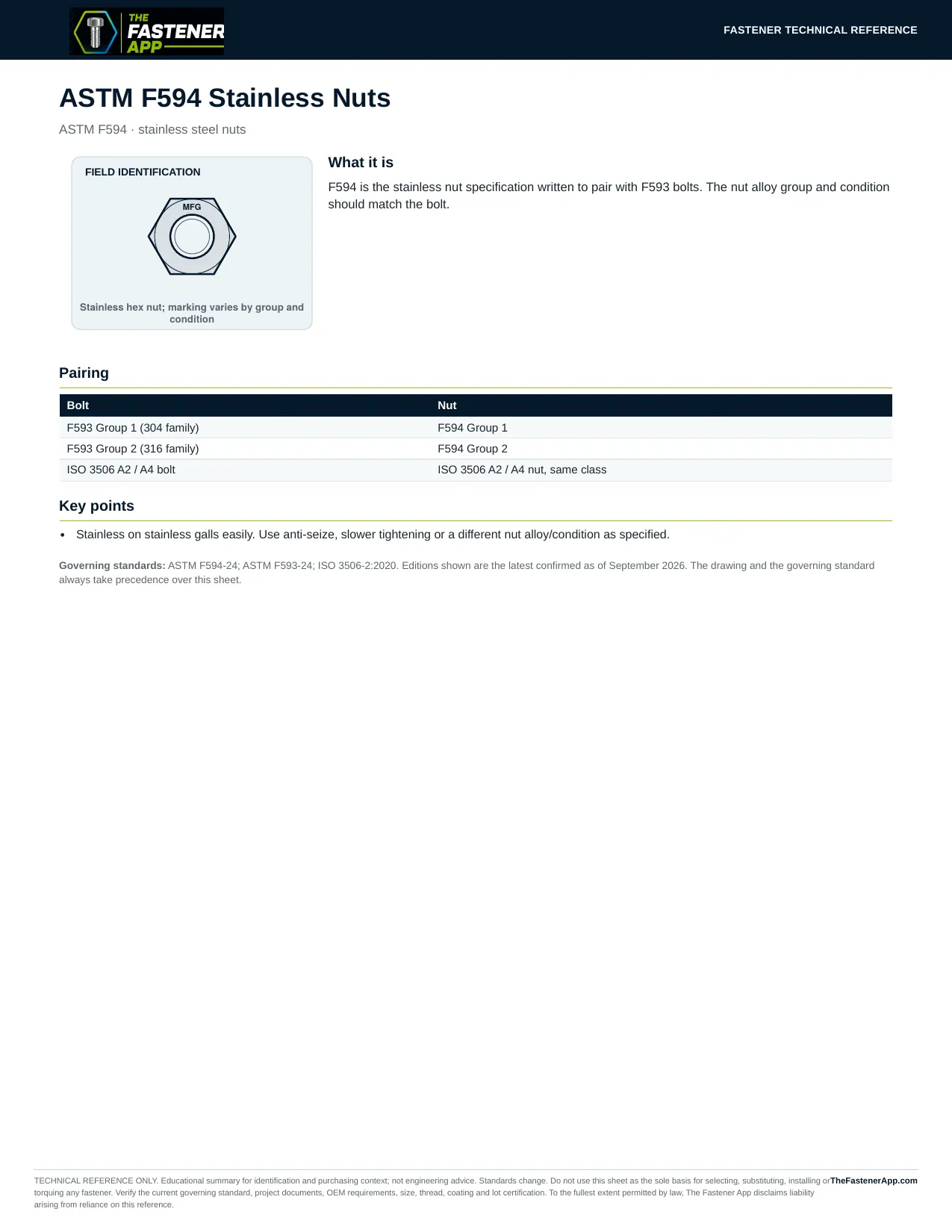
F594 is the stainless nut specification written to pair with F593 bolts. The nut alloy group and condition should match the bolt.
 Report an error on this sheet
18-8 Stainless Explained
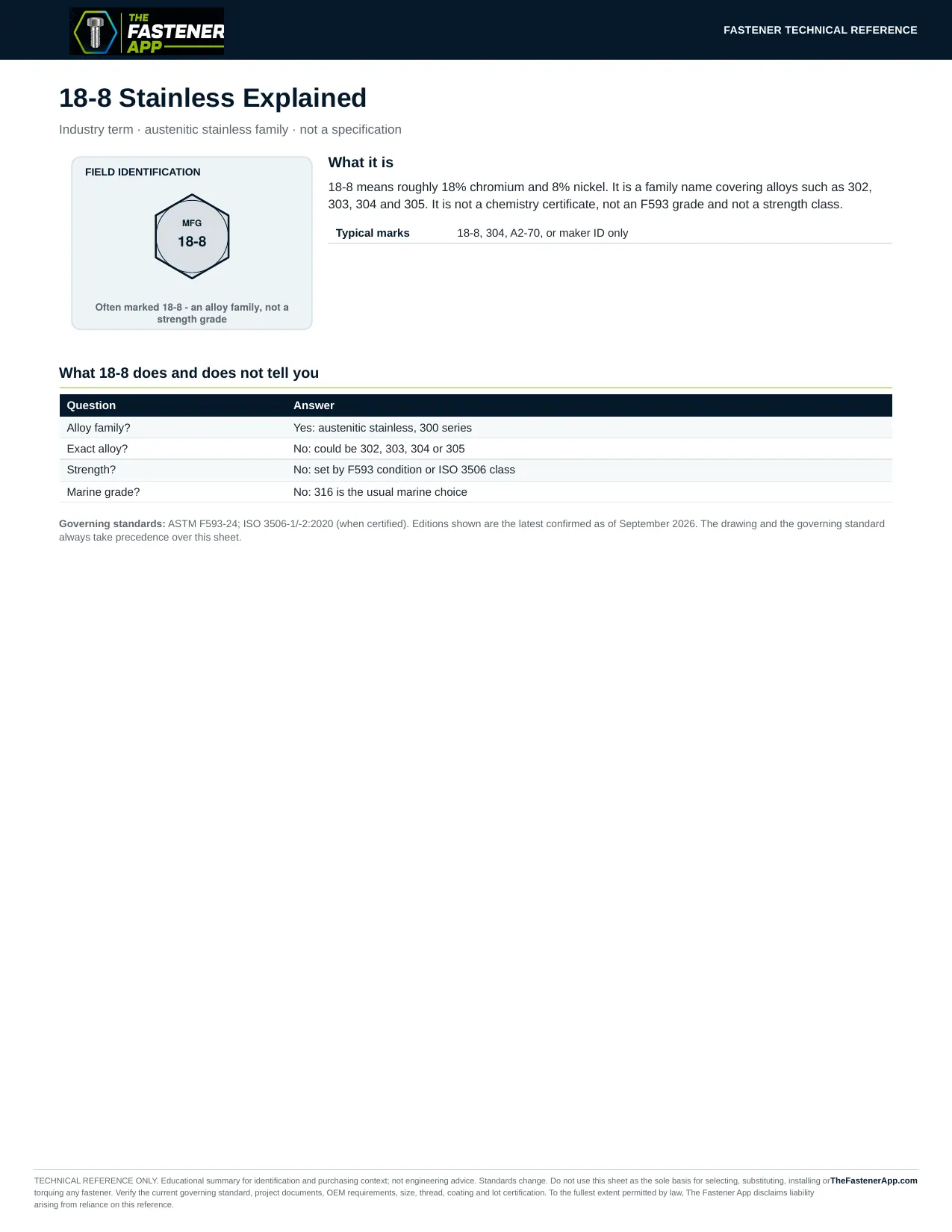
18-8 means roughly 18% chromium and 8% nickel. It is a family name covering alloys such as 302, 303, 304 and 305. It is not a chemistry certificate, not an F593 grade and not a strength class.
 Report an error on this sheet
410 Stainless Fasteners
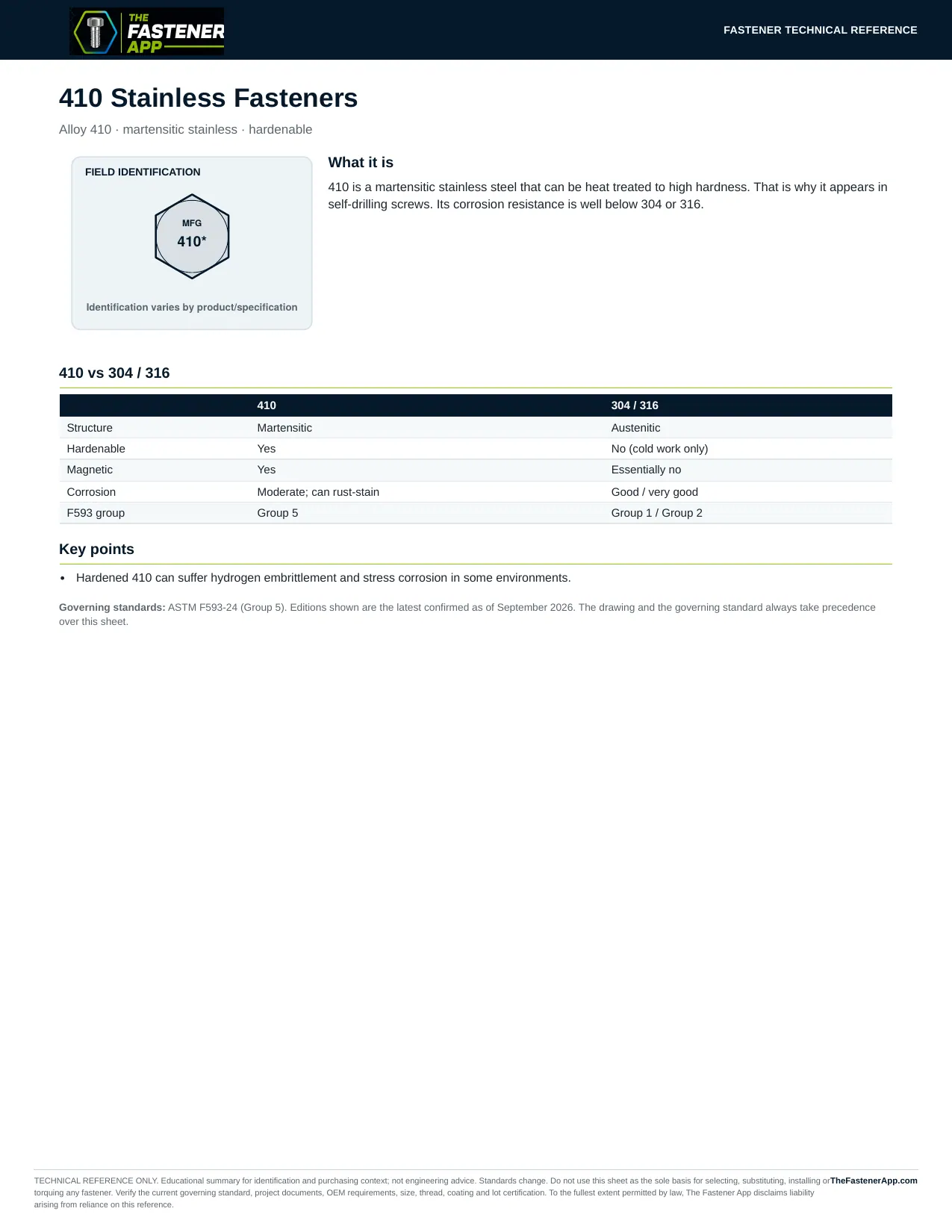
410 is a martensitic stainless steel that can be heat treated to high hardness. That is why it appears in self-drilling screws. Its corrosion resistance is well below 304 or 316.
 Report an error on this sheet
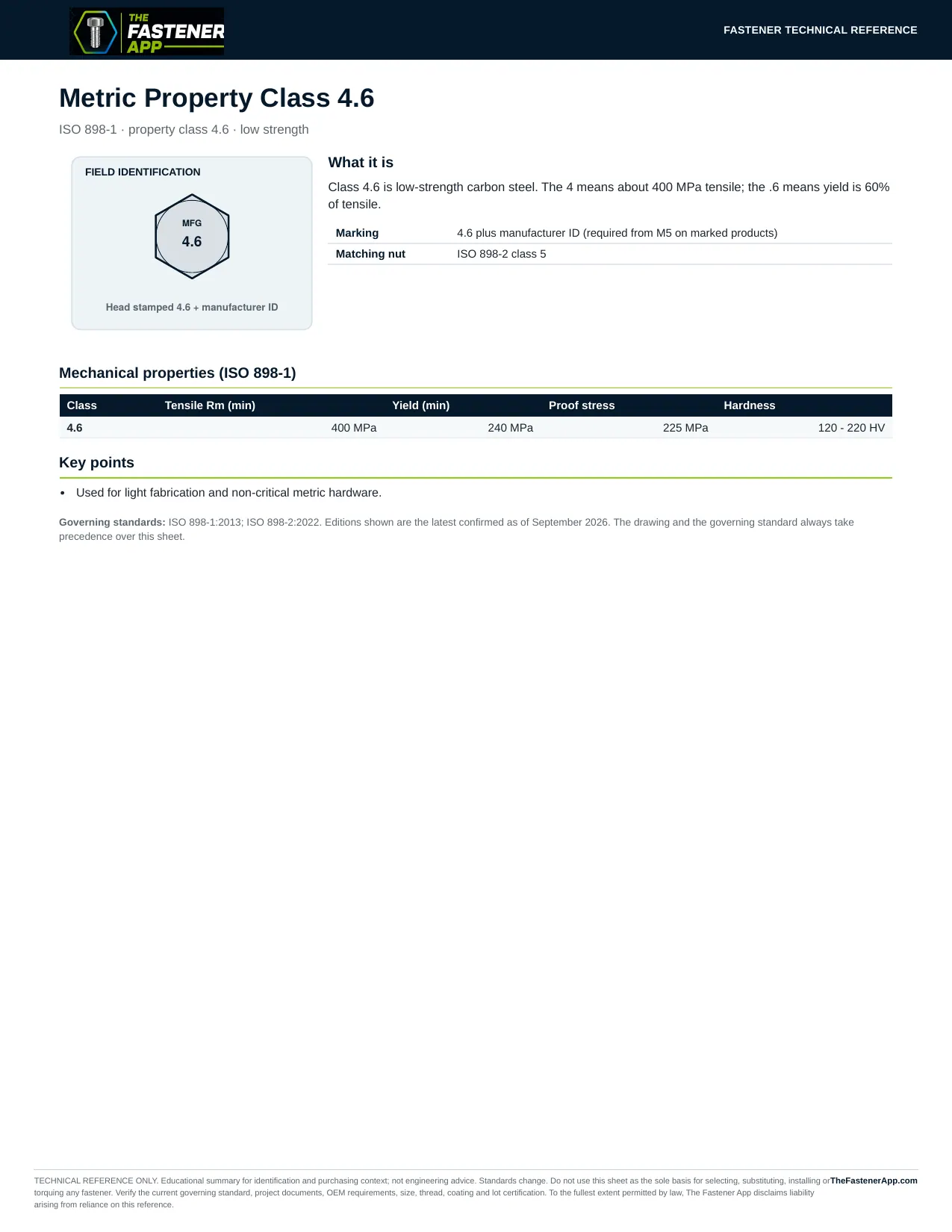
Metric Property Class 4.6
Class 4.6 is low-strength carbon steel. The 4 means about 400 MPa tensile; the .6 means yield is 60% of tensile.
 Report an error on this sheet
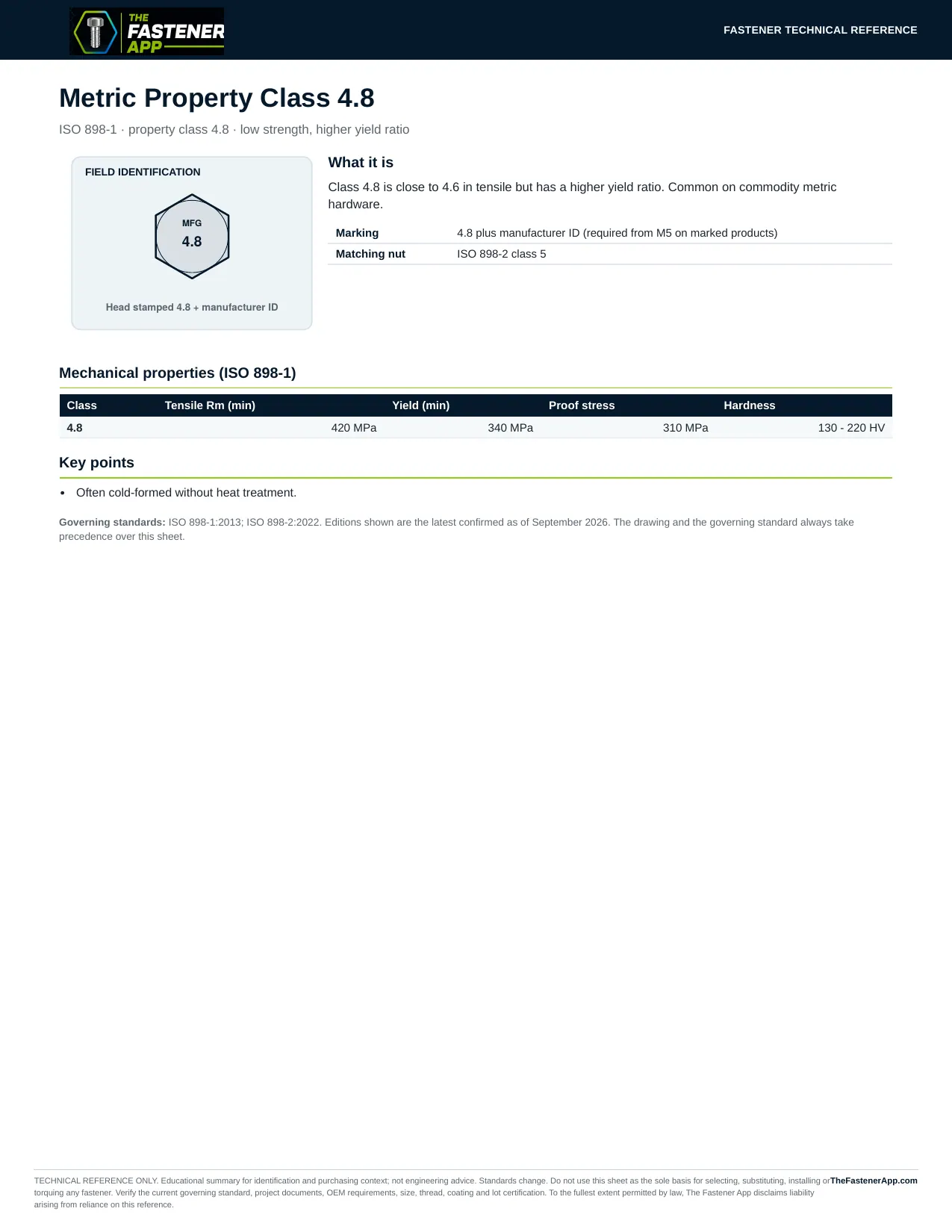
Metric Property Class 4.8
Class 4.8 is close to 4.6 in tensile but has a higher yield ratio. Common on commodity metric hardware.
 Report an error on this sheet
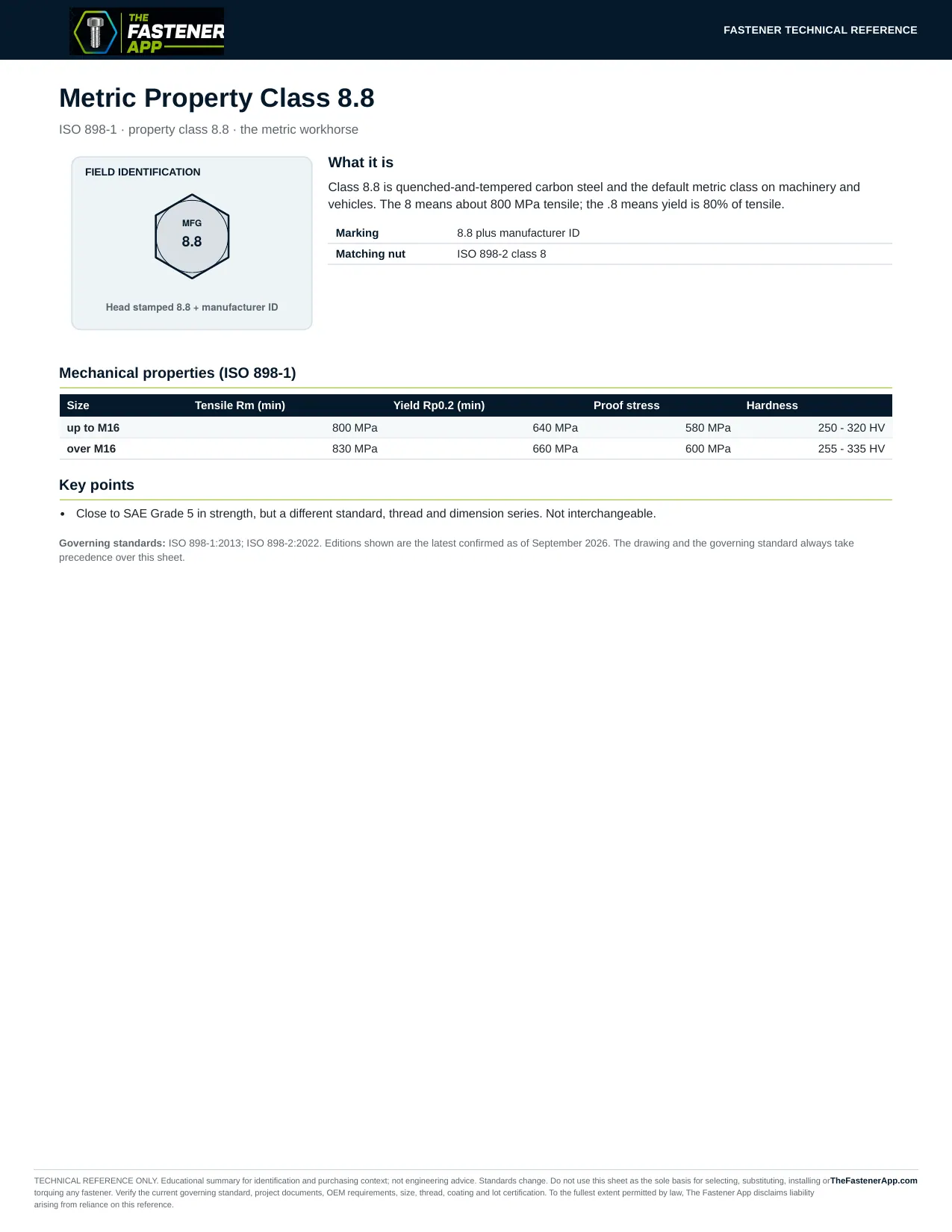
Metric Property Class 8.8
Class 8.8 is quenched-and-tempered carbon steel and the default metric class on machinery and vehicles. The 8 means about 800 MPa tensile; the .8 means yield is 80% of tensile.
 Report an error on this sheet
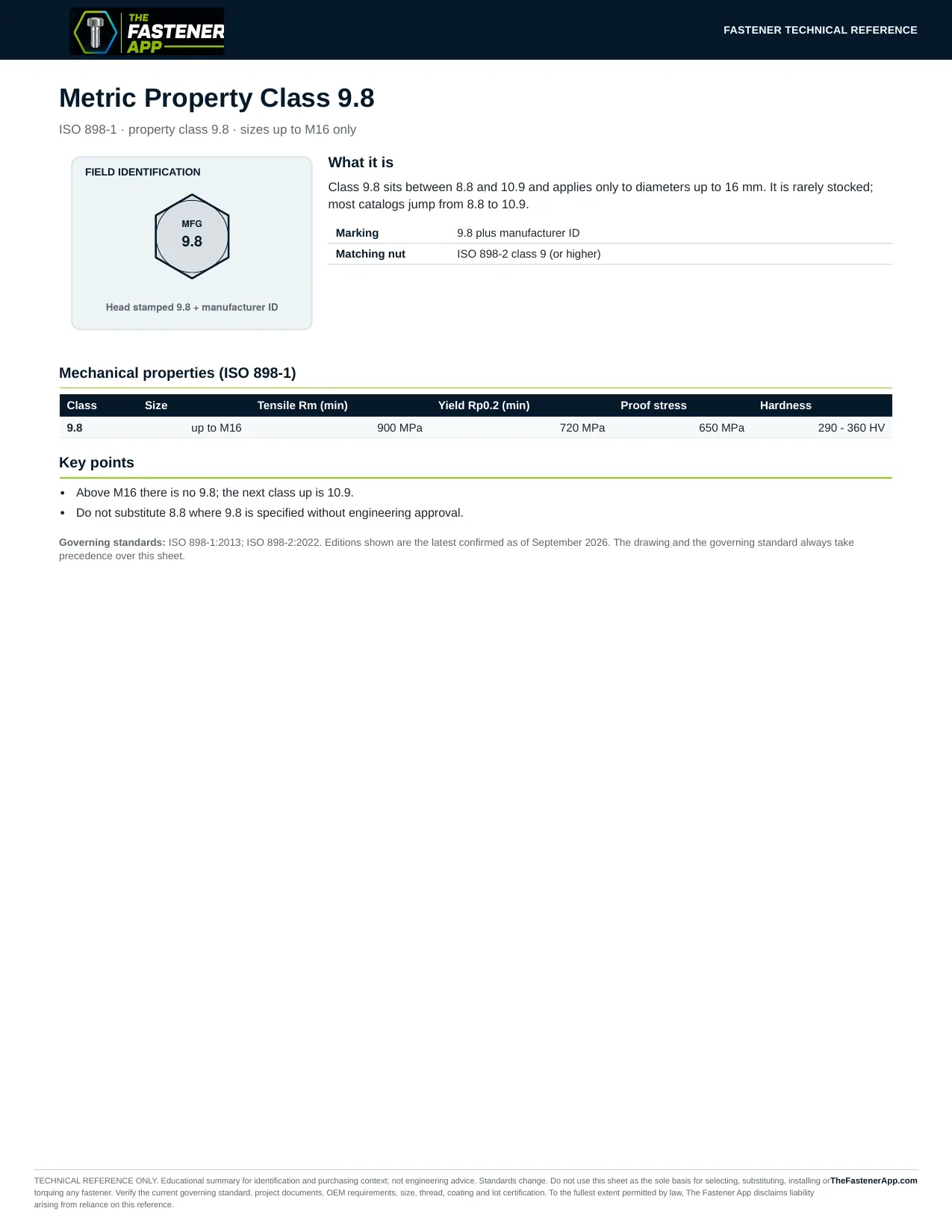
Metric Property Class 9.8
Class 9.8 sits between 8.8 and 10.9 and applies only to diameters up to 16 mm. It is rarely stocked; most catalogs jump from 8.8 to 10.9.
 Report an error on this sheet
Metric Property Class 10.9
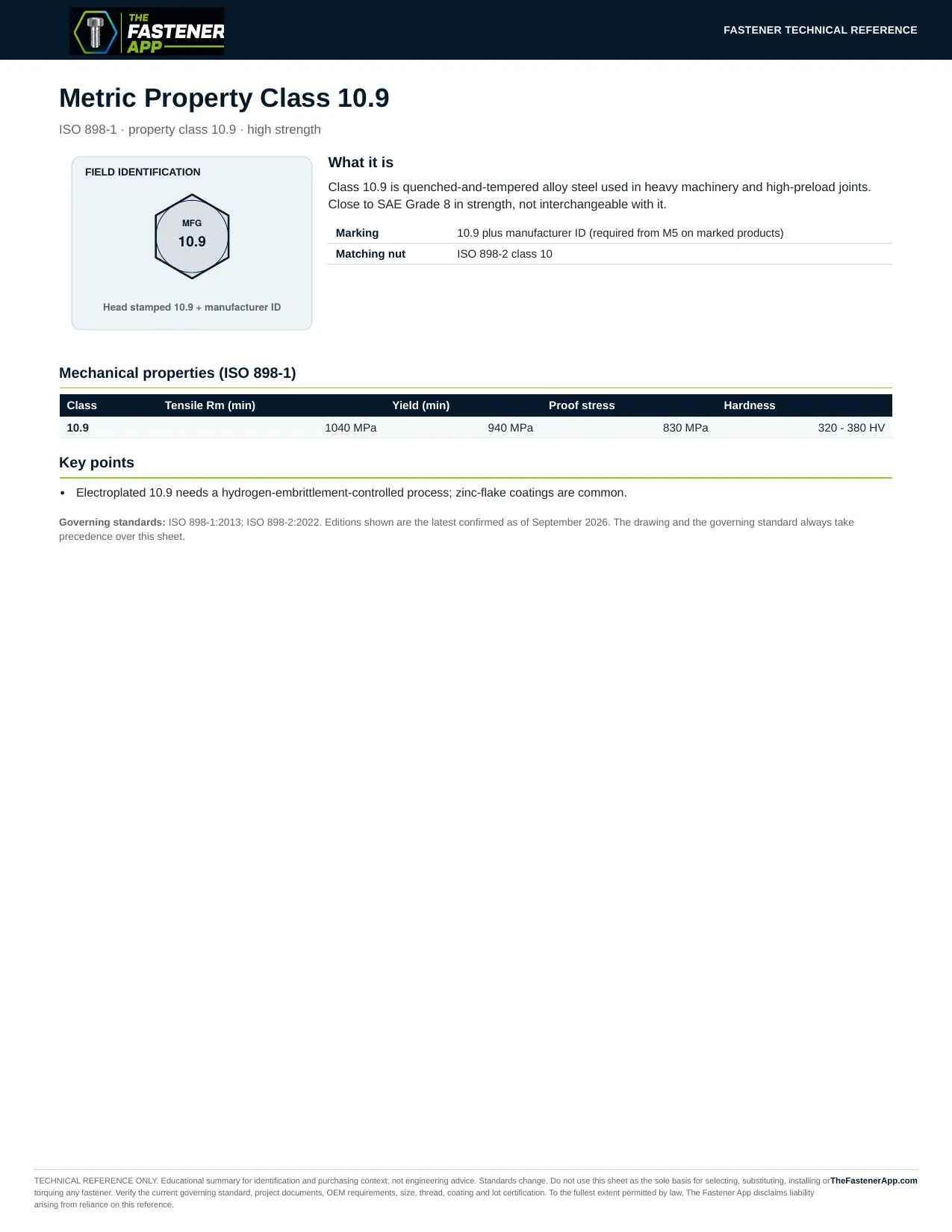
Class 10.9 is quenched-and-tempered alloy steel used in heavy machinery and high-preload joints. Close to SAE Grade 8 in strength, not interchangeable with it.
 Report an error on this sheet
Metric Property Class 12.9
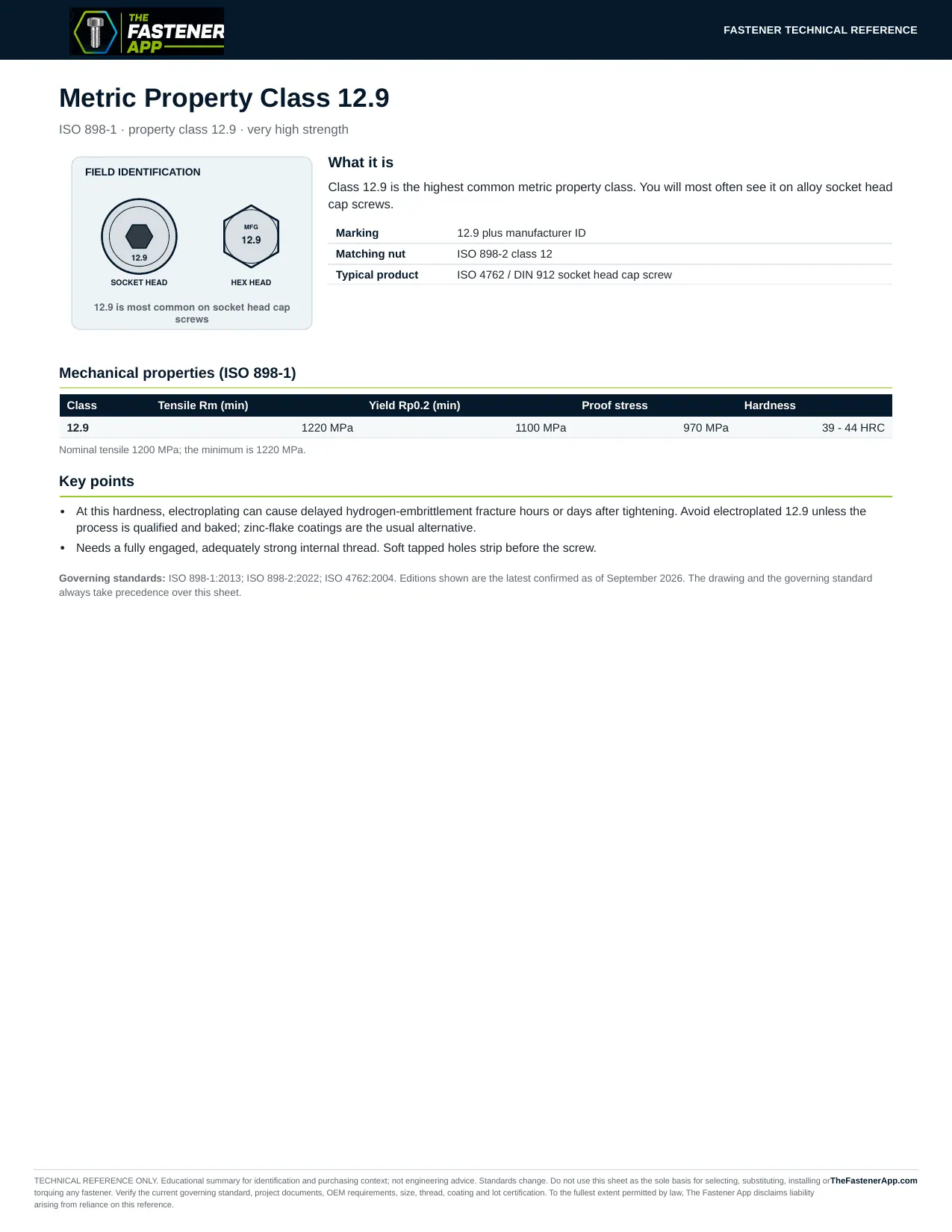
Class 12.9 is the highest common metric property class. You will most often see it on alloy socket head cap screws.
 Report an error on this sheet
Metric 8.8 vs 10.9 vs 12.9
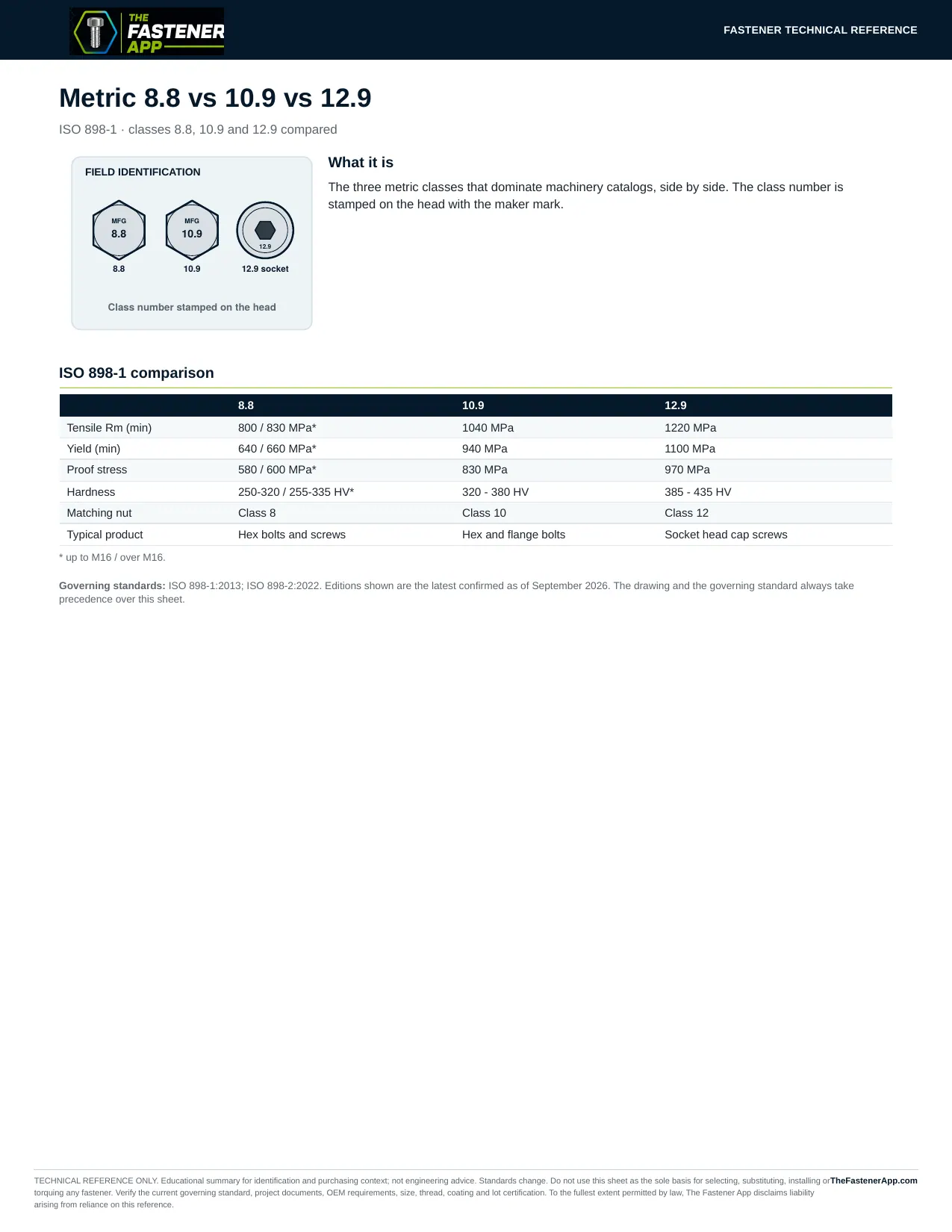
The three metric classes that dominate machinery catalogs, side by side. The class number is stamped on the head with the maker mark.
 Report an error on this sheet
ISO 898-2 Metric Nut Classes
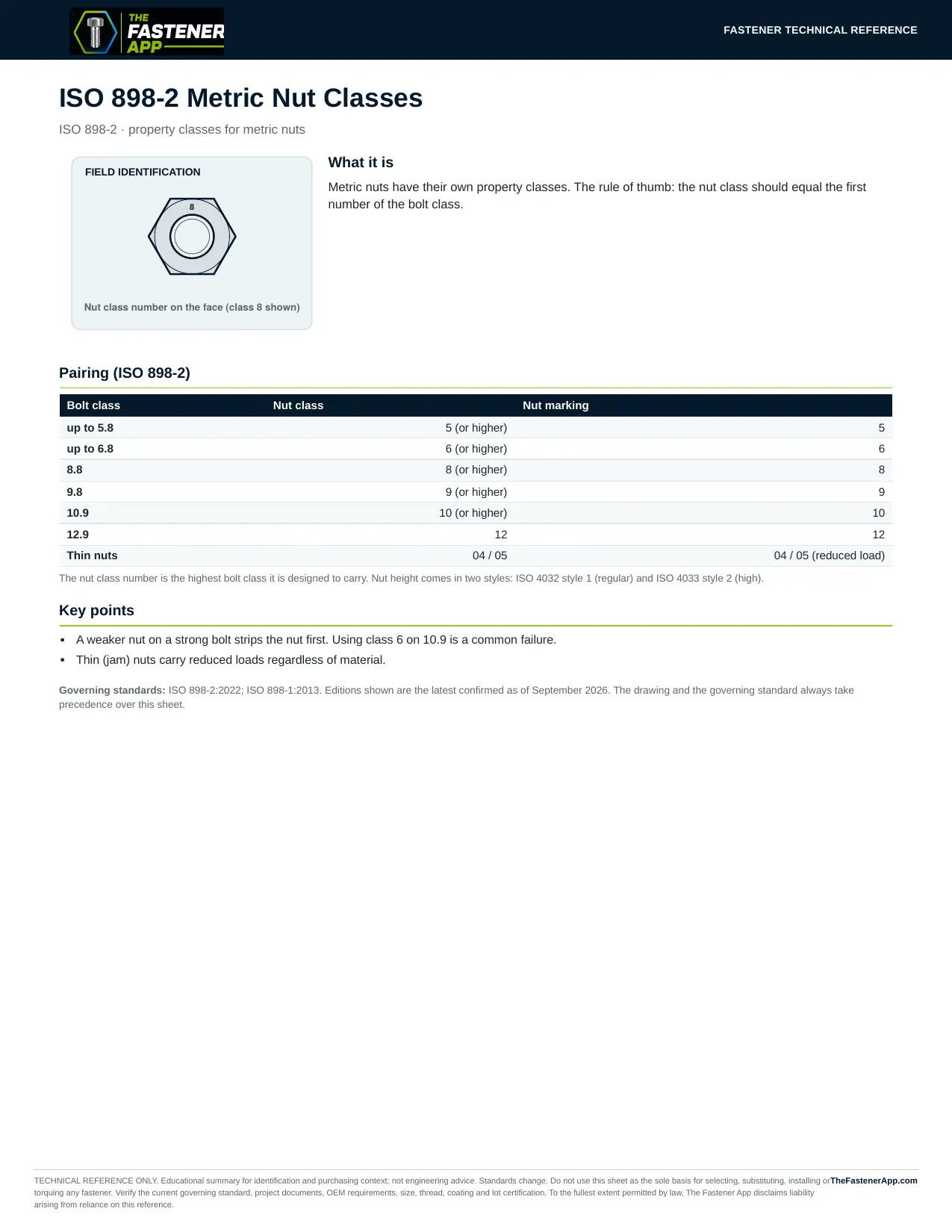
Metric nuts have their own property classes. The rule of thumb: the nut class should equal the first number of the bolt class.
 Report an error on this sheet
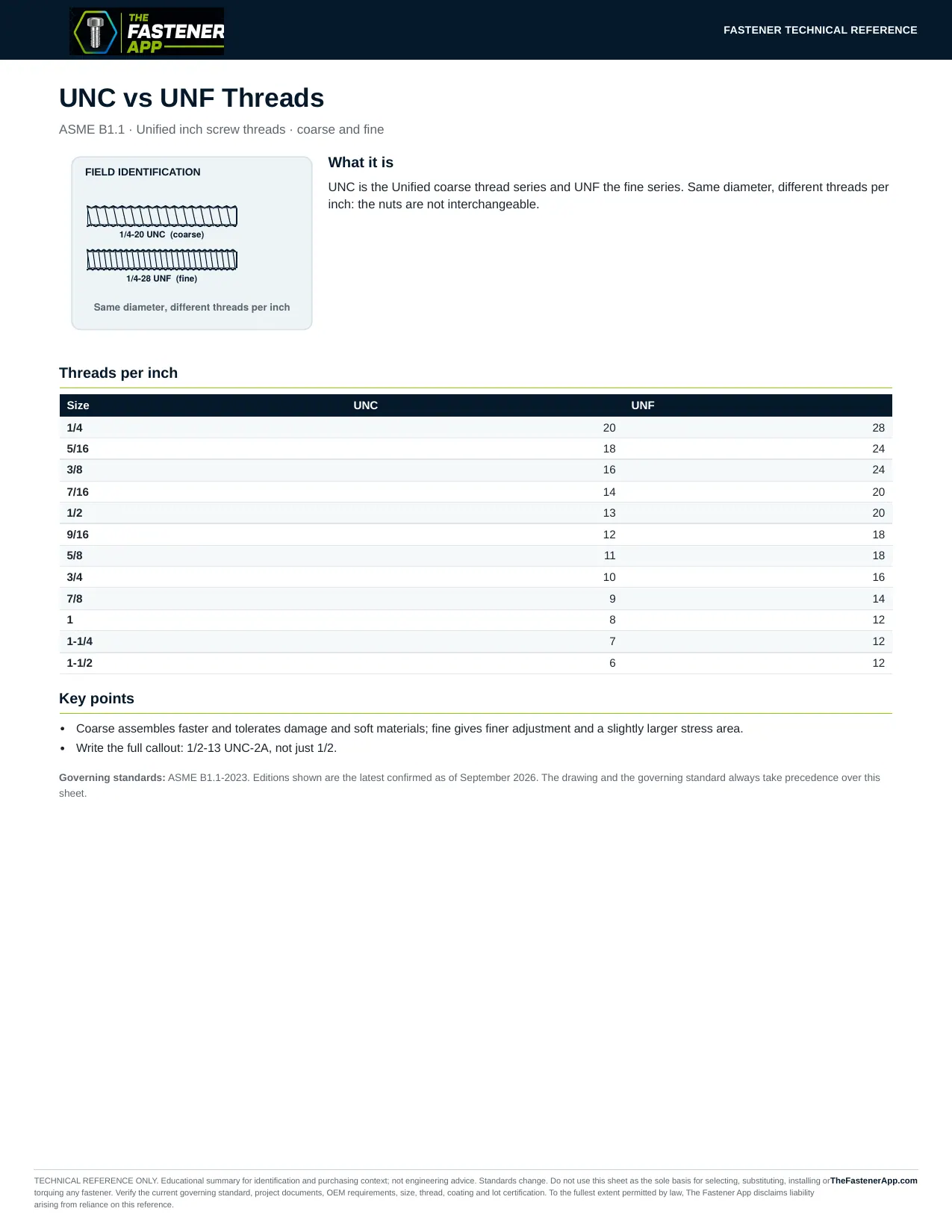
UNC vs UNF Threads
UNC is the Unified coarse thread series and UNF the fine series. Same diameter, different threads per inch: the nuts are not interchangeable.
 Report an error on this sheet
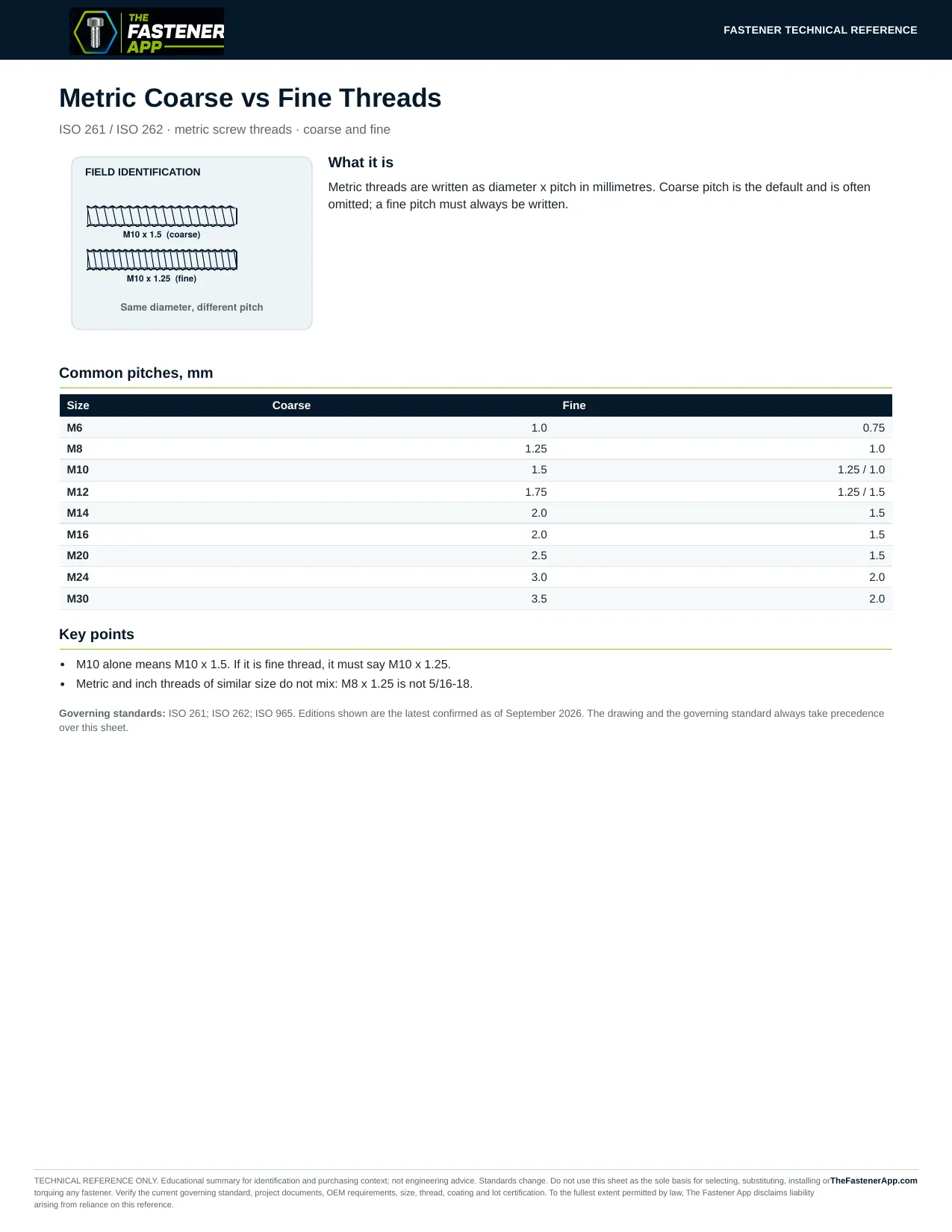
Metric Coarse vs Fine Threads
Metric threads are written as diameter x pitch in millimetres. Coarse pitch is the default and is often omitted; a fine pitch must always be written.
 Report an error on this sheet
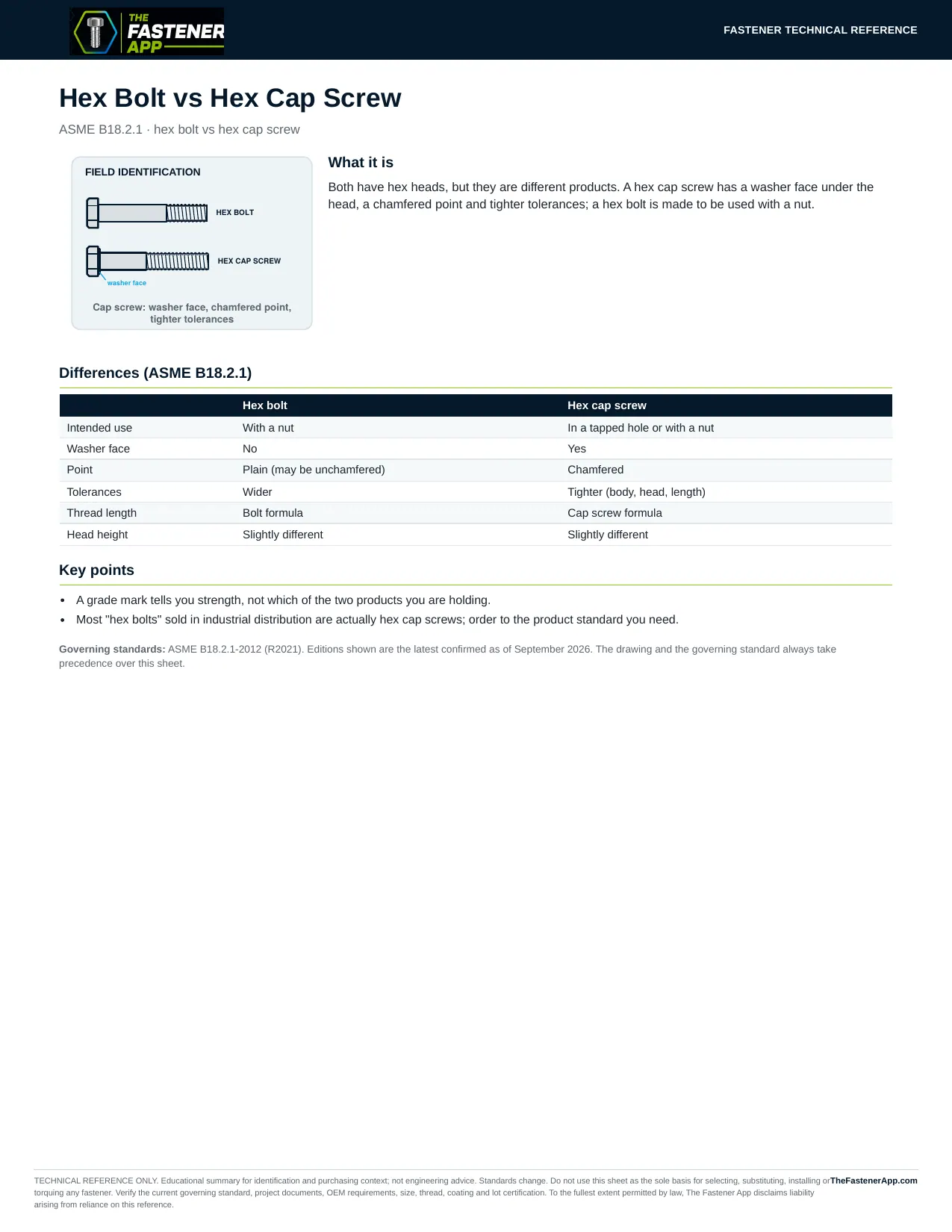
Hex Bolt vs Hex Cap Screw
Both have hex heads, but they are different products. A hex cap screw has a washer face under the head, a chamfered point and tighter tolerances; a hex bolt is made to be used with a nut.
 Report an error on this sheet
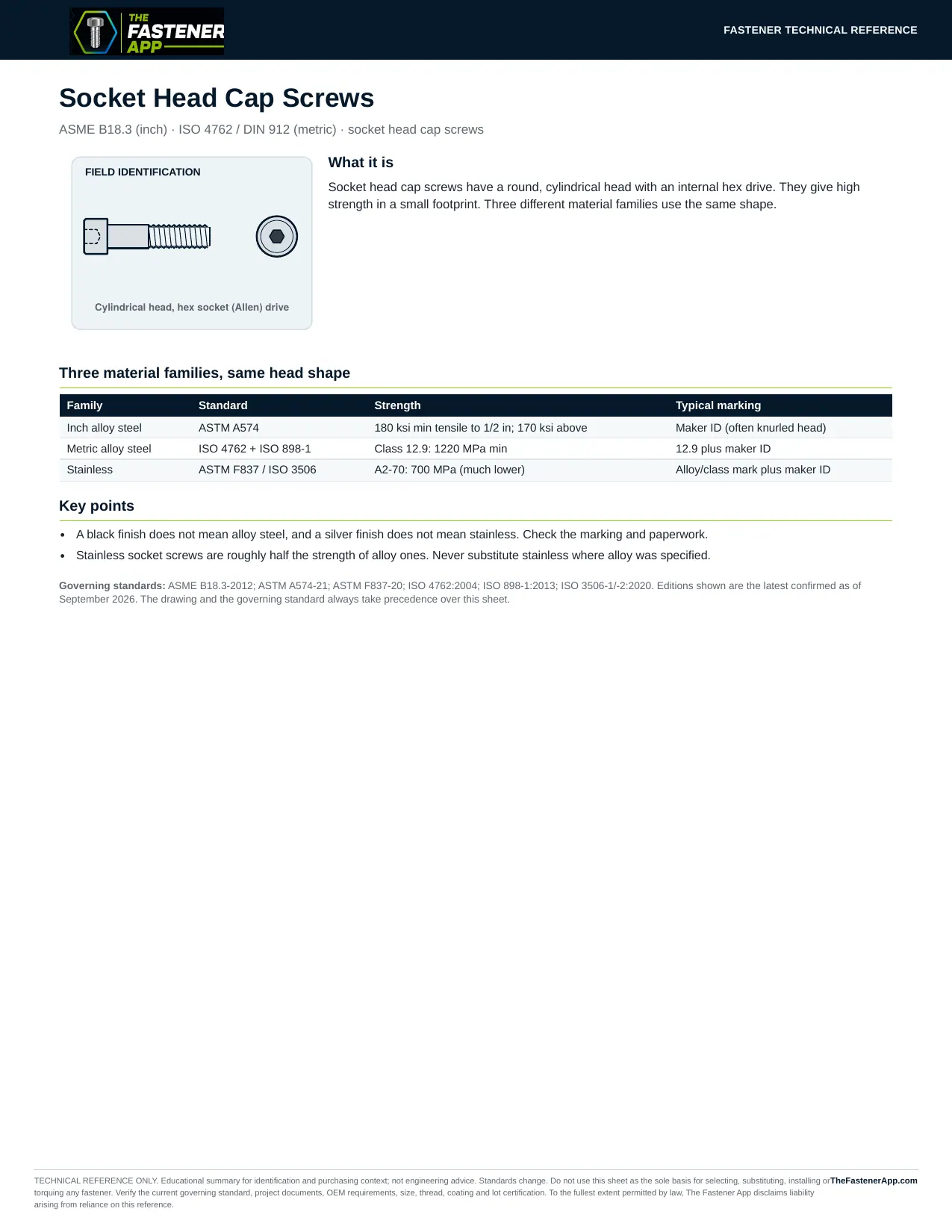
Socket Head Cap Screws
Socket head cap screws have a round, cylindrical head with an internal hex drive. They give high strength in a small footprint. Three different material families use the same shape.
 Report an error on this sheet
Button Head Socket Screws
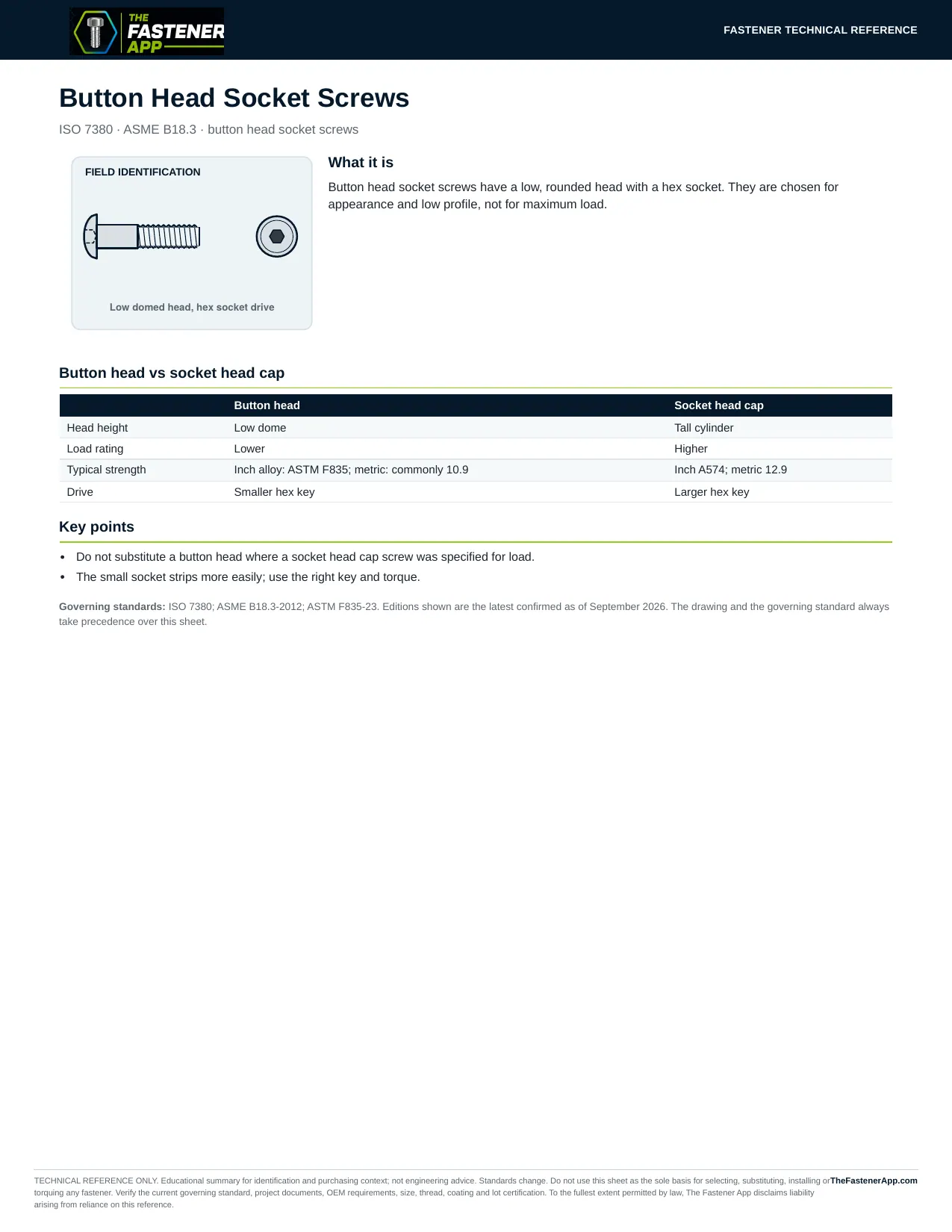
Button head socket screws have a low, rounded head with a hex socket. They are chosen for appearance and low profile, not for maximum load.
 Report an error on this sheet
Flat Head Socket Screws
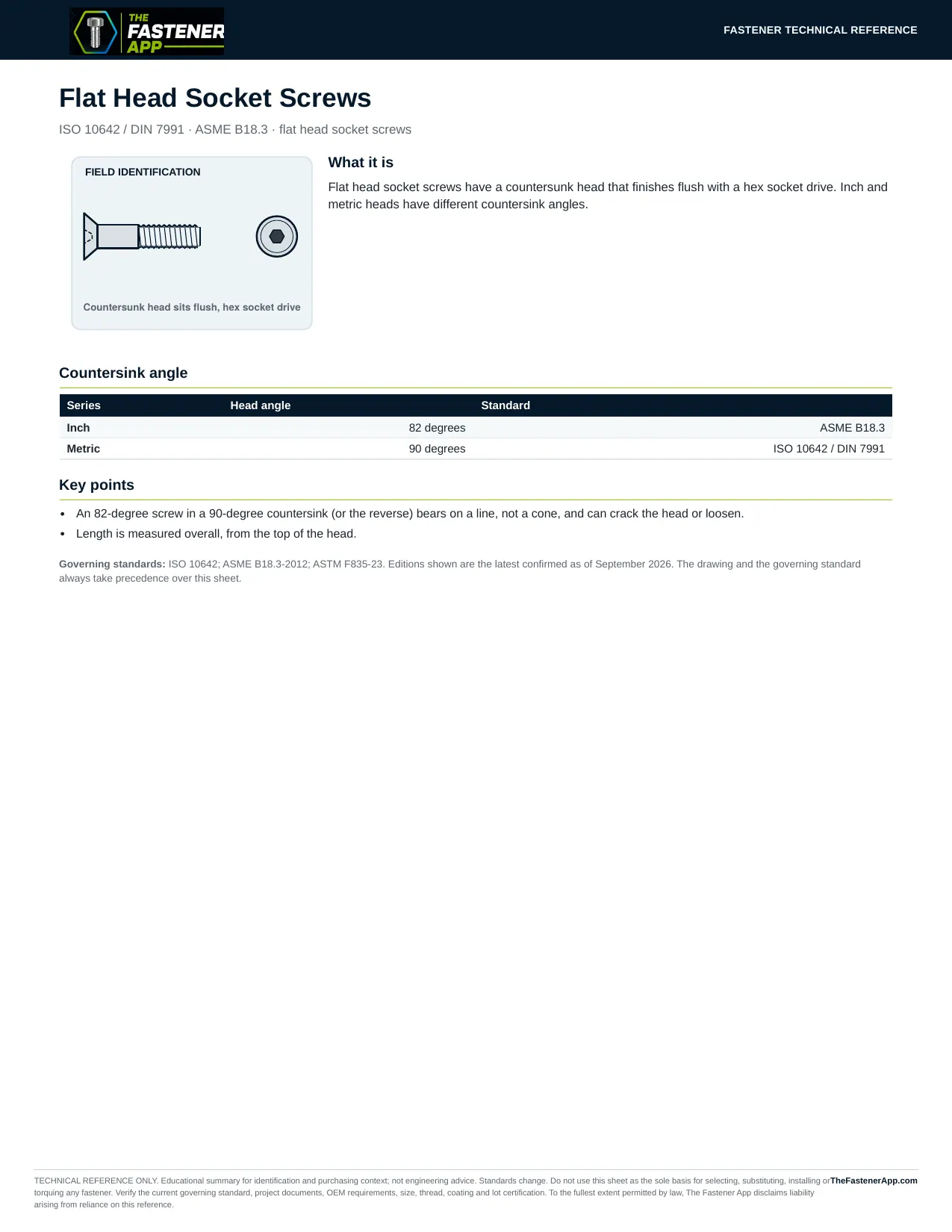
Flat head socket screws have a countersunk head that finishes flush with a hex socket drive. Inch and metric heads have different countersink angles.
 Report an error on this sheet
Machine Screws
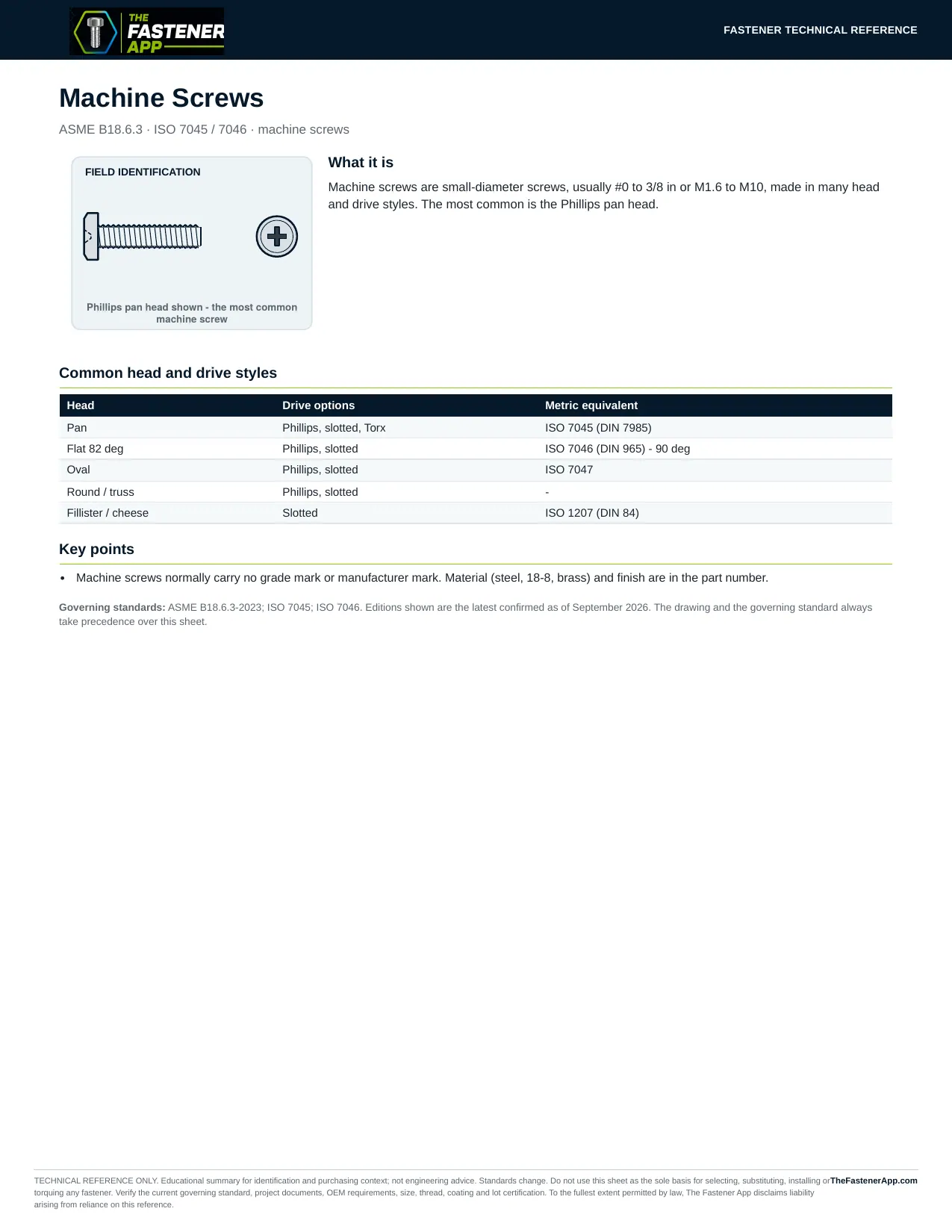
Machine screws are small-diameter screws, usually #0 to 3/8 in or M1.6 to M10, made in many head and drive styles. The most common is the Phillips pan head.
 Report an error on this sheet
Self-Drilling Screws
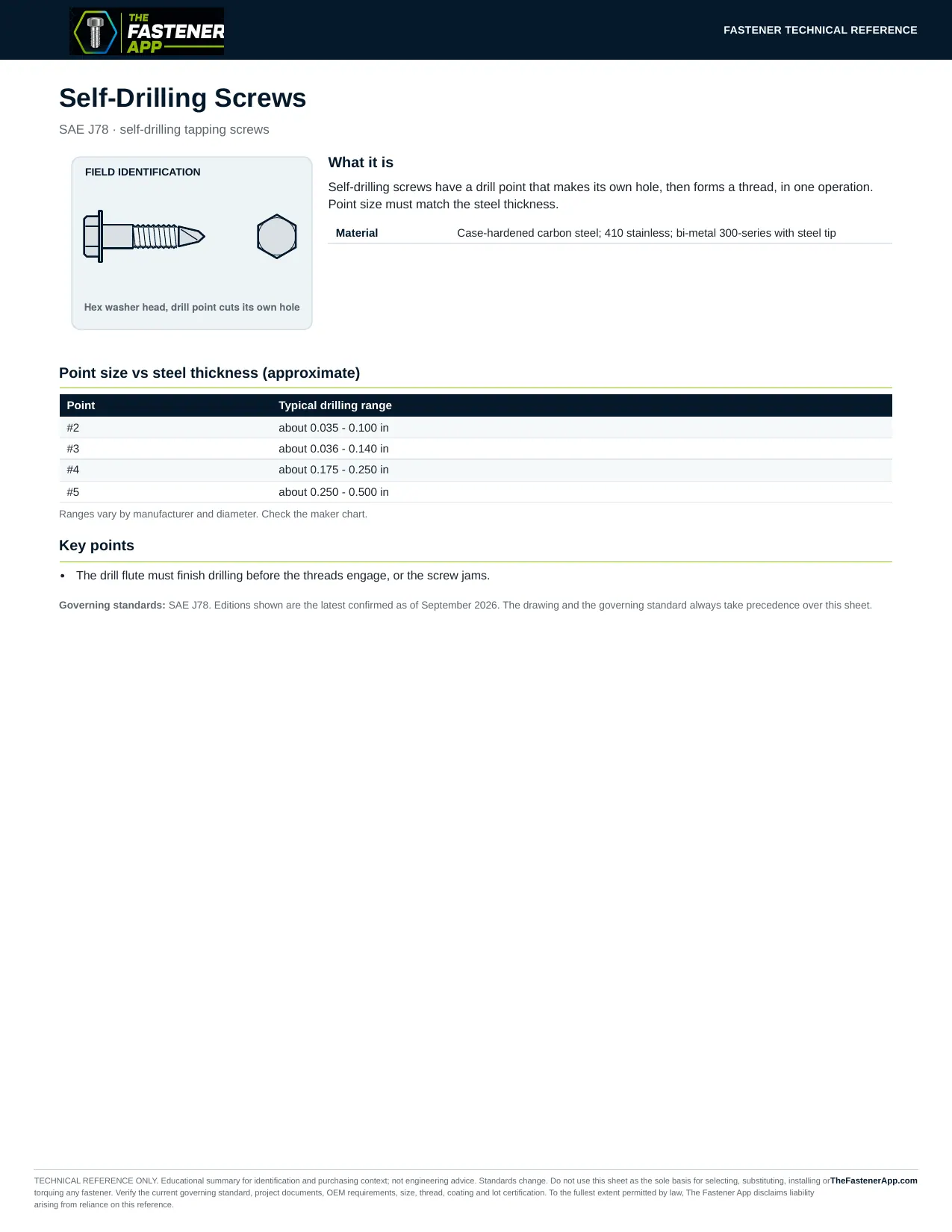
Self-drilling screws have a drill point that makes its own hole, then forms a thread, in one operation. Point size must match the steel thickness.
 Report an error on this sheet
Self-Tapping / Thread-Forming Screws
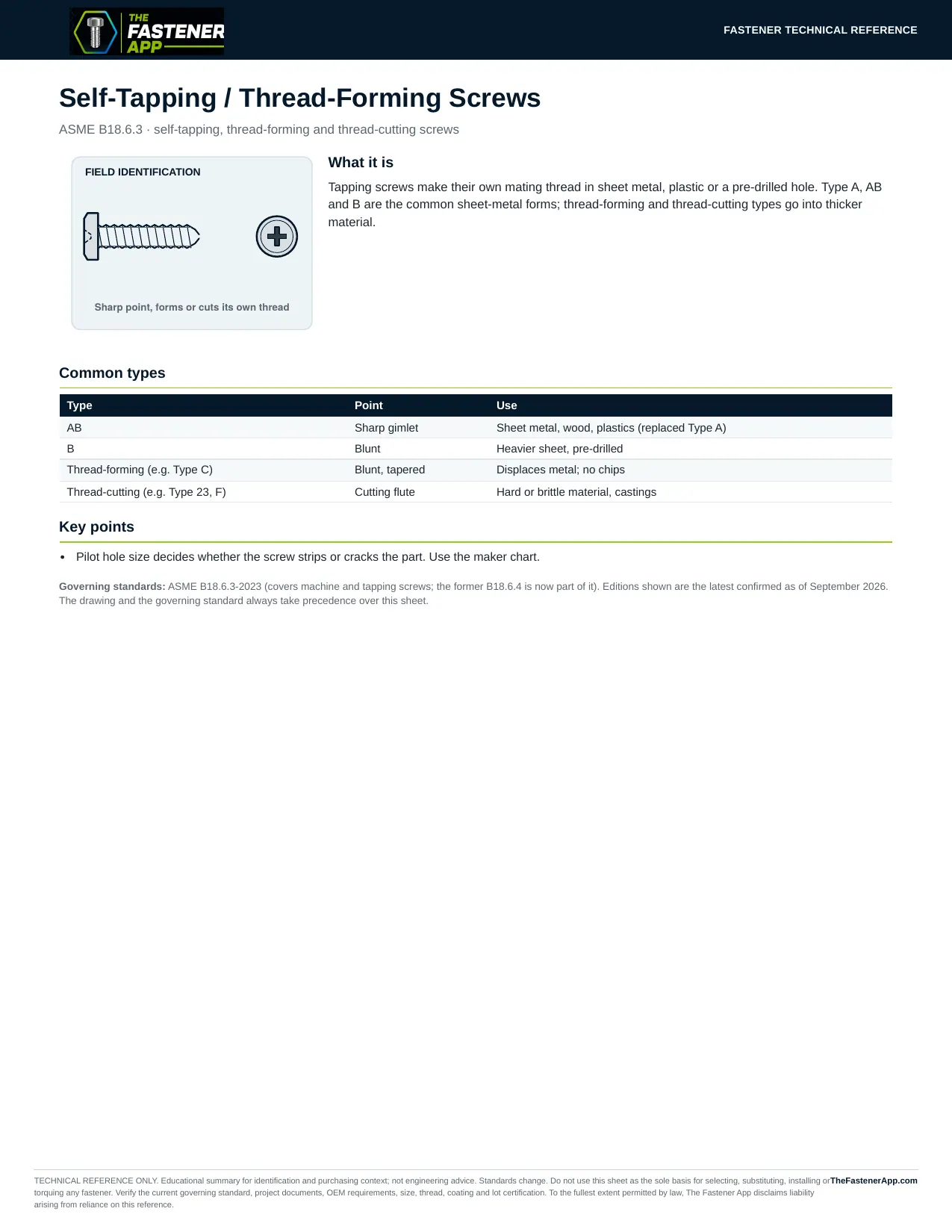
Tapping screws make their own mating thread in sheet metal, plastic or a pre-drilled hole. Type A, AB and B are the common sheet-metal forms; thread-forming and thread-cutting types go into thicker material.
 Report an error on this sheet
Lag Screws
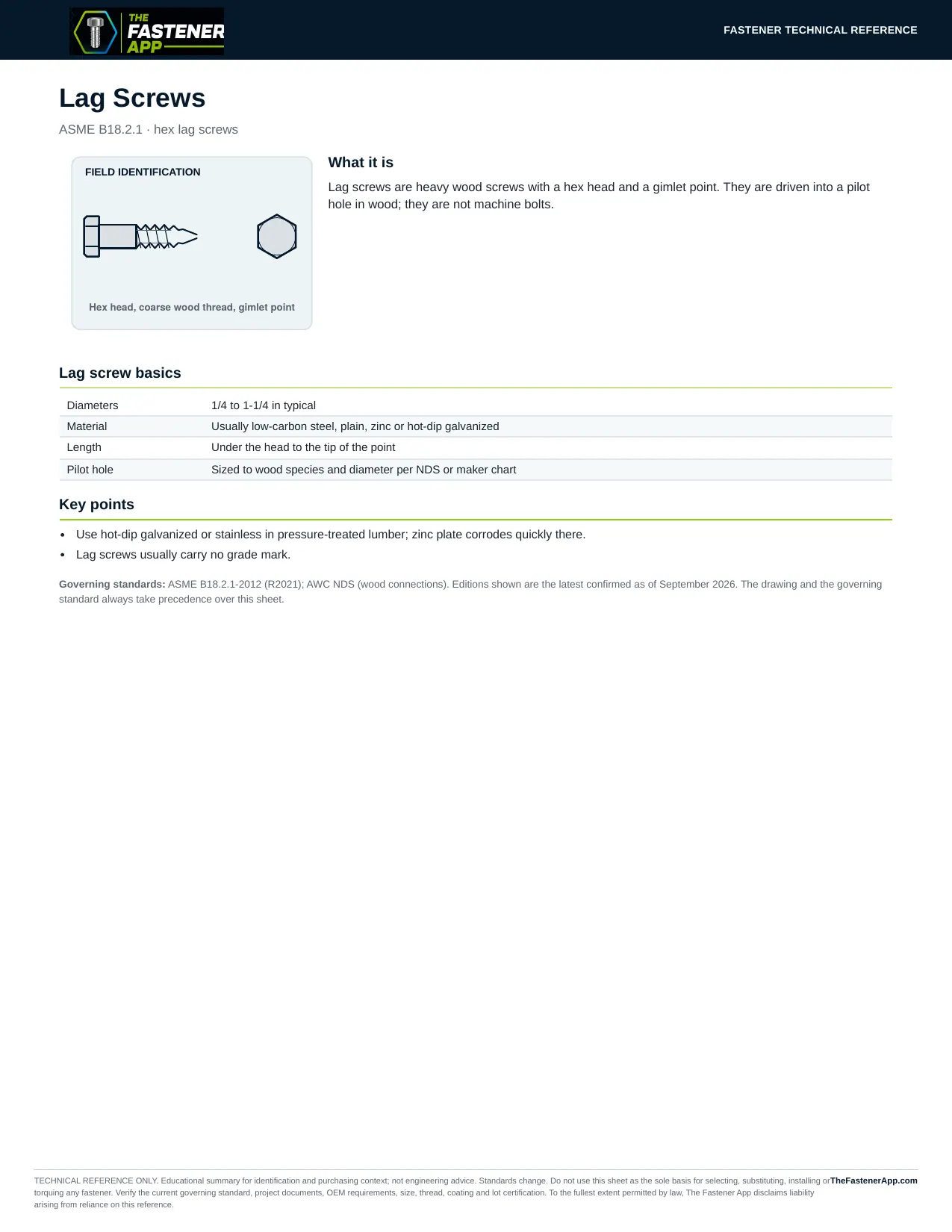
Lag screws are heavy wood screws with a hex head and a gimlet point. They are driven into a pilot hole in wood; they are not machine bolts.
 Report an error on this sheet
Carriage Bolts
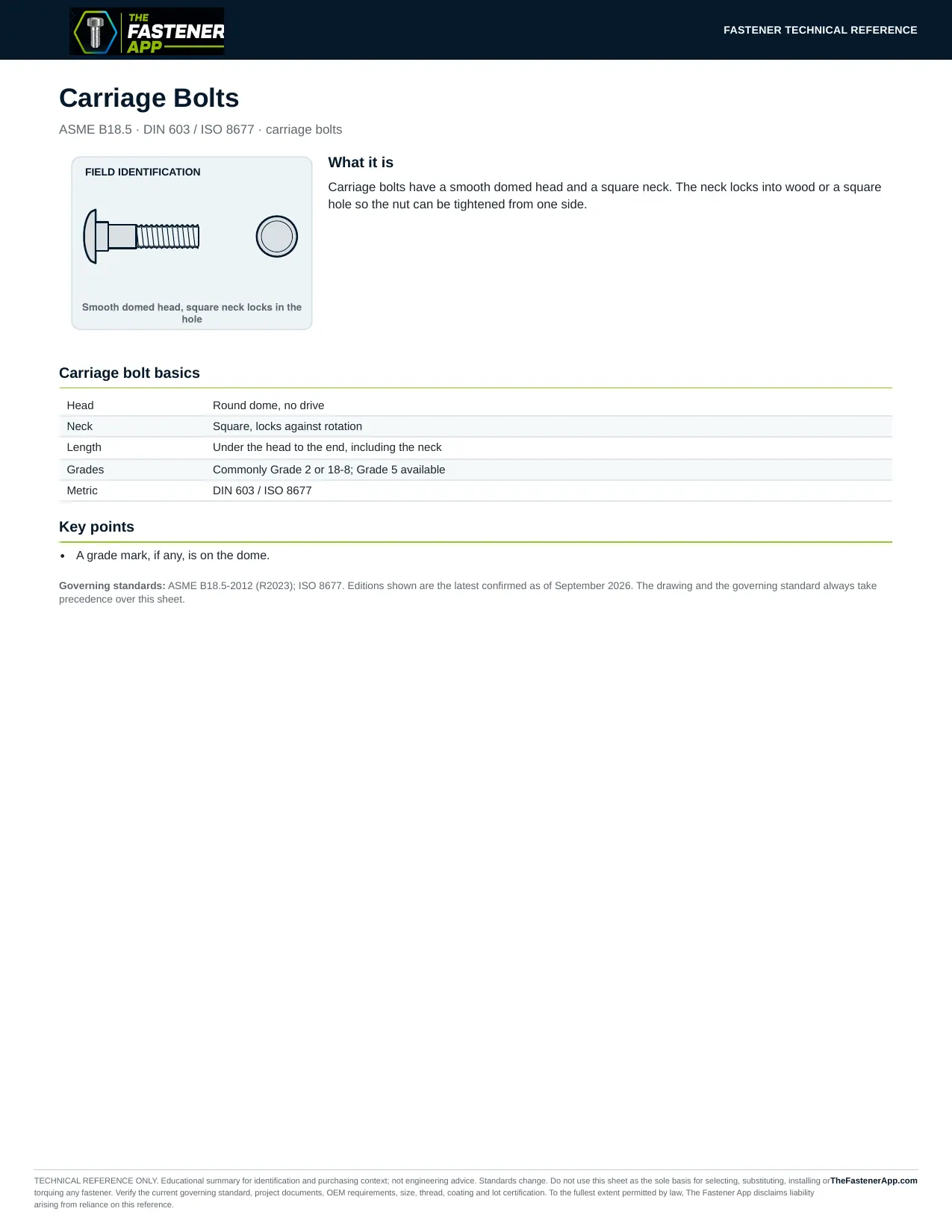
Carriage bolts have a smooth domed head and a square neck. The neck locks into wood or a square hole so the nut can be tightened from one side.
 Report an error on this sheet
Threaded Rod and Studs
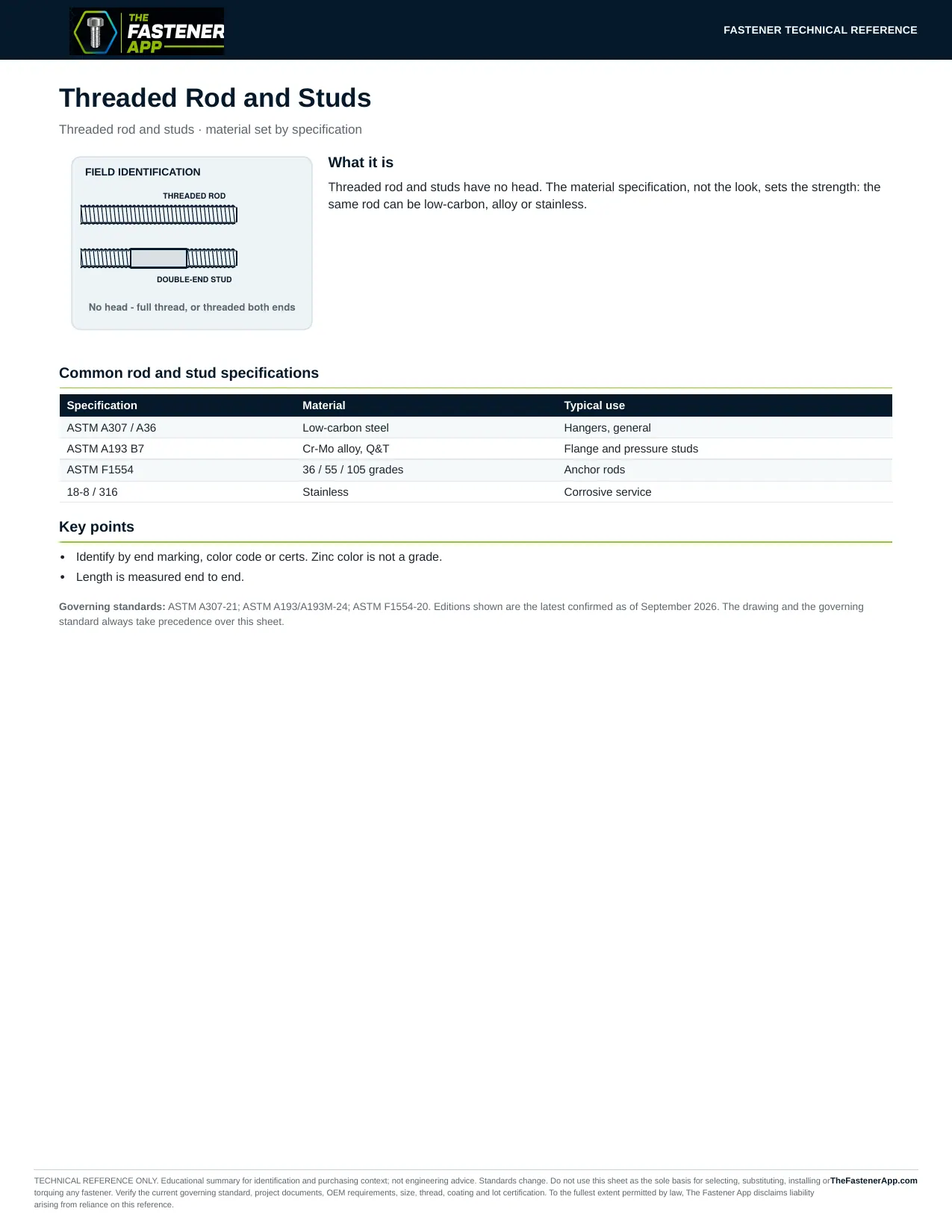
Threaded rod and studs have no head. The material specification, not the look, sets the strength: the same rod can be low-carbon, alloy or stainless.
 Report an error on this sheet
SAE vs USS Flat Washers
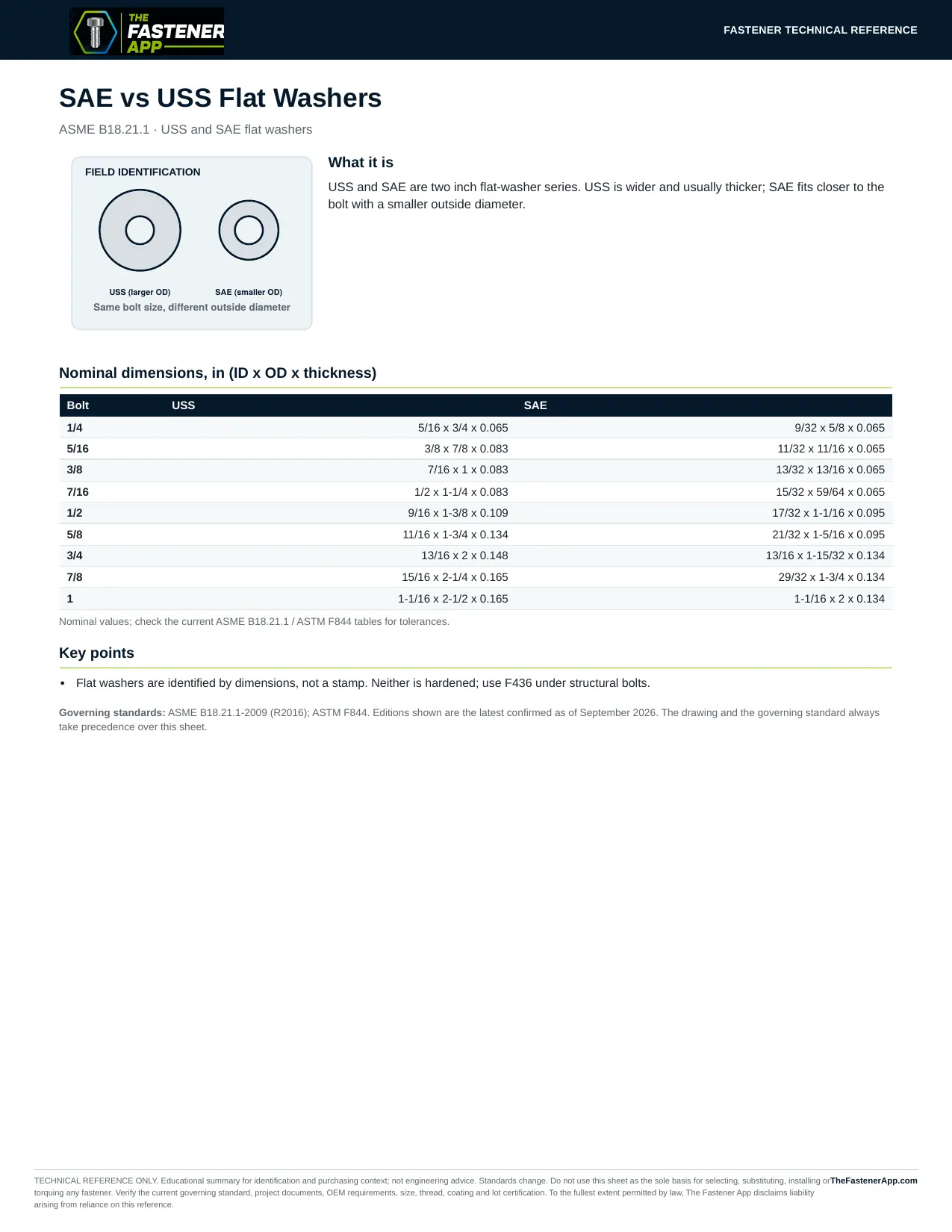
USS and SAE are two inch flat-washer series. USS is wider and usually thicker; SAE fits closer to the bolt with a smaller outside diameter.
 Report an error on this sheet
Lock Washers and Locking Methods
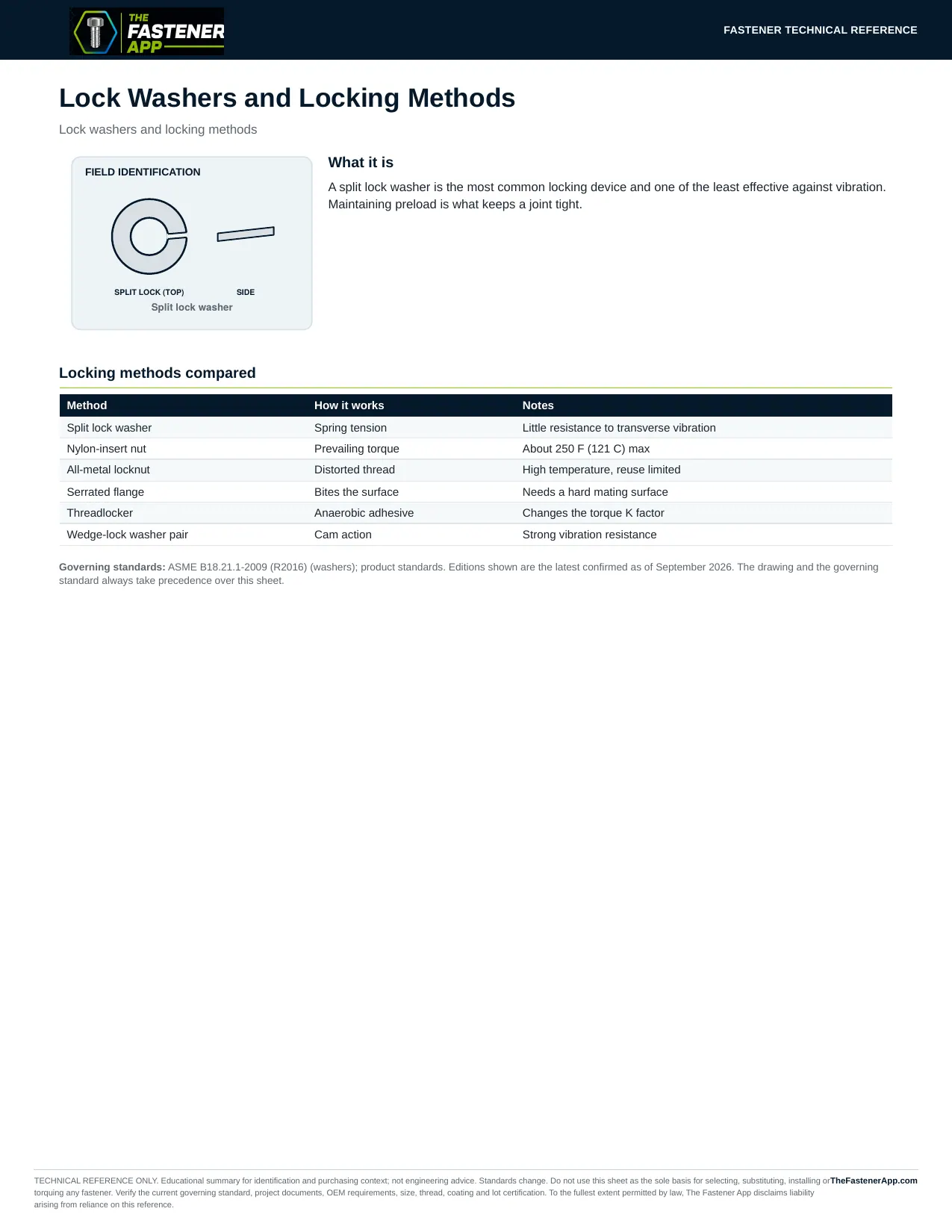
A split lock washer is the most common locking device and one of the least effective against vibration. Maintaining preload is what keeps a joint tight.
 Report an error on this sheet
Hex Nuts, Jam Nuts and Heavy Hex Nuts
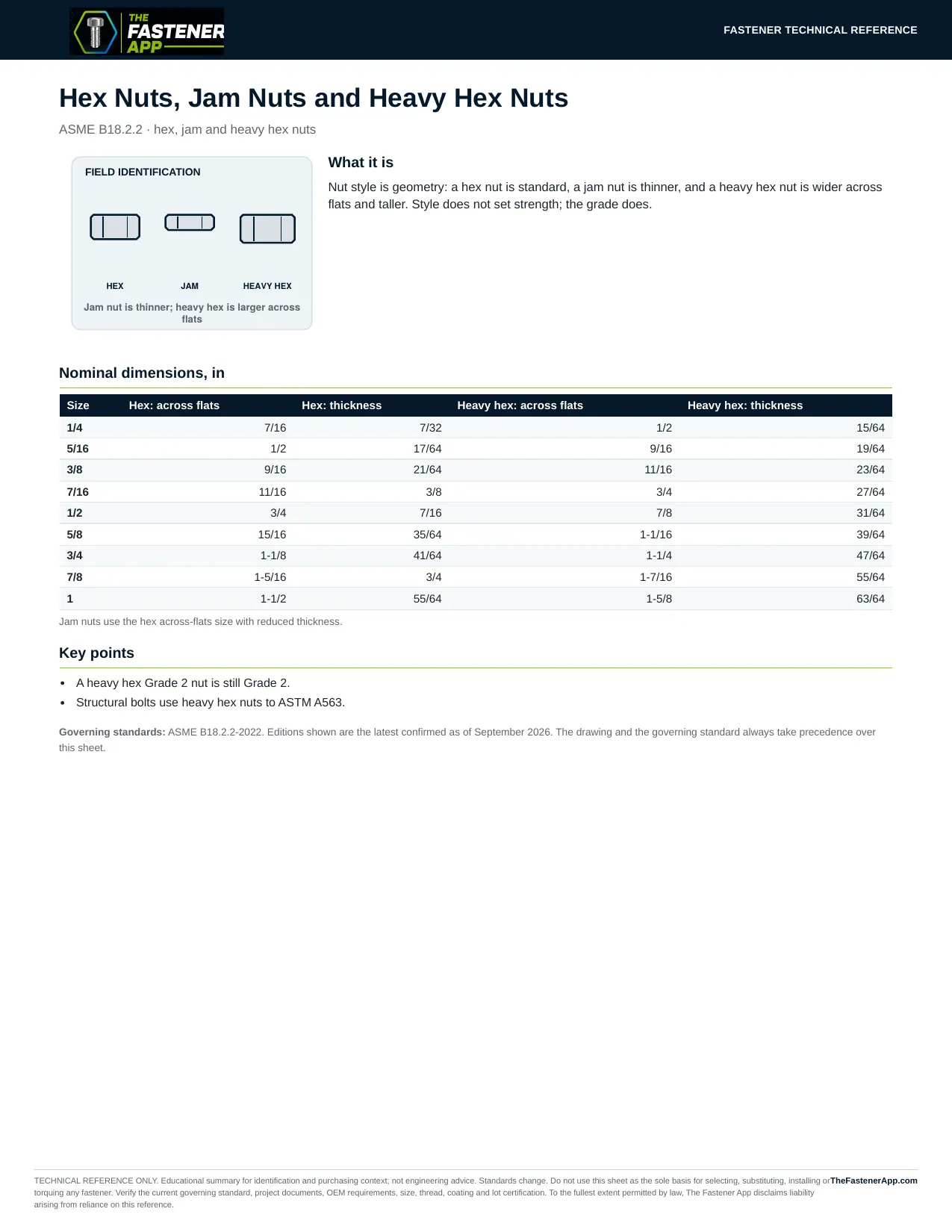
Nut style is geometry: a hex nut is standard, a jam nut is thinner, and a heavy hex nut is wider across flats and taller. Style does not set strength; the grade does.
 Report an error on this sheet
Nylon-Insert Locknuts
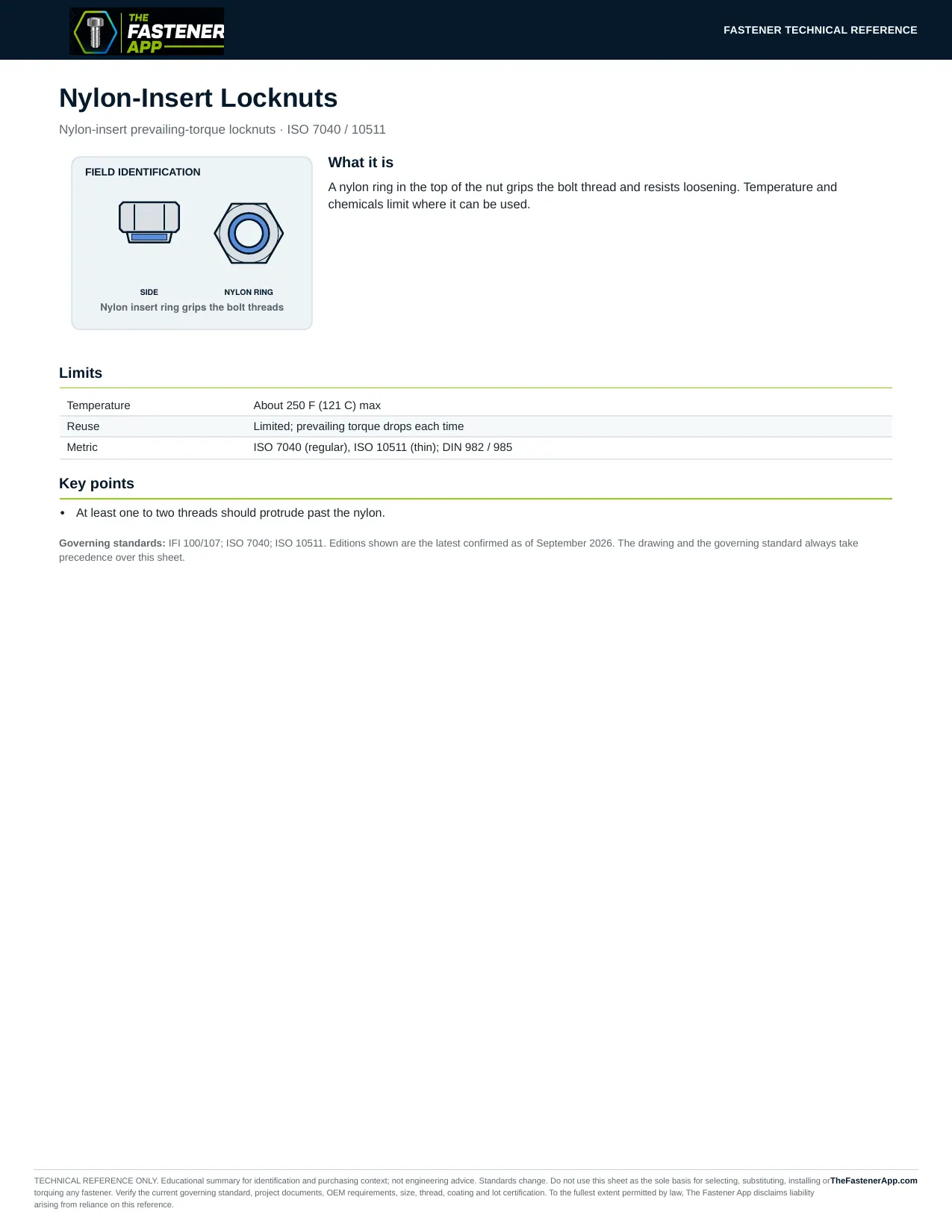
A nylon ring in the top of the nut grips the bolt thread and resists loosening. Temperature and chemicals limit where it can be used.
 Report an error on this sheet
Prevailing-Torque All-Metal Locknuts
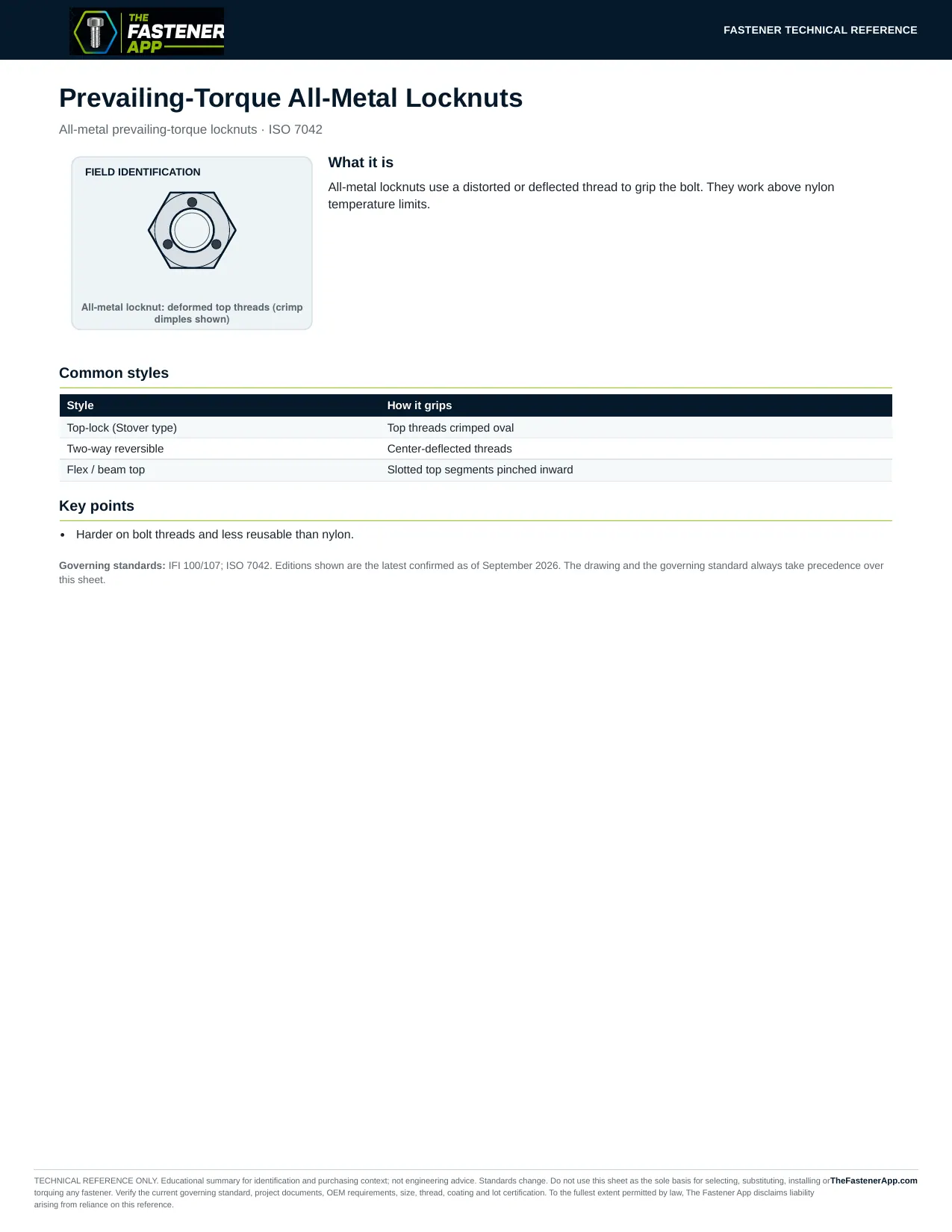
All-metal locknuts use a distorted or deflected thread to grip the bolt. They work above nylon temperature limits.
 Report an error on this sheet
Zinc-Plated Fasteners
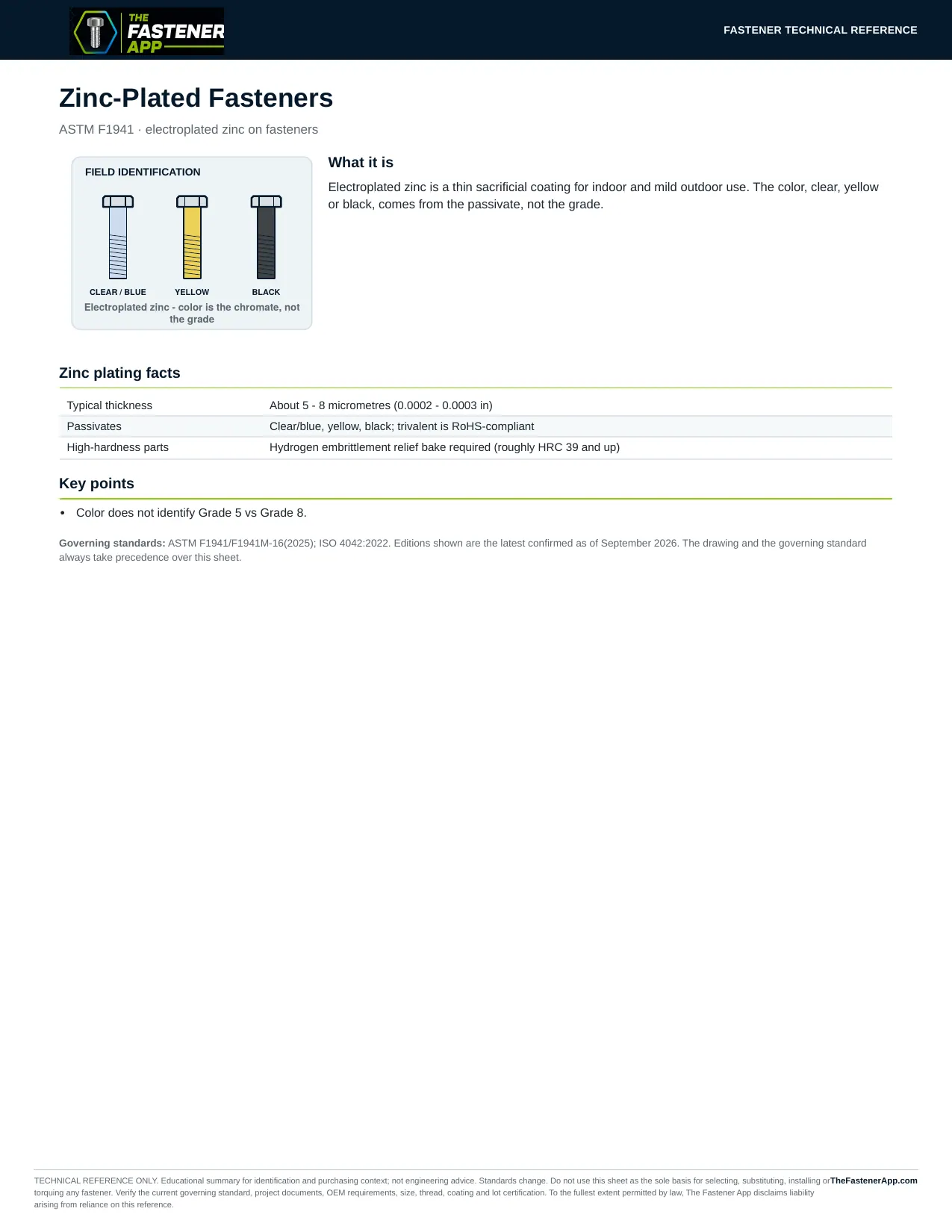
Electroplated zinc is a thin sacrificial coating for indoor and mild outdoor use. The color, clear, yellow or black, comes from the passivate, not the grade.
 Report an error on this sheet
Hot-Dip Galvanized Fasteners
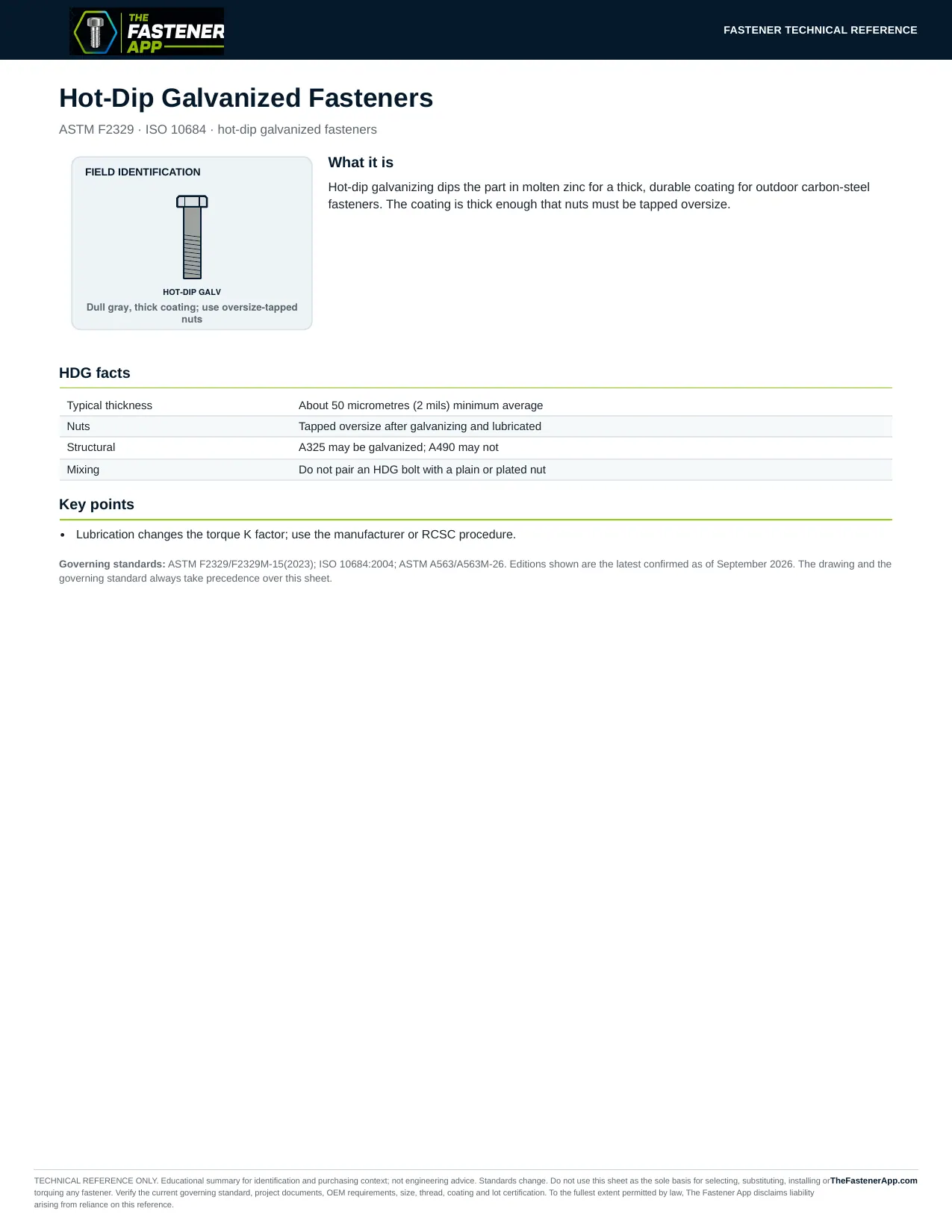
Hot-dip galvanizing dips the part in molten zinc for a thick, durable coating for outdoor carbon-steel fasteners. The coating is thick enough that nuts must be tapped oversize.
 Report an error on this sheet
Mechanical Galvanizing and Zinc-Flake Coatings
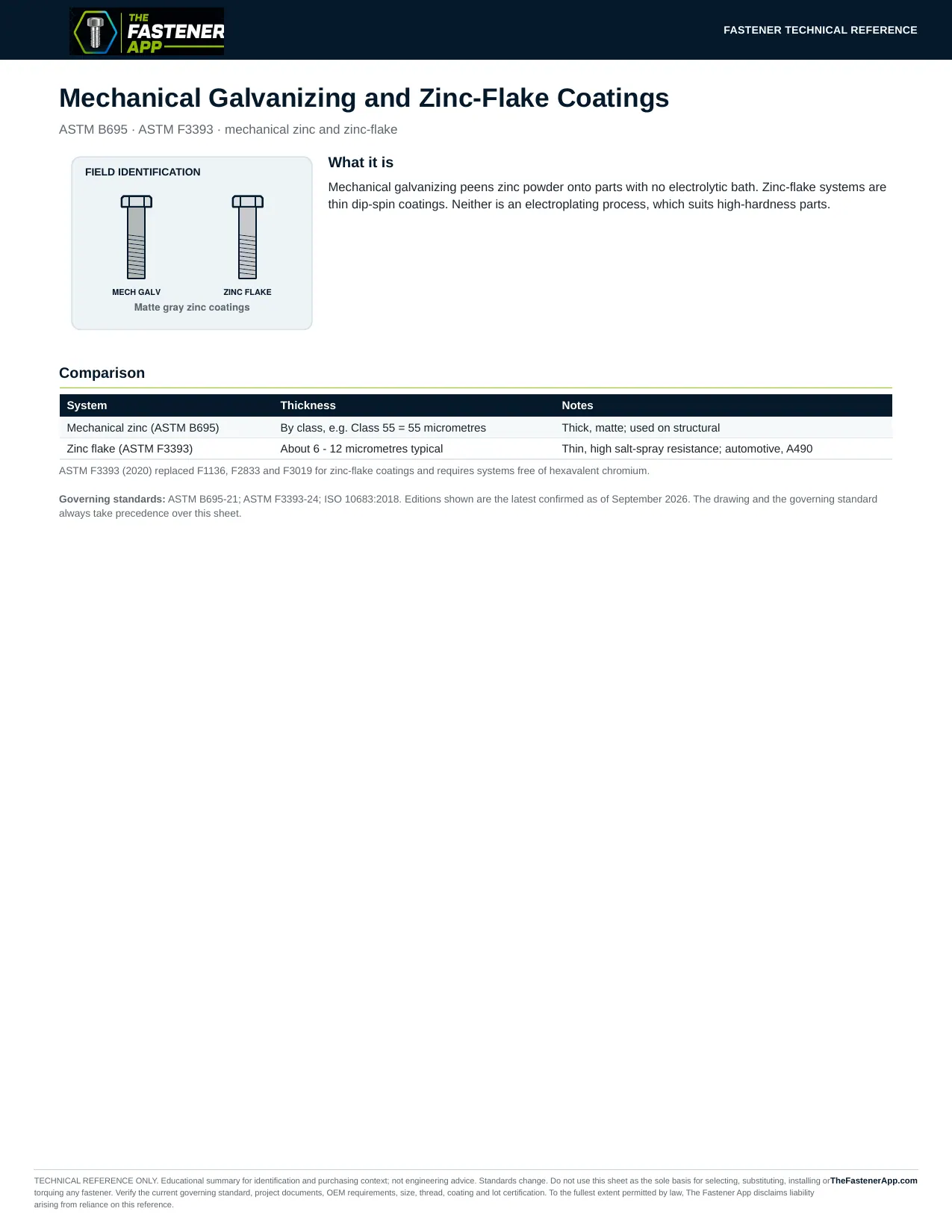
Mechanical galvanizing peens zinc powder onto parts with no electrolytic bath. Zinc-flake systems are thin dip-spin coatings. Neither is an electroplating process, which suits high-hardness parts.
 Report an error on this sheet
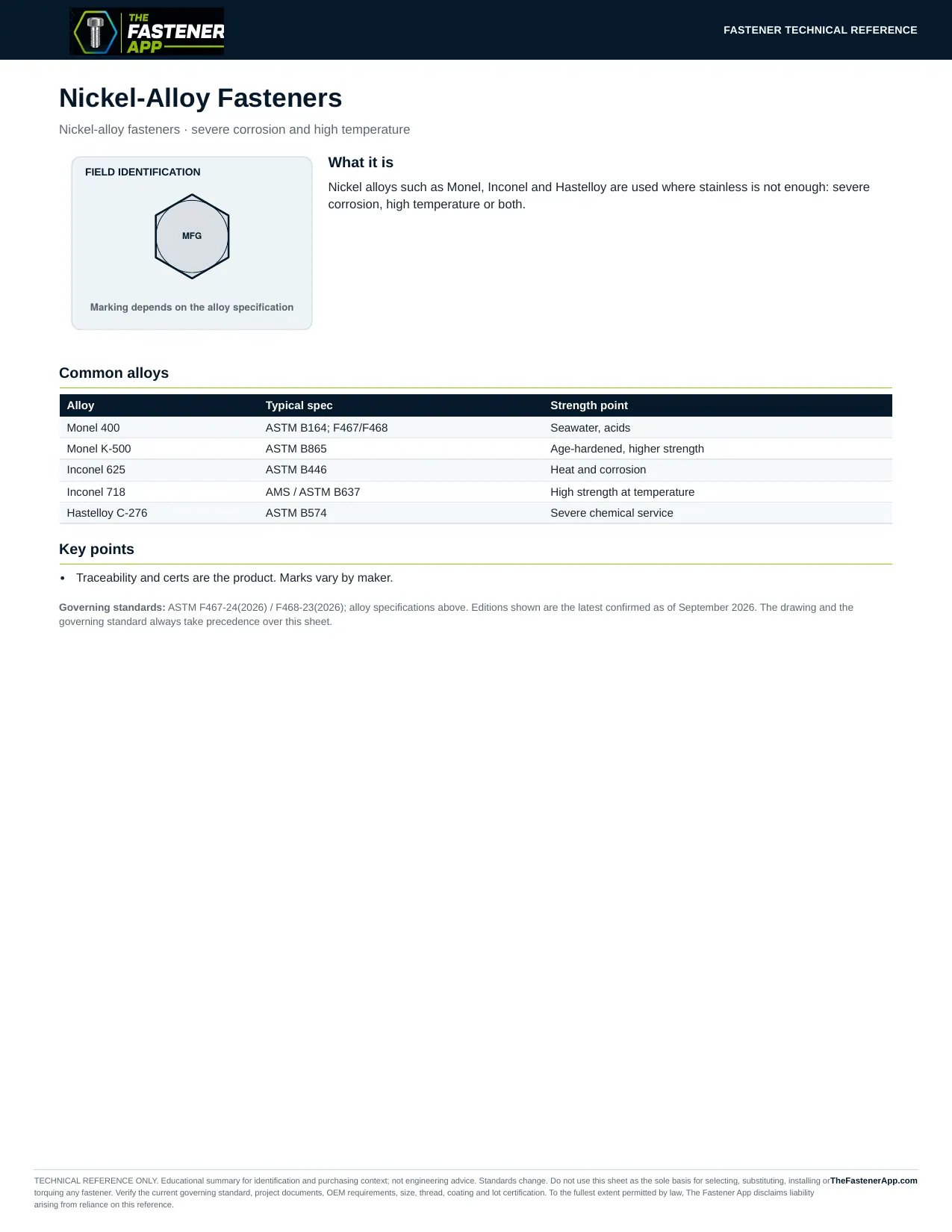
Nickel-Alloy Fasteners
Nickel alloys such as Monel, Inconel and Hastelloy are used where stainless is not enough: severe corrosion, high temperature or both.
 Report an error on this sheet
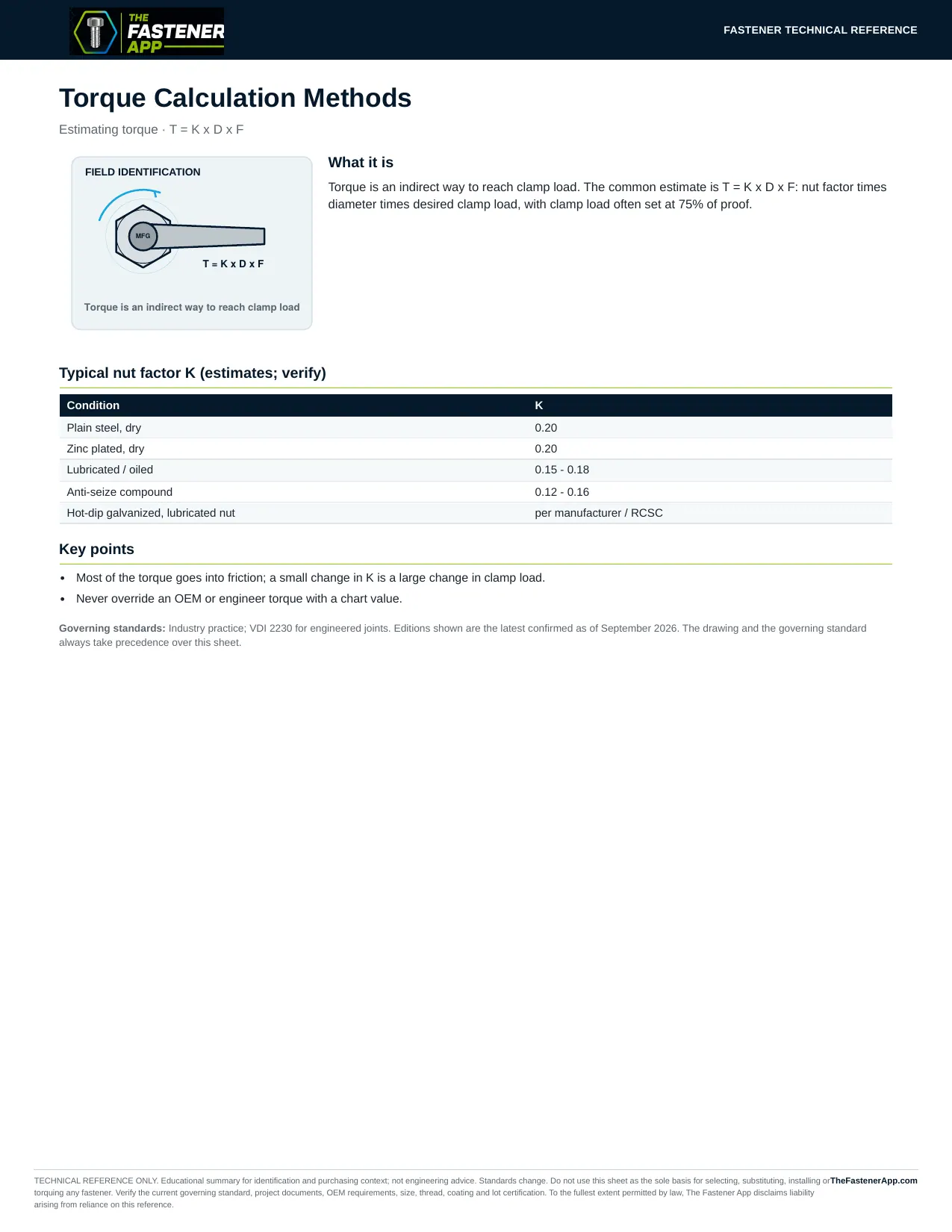
Torque Calculation Methods
Torque is an indirect way to reach clamp load. The common estimate is T = K x D x F: nut factor times diameter times desired clamp load, with clamp load often set at 75% of proof.
 Report an error on this sheet
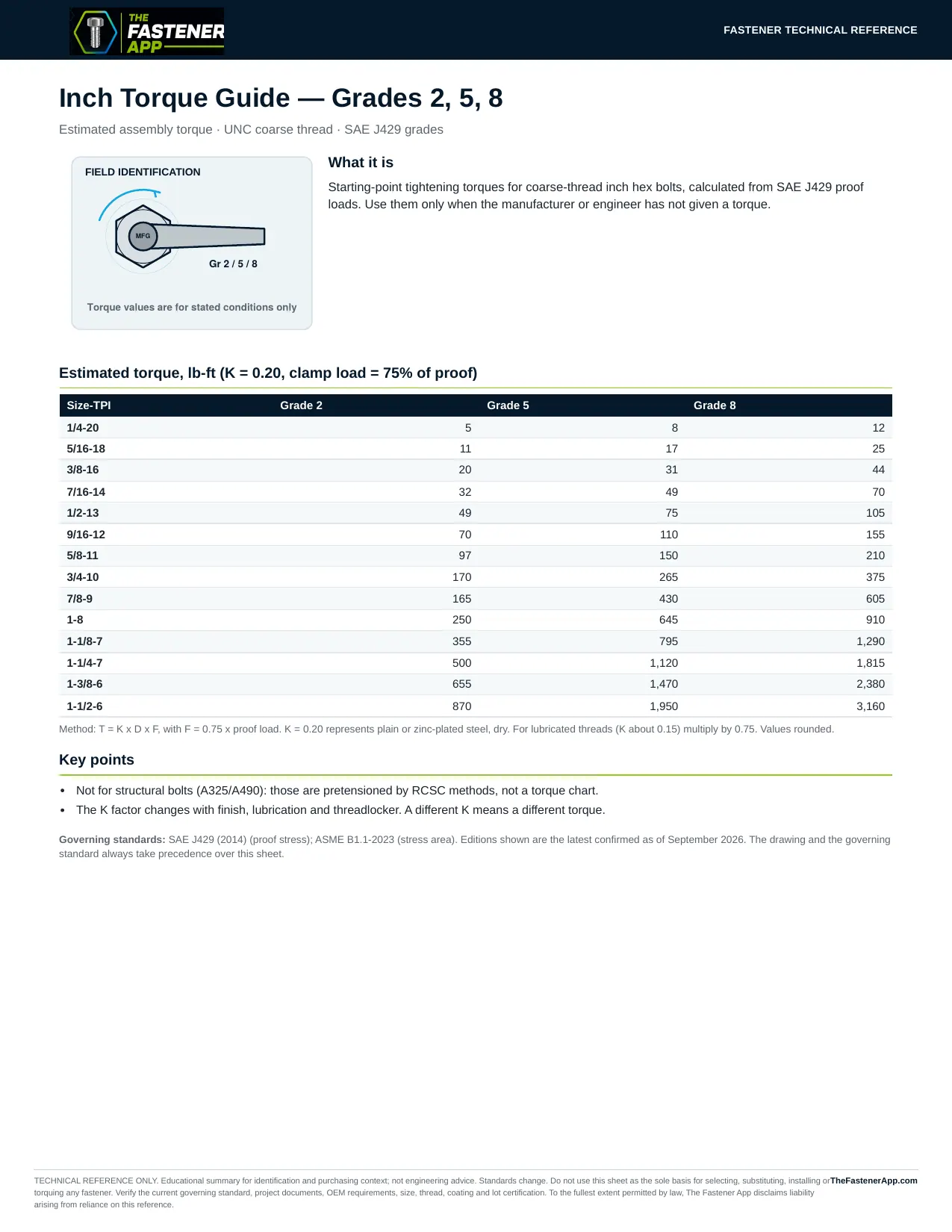
Inch Torque Guide — Grades 2, 5, 8
Starting-point tightening torques for coarse-thread inch hex bolts, calculated from SAE J429 proof loads. Use them only when the manufacturer or engineer has not given a torque.
 Report an error on this sheet
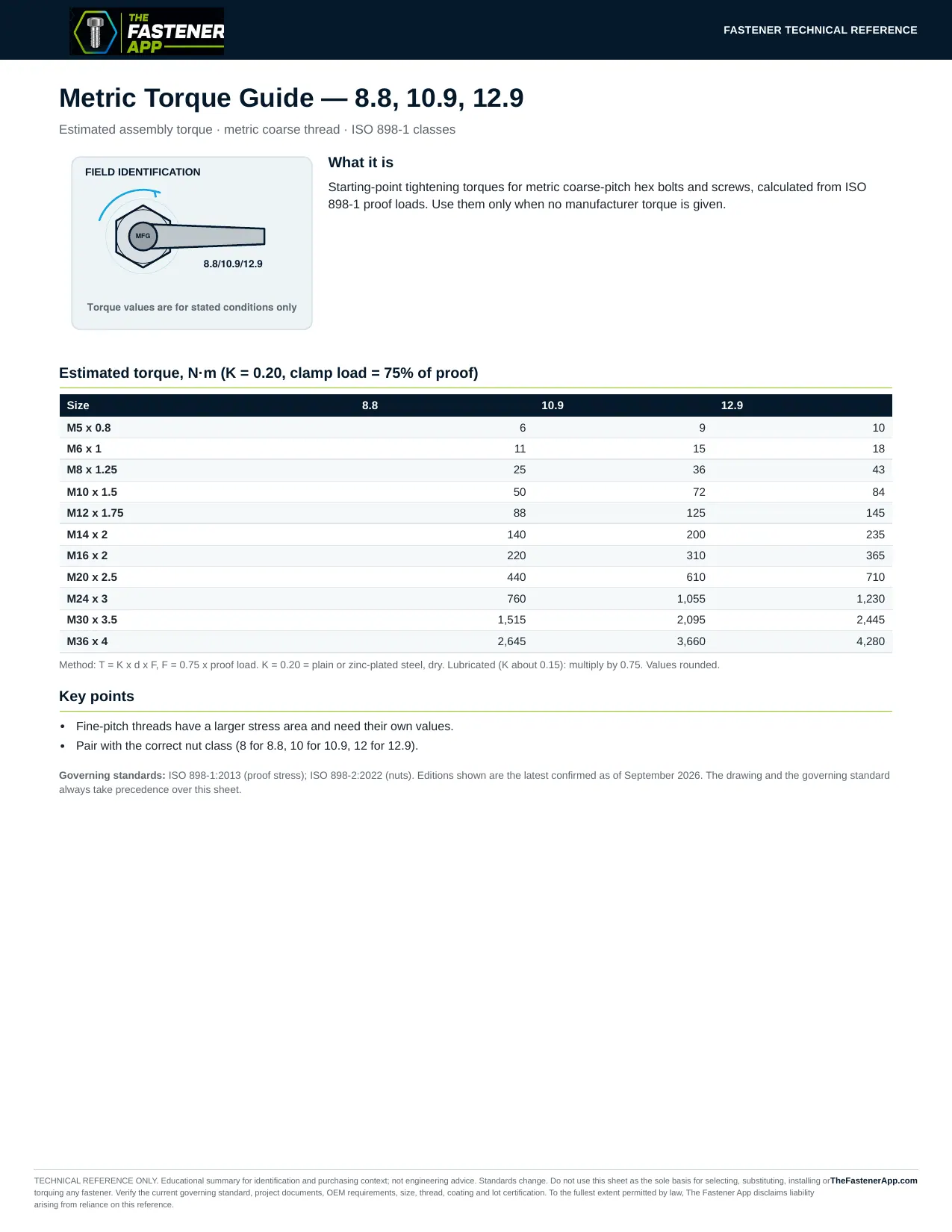
Metric Torque Guide — 8.8, 10.9, 12.9
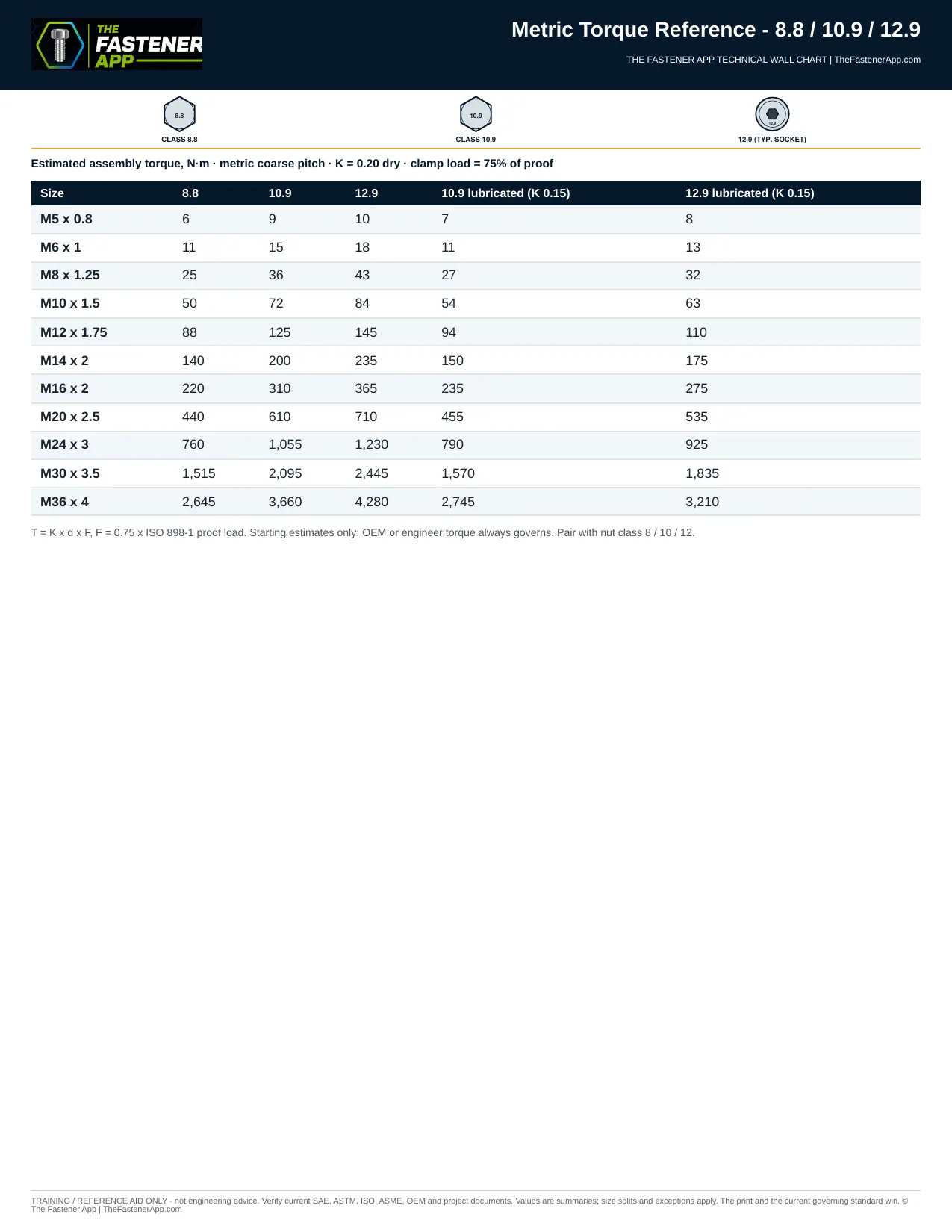
Starting-point tightening torques for metric coarse-pitch hex bolts and screws, calculated from ISO 898-1 proof loads. Use them only when no manufacturer torque is given.
 Report an error on this sheet
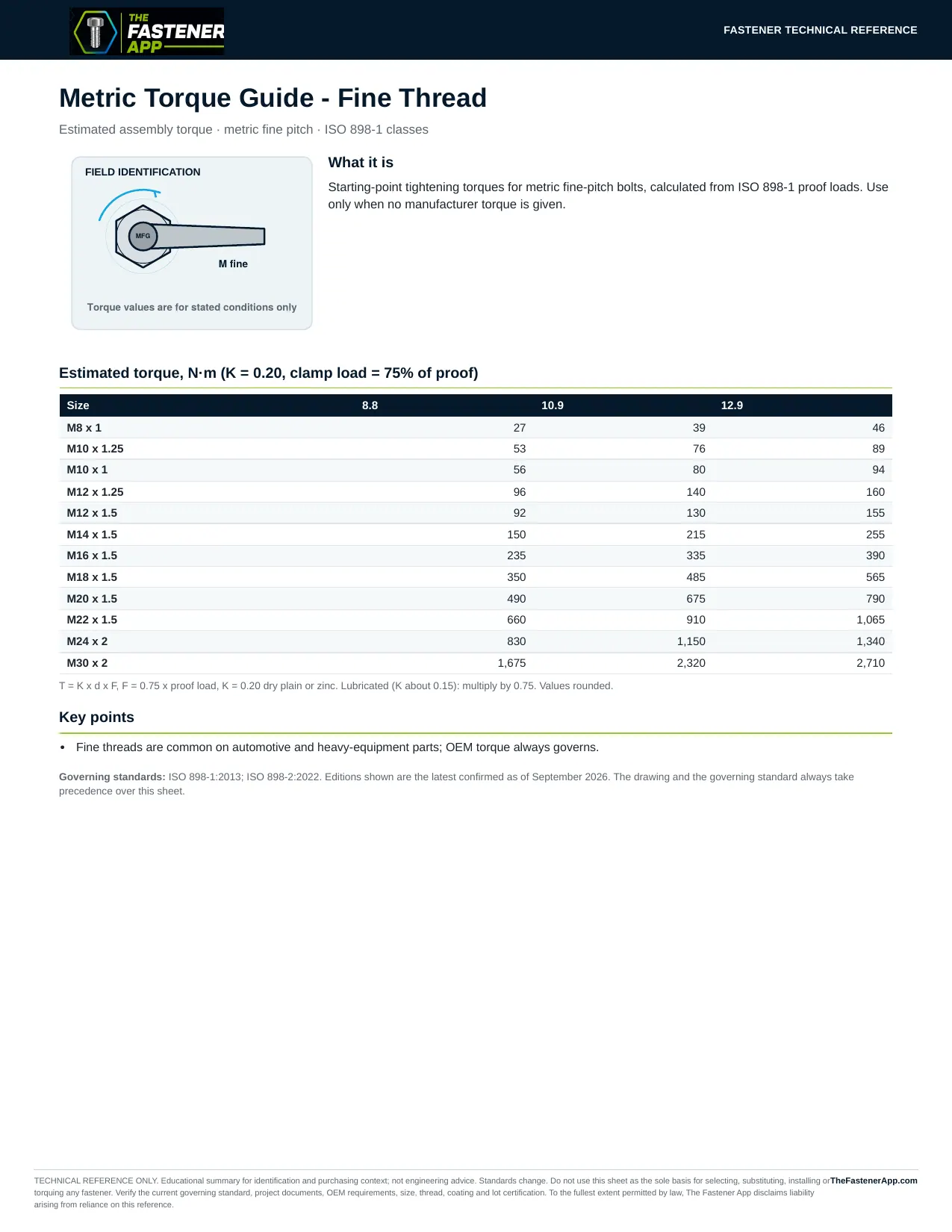
Metric Torque Guide - Fine Thread
Starting-point tightening torques for metric fine-pitch bolts, calculated from ISO 898-1 proof loads. Use only when no manufacturer torque is given.
 Report an error on this sheet
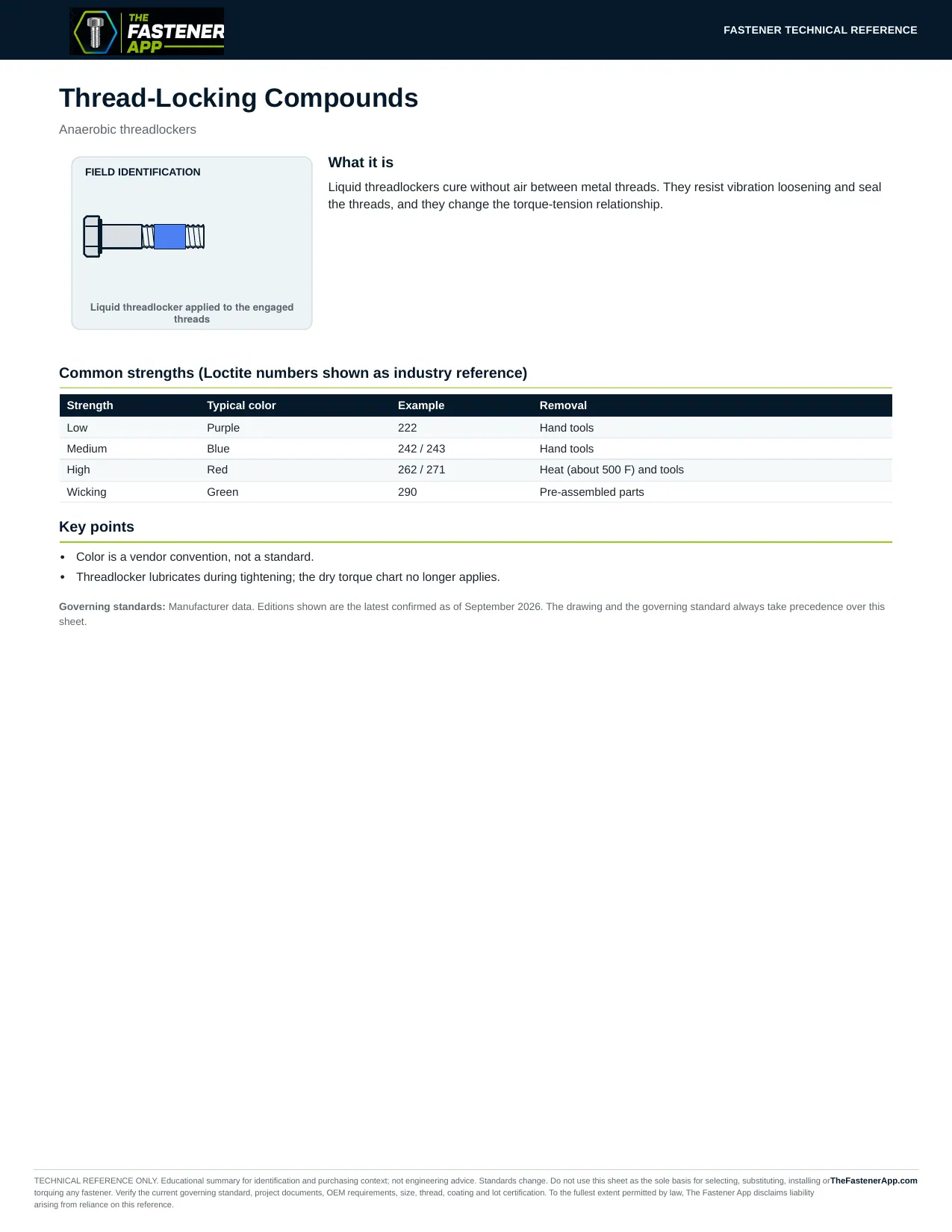
Thread-Locking Compounds
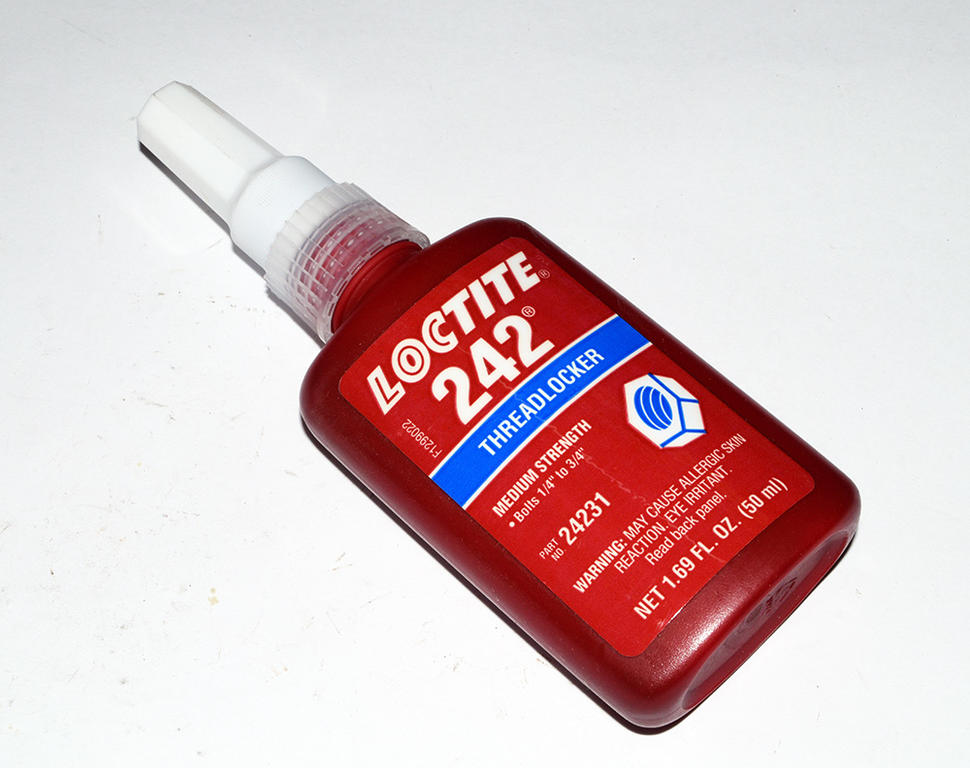
Liquid threadlockers cure without air between metal threads. They resist vibration loosening and seal the threads, and they change the torque-tension relationship.
 Report an error on this sheet
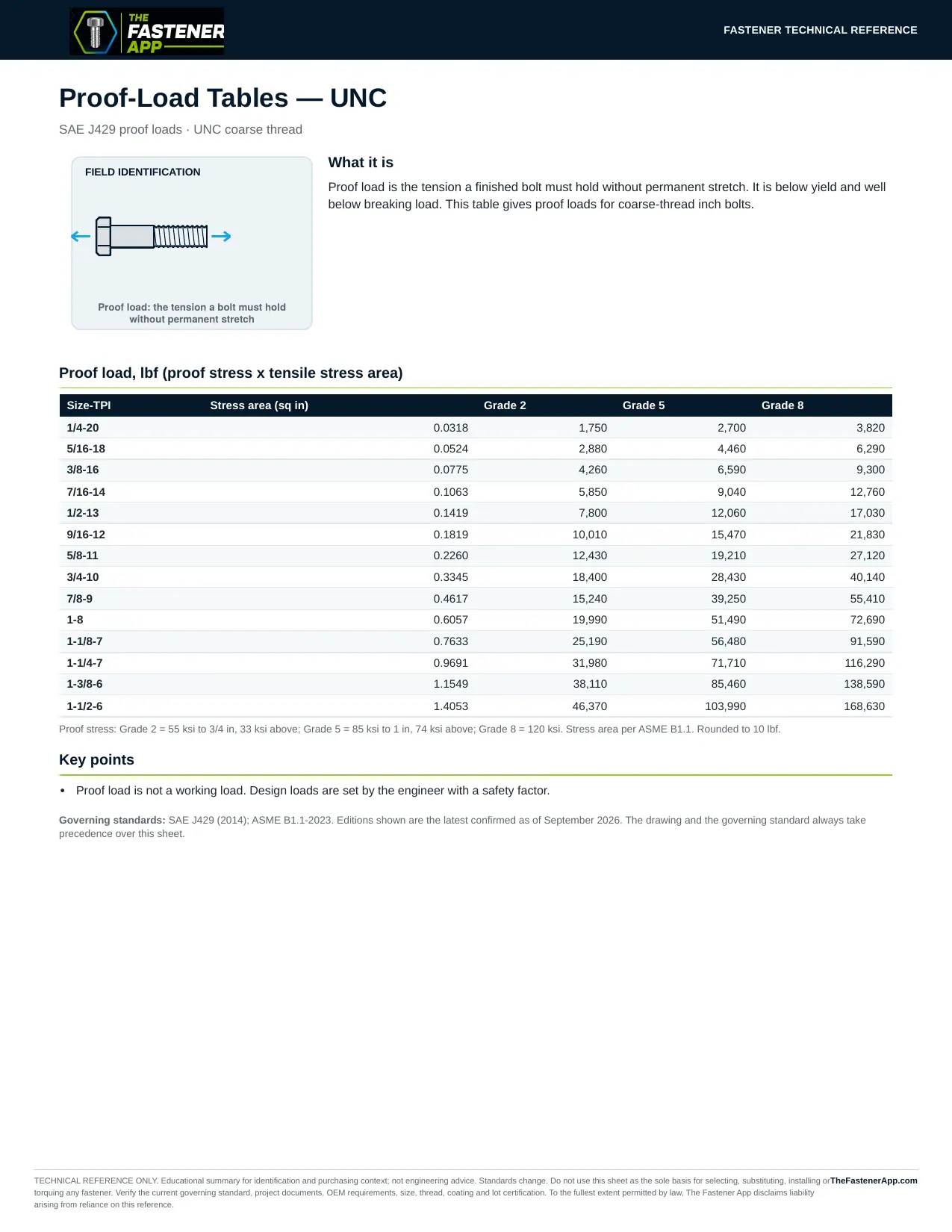
Proof-Load Tables — UNC
Proof load is the tension a finished bolt must hold without permanent stretch. It is below yield and well below breaking load. This table gives proof loads for coarse-thread inch bolts.
 Report an error on this sheet
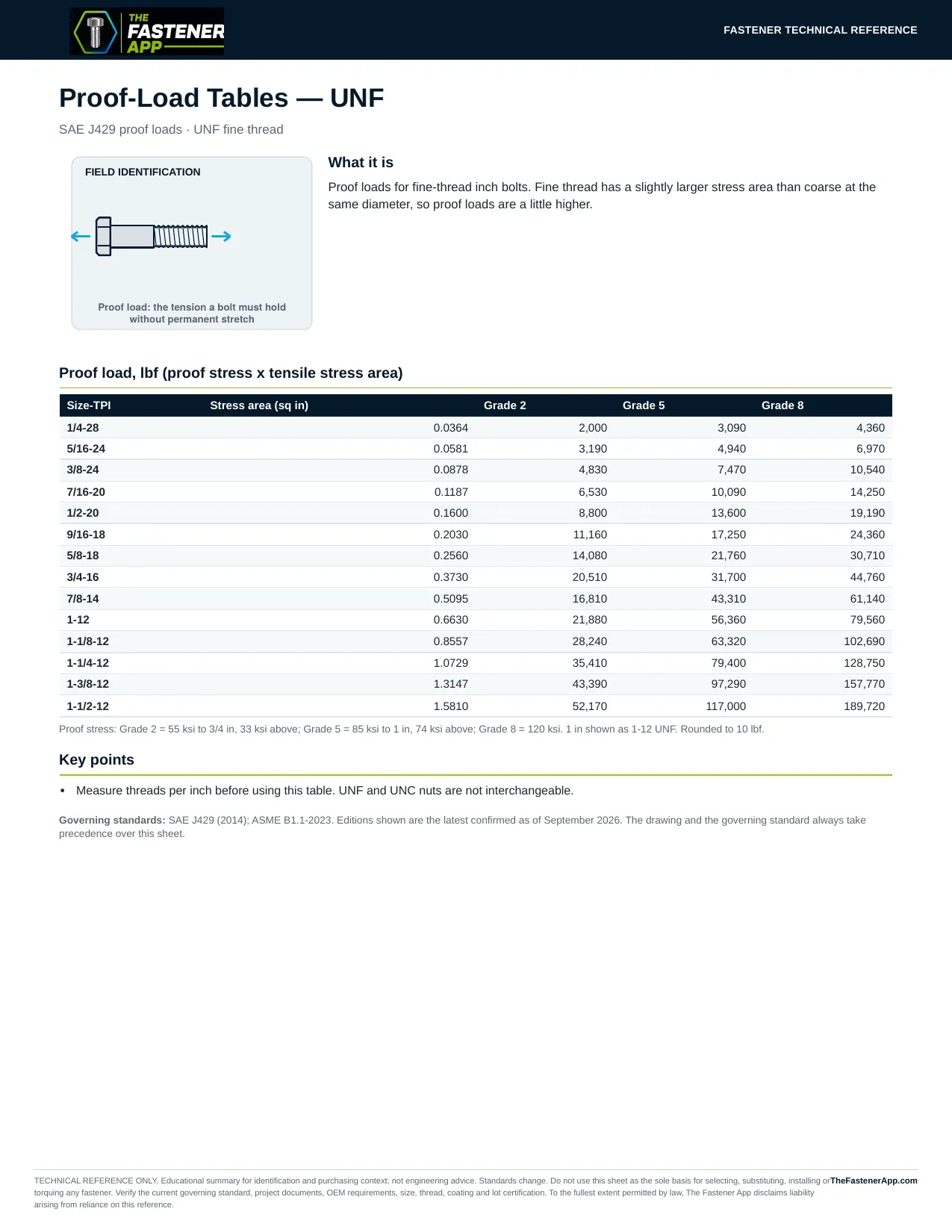
Proof-Load Tables — UNF
Proof loads for fine-thread inch bolts. Fine thread has a slightly larger stress area than coarse at the same diameter, so proof loads are a little higher.
 Report an error on this sheet
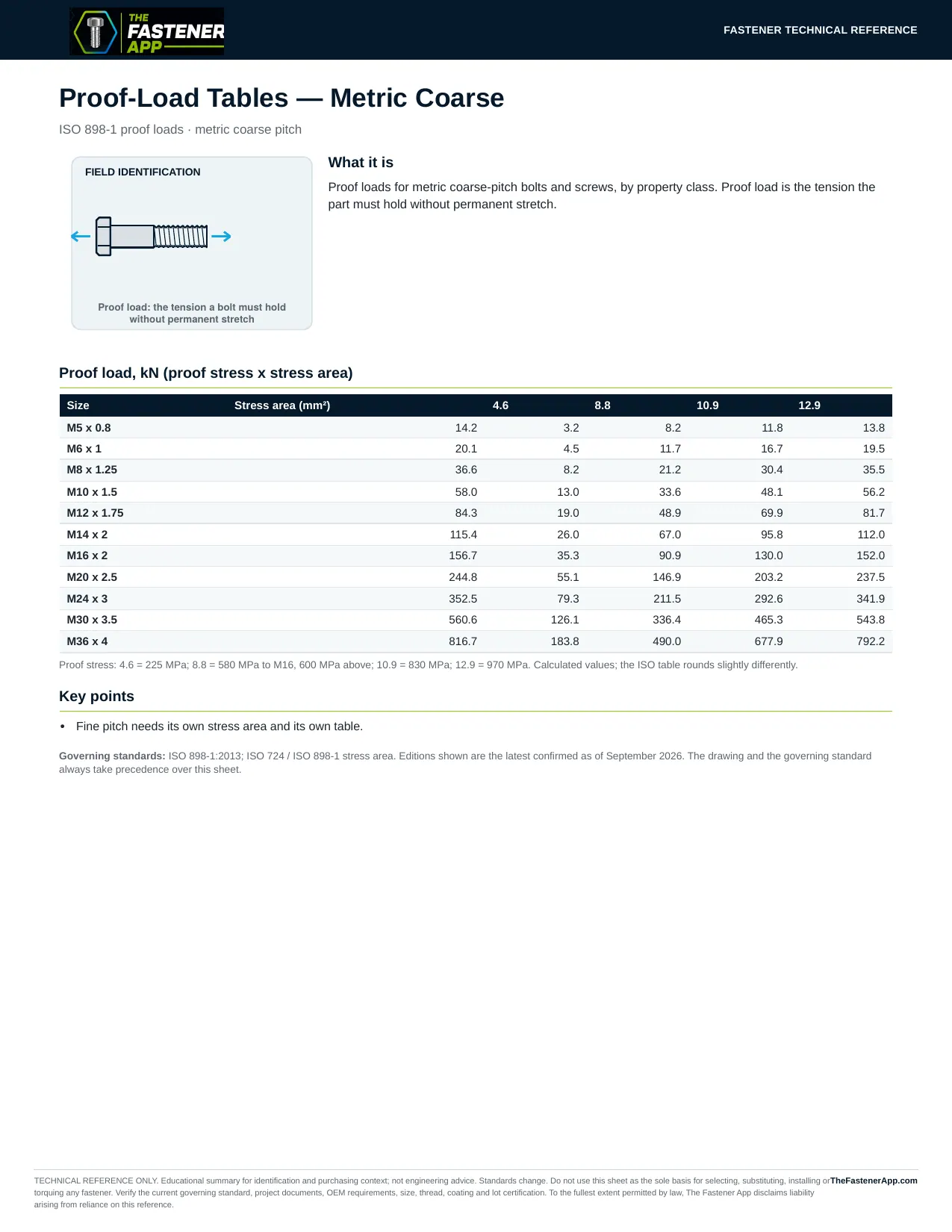
Proof-Load Tables — Metric Coarse
Proof loads for metric coarse-pitch bolts and screws, by property class. Proof load is the tension the part must hold without permanent stretch.
 Report an error on this sheet
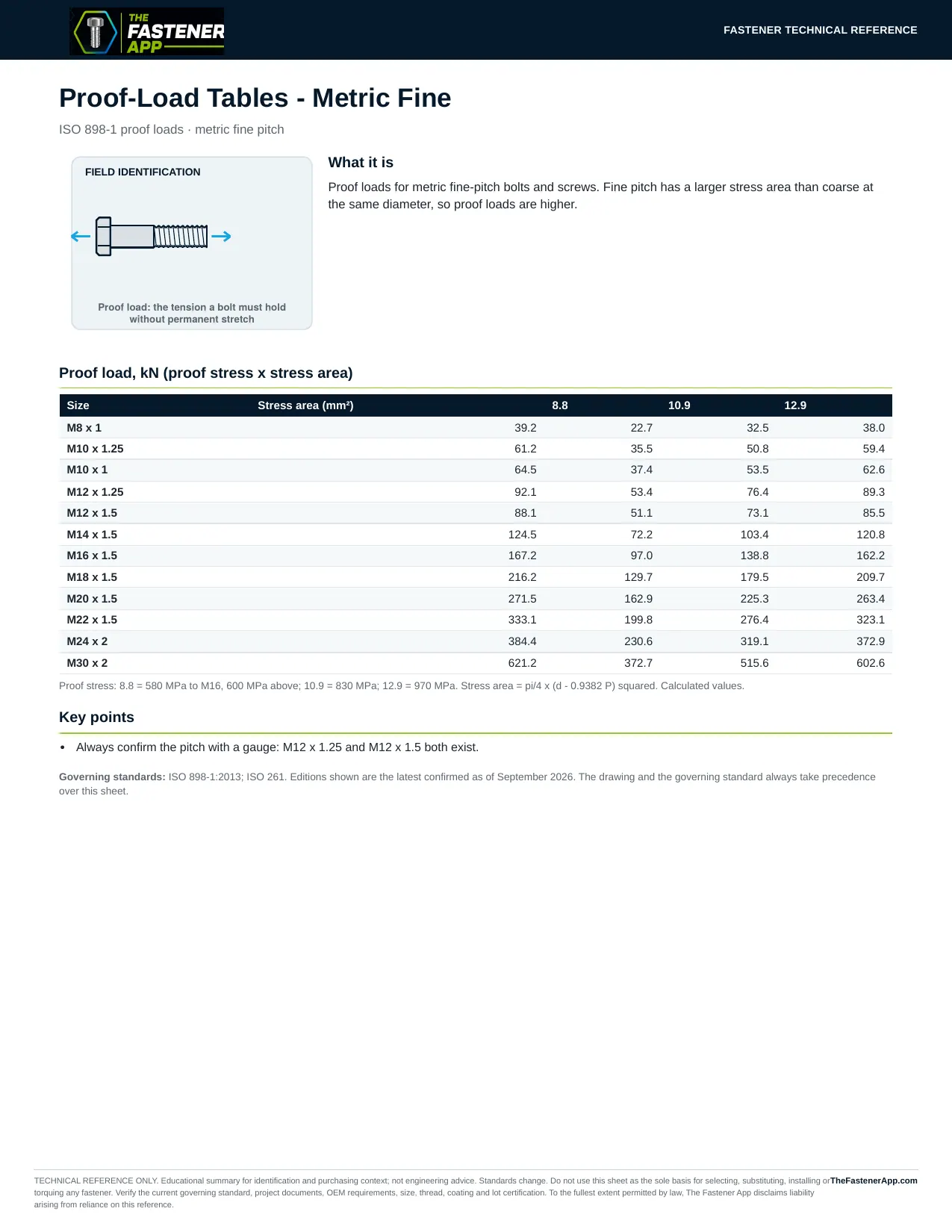
Proof-Load Tables - Metric Fine
Proof loads for metric fine-pitch bolts and screws. Fine pitch has a larger stress area than coarse at the same diameter, so proof loads are higher.
 Report an error on this sheet
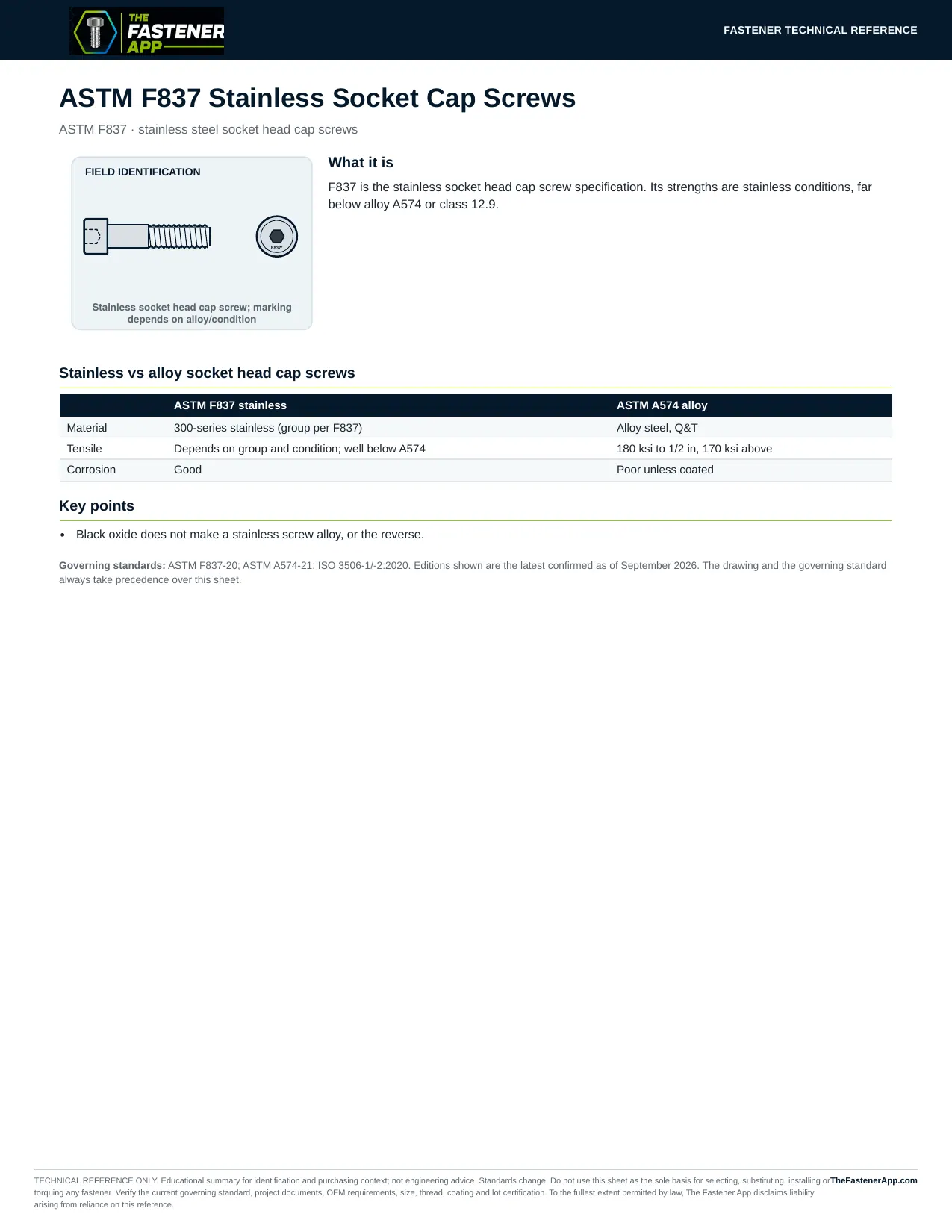
ASTM F837 Stainless Socket Cap Screws
F837 is the stainless socket head cap screw specification. Its strengths are stainless conditions, far below alloy A574 or class 12.9.
 Report an error on this sheet
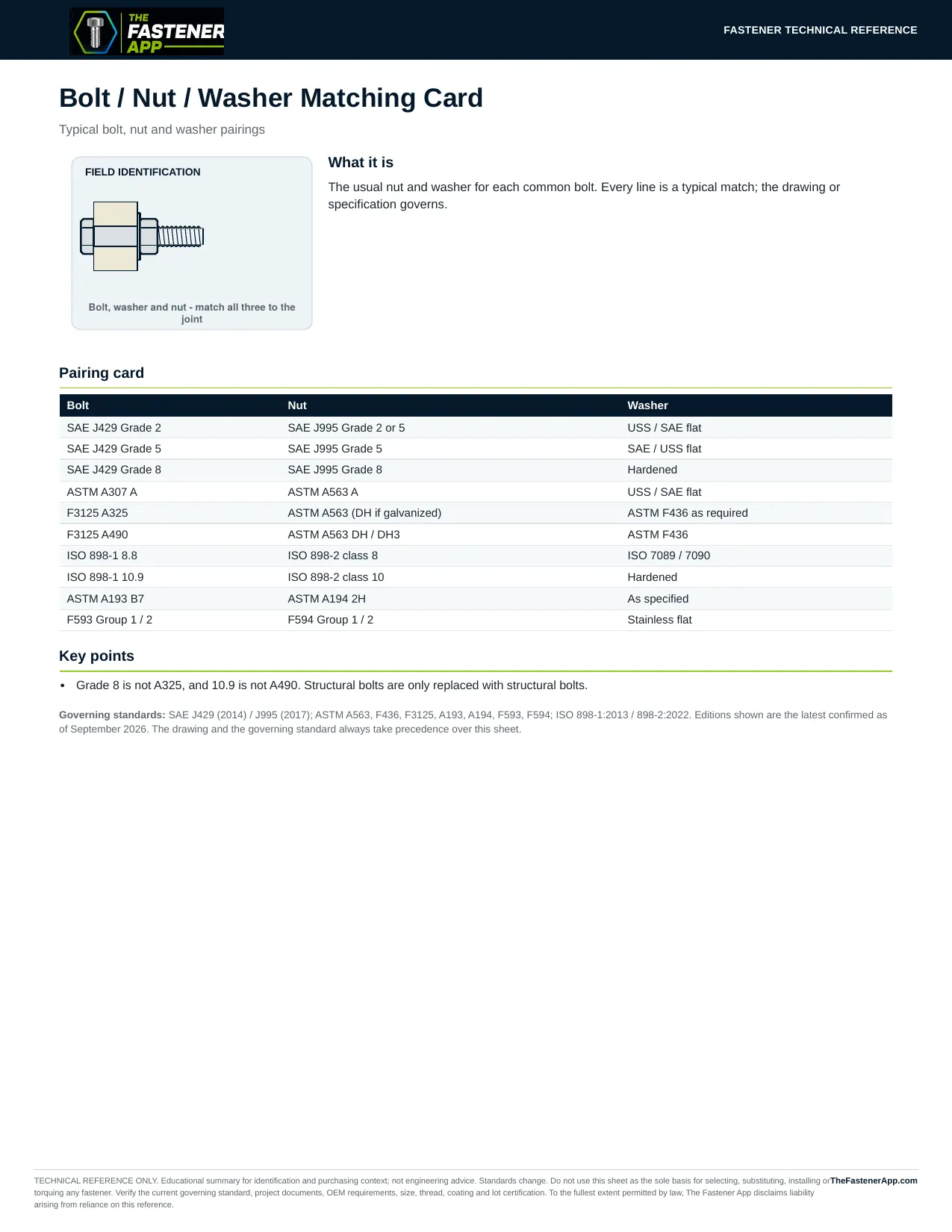
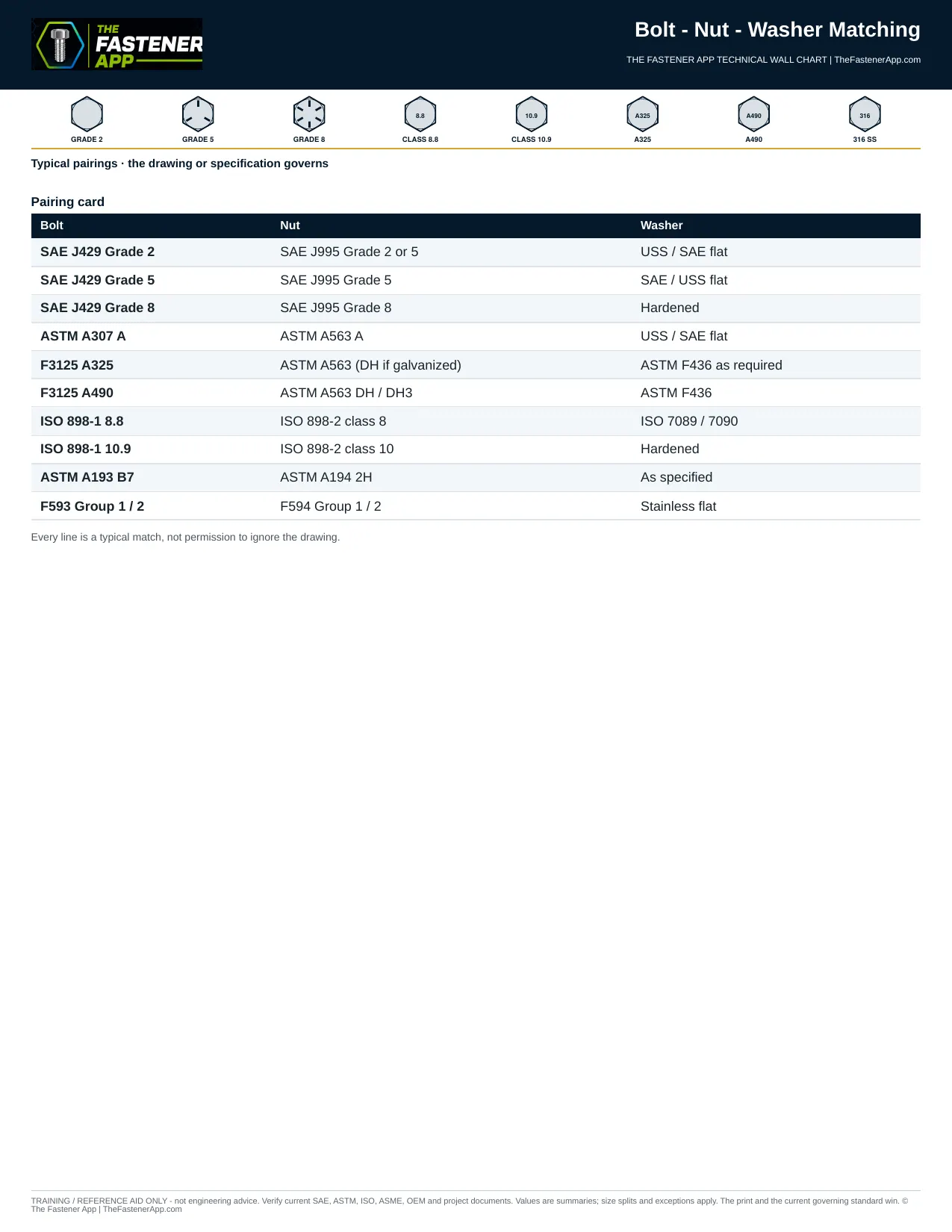
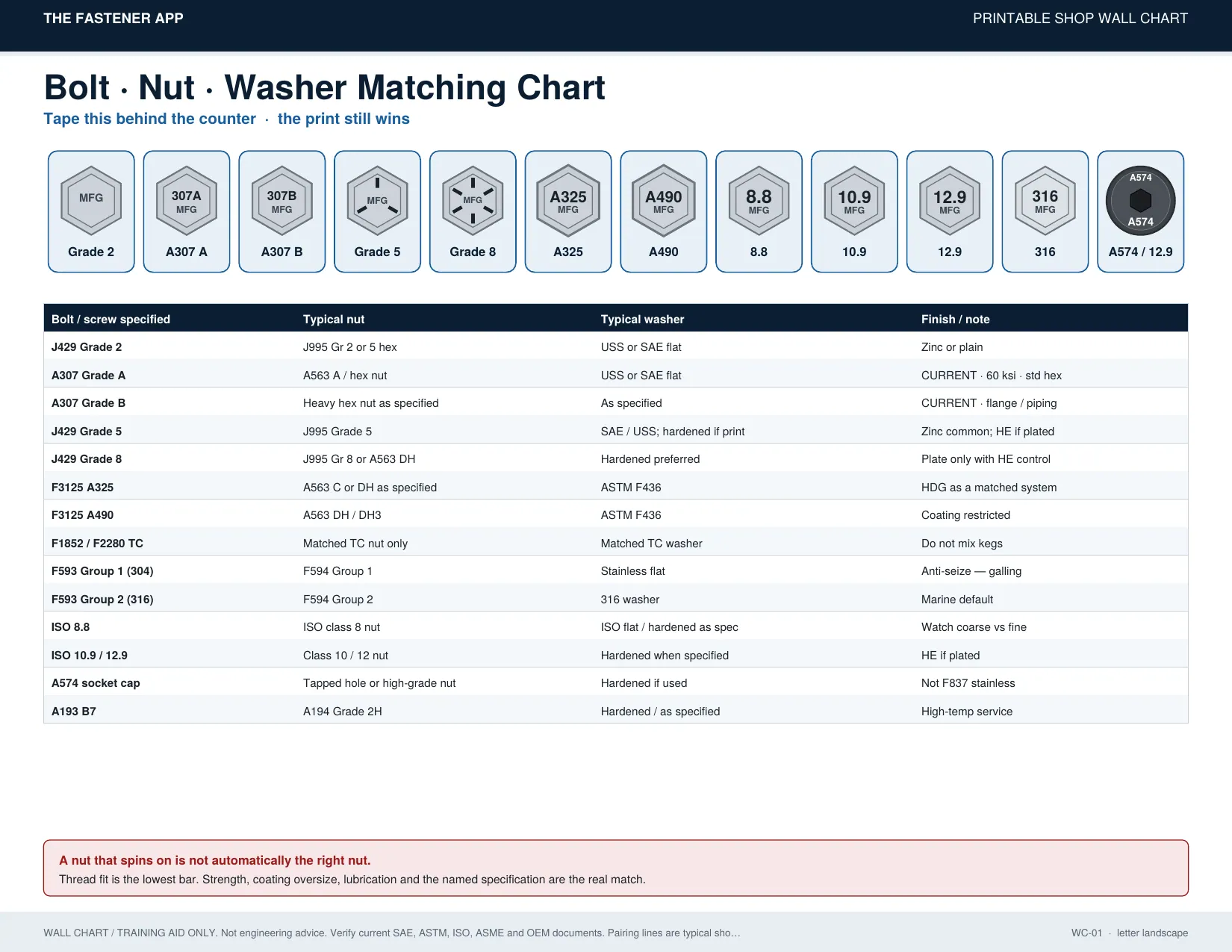
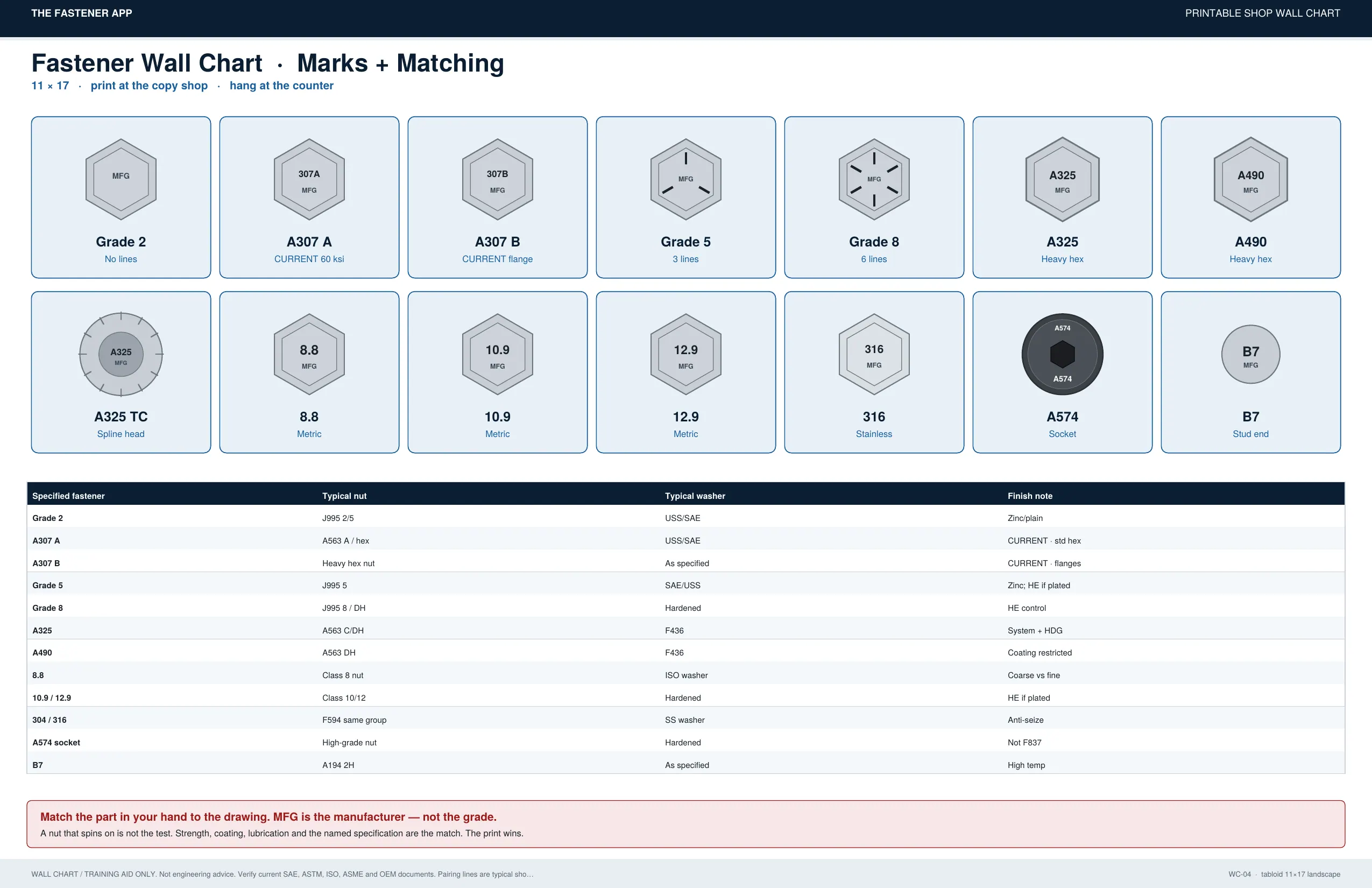
Bolt / Nut / Washer Matching Card
The usual nut and washer for each common bolt. Every line is a typical match; the drawing or specification governs.
 Report an error on this sheet
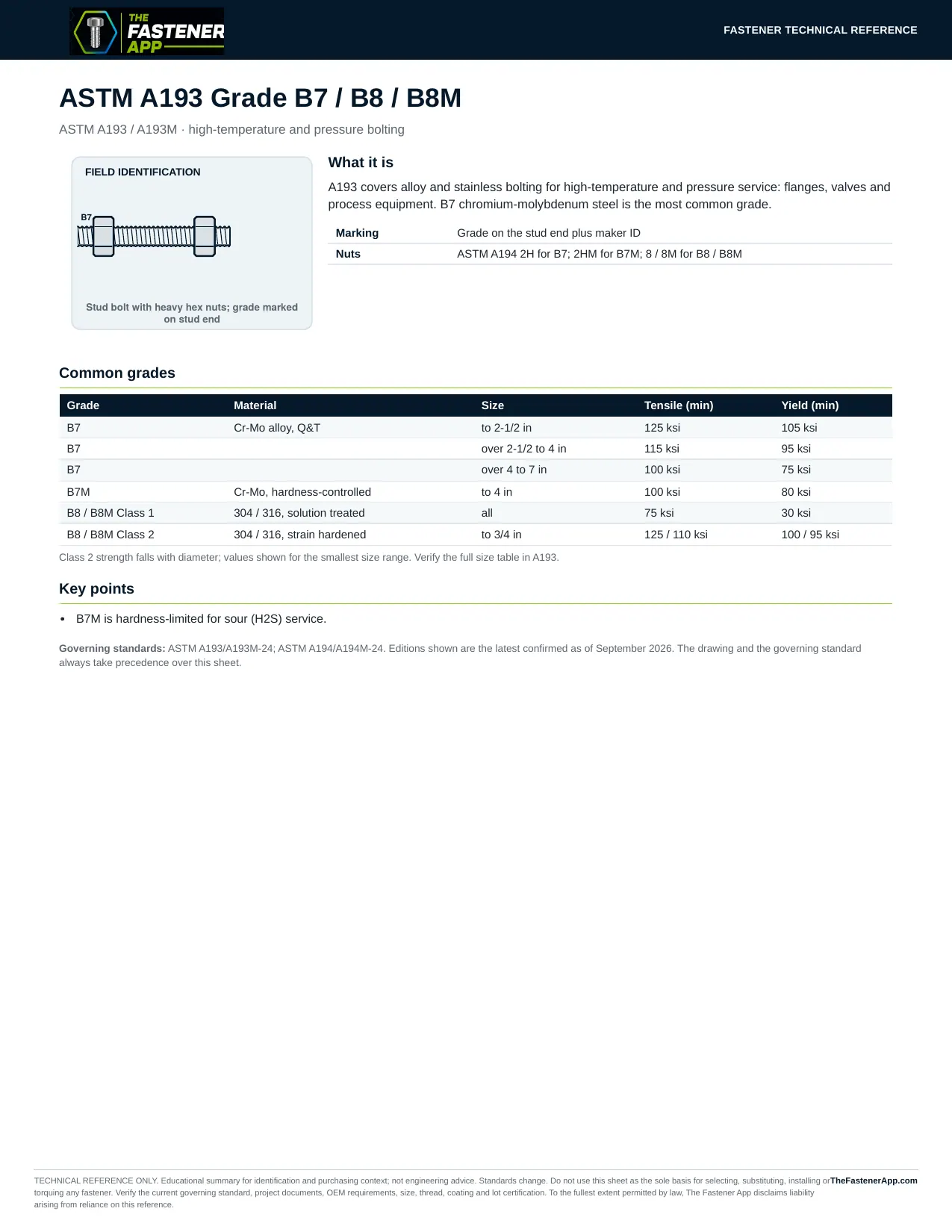
ASTM A193 Grade B7 / B8 / B8M
A193 covers alloy and stainless bolting for high-temperature and pressure service: flanges, valves and process equipment. B7 chromium-molybdenum steel is the most common grade.
 Report an error on this sheet
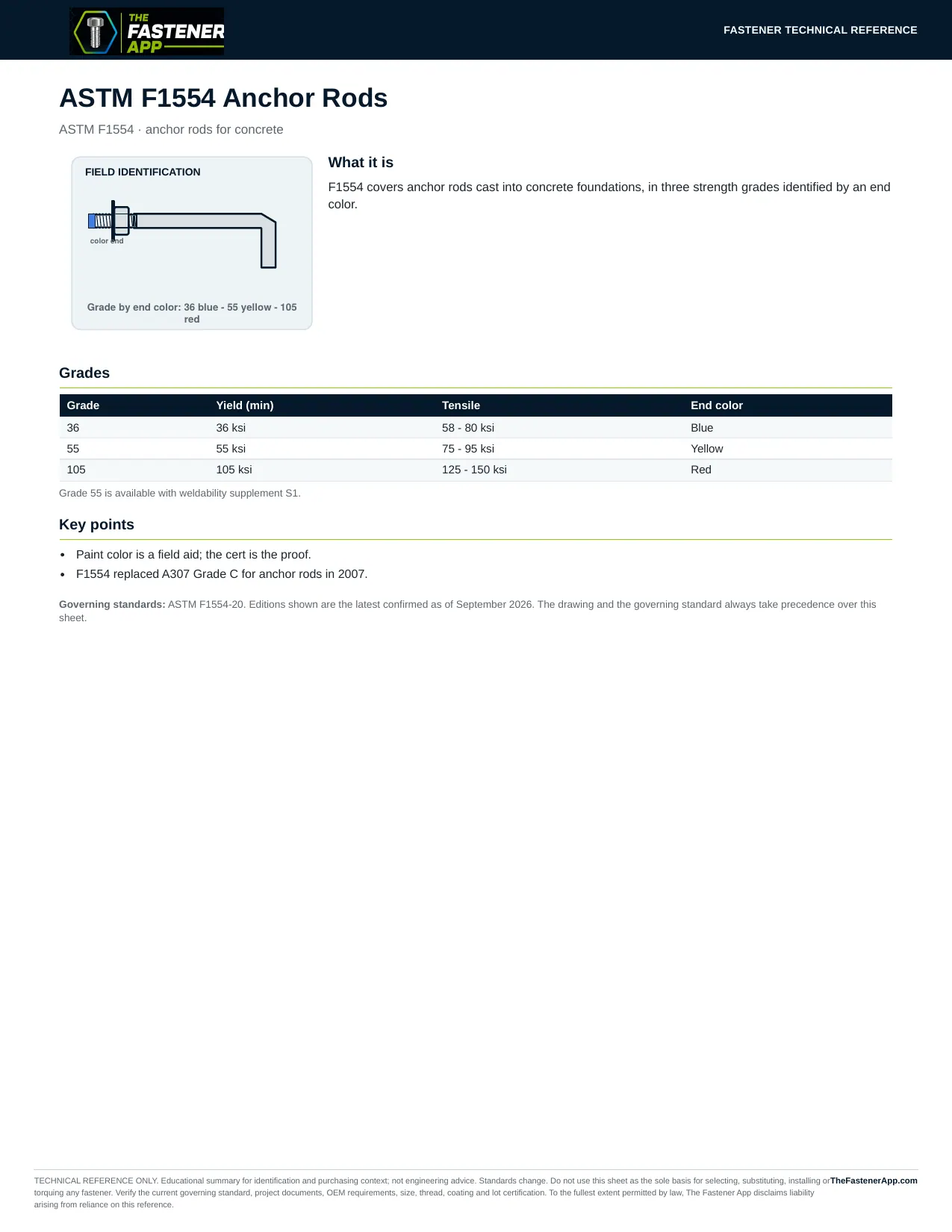
ASTM F1554 Anchor Rods
F1554 covers anchor rods cast into concrete foundations, in three strength grades identified by an end color.
 Report an error on this sheet
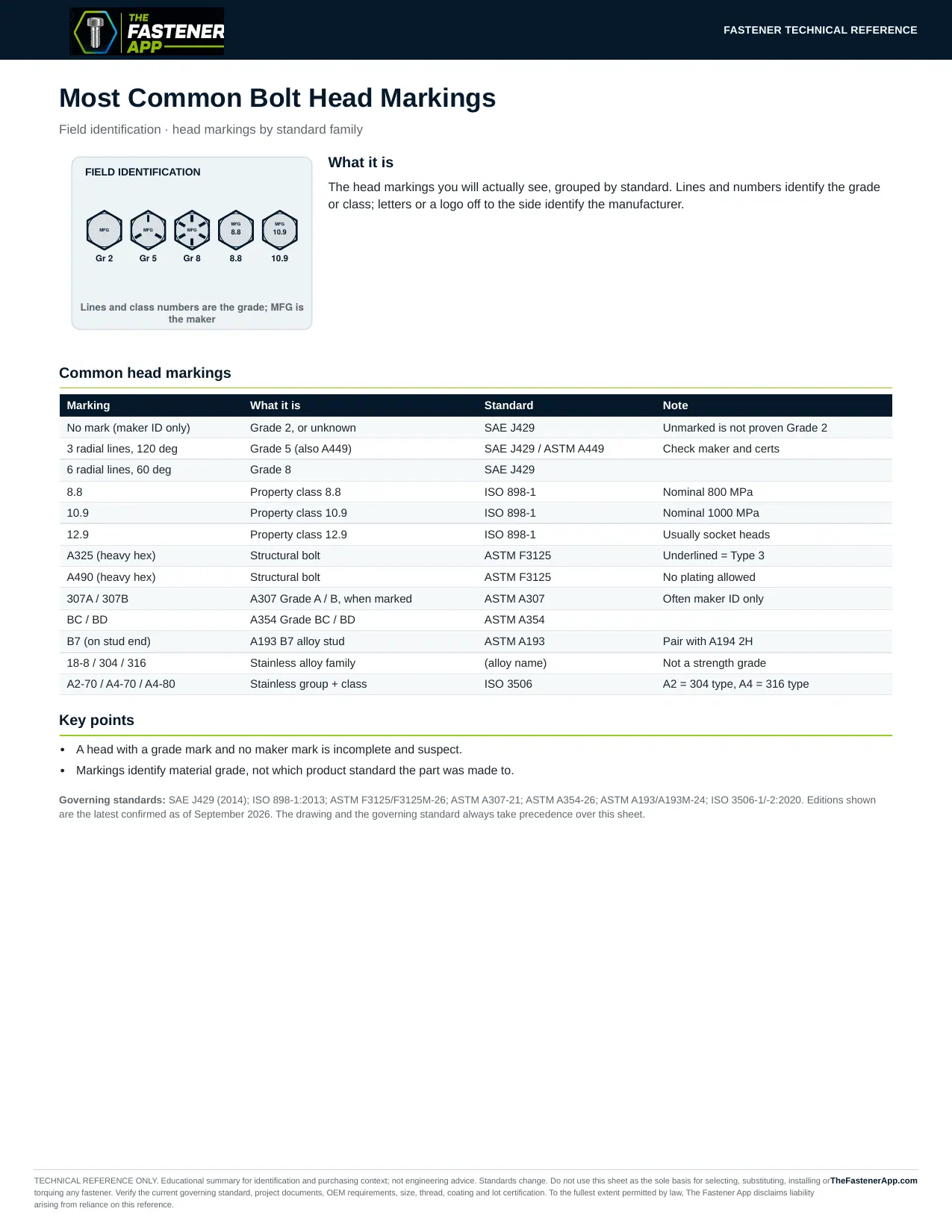
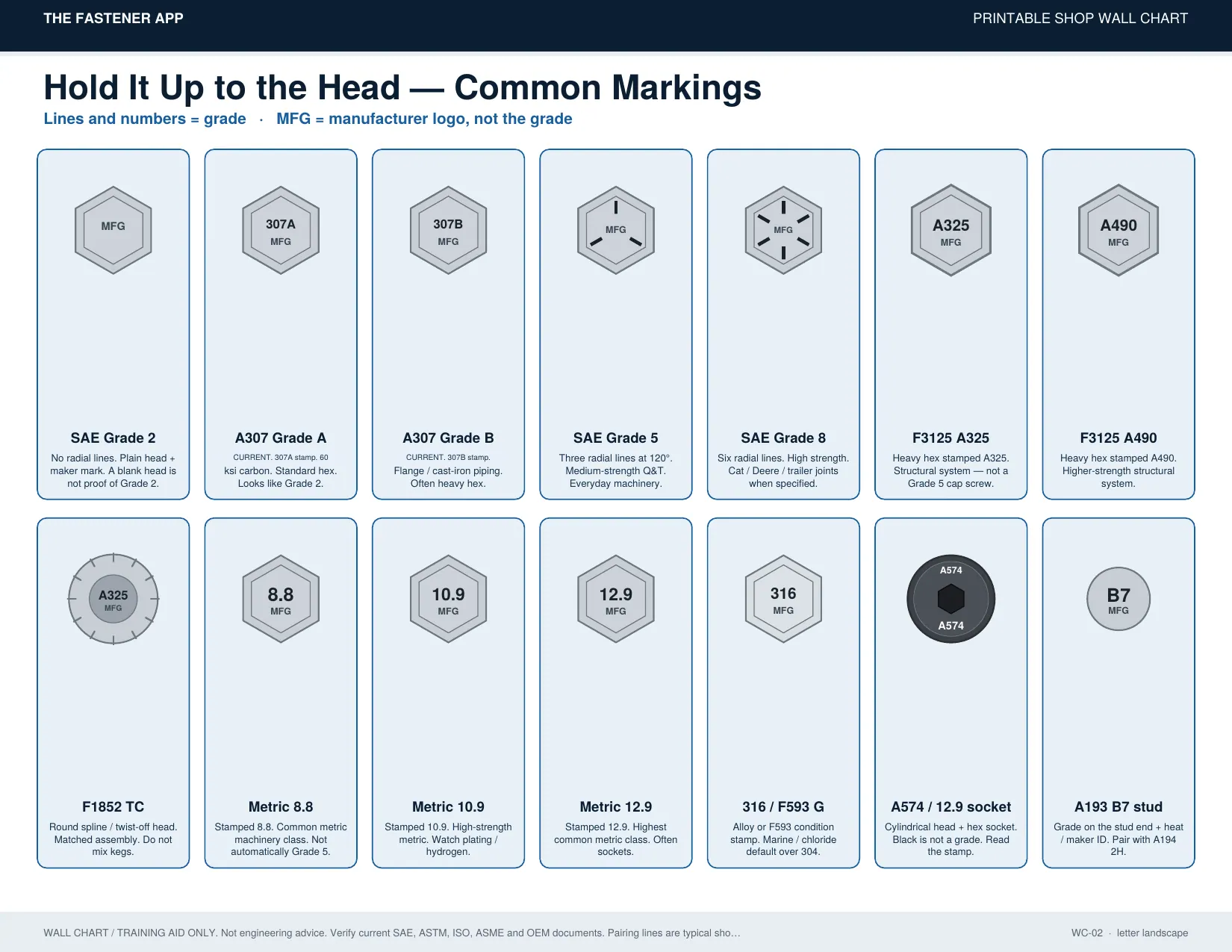
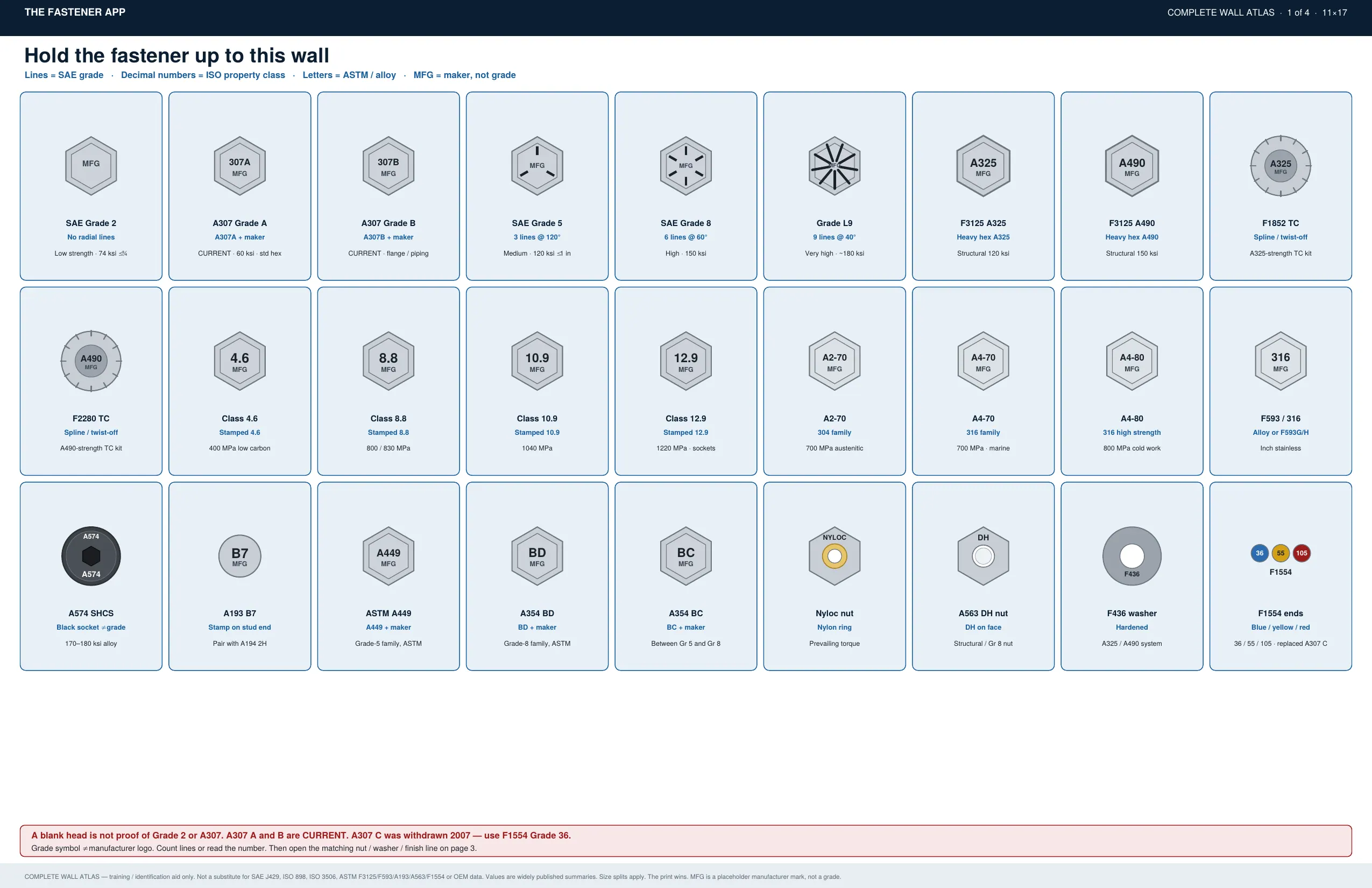
Most Common Bolt Head Markings
The head markings you will actually see, grouped by standard. Lines and numbers identify the grade or class; letters or a logo off to the side identify the manufacturer.
 Report an error on this sheet
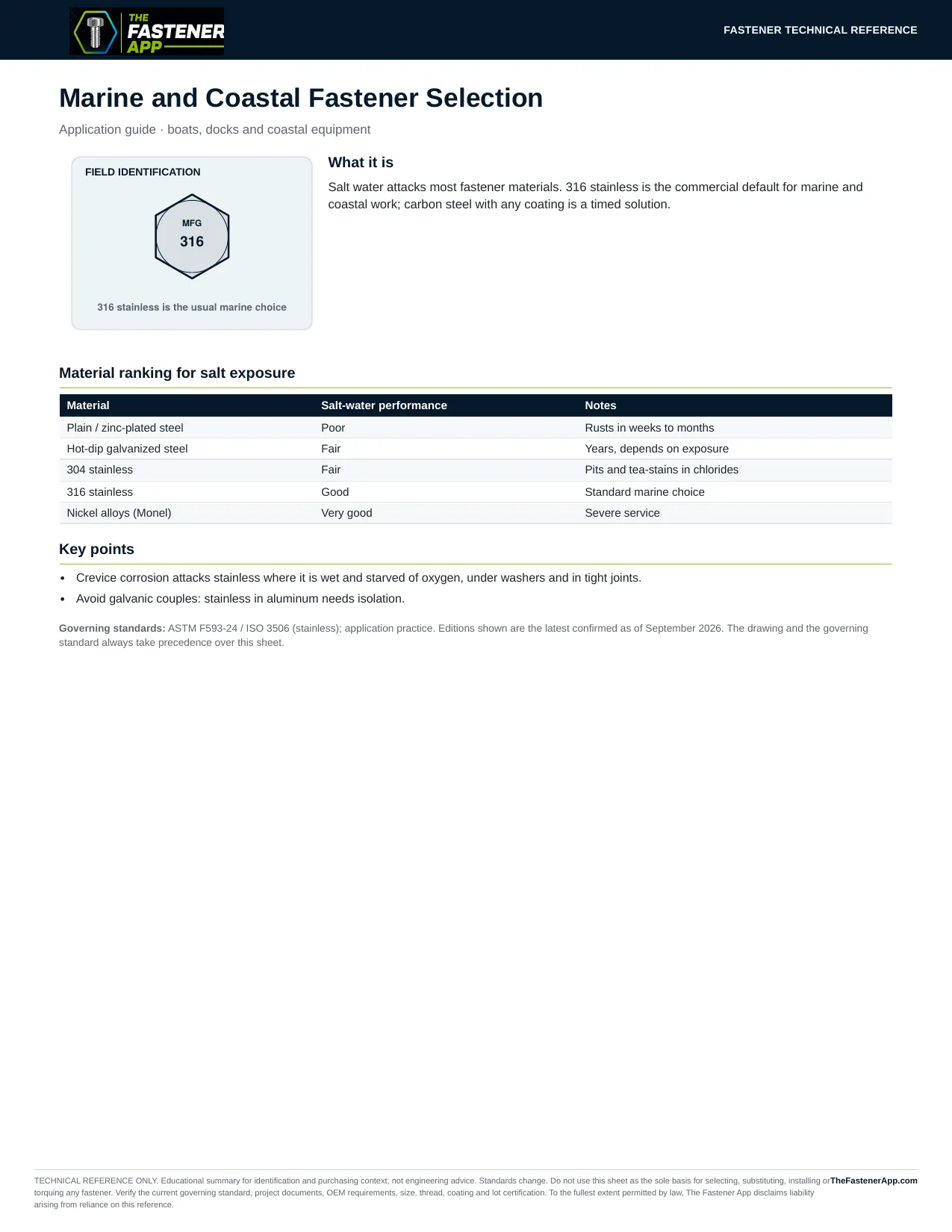
Marine and Coastal Fastener Selection
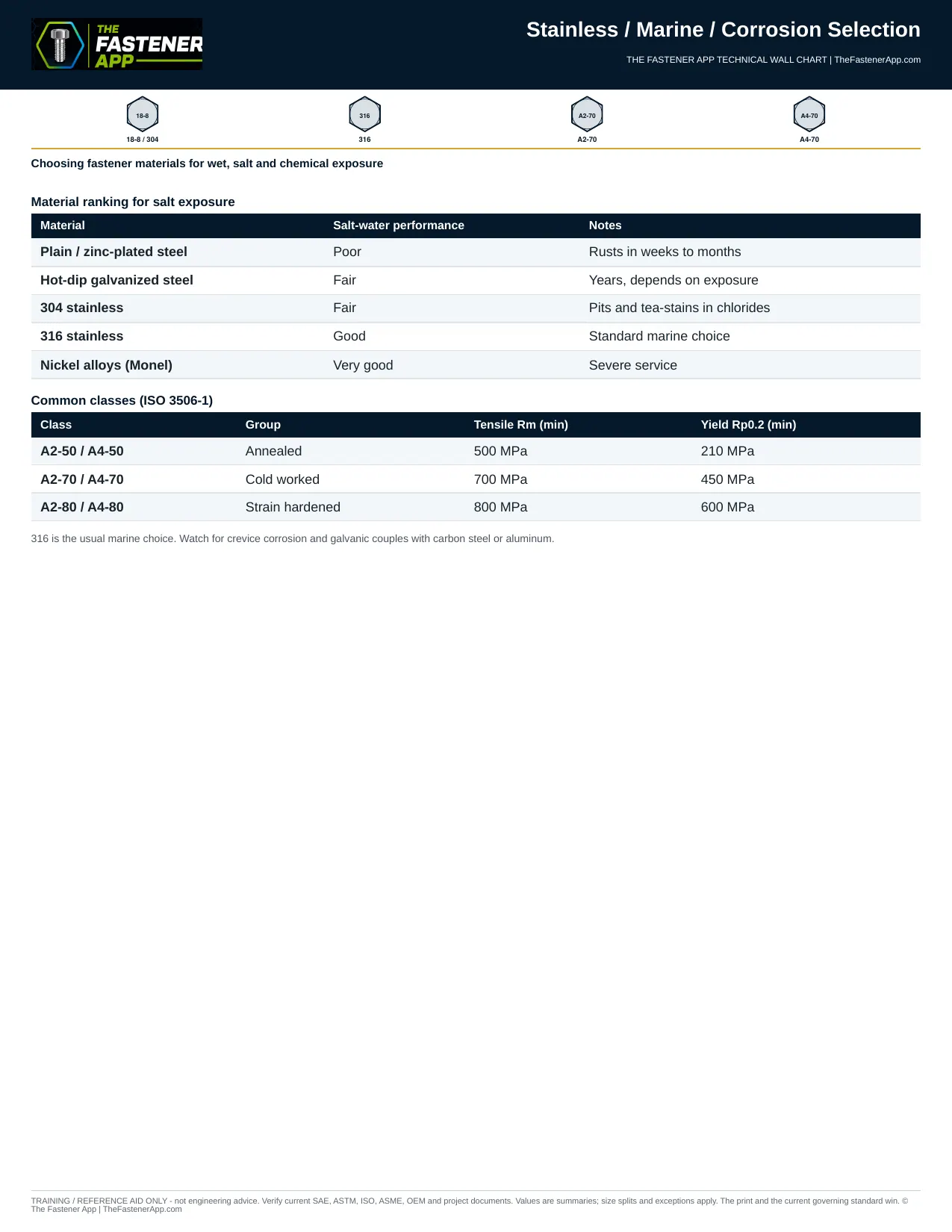
Salt water attacks most fastener materials. 316 stainless is the commercial default for marine and coastal work; carbon steel with any coating is a timed solution.
 Report an error on this sheet
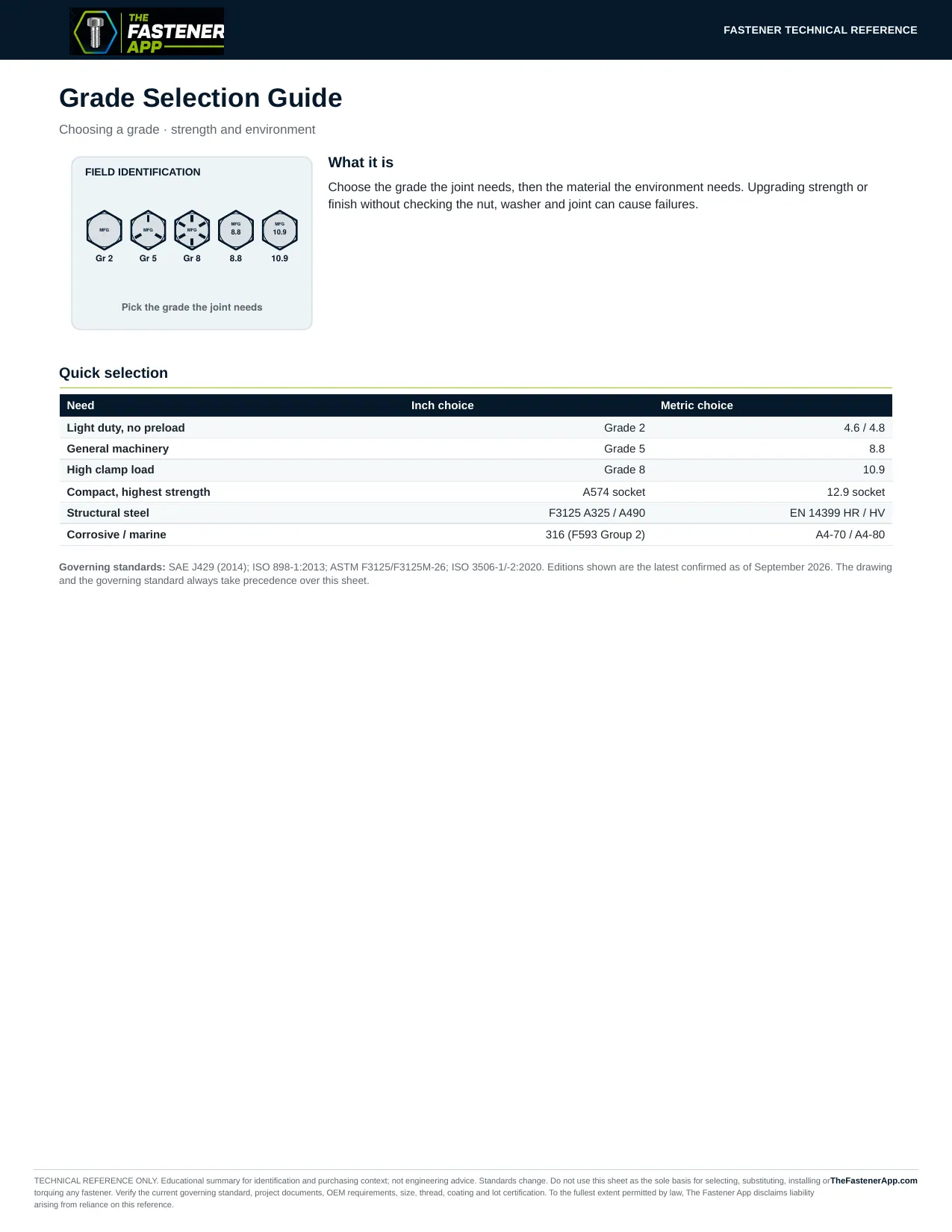
Grade Selection Guide
Choose the grade the joint needs, then the material the environment needs. Upgrading strength or finish without checking the nut, washer and joint can cause failures.
 Report an error on this sheet
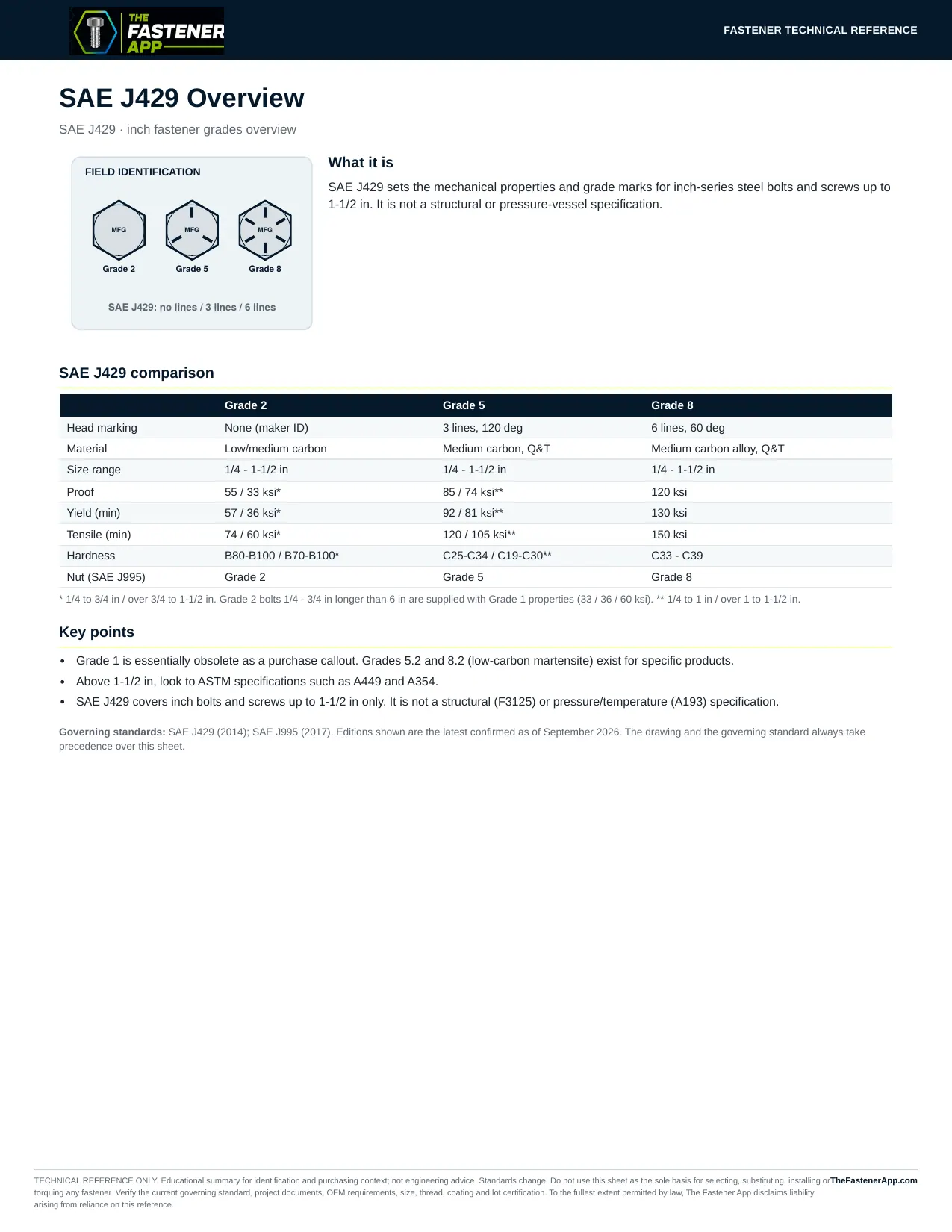
SAE J429 Overview
SAE J429 sets the mechanical properties and grade marks for inch-series steel bolts and screws up to 1-1/2 in. It is not a structural or pressure-vessel specification.
 Report an error on this sheet
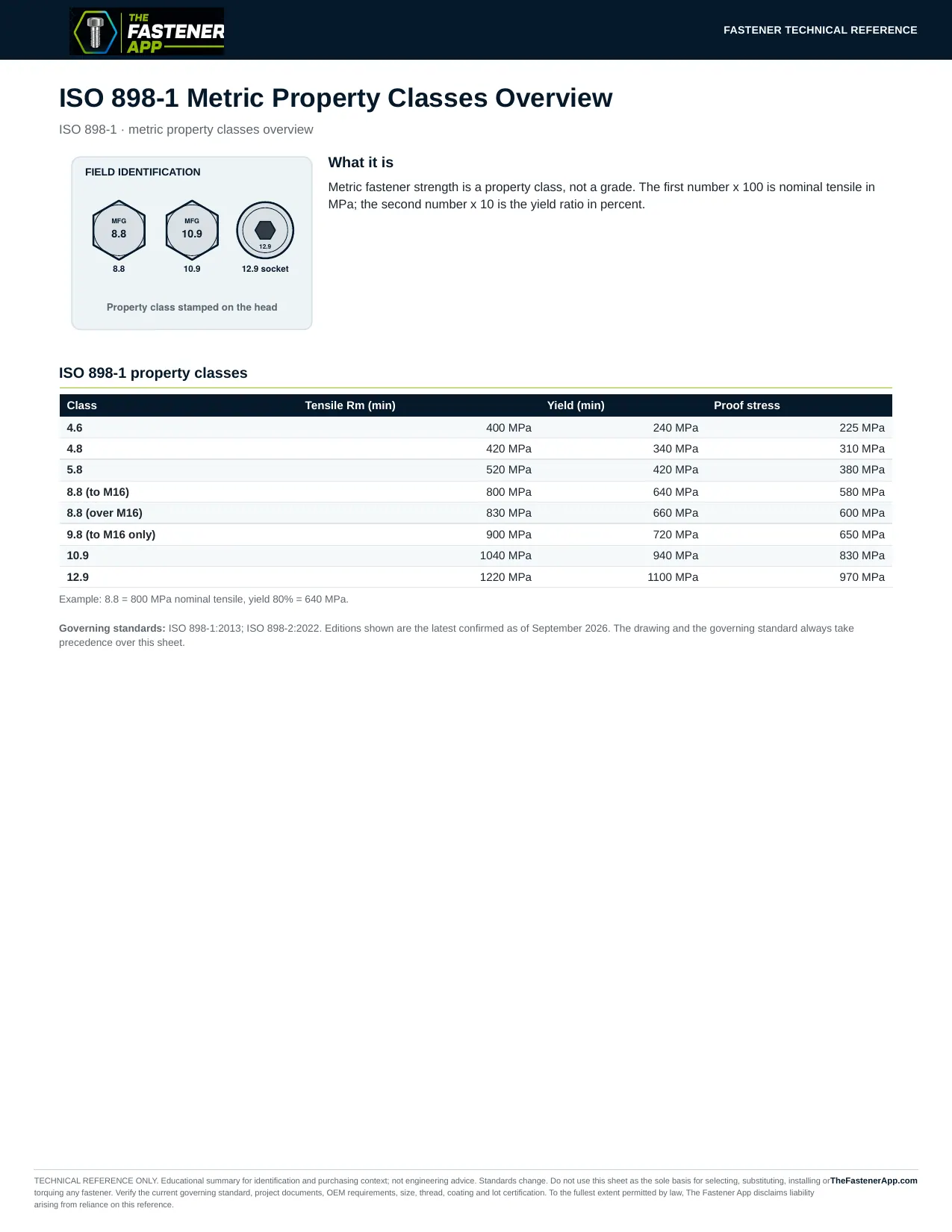
ISO 898-1 Metric Property Classes Overview
Metric fastener strength is a property class, not a grade. The first number x 100 is nominal tensile in MPa; the second number x 10 is the yield ratio in percent.
 Report an error on this sheet
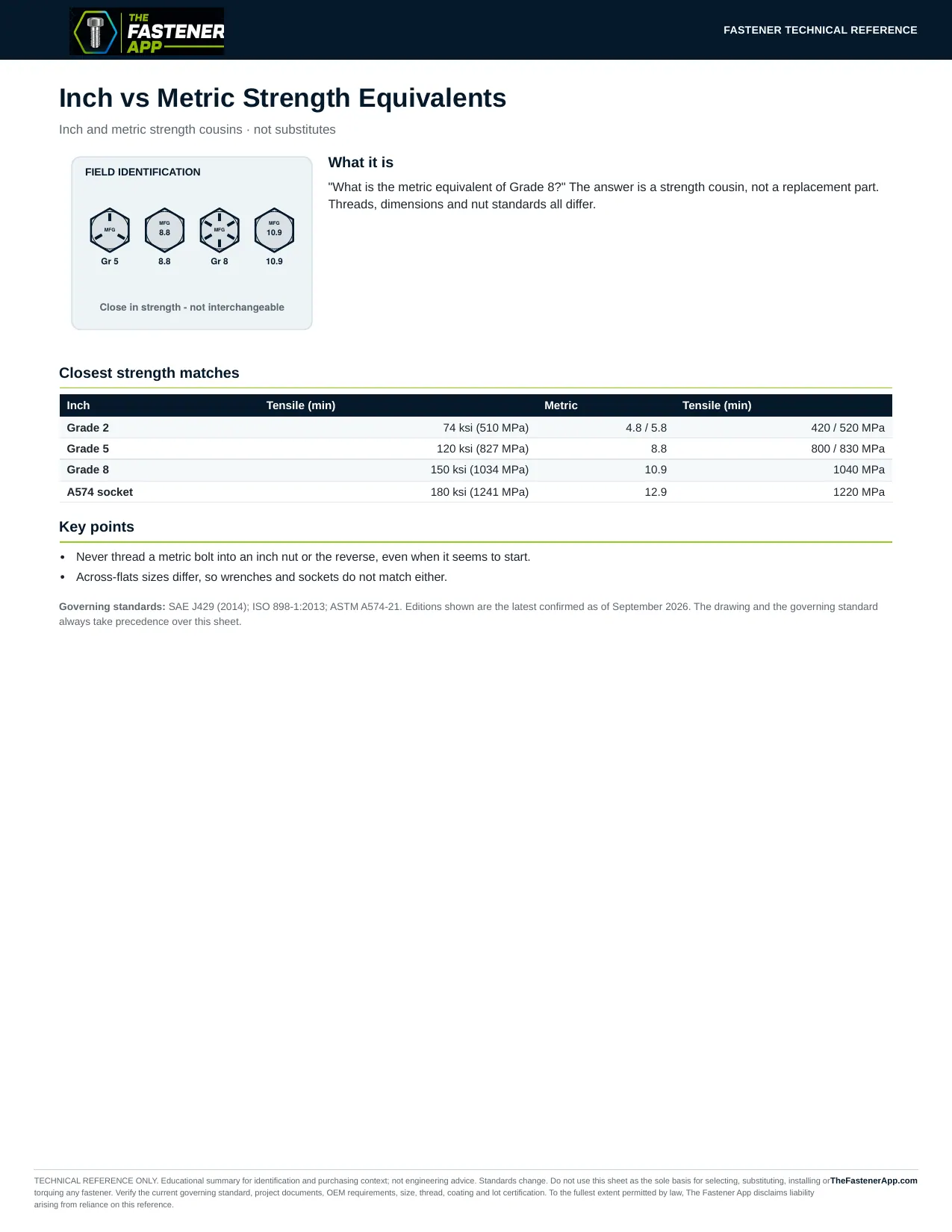
Inch vs Metric Strength Equivalents
"What is the metric equivalent of Grade 8?" The answer is a strength cousin, not a replacement part. Threads, dimensions and nut standards all differ.
 Report an error on this sheet
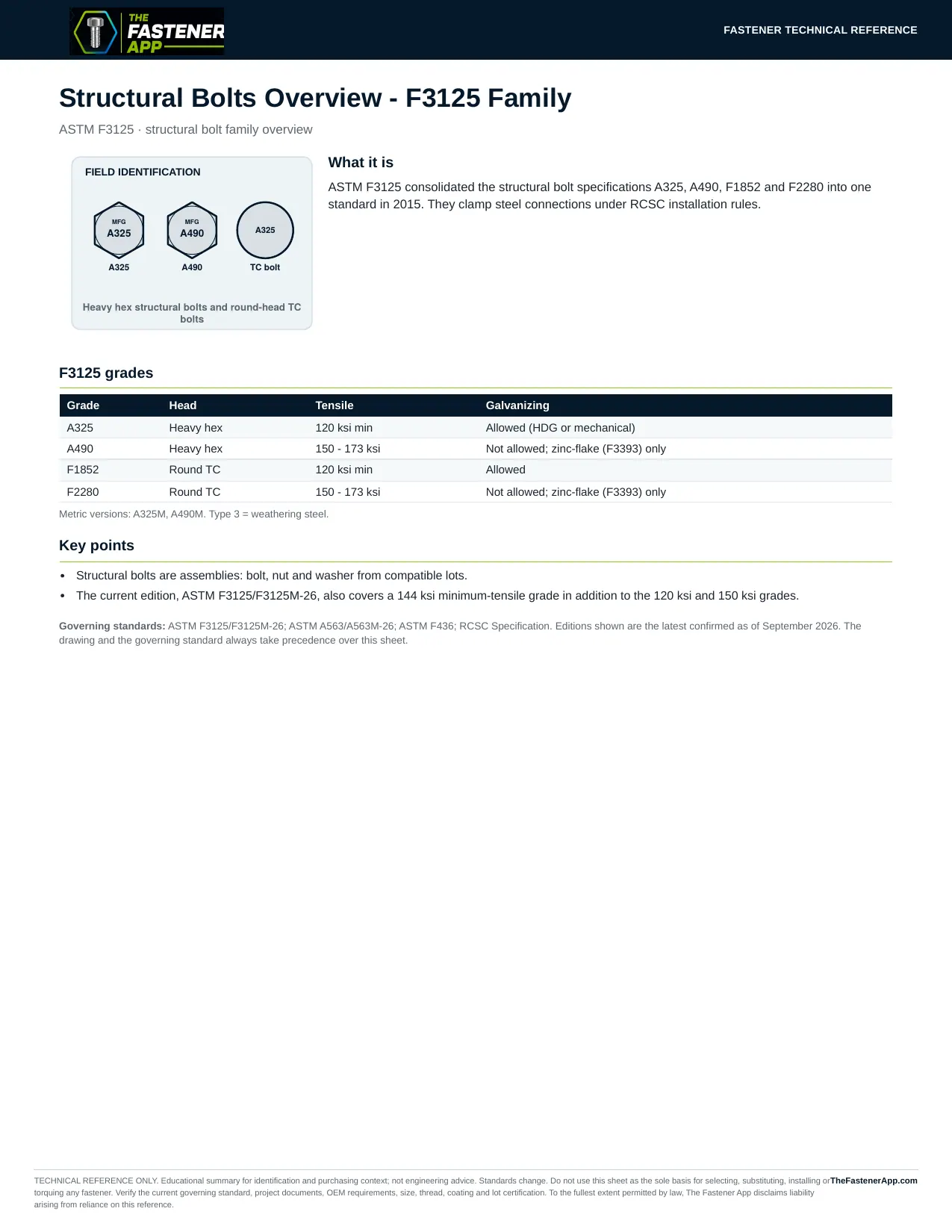
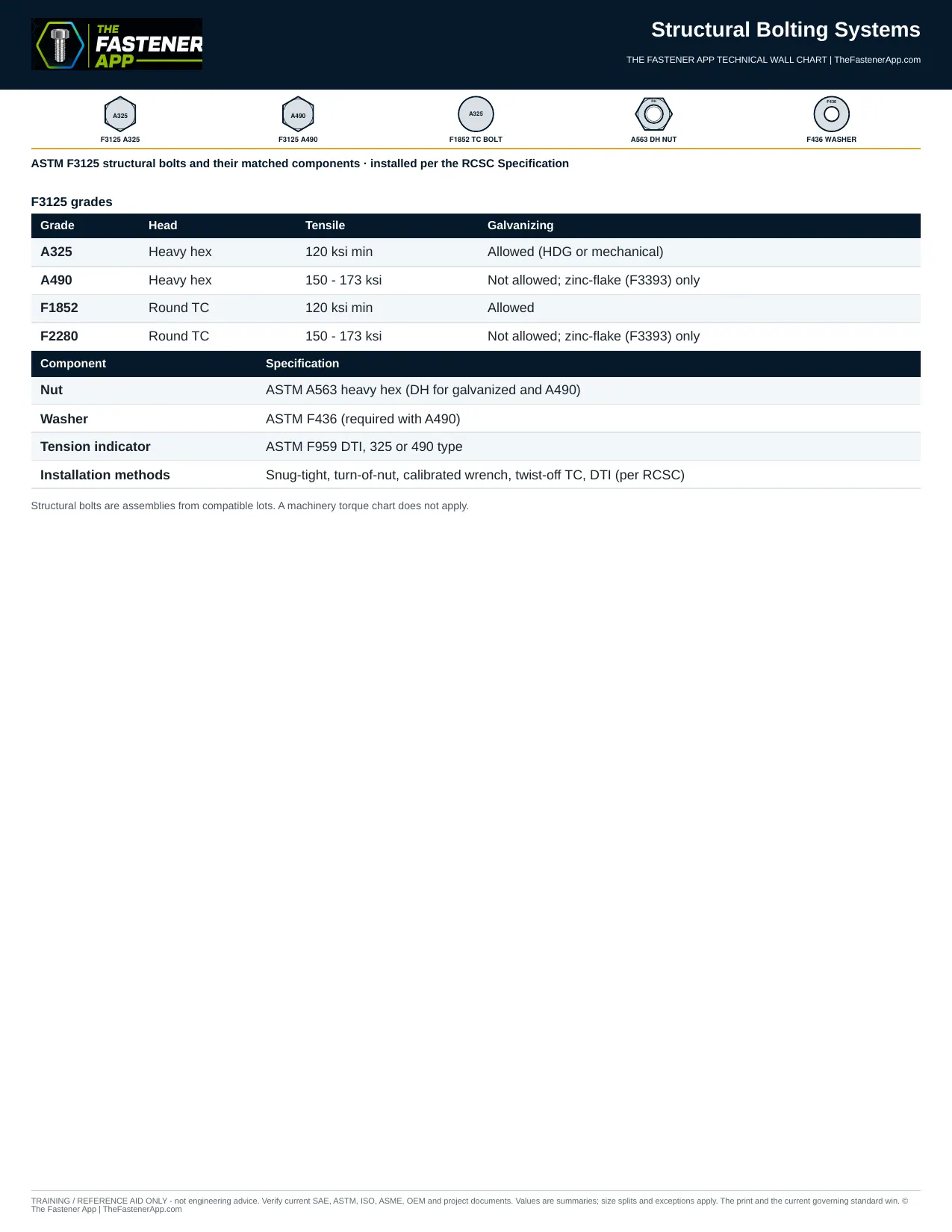
Structural Bolts Overview - F3125 Family
ASTM F3125 consolidated the structural bolt specifications A325, A490, F1852 and F2280 into one standard in 2015. They clamp steel connections under RCSC installation rules.
 Report an error on this sheet
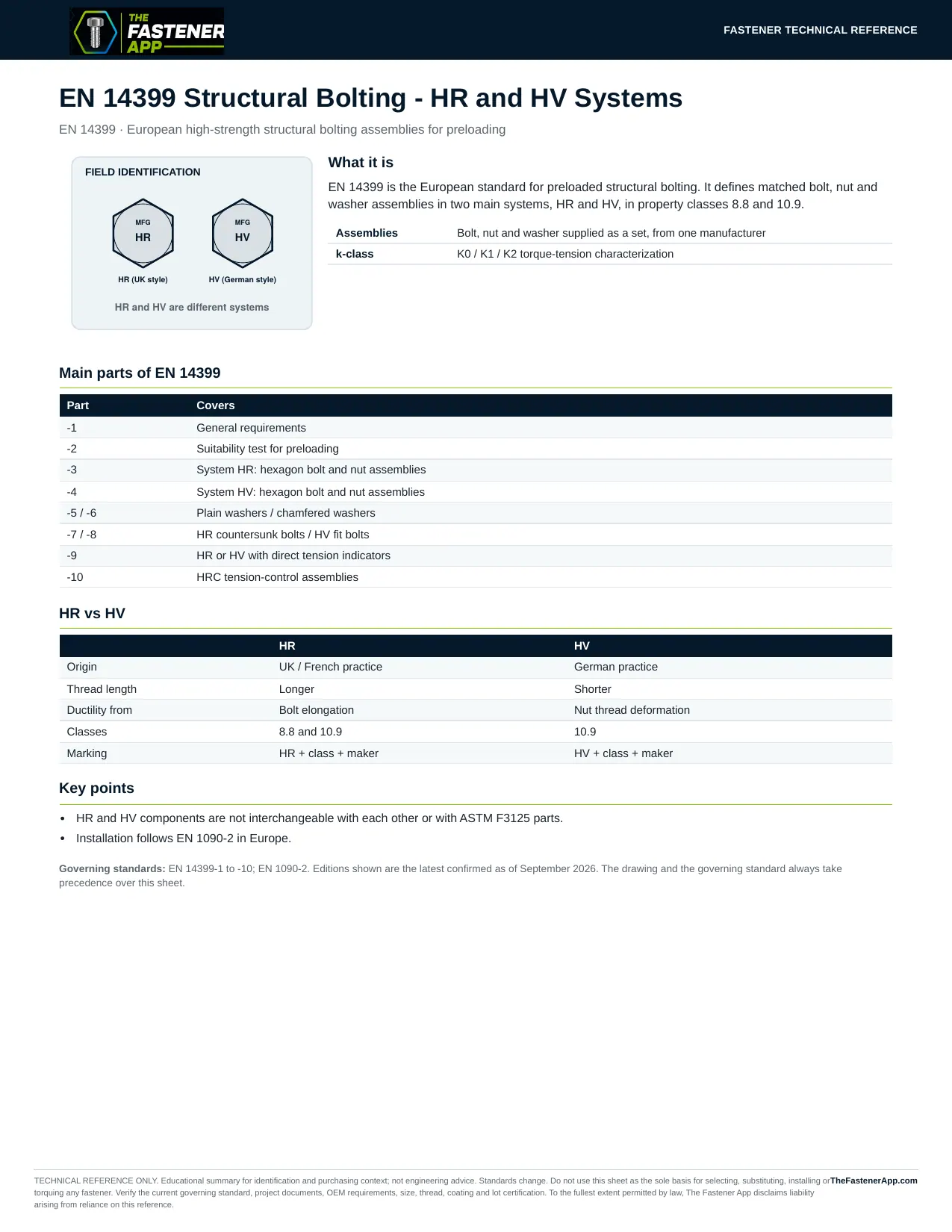
EN 14399 Structural Bolting - HR and HV Systems
EN 14399 is the European standard for preloaded structural bolting. It defines matched bolt, nut and washer assemblies in two main systems, HR and HV, in property classes 8.8 and 10.9.
 Report an error on this sheet
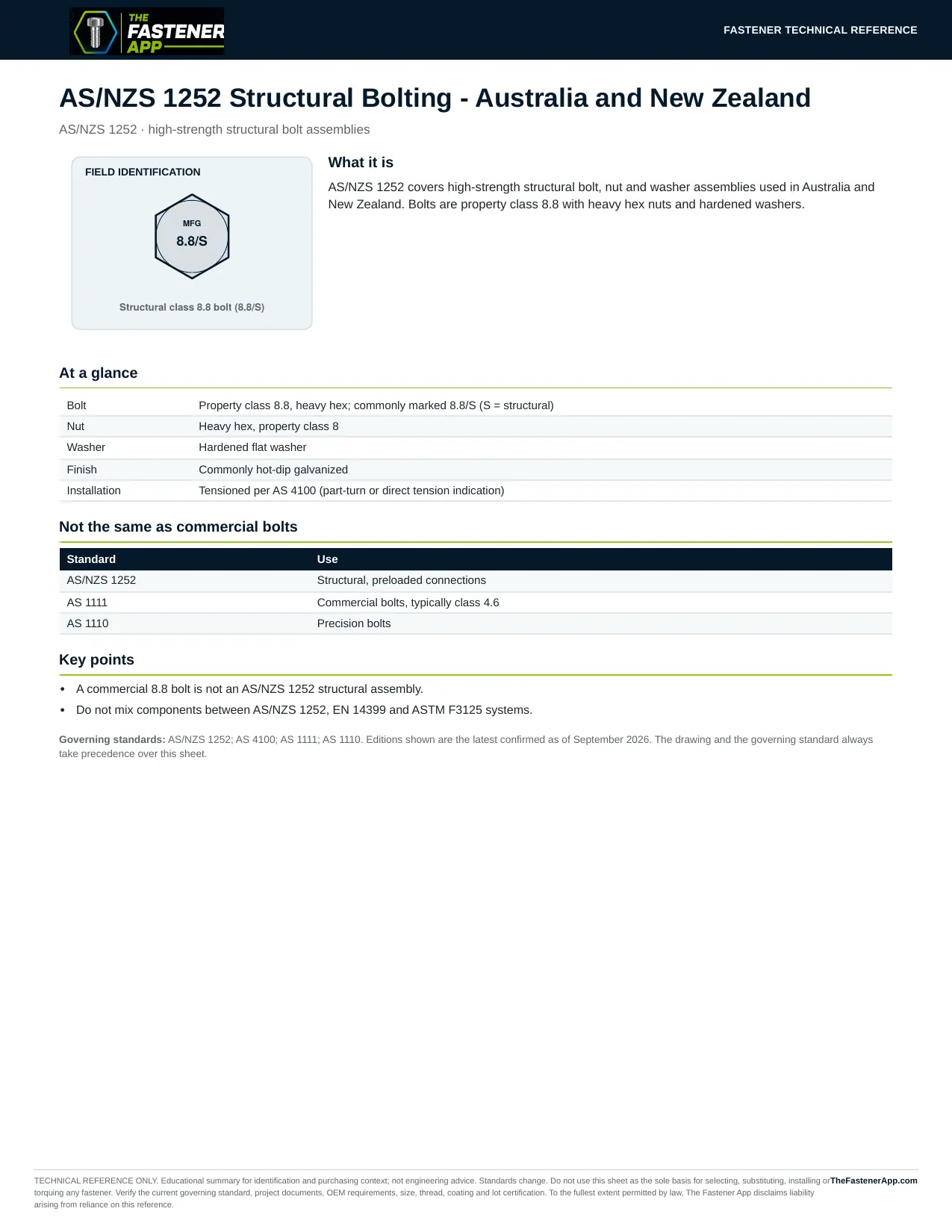
AS/NZS 1252 Structural Bolting - Australia and New Zealand
AS/NZS 1252 covers high-strength structural bolt, nut and washer assemblies used in Australia and New Zealand. Bolts are property class 8.8 with heavy hex nuts and hardened washers.
 Report an error on this sheet
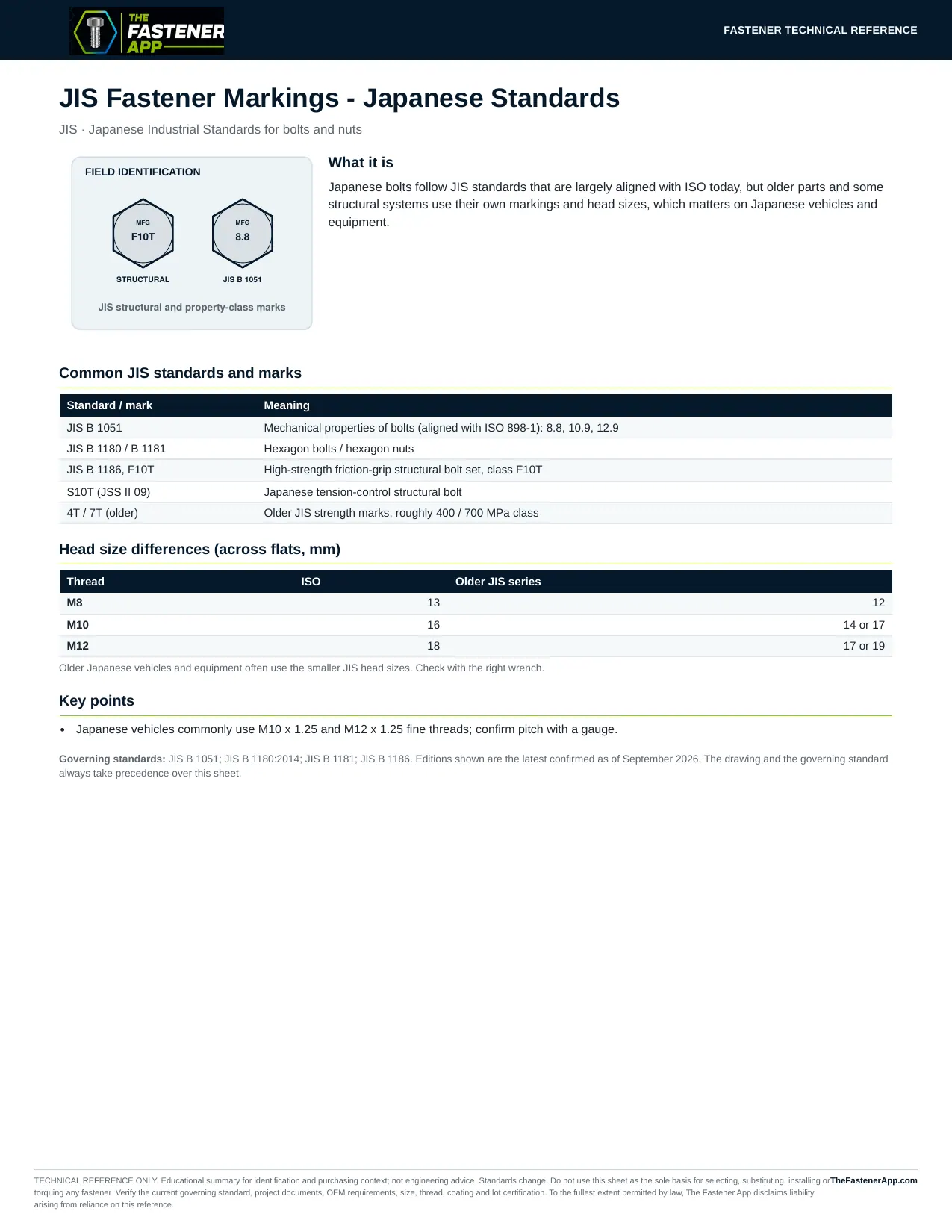
JIS Fastener Markings - Japanese Standards
Japanese bolts follow JIS standards that are largely aligned with ISO today, but older parts and some structural systems use their own markings and head sizes, which matters on Japanese vehicles and equipment.
 Report an error on this sheet
ASTM A194 High-Temperature Nuts
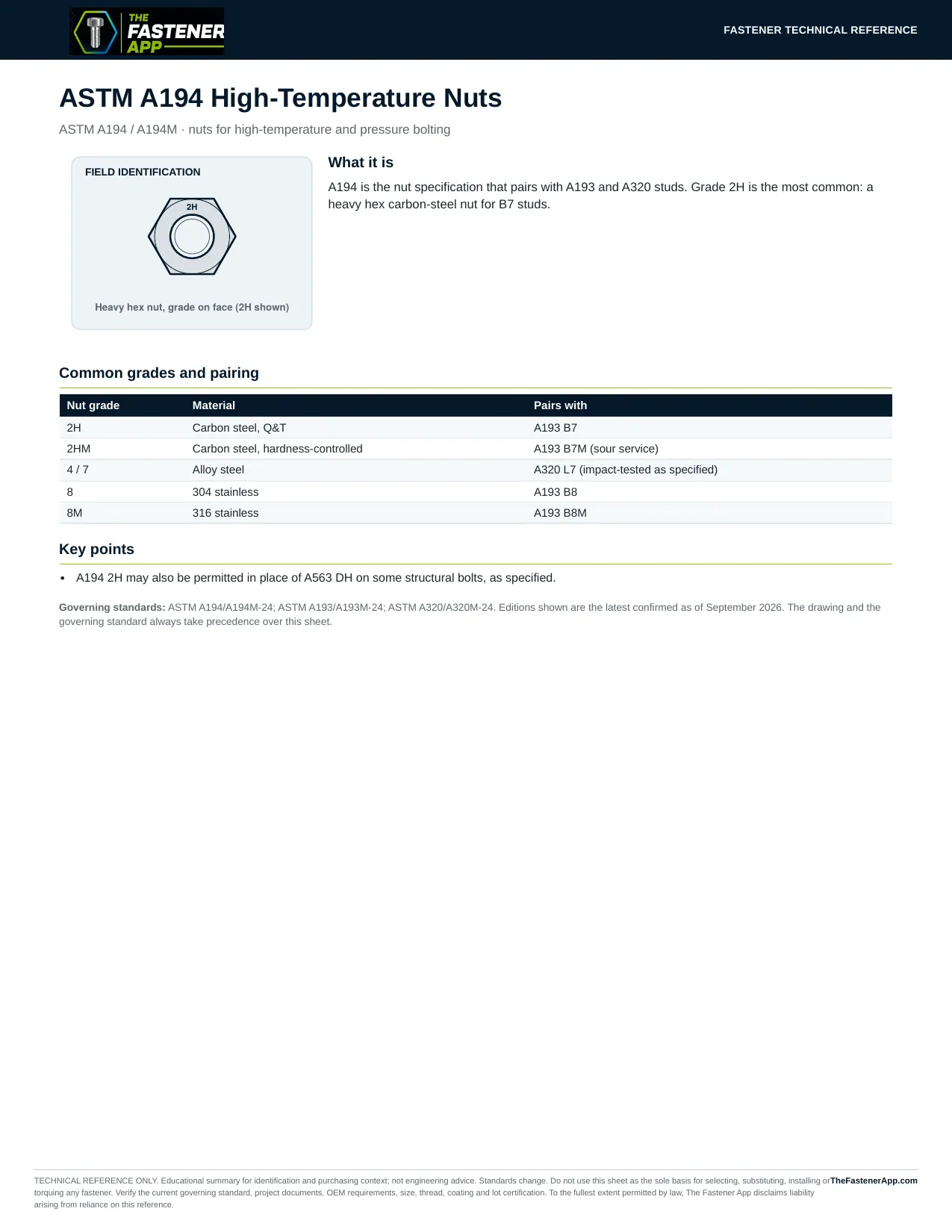
A194 is the nut specification that pairs with A193 and A320 studs. Grade 2H is the most common: a heavy hex carbon-steel nut for B7 studs.
 Report an error on this sheet
ASTM F844 / USS / SAE Flat Washers
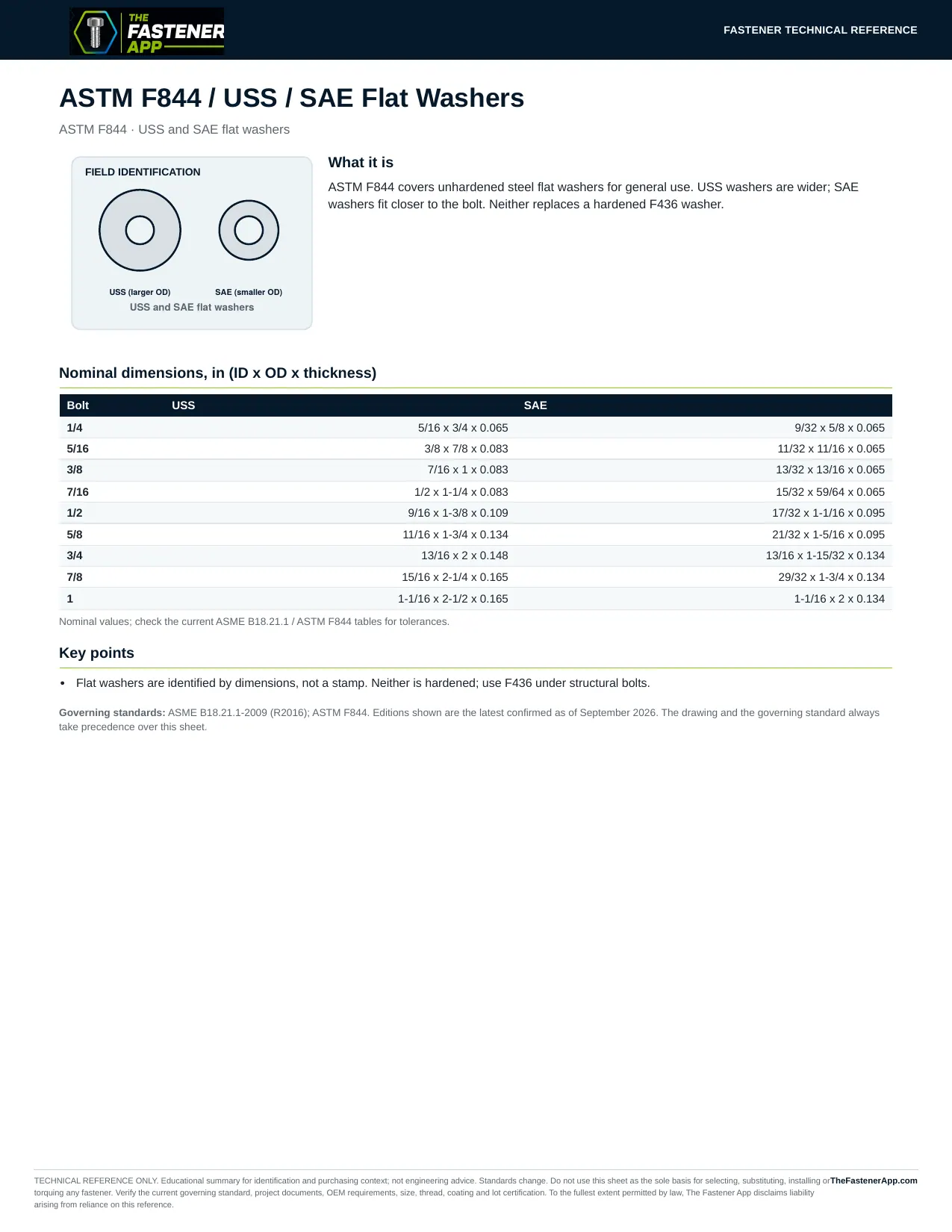
ASTM F844 covers unhardened steel flat washers for general use. USS washers are wider; SAE washers fit closer to the bolt. Neither replaces a hardened F436 washer.
 Report an error on this sheet
ASTM F959 Direct Tension Indicator Washers
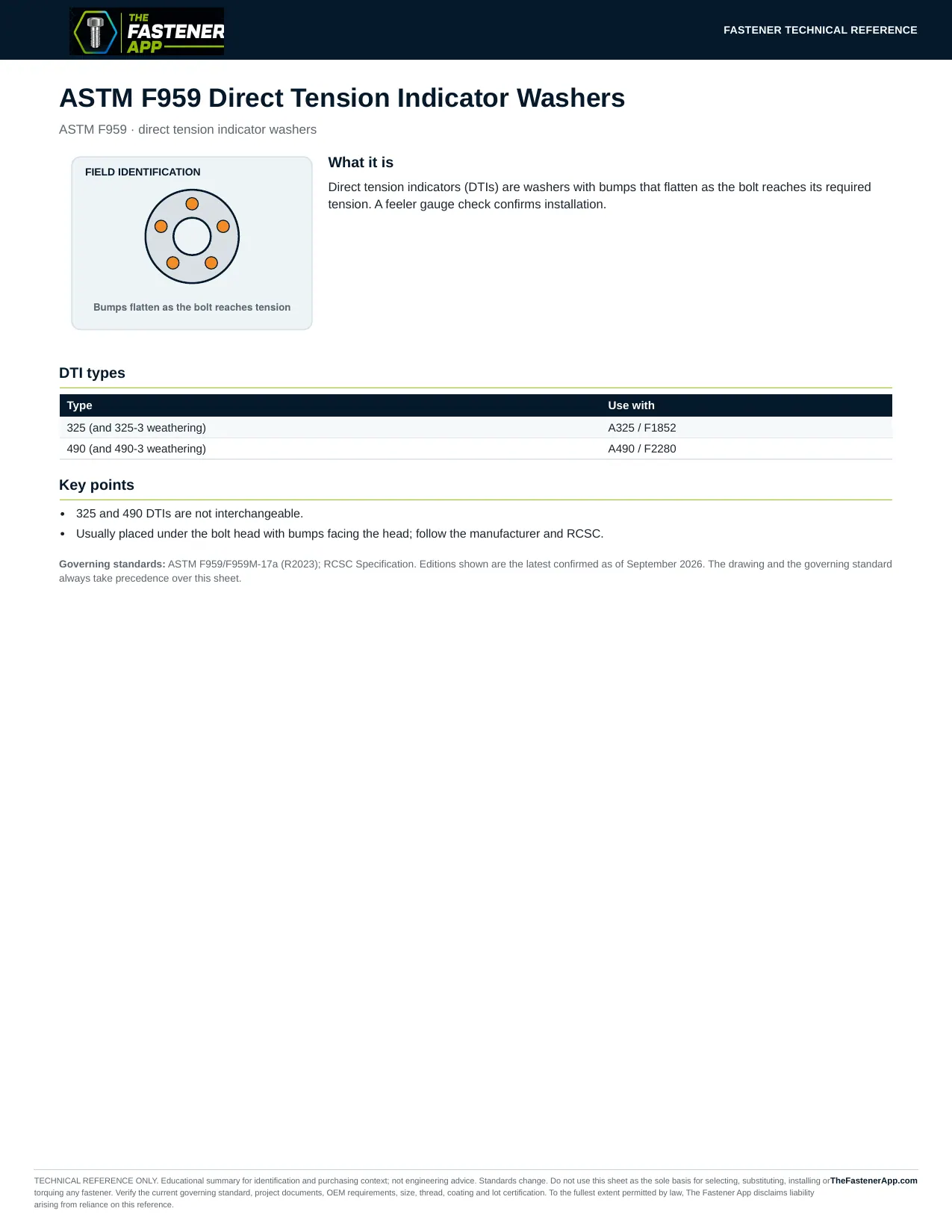
Direct tension indicators (DTIs) are washers with bumps that flatten as the bolt reaches its required tension. A feeler gauge check confirms installation.
 Report an error on this sheet
ASTM A320 Low-Temperature Bolting
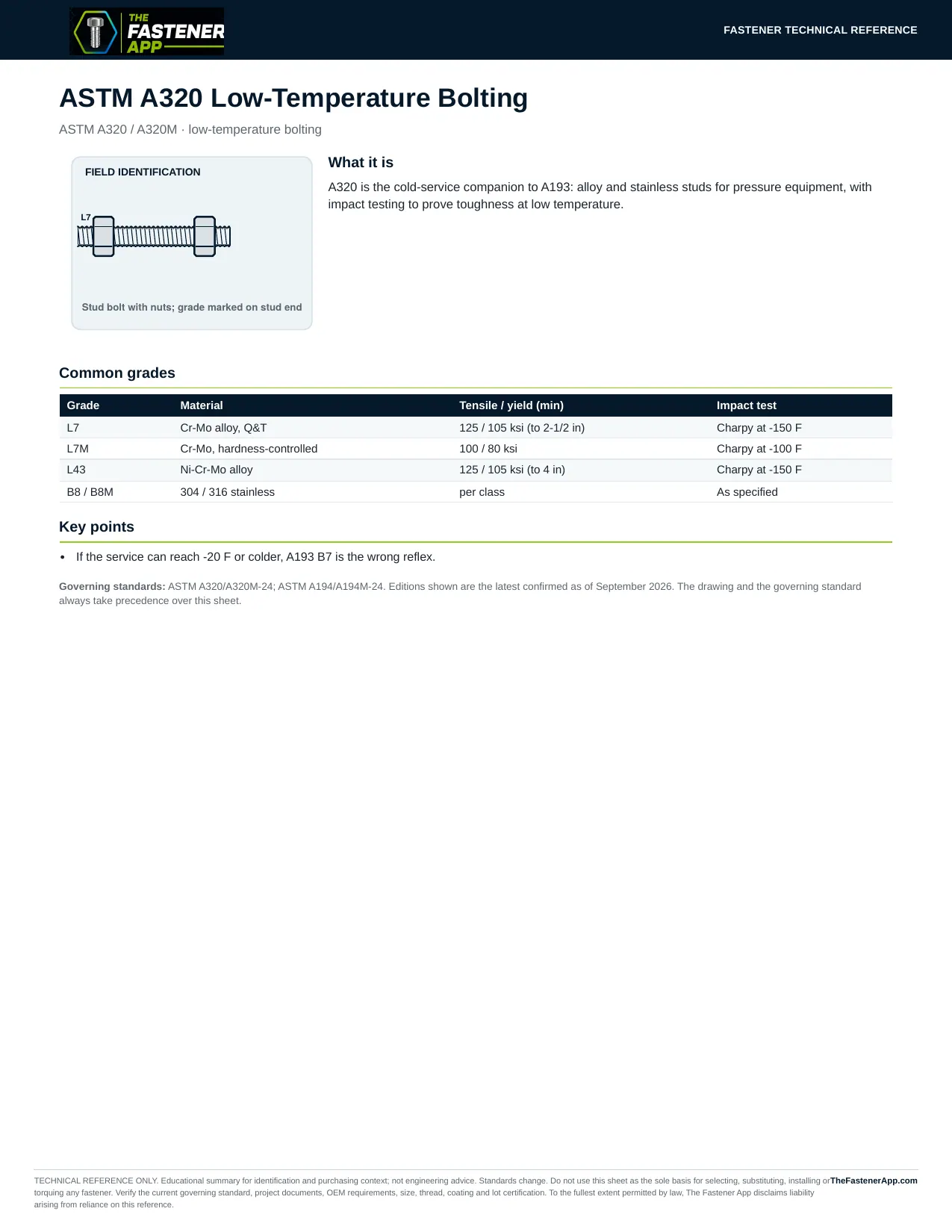
A320 is the cold-service companion to A193: alloy and stainless studs for pressure equipment, with impact testing to prove toughness at low temperature.
 Report an error on this sheet
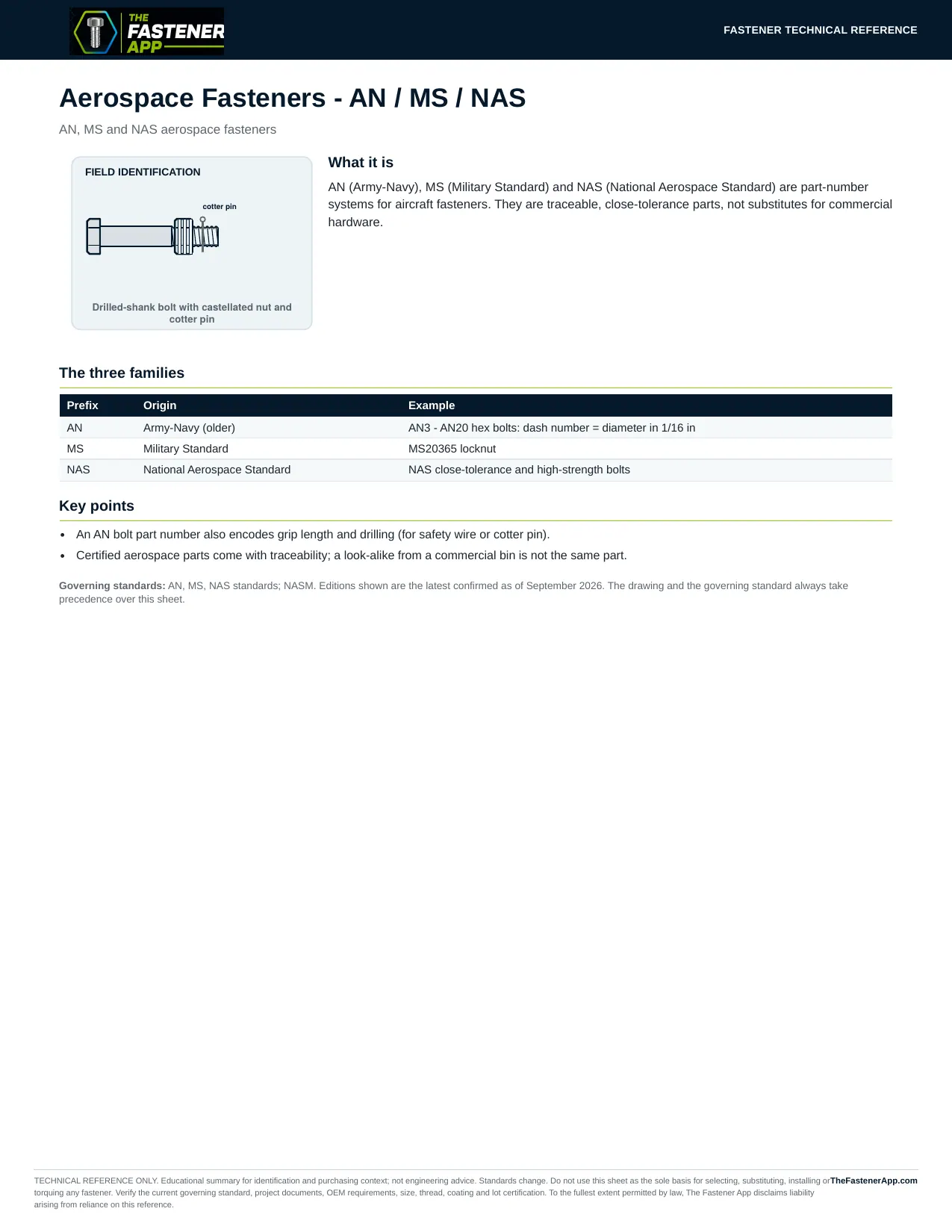
Aerospace Fasteners - AN / MS / NAS
AN (Army-Navy), MS (Military Standard) and NAS (National Aerospace Standard) are part-number systems for aircraft fasteners. They are traceable, close-tolerance parts, not substitutes for commercial hardware.
 Report an error on this sheet
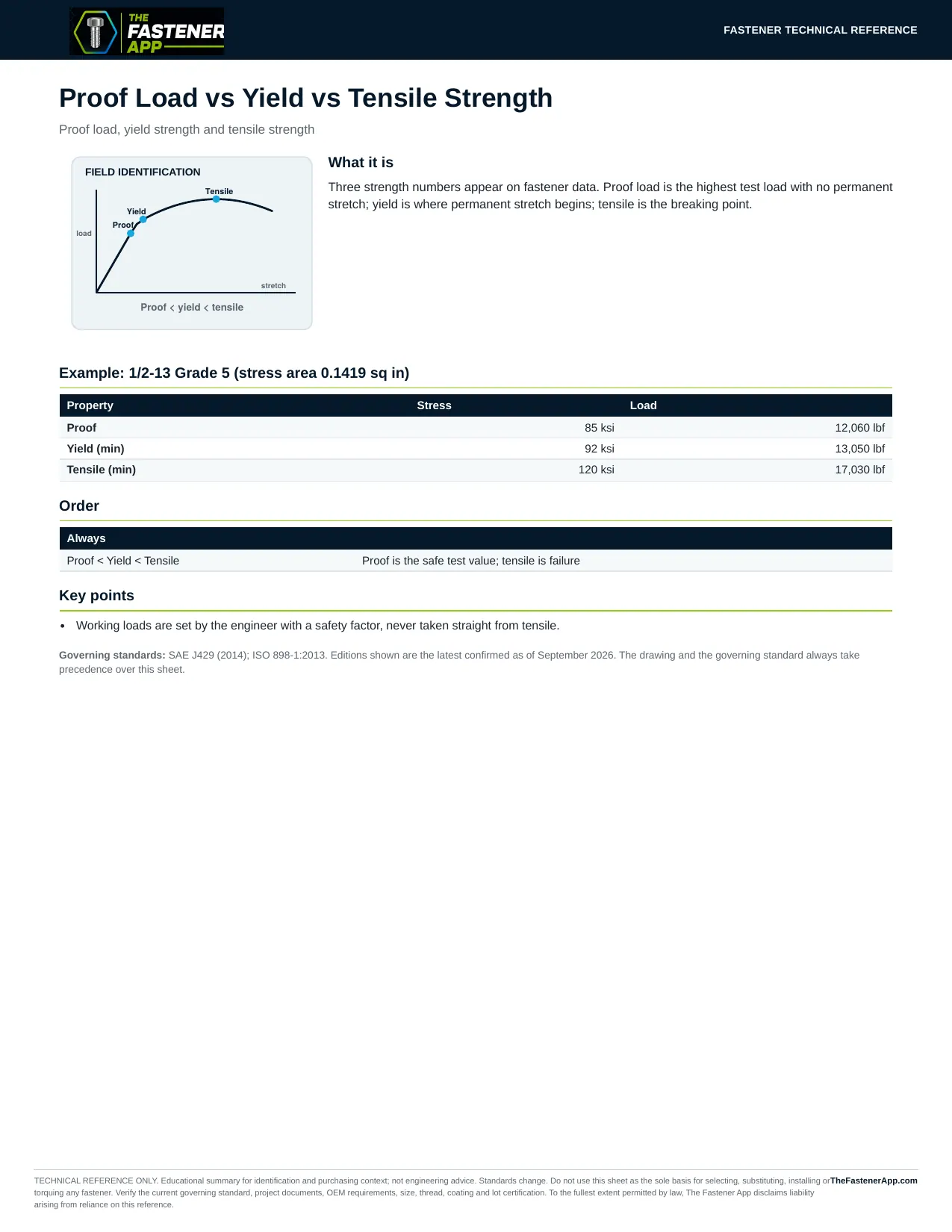
Proof Load vs Yield vs Tensile Strength
Three strength numbers appear on fastener data. Proof load is the highest test load with no permanent stretch; yield is where permanent stretch begins; tensile is the breaking point.
 Report an error on this sheet
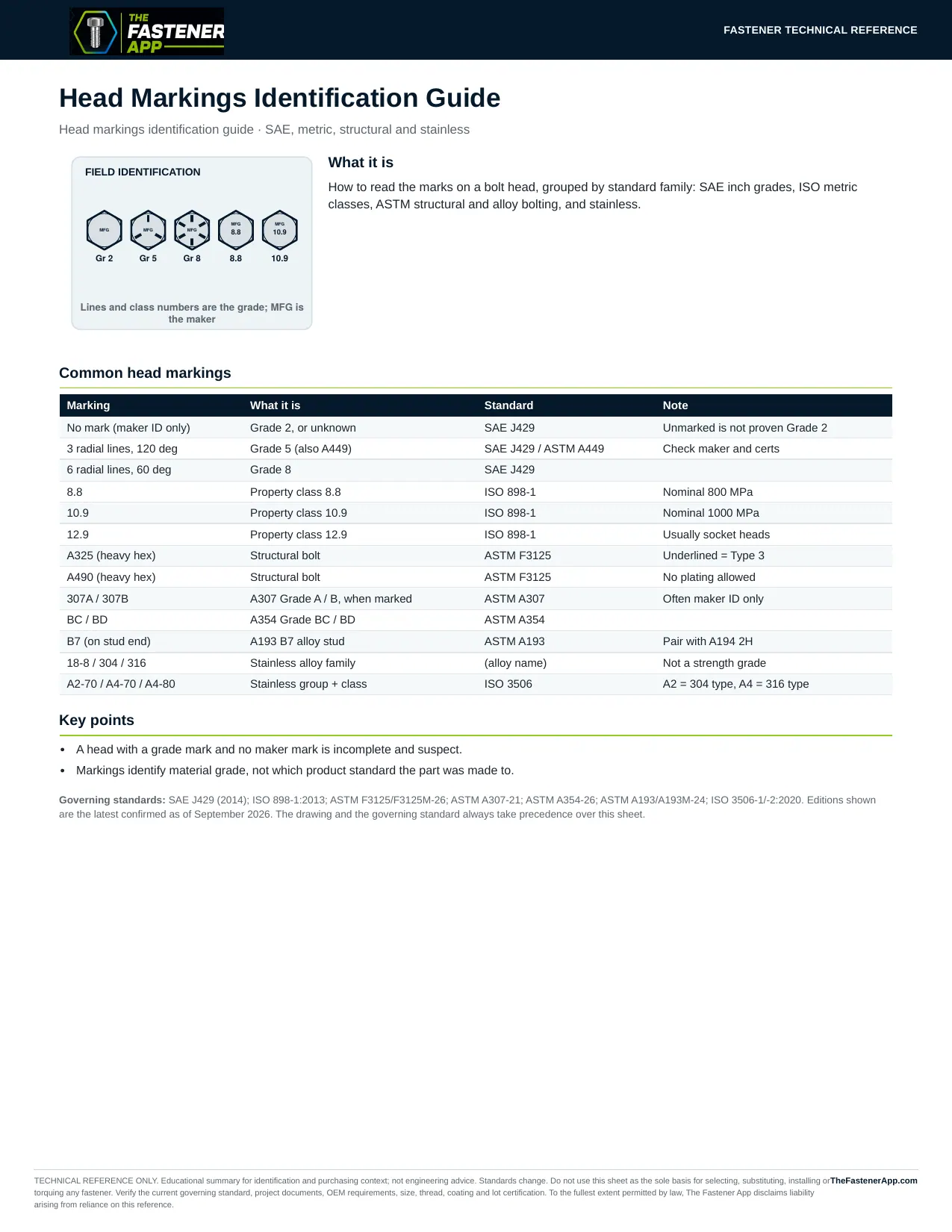
Head Markings Identification Guide
How to read the marks on a bolt head, grouped by standard family: SAE inch grades, ISO metric classes, ASTM structural and alloy bolting, and stainless.
 Report an error on this sheet
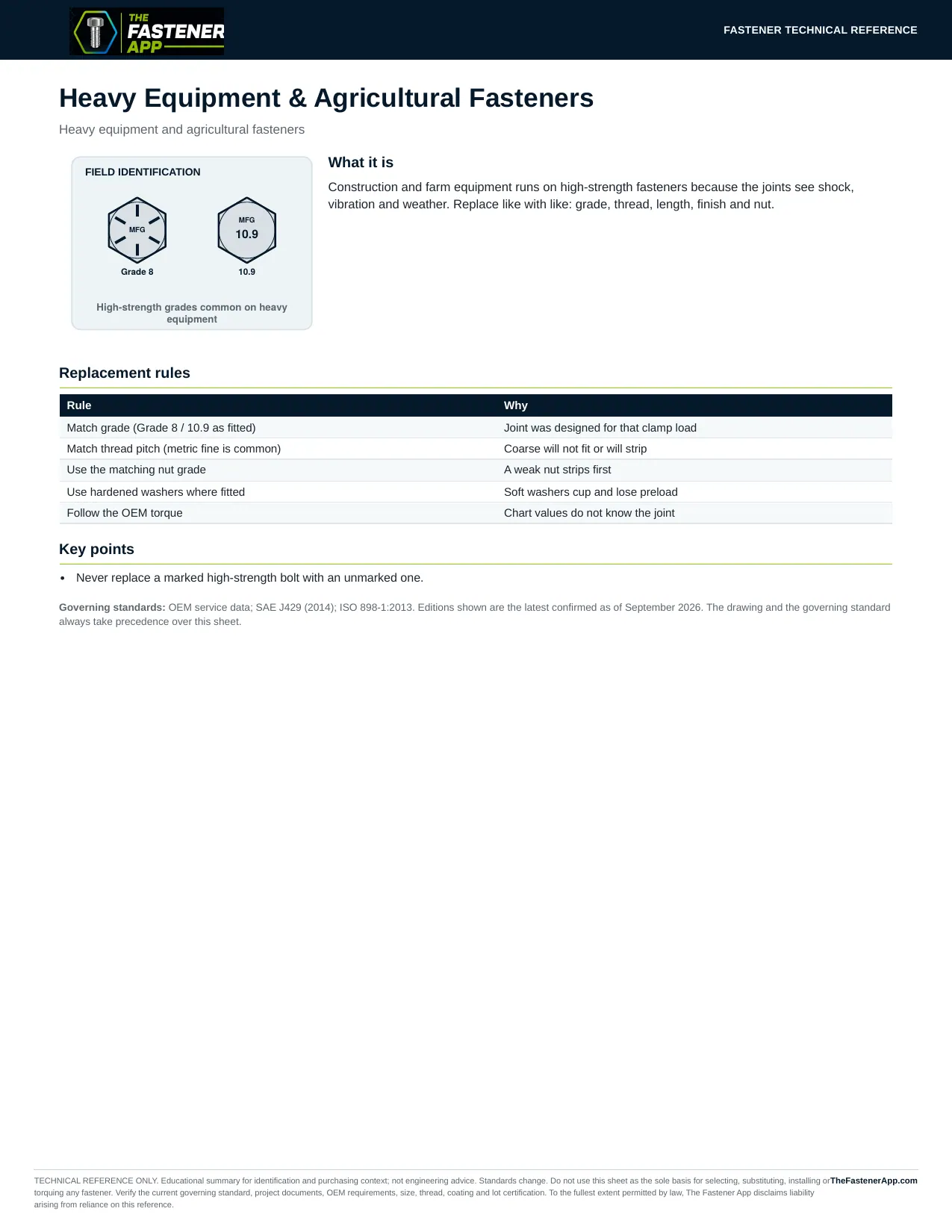
Heavy Equipment & Agricultural Fasteners
Construction and farm equipment runs on high-strength fasteners because the joints see shock, vibration and weather. Replace like with like: grade, thread, length, finish and nut.
 Report an error on this sheet
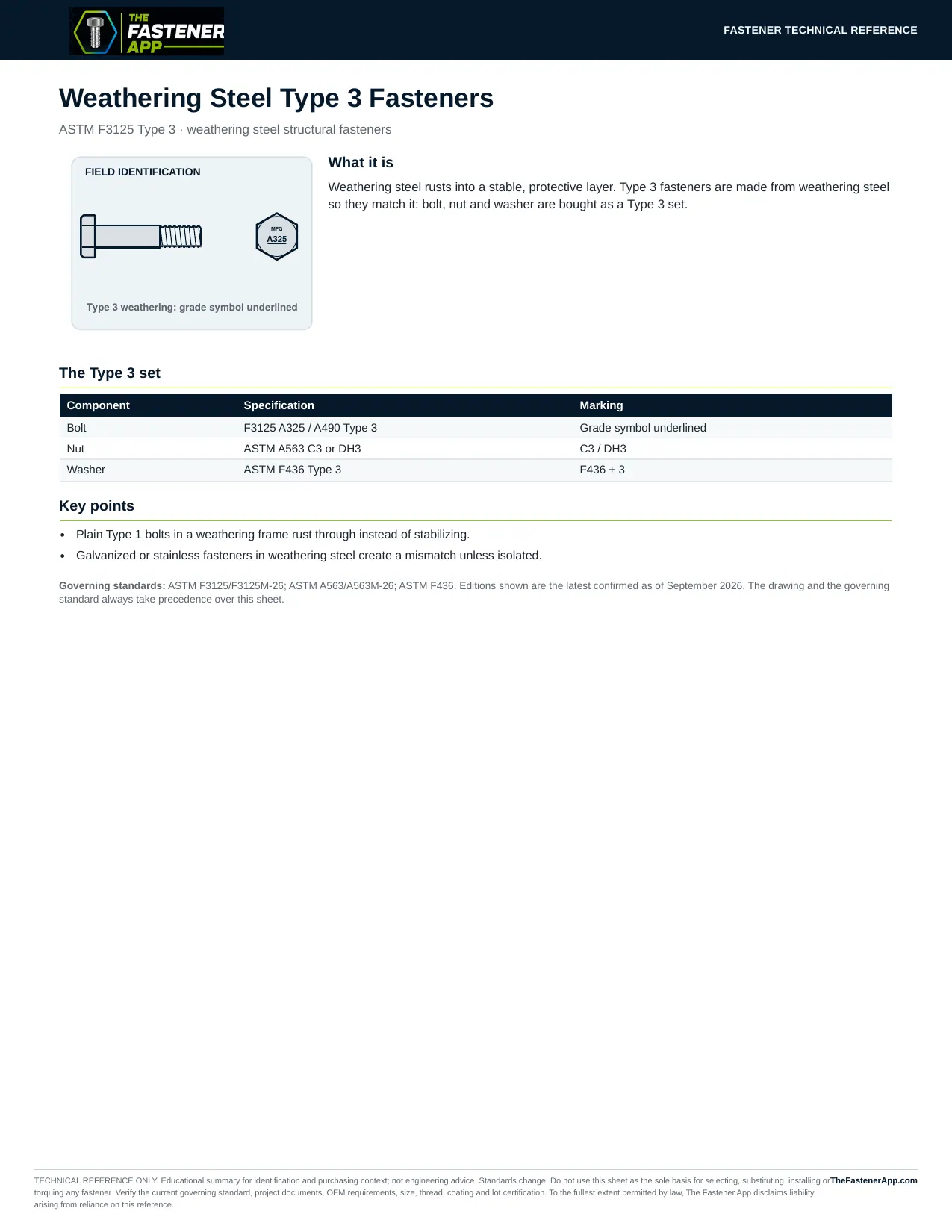
Weathering Steel Type 3 Fasteners
Weathering steel rusts into a stable, protective layer. Type 3 fasteners are made from weathering steel so they match it: bolt, nut and washer are bought as a Type 3 set.
 Report an error on this sheet
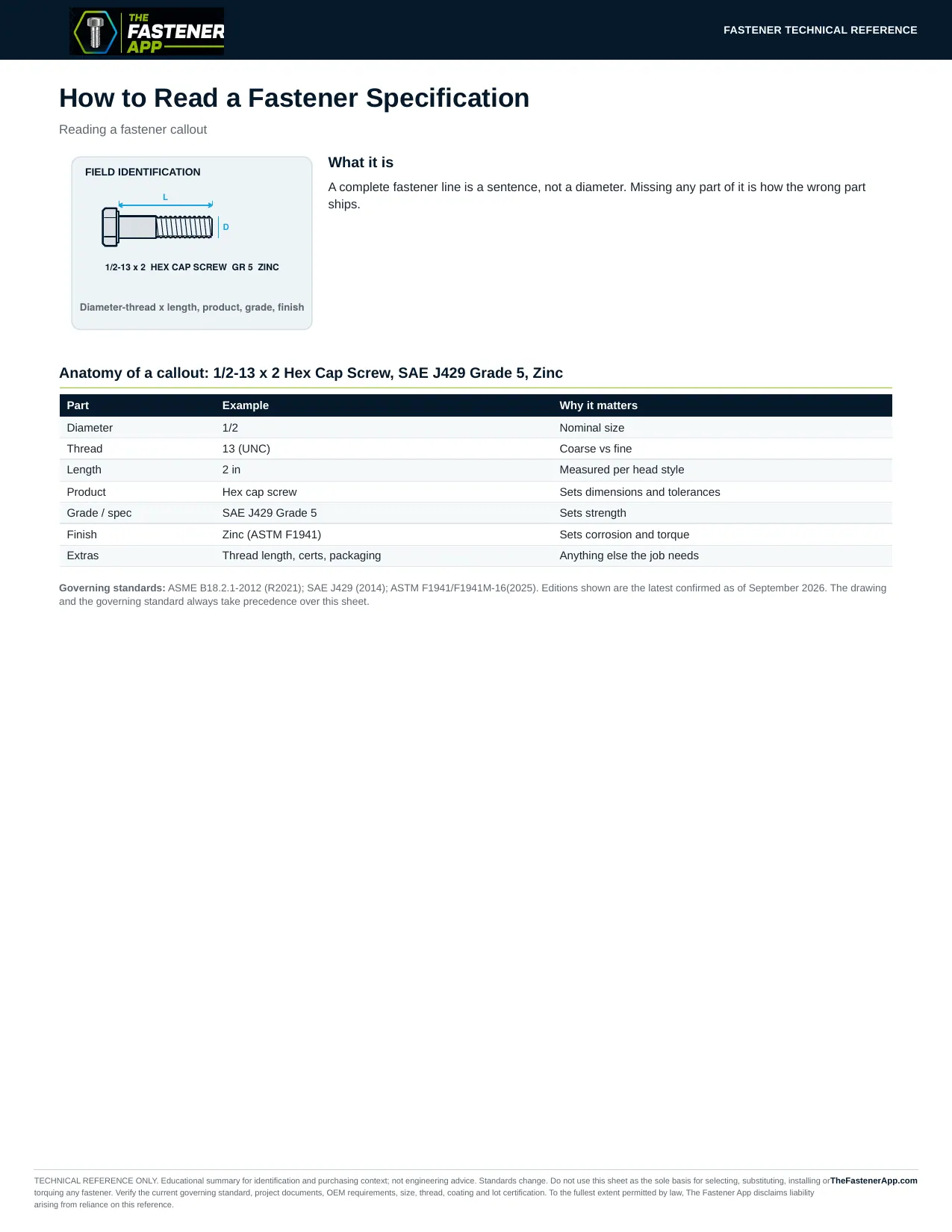
How to Read a Fastener Specification
A complete fastener line is a sentence, not a diameter. Missing any part of it is how the wrong part ships.
 Report an error on this sheet
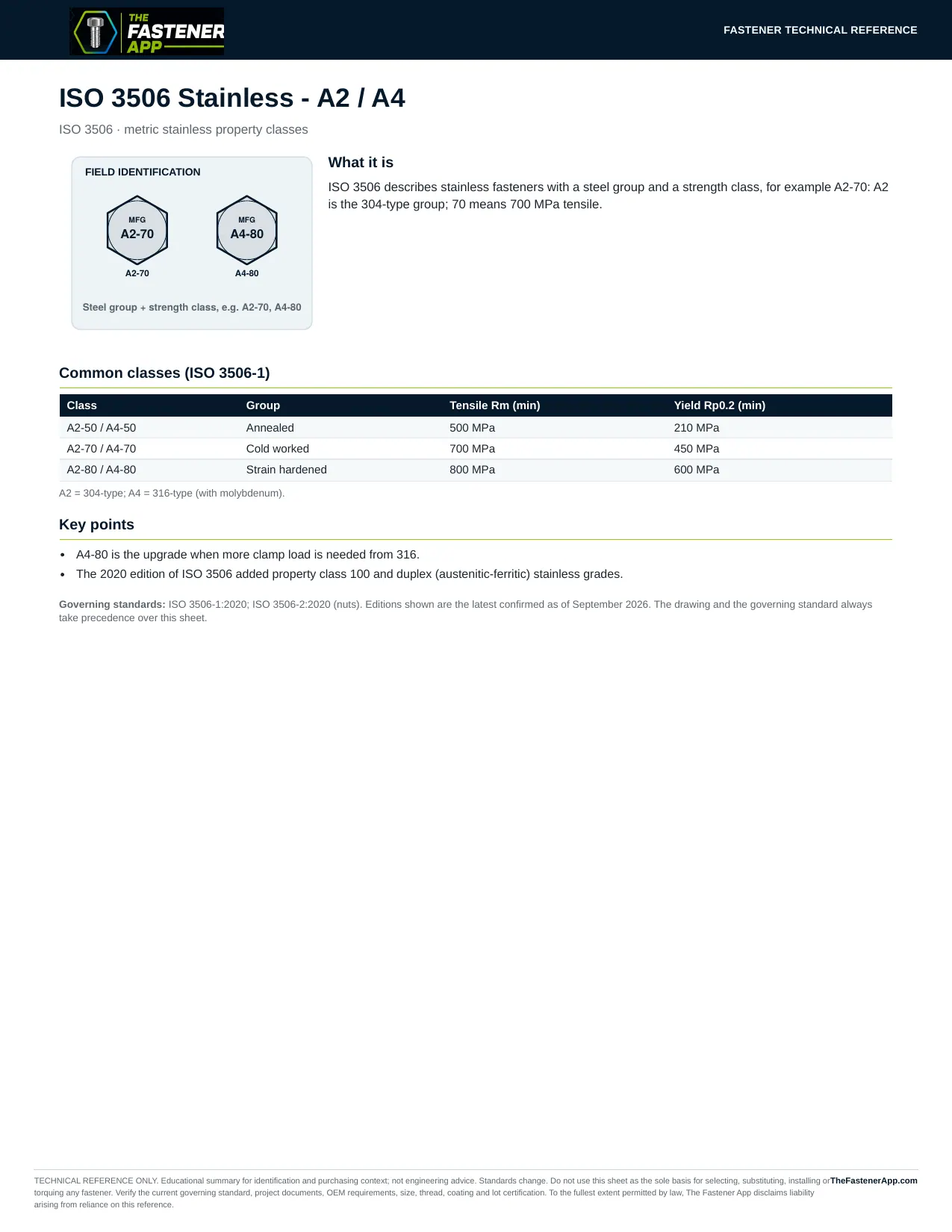
ISO 3506 Stainless - A2 / A4
ISO 3506 describes stainless fasteners with a steel group and a strength class, for example A2-70: A2 is the 304-type group; 70 means 700 MPa tensile.
 Report an error on this sheet
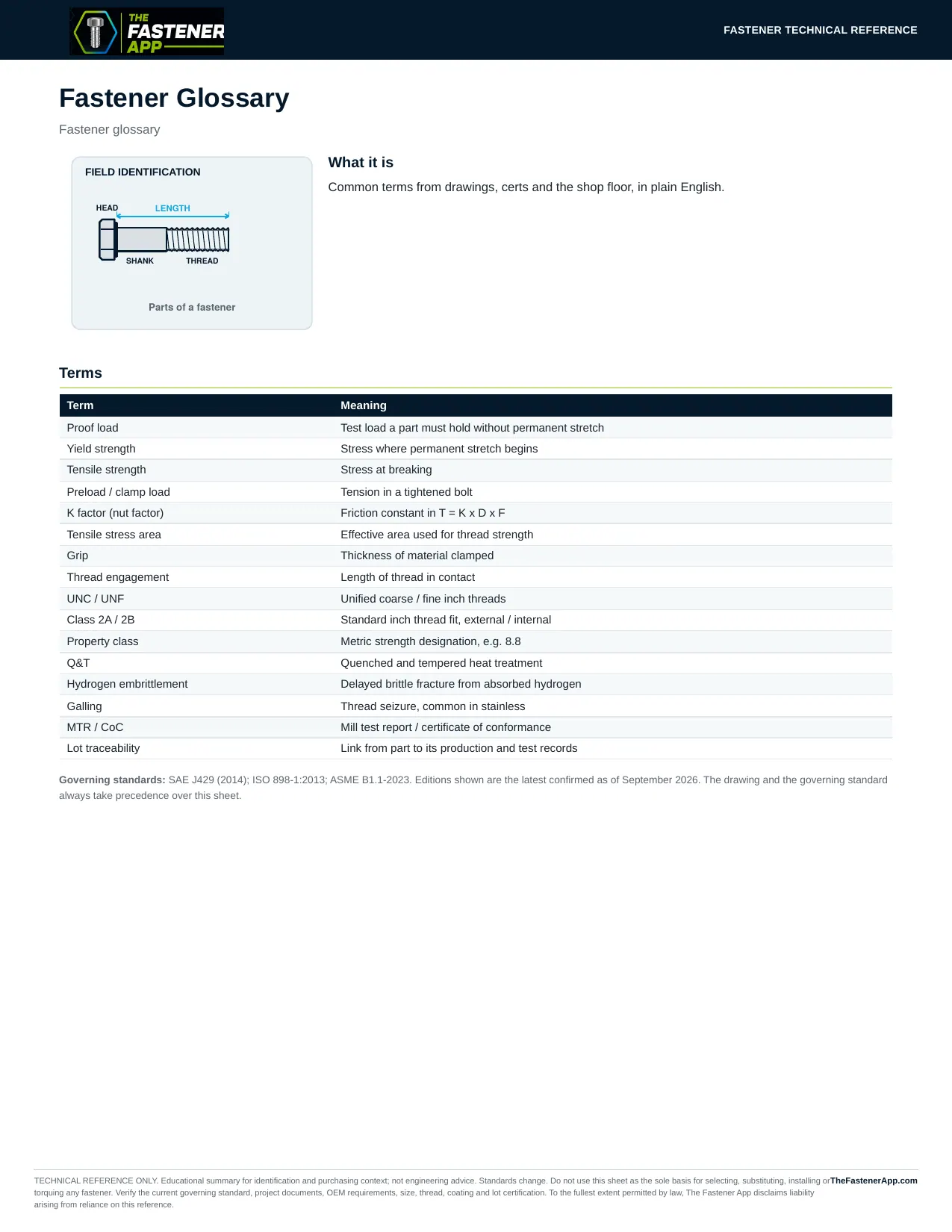
Fastener Glossary
Common terms from drawings, certs and the shop floor, in plain English.
 Report an error on this sheet
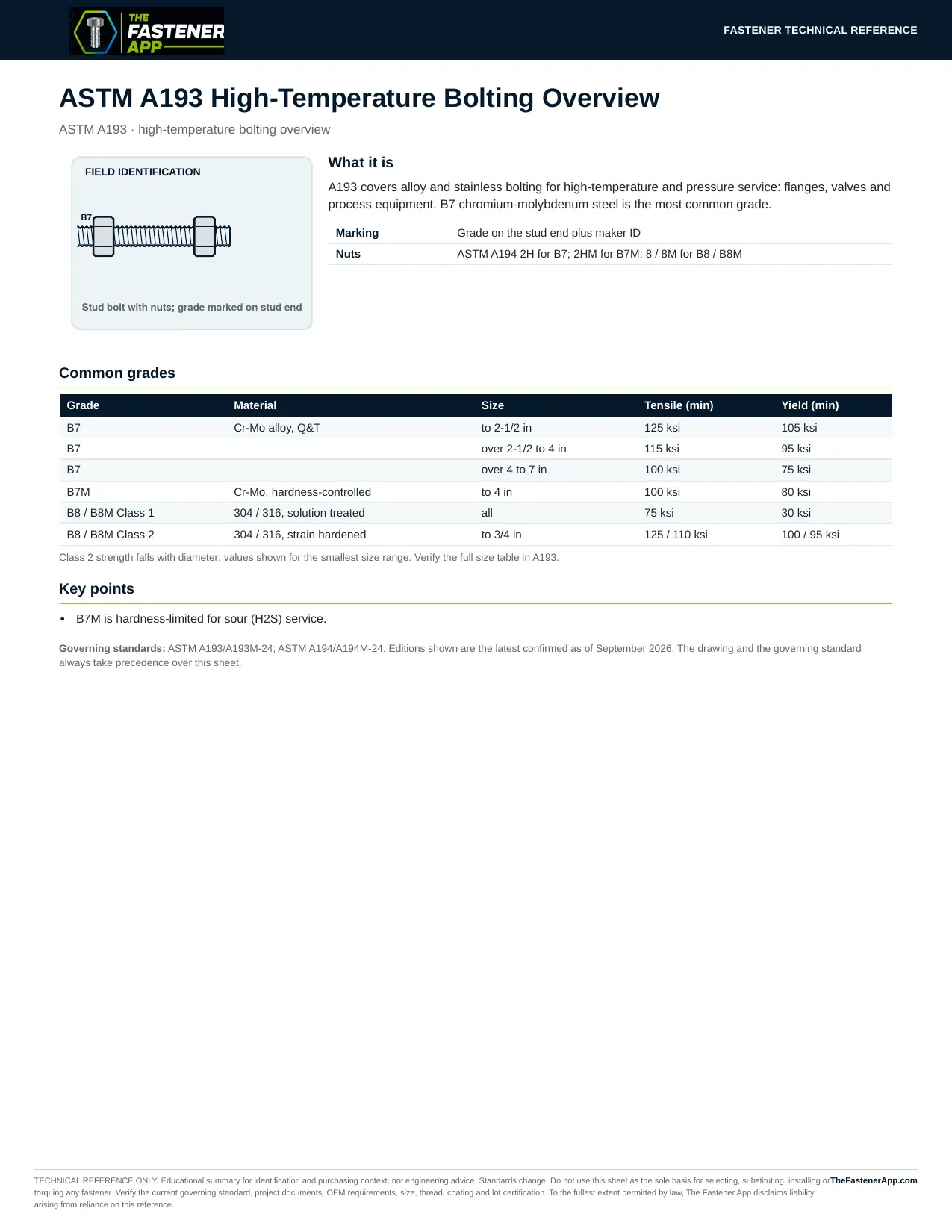
ASTM A193 High-Temperature Bolting Overview
A193 covers alloy and stainless bolting for high-temperature and pressure service: flanges, valves and process equipment. B7 chromium-molybdenum steel is the most common grade.
 Report an error on this sheet
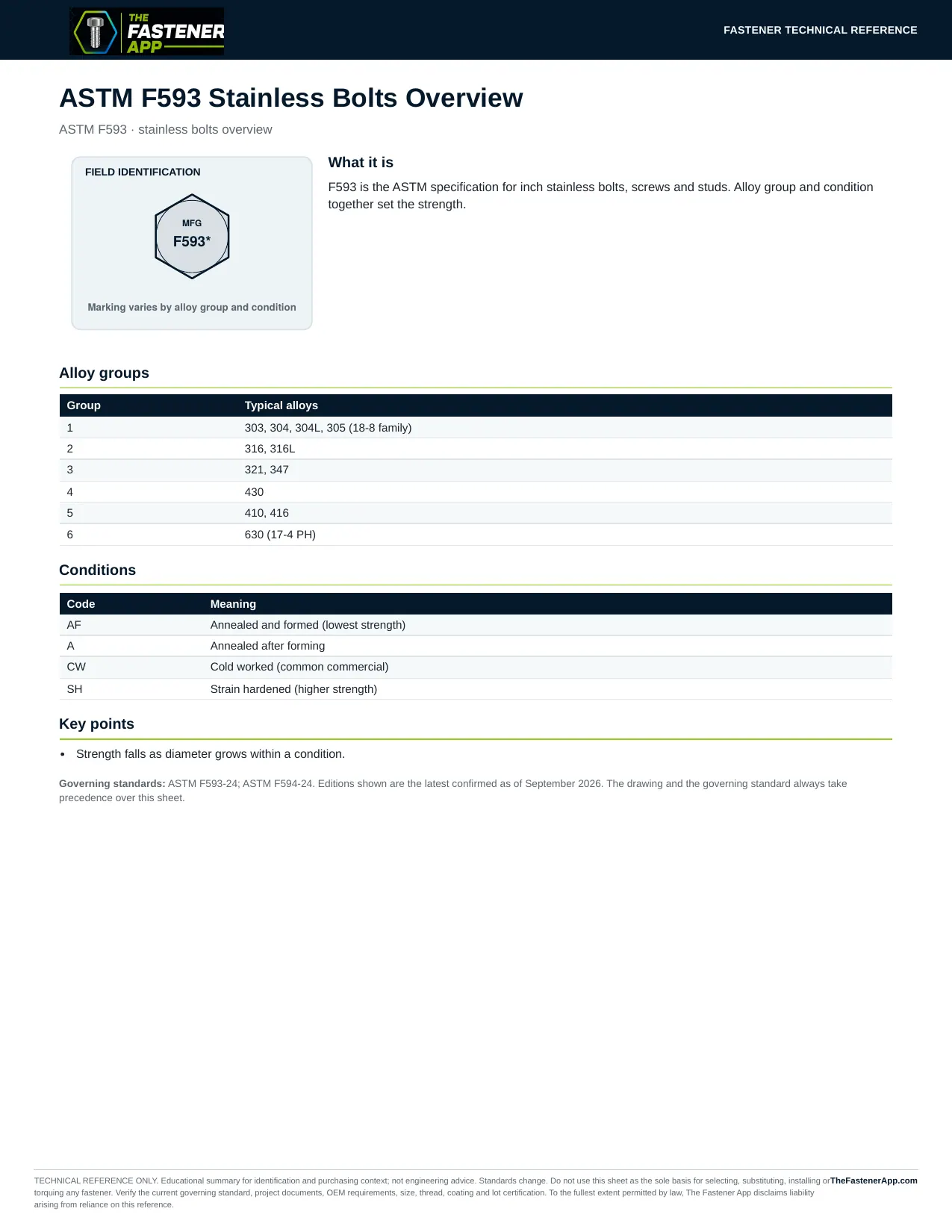
ASTM F593 Stainless Bolts Overview
F593 is the ASTM specification for inch stainless bolts, screws and studs. Alloy group and condition together set the strength.
 Report an error on this sheet
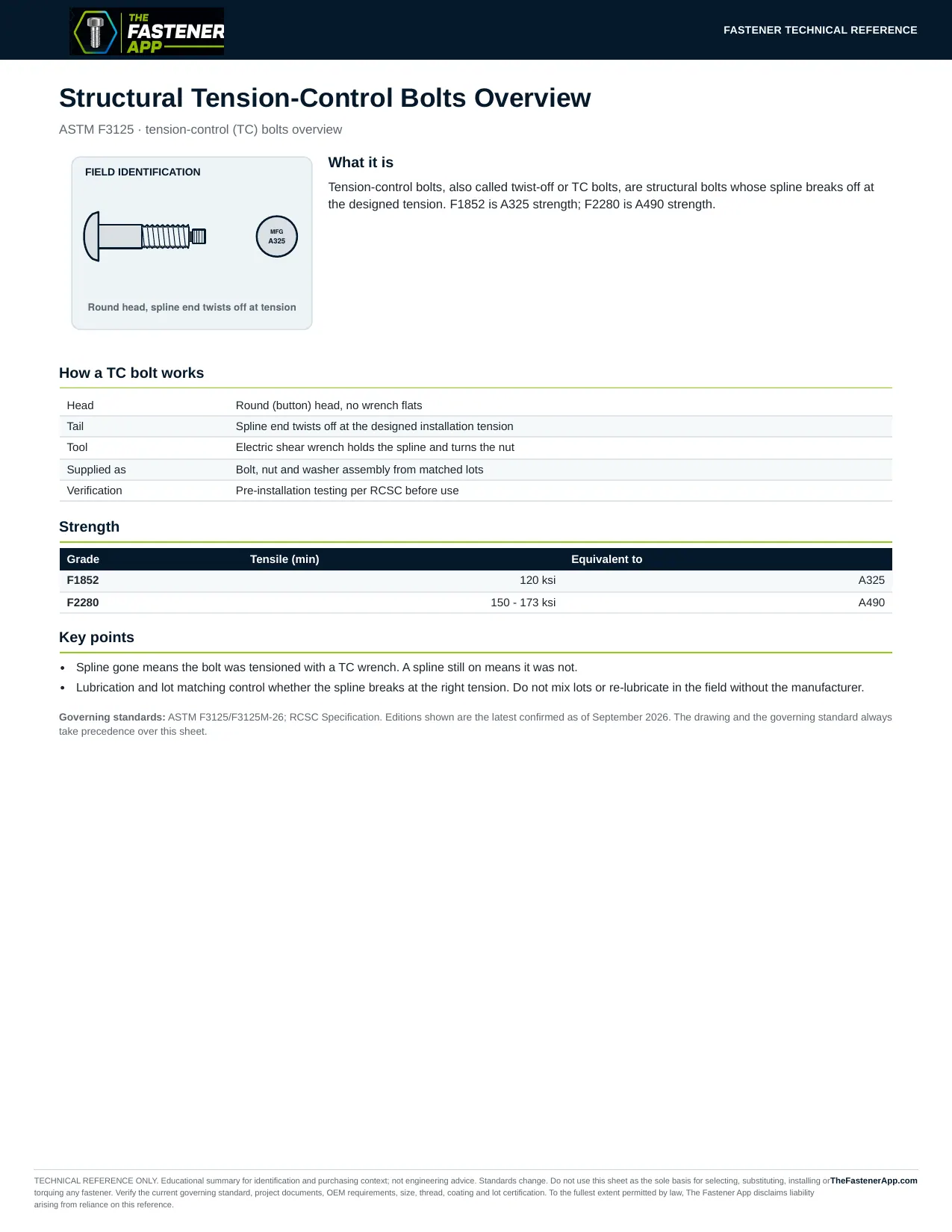
Structural Tension-Control Bolts Overview
Tension-control bolts, also called twist-off or TC bolts, are structural bolts whose spline breaks off at the designed tension. F1852 is A325 strength; F2280 is A490 strength.
 Report an error on this sheet
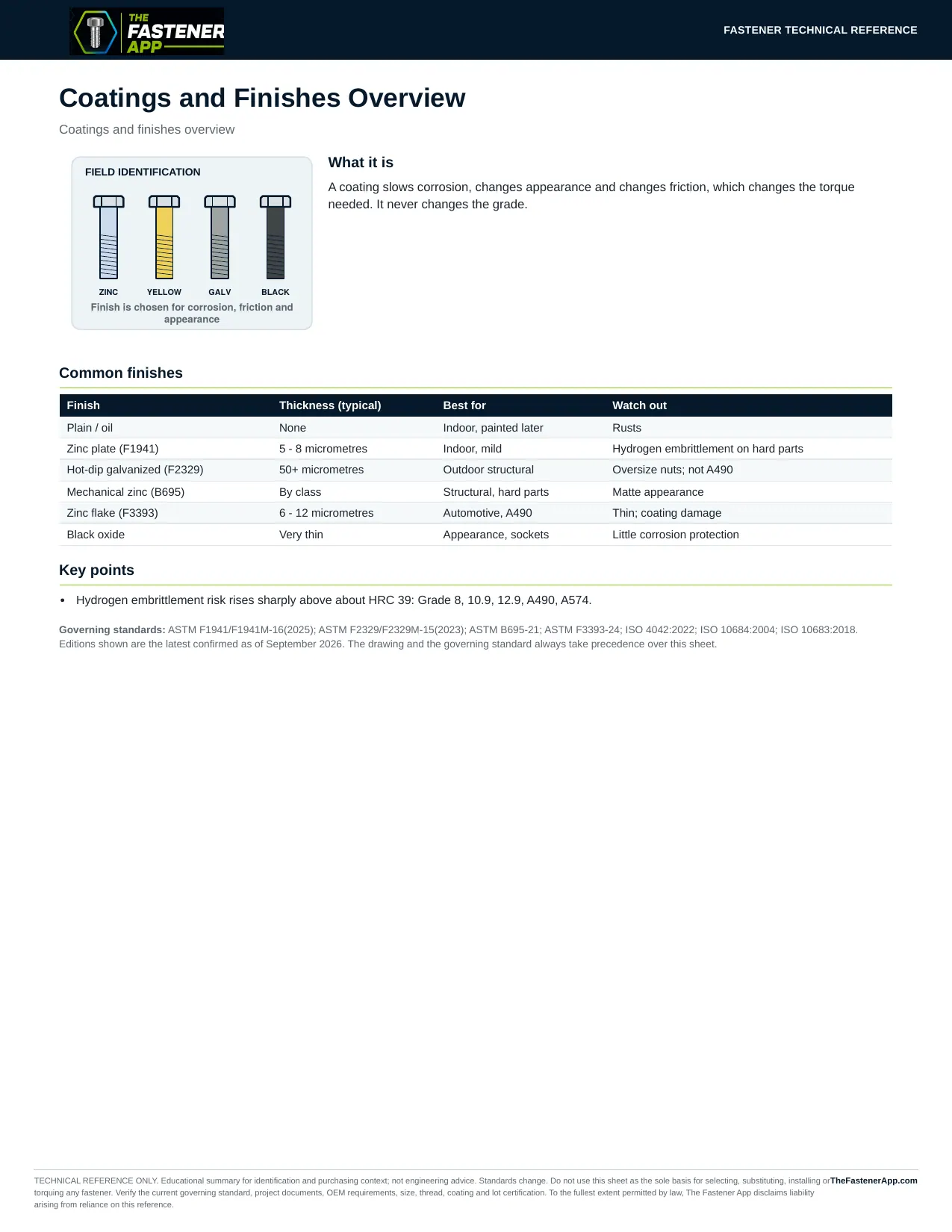
Coatings and Finishes Overview
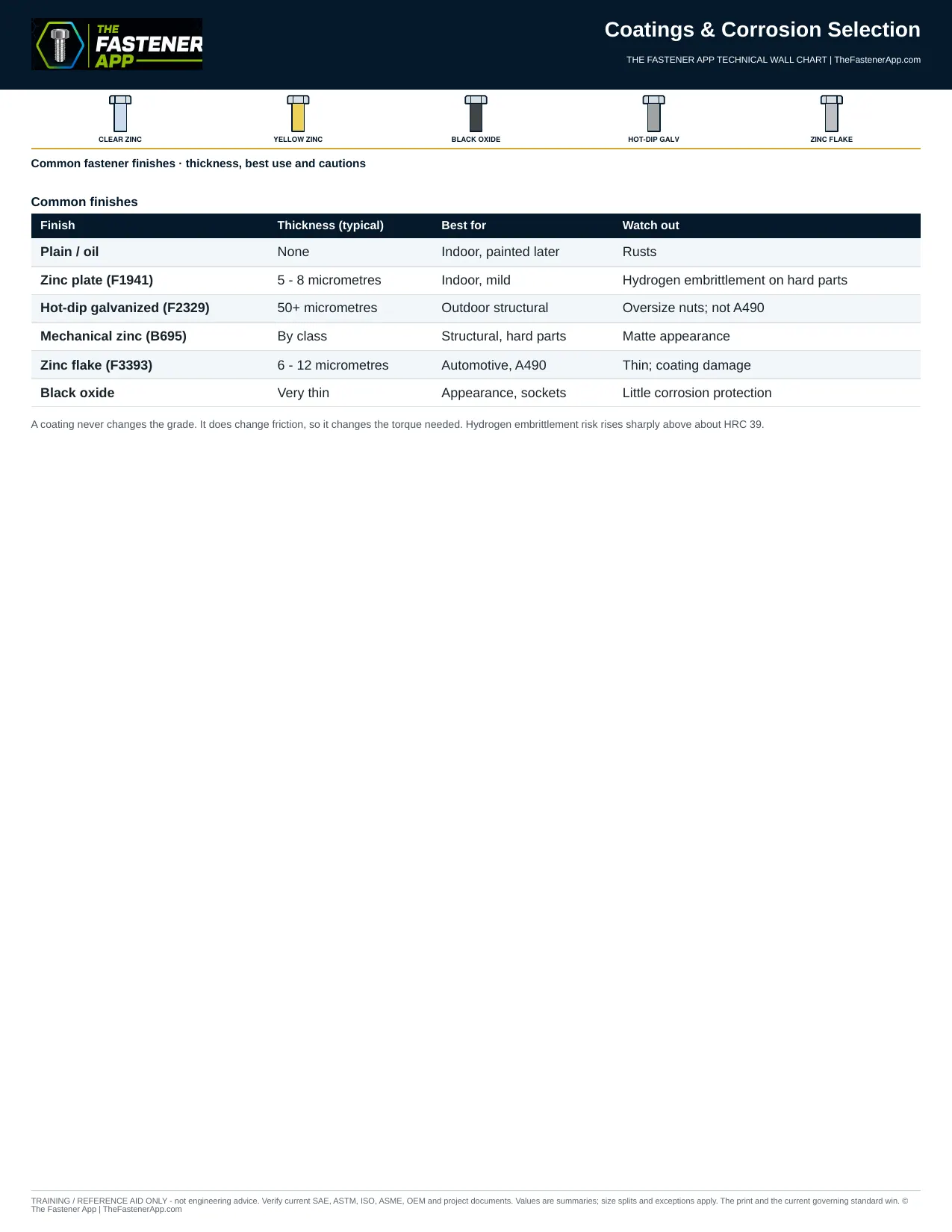
A coating slows corrosion, changes appearance and changes friction, which changes the torque needed. It never changes the grade.
 Report an error on this sheet
DIN to ISO Cross-Reference - Metric Fastener Standards
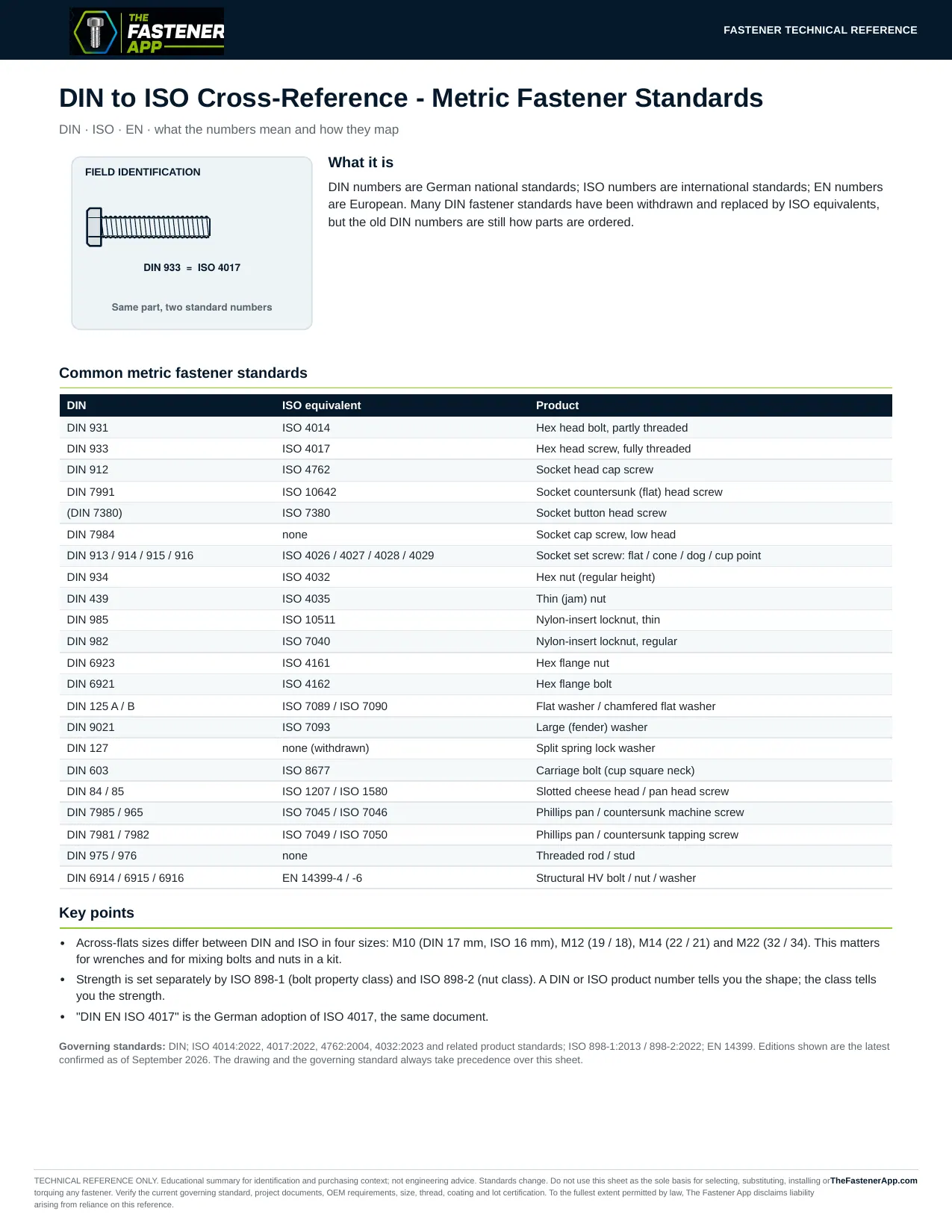
DIN numbers are German national standards; ISO numbers are international standards; EN numbers are European. Many DIN fastener standards have been withdrawn and replaced by ISO equivalents, but the old DIN numbers are still how parts are ordered.
 Report an error on this sheet
How to Read This Guide - Grades, Classes and Systems
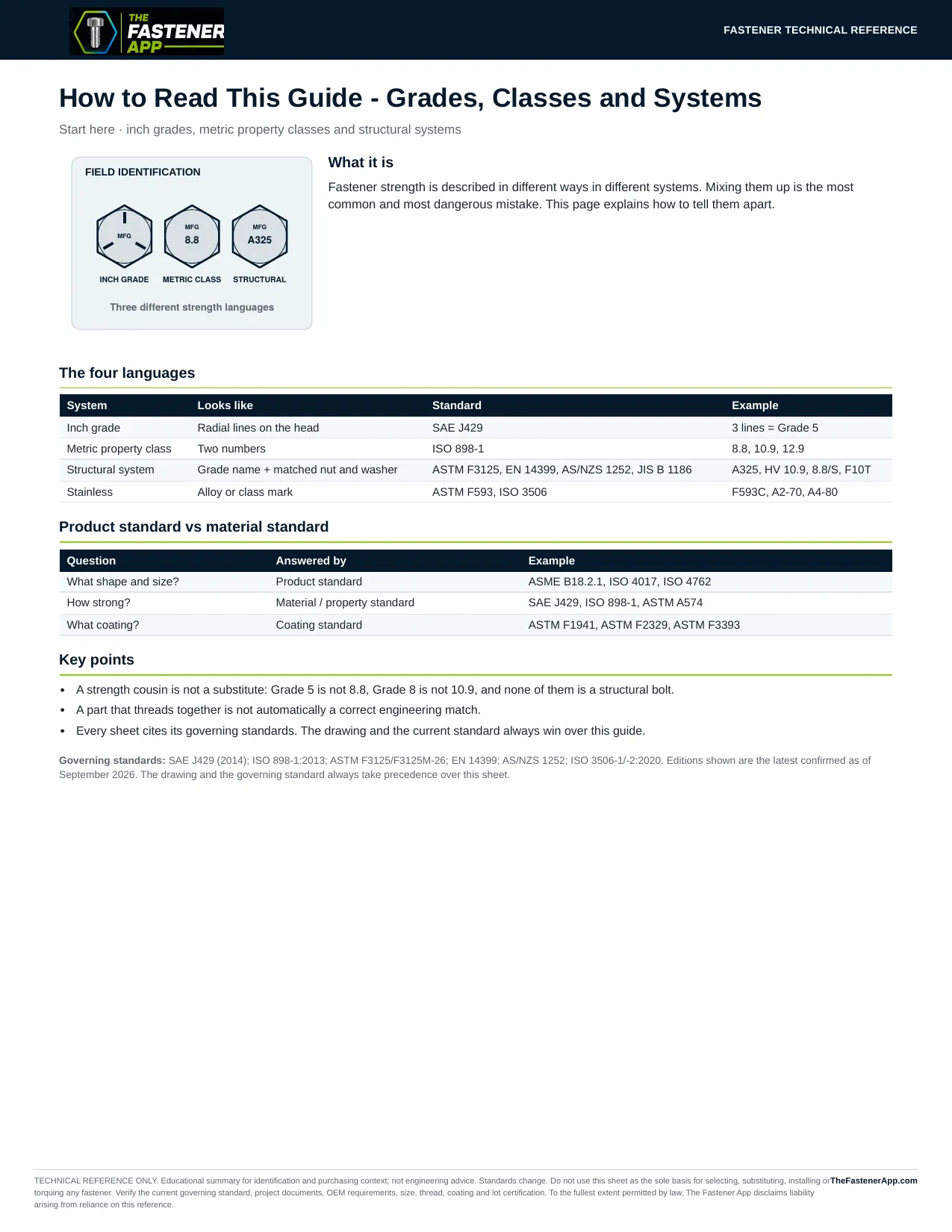
Fastener strength is described in different ways in different systems. Mixing them up is the most common and most dangerous mistake. This page explains how to tell them apart.
 Report an error on this sheet
Wall Charts
Printable shop wall charts — head markings, strength, threads, tap drills, clearance holes, dimensions and torque. Letter size free; 25 x 36 in posters on request.
Master Fastener Head Markings
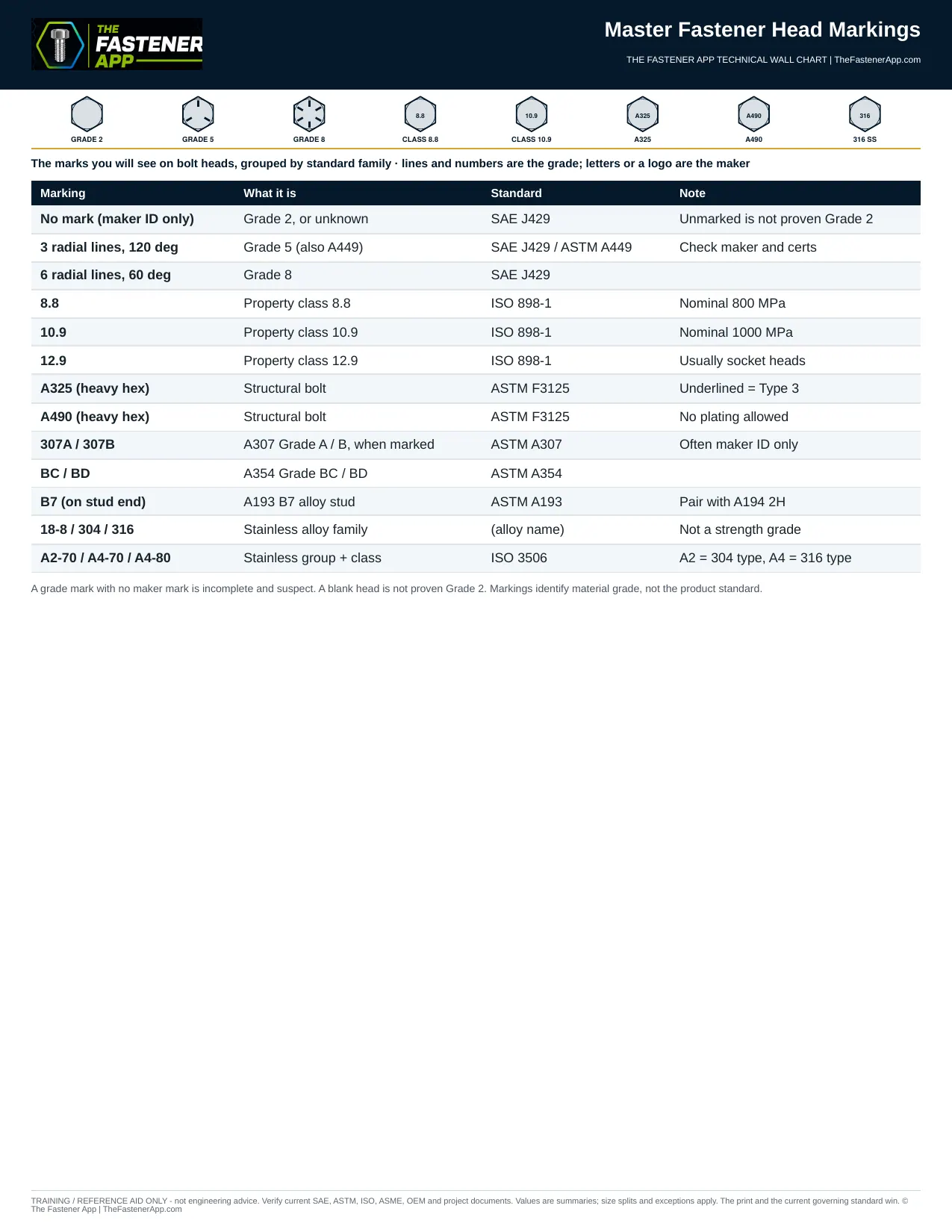
Printable shop wall chart: Master Fastener Head Markings. Free letter-size PDF to print and post at the counter; 25 x 36 inch poster version available.
 25 x 36 inch poster version →Report an error on this sheet
SAE Grade 2 / 5 / 8 - Markings & Strength
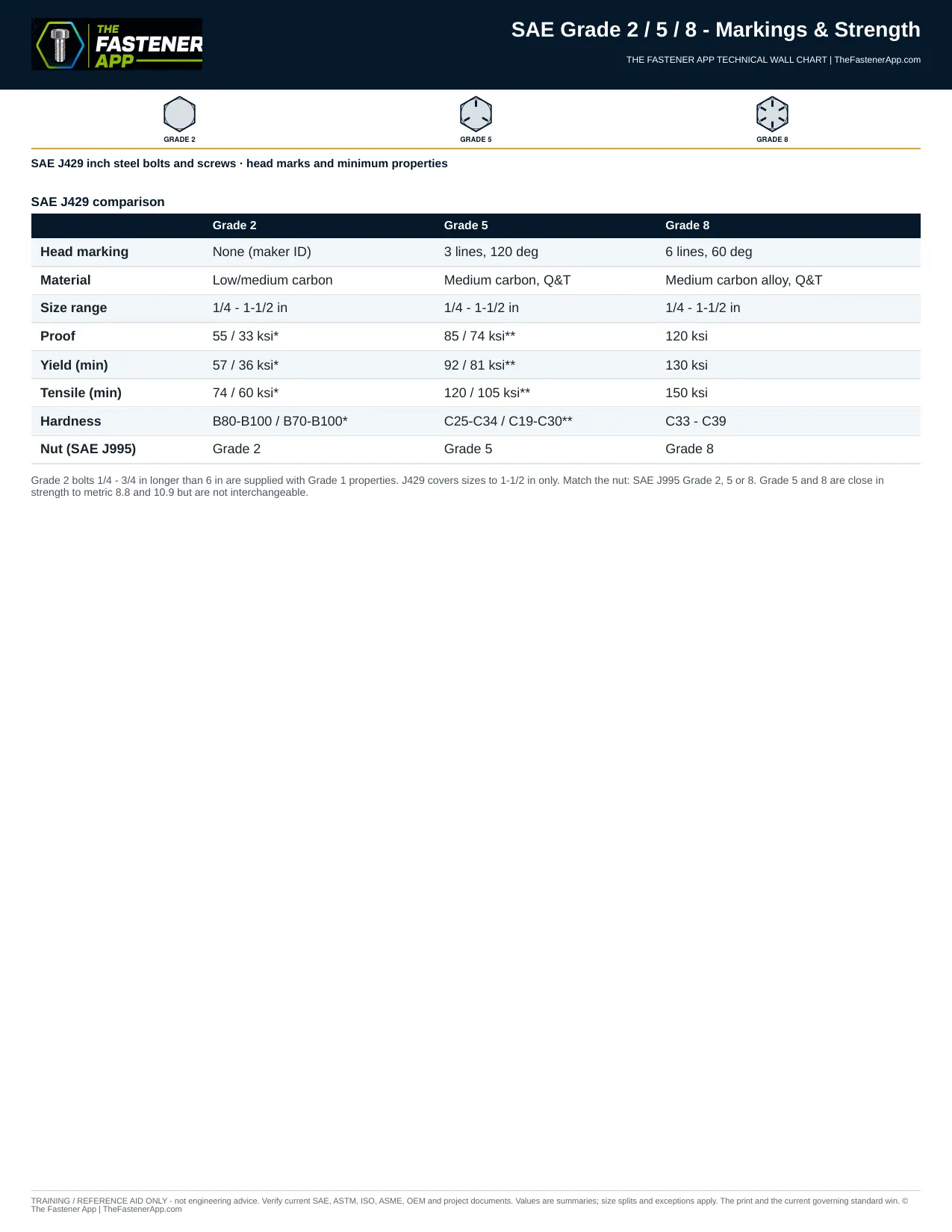
Printable shop wall chart: SAE Grade 2 / 5 / 8 - Markings & Strength. Free letter-size PDF to print and post at the counter; 25 x 36 inch poster version available.
 25 x 36 inch poster version →Report an error on this sheet
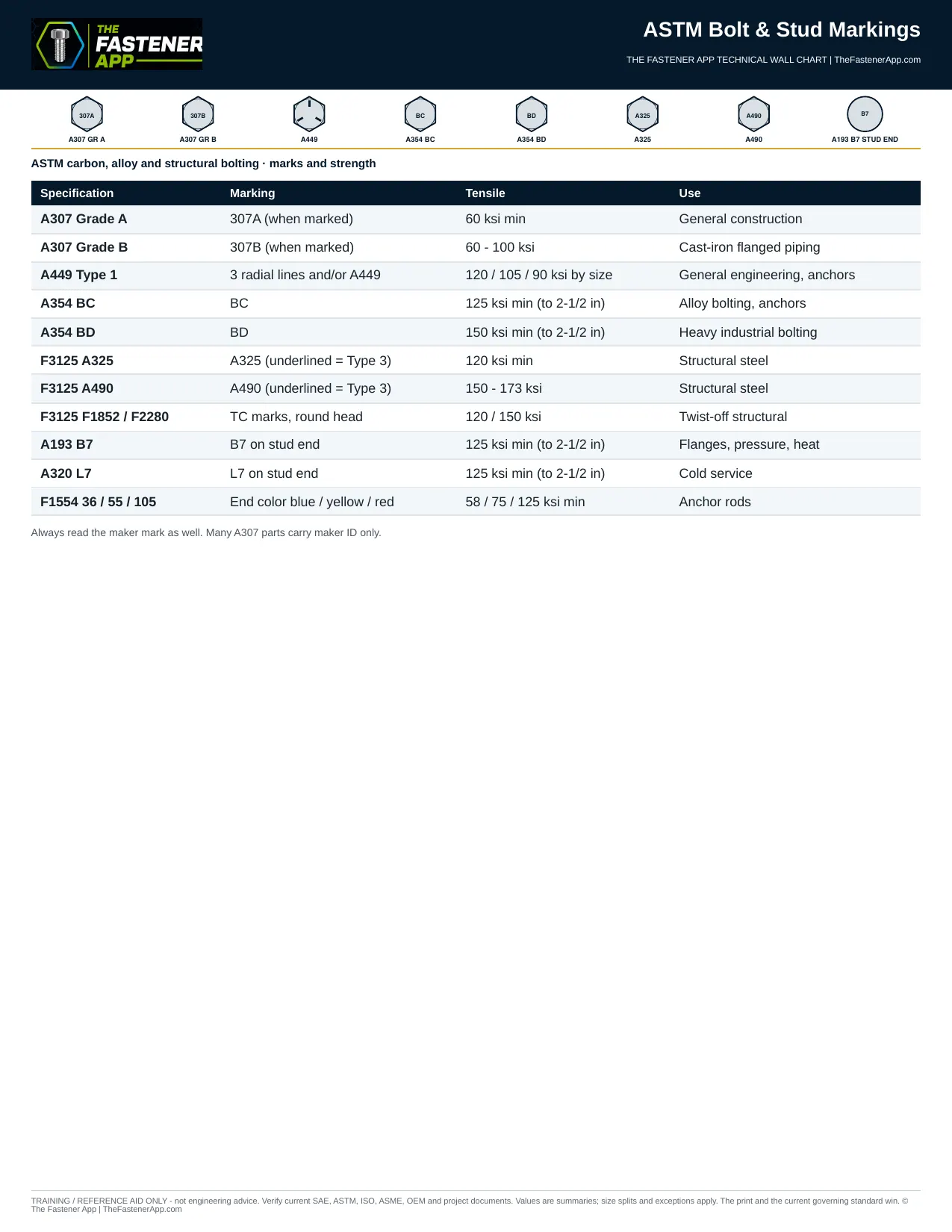
ASTM Bolt & Stud Markings
Printable shop wall chart: ASTM Bolt & Stud Markings. Free letter-size PDF to print and post at the counter; 25 x 36 inch poster version available.
 25 x 36 inch poster version →Report an error on this sheet
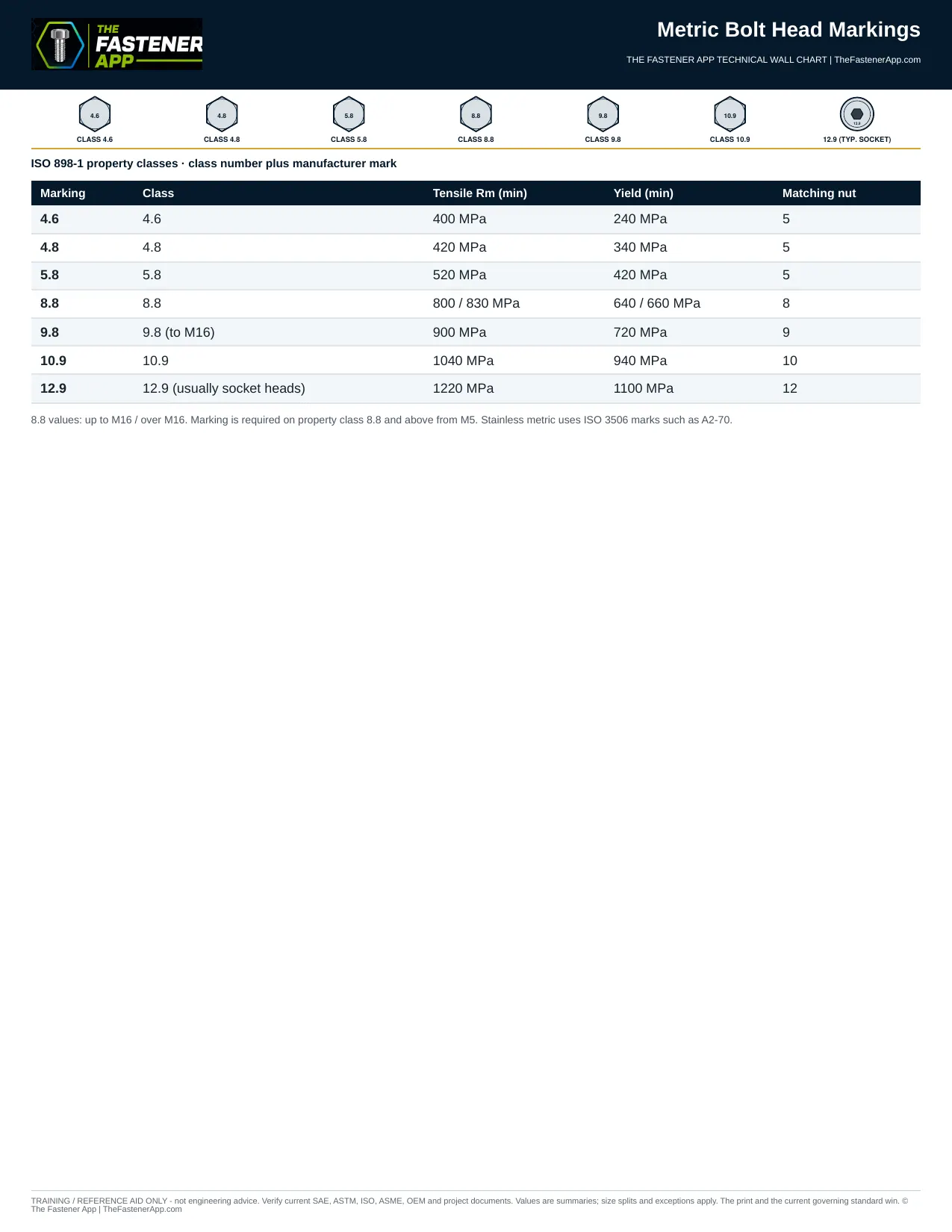
Metric Bolt Head Markings
Printable shop wall chart: Metric Bolt Head Markings. Free letter-size PDF to print and post at the counter; 25 x 36 inch poster version available.
 25 x 36 inch poster version →Report an error on this sheet
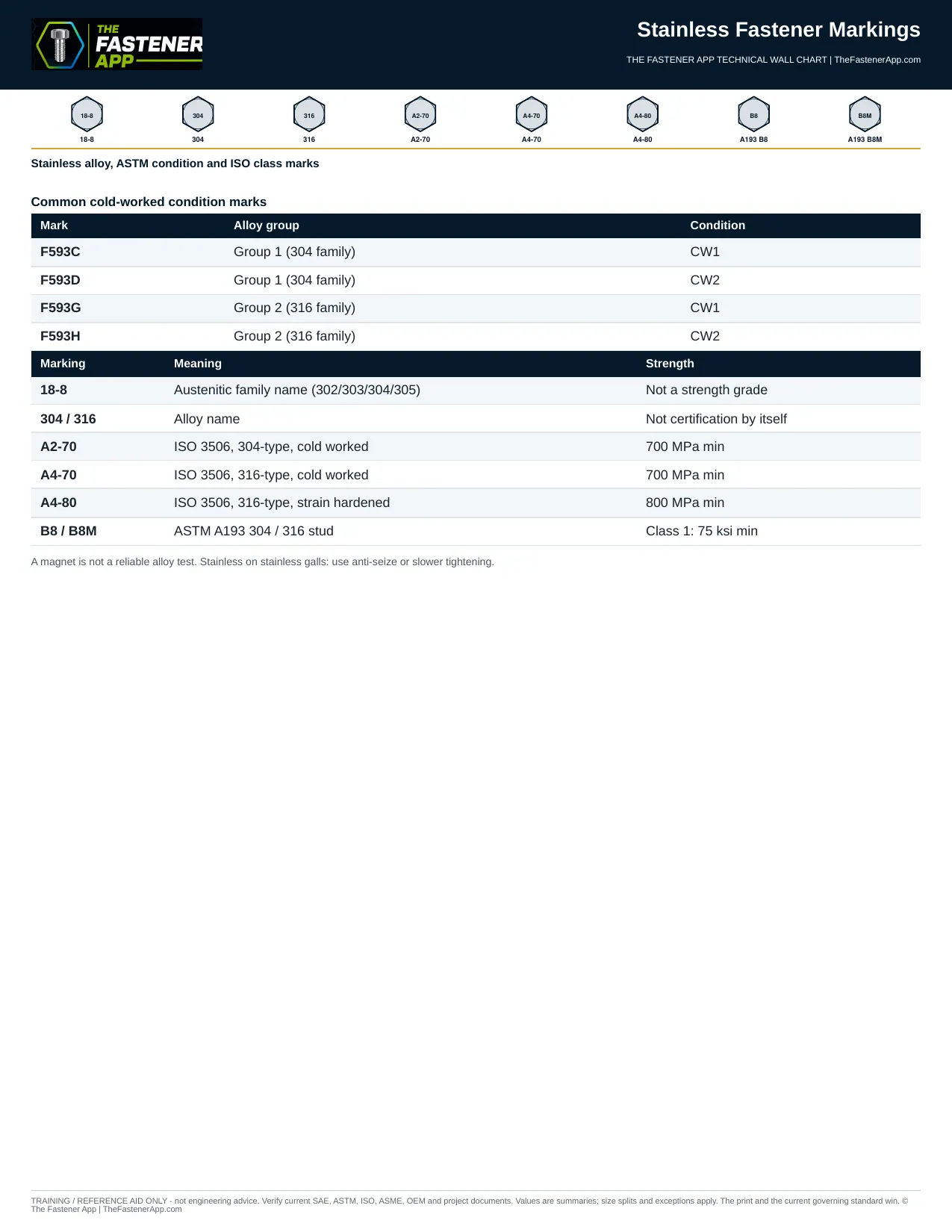
Stainless Fastener Markings
Printable shop wall chart: Stainless Fastener Markings. Free letter-size PDF to print and post at the counter; 25 x 36 inch poster version available.
 25 x 36 inch poster version →Report an error on this sheet
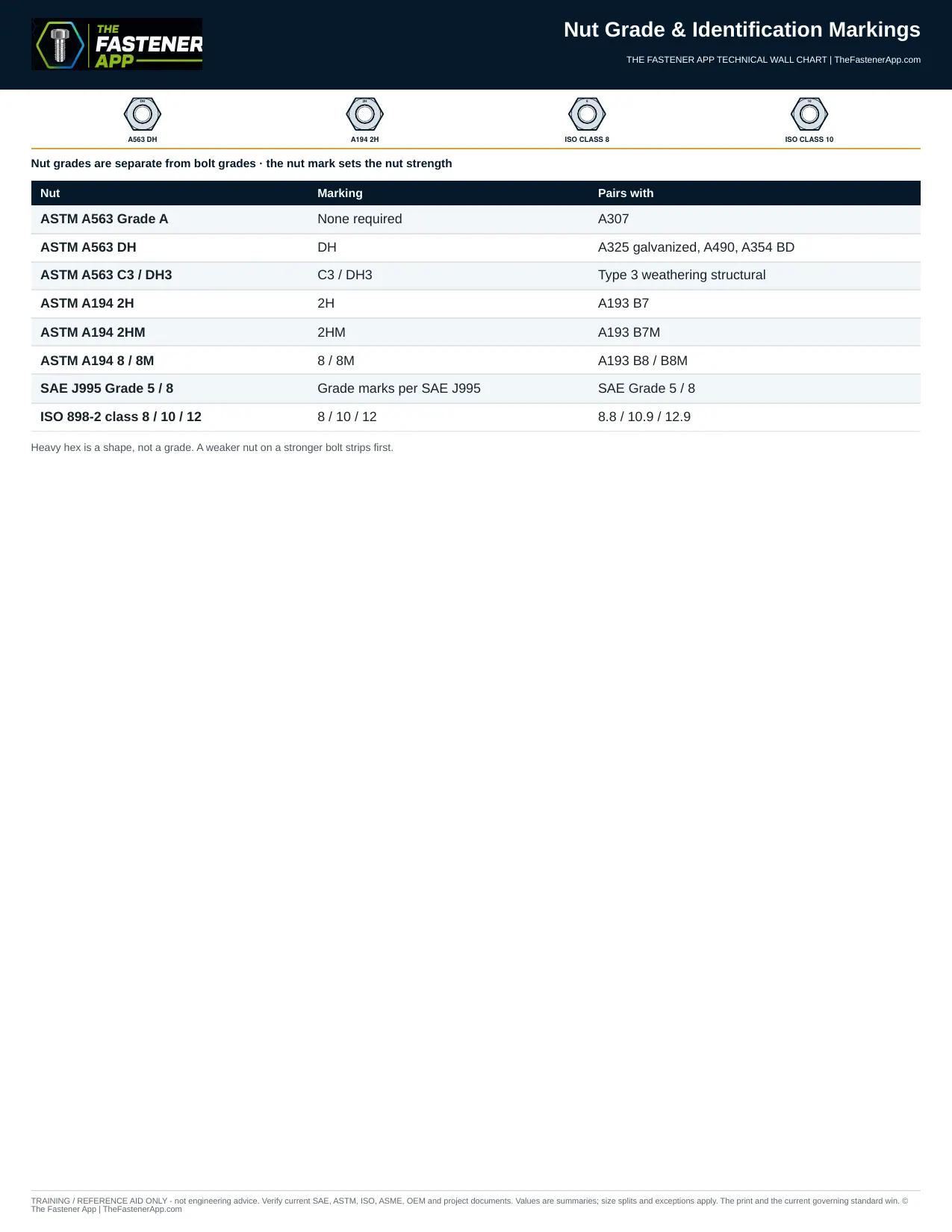
Nut Grade & Identification Markings
Printable shop wall chart: Nut Grade & Identification Markings. Free letter-size PDF to print and post at the counter; 25 x 36 inch poster version available.
 25 x 36 inch poster version →Report an error on this sheet
Bolt - Nut - Washer Matching
Printable shop wall chart: Bolt - Nut - Washer Matching. Free letter-size PDF to print and post at the counter; 25 x 36 inch poster version available.
 25 x 36 inch poster version →Report an error on this sheet
Structural Bolting Systems
Printable shop wall chart: Structural Bolting Systems. Free letter-size PDF to print and post at the counter; 25 x 36 inch poster version available.
 25 x 36 inch poster version →Report an error on this sheet
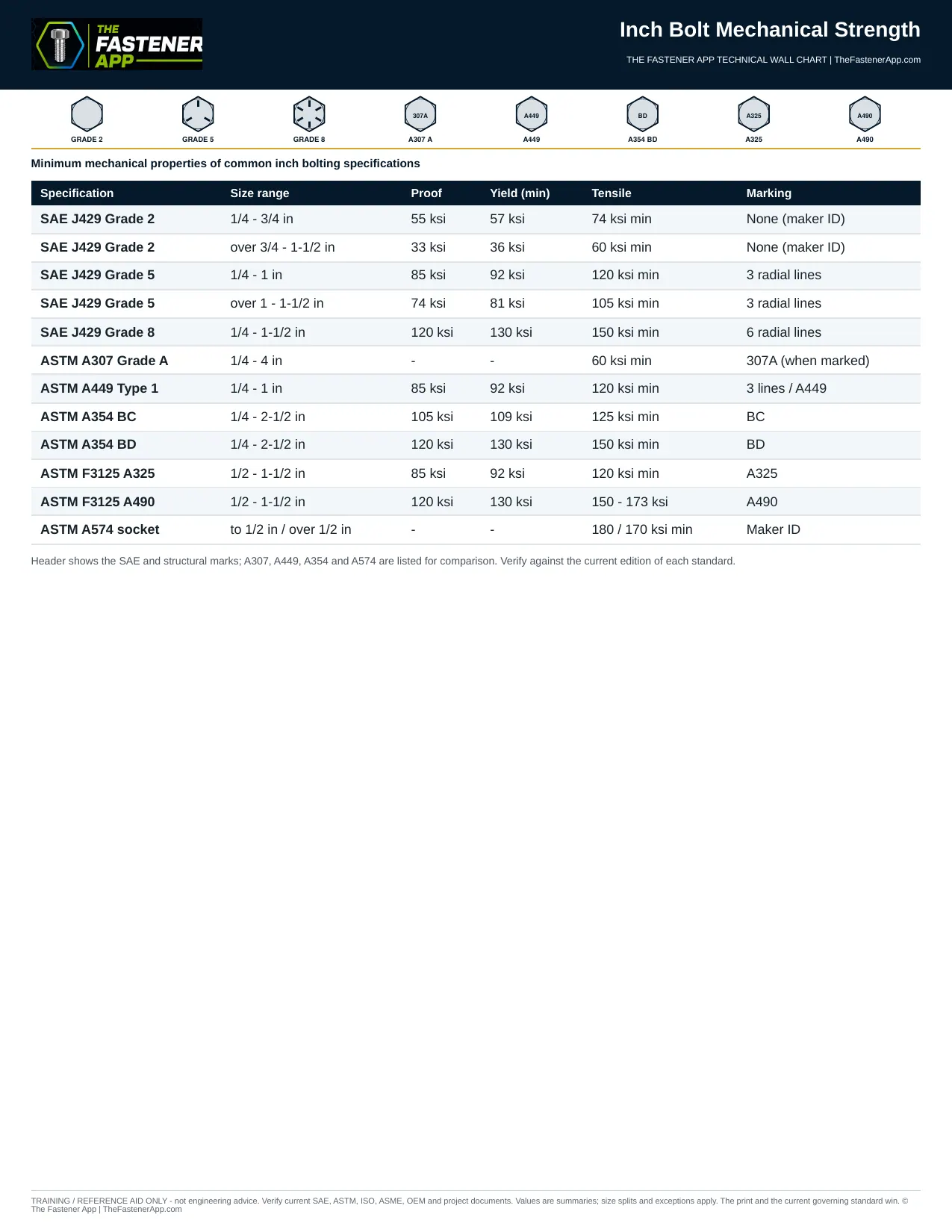
Inch Bolt Mechanical Strength
Printable shop wall chart: Inch Bolt Mechanical Strength. Free letter-size PDF to print and post at the counter; 25 x 36 inch poster version available.
 25 x 36 inch poster version →Report an error on this sheet
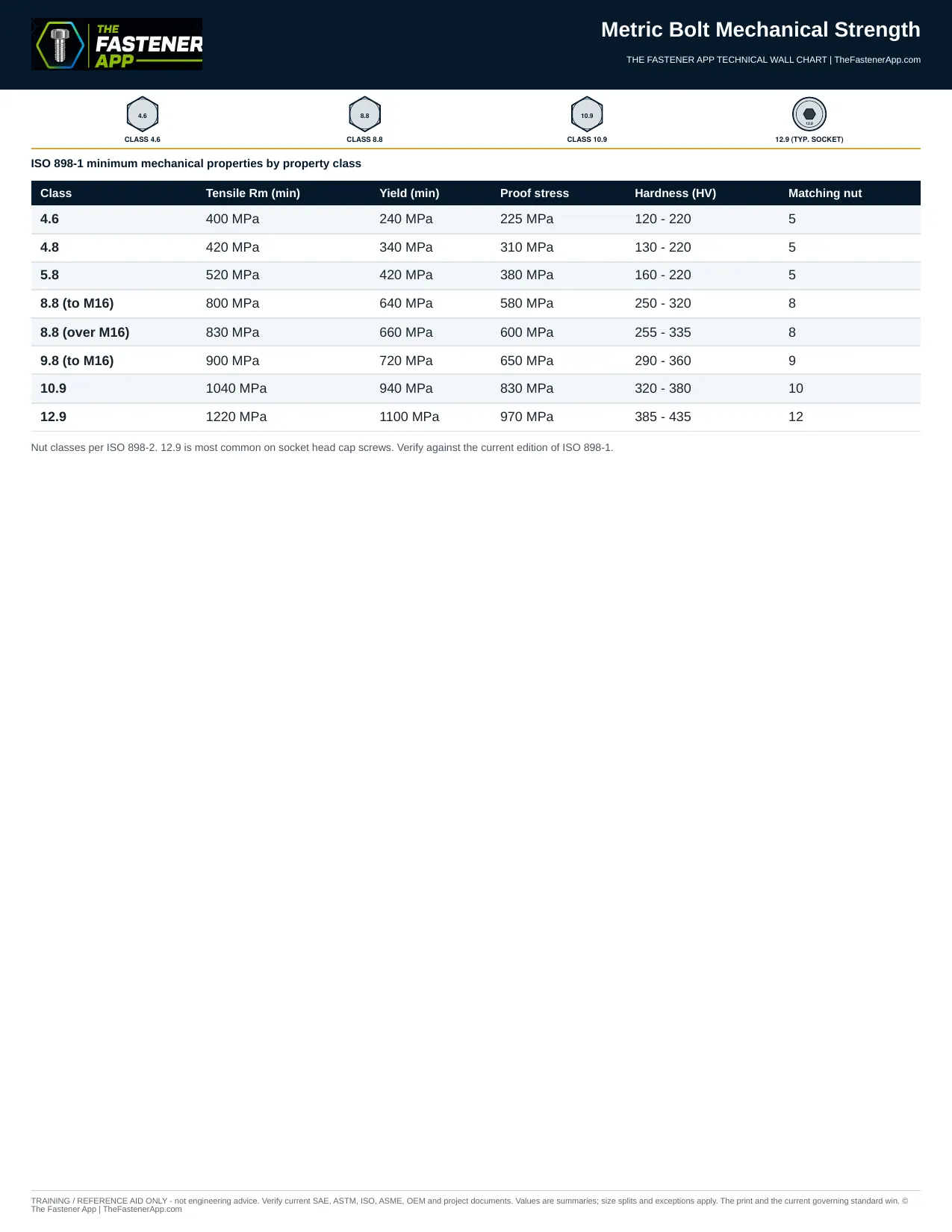
Metric Bolt Mechanical Strength
Printable shop wall chart: Metric Bolt Mechanical Strength. Free letter-size PDF to print and post at the counter; 25 x 36 inch poster version available.
 25 x 36 inch poster version →Report an error on this sheet
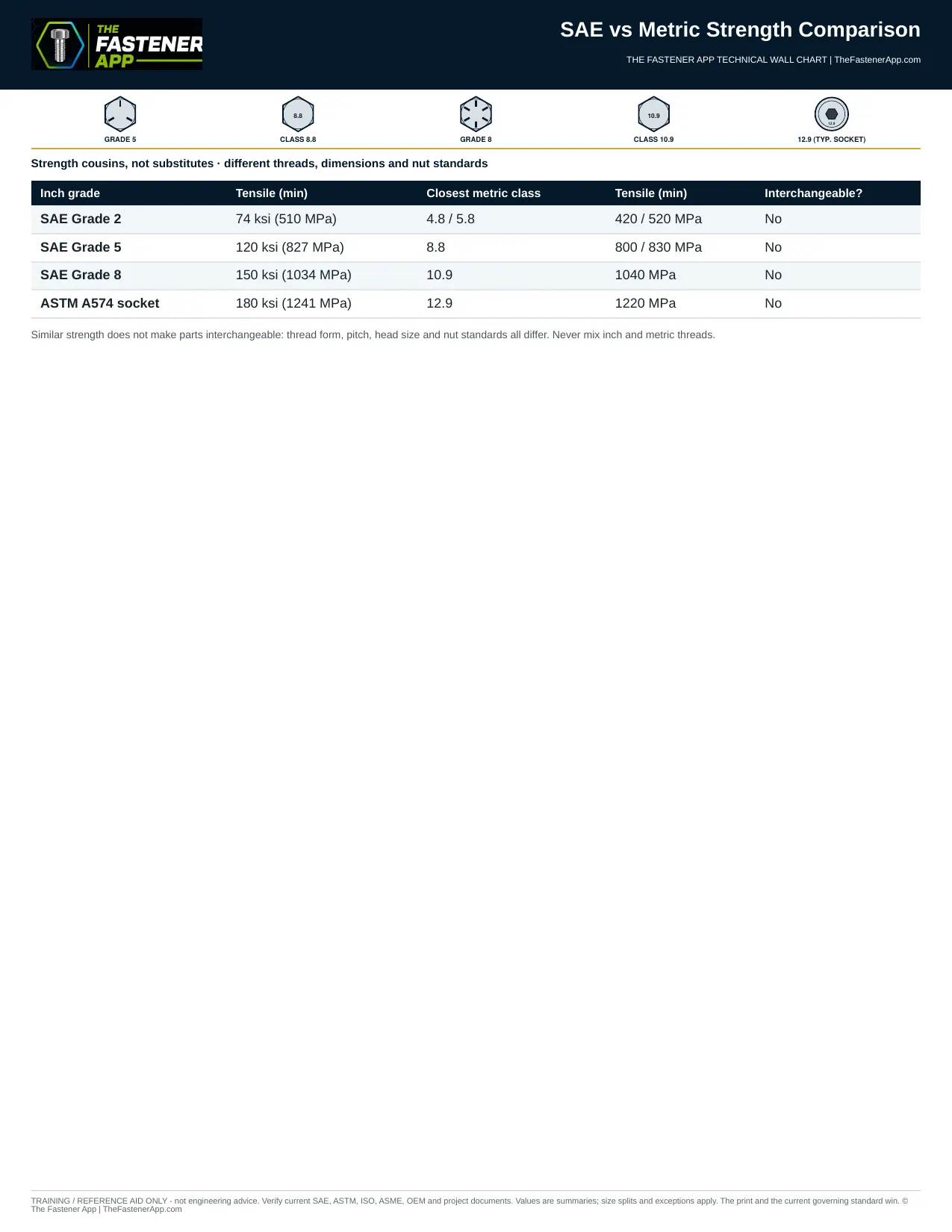
SAE vs Metric Strength Comparison
Printable shop wall chart: SAE vs Metric Strength Comparison. Free letter-size PDF to print and post at the counter; 25 x 36 inch poster version available.
 25 x 36 inch poster version →Report an error on this sheet
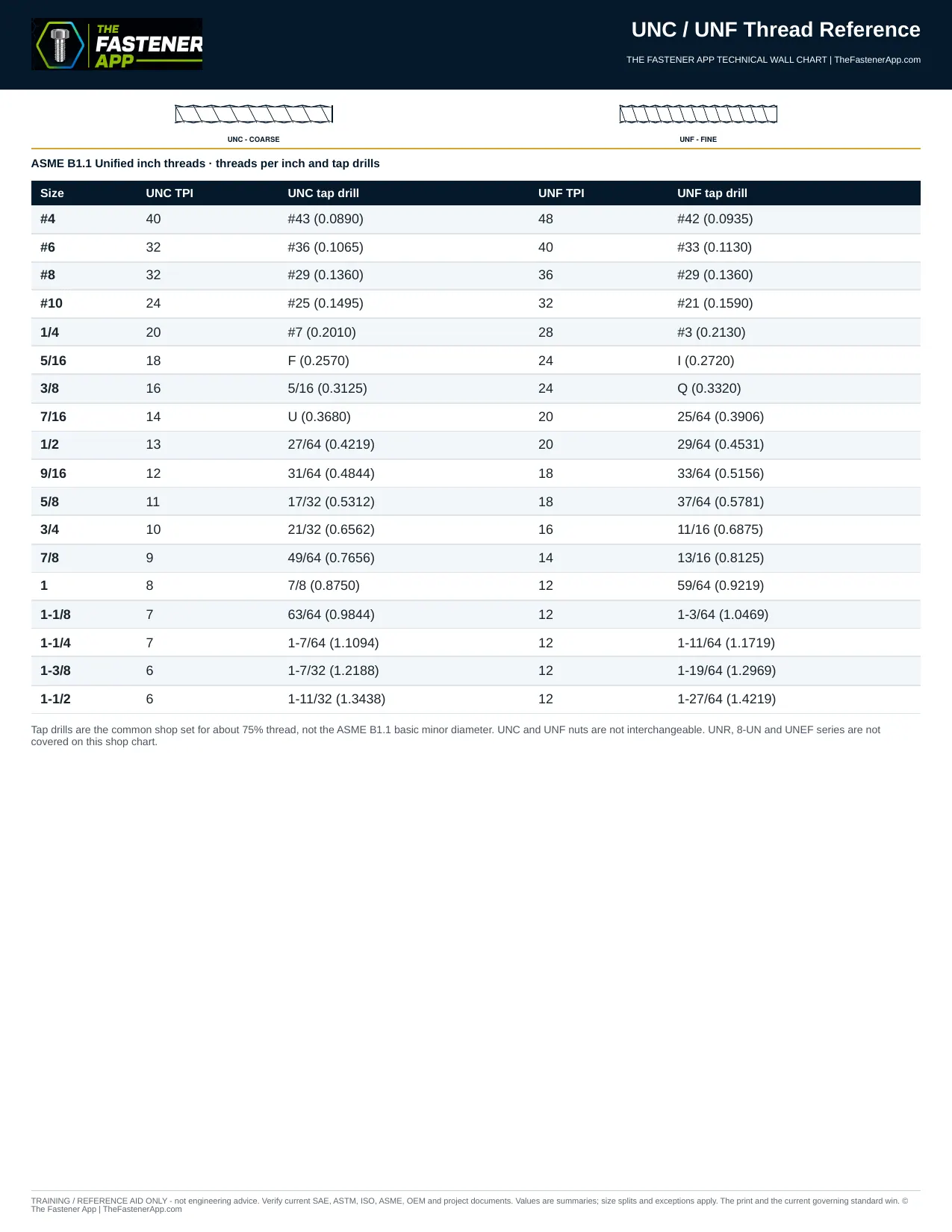
UNC / UNF Thread Reference
Printable shop wall chart: UNC / UNF Thread Reference. Free letter-size PDF to print and post at the counter; 25 x 36 inch poster version available.
 25 x 36 inch poster version →Report an error on this sheet
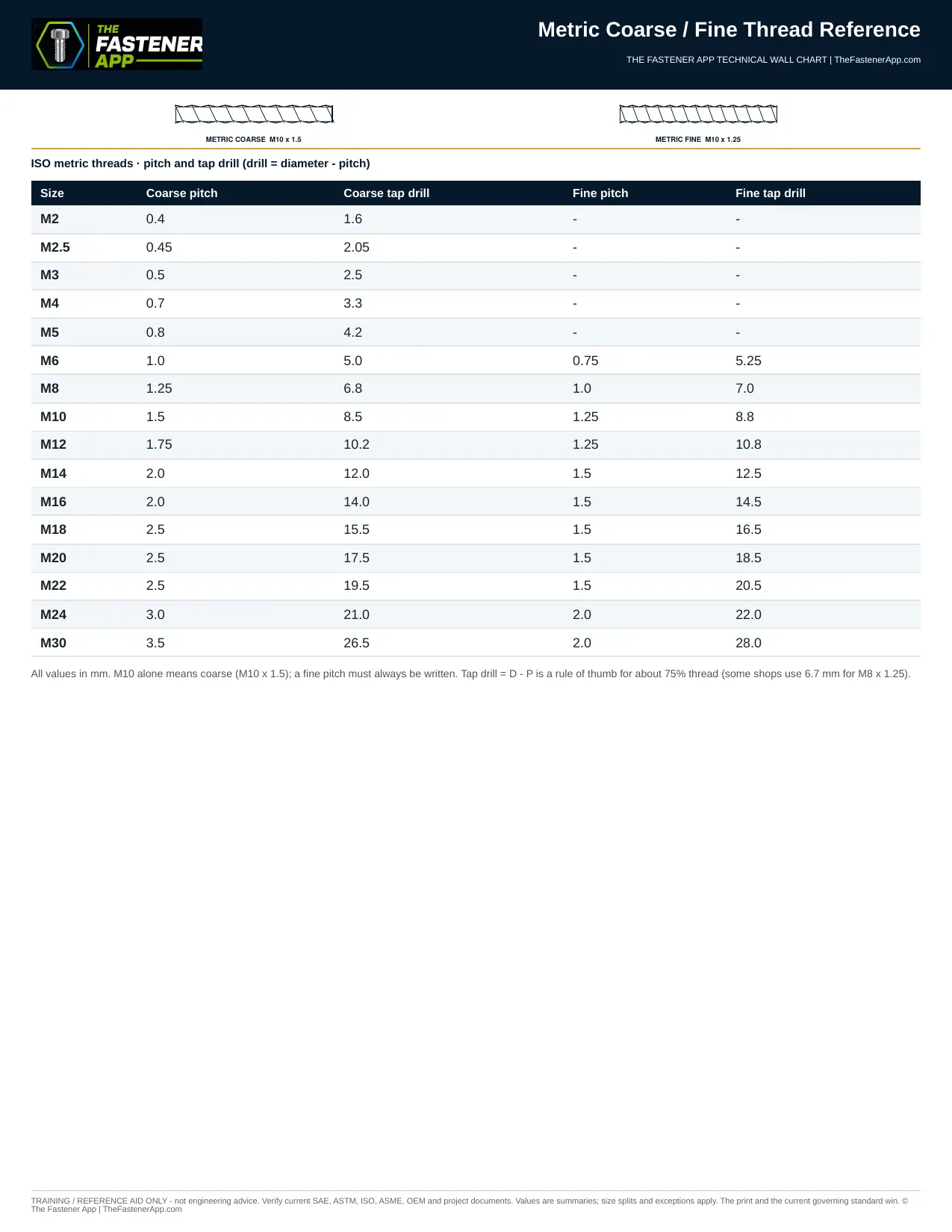
Metric Coarse / Fine Thread Reference
Printable shop wall chart: Metric Coarse / Fine Thread Reference. Free letter-size PDF to print and post at the counter; 25 x 36 inch poster version available.
 25 x 36 inch poster version →Report an error on this sheet
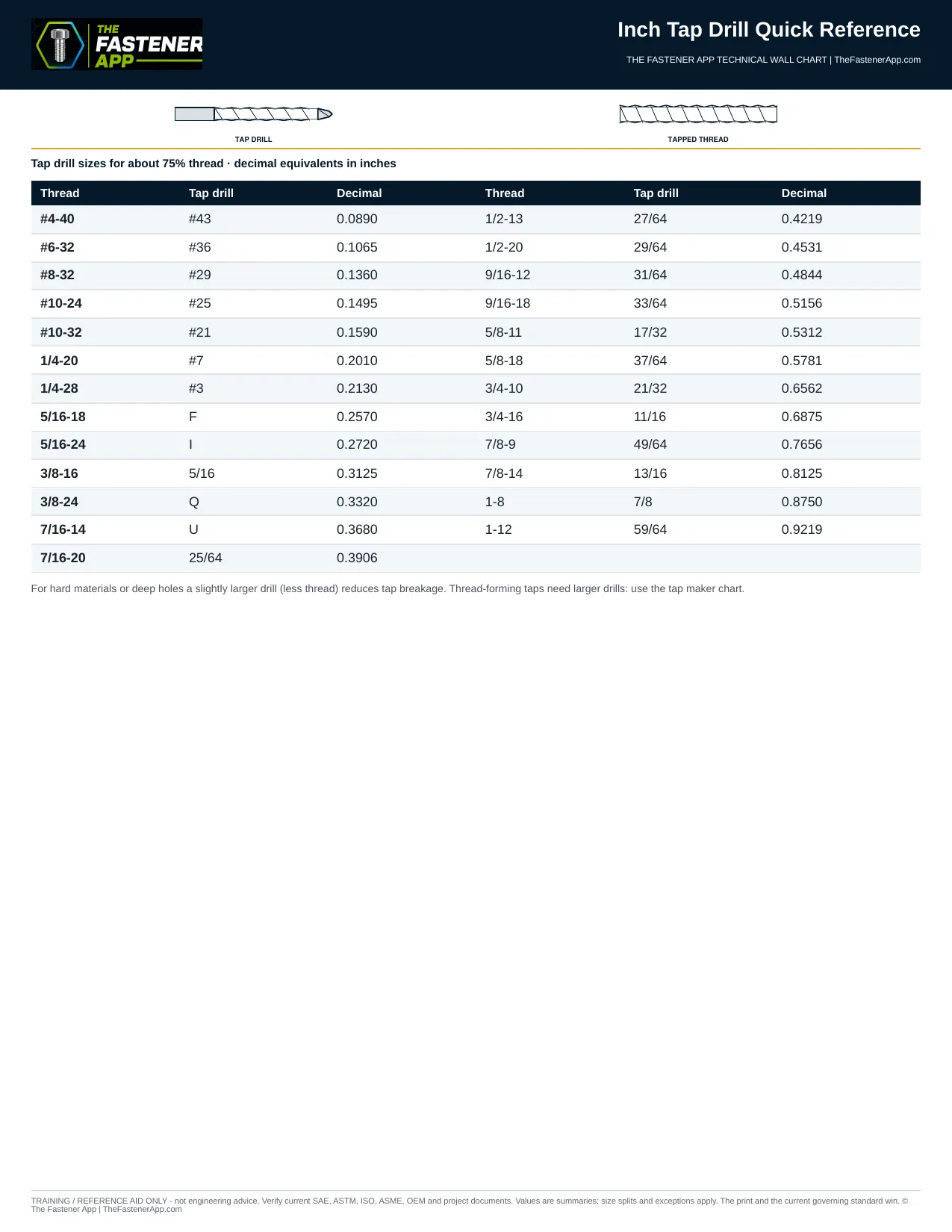
Inch Tap Drill Quick Reference
Printable shop wall chart: Inch Tap Drill Quick Reference. Free letter-size PDF to print and post at the counter; 25 x 36 inch poster version available.
 25 x 36 inch poster version →Report an error on this sheet
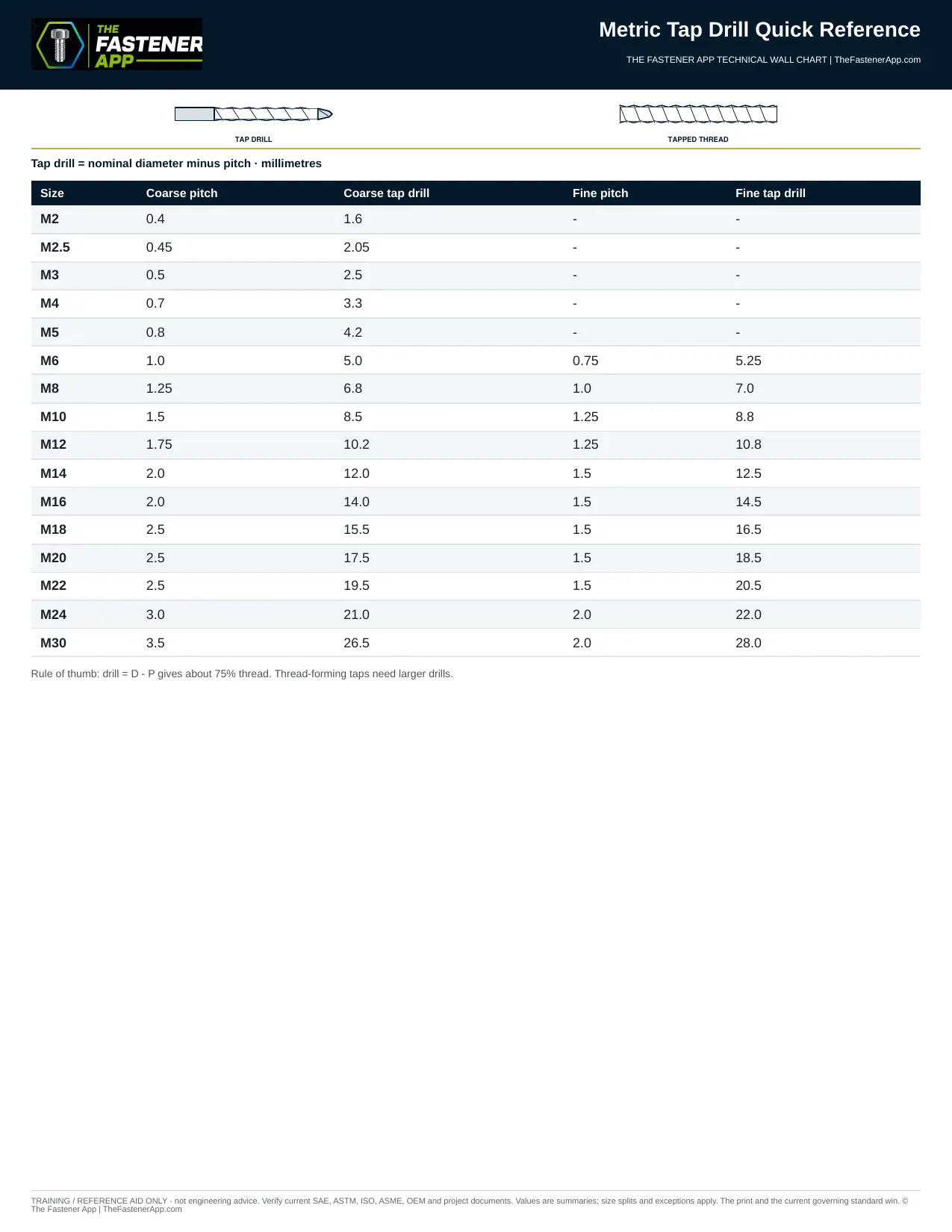
Metric Tap Drill Quick Reference
Printable shop wall chart: Metric Tap Drill Quick Reference. Free letter-size PDF to print and post at the counter; 25 x 36 inch poster version available.
 25 x 36 inch poster version →Report an error on this sheet
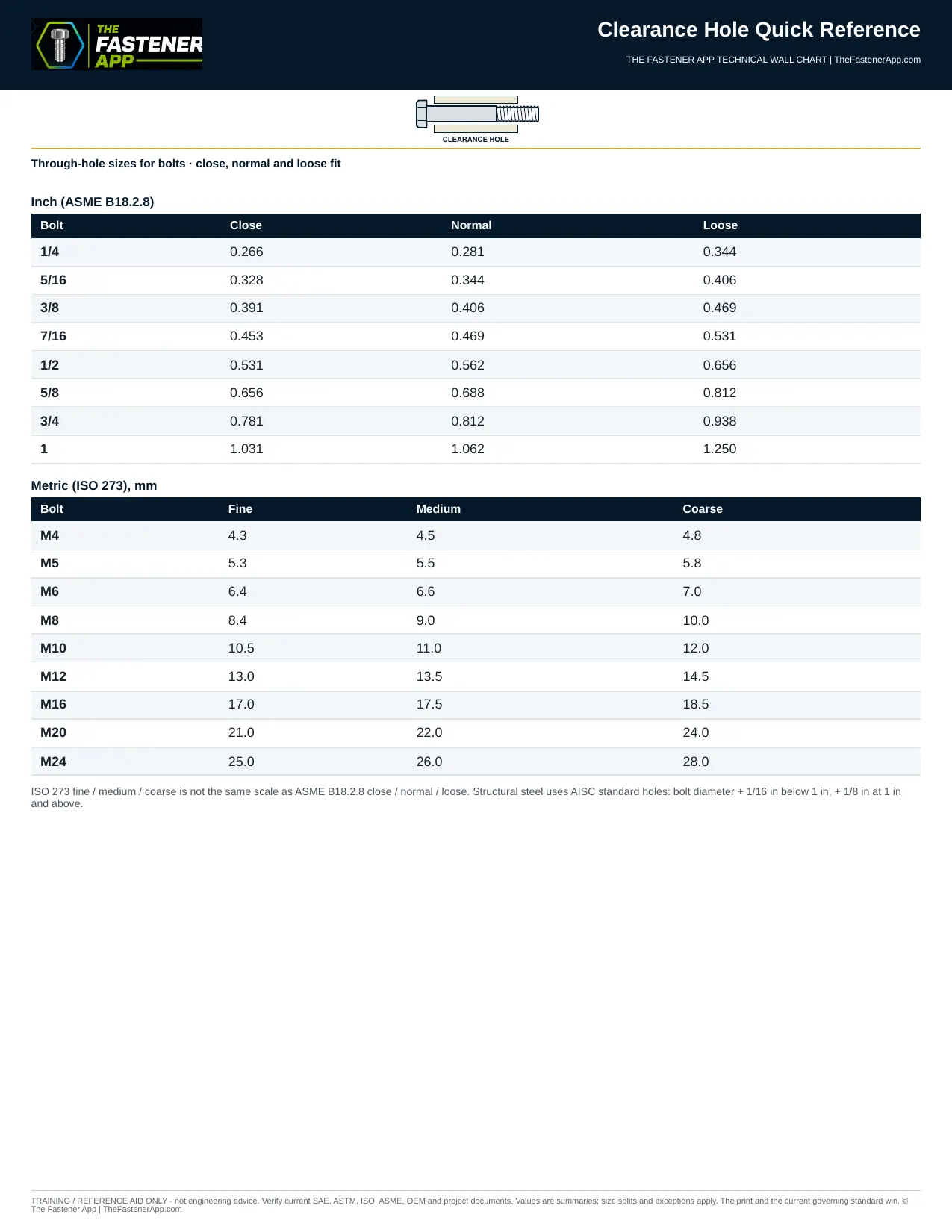
Clearance Hole Quick Reference
Printable shop wall chart: Clearance Hole Quick Reference. Free letter-size PDF to print and post at the counter; 25 x 36 inch poster version available.
 25 x 36 inch poster version →Report an error on this sheet
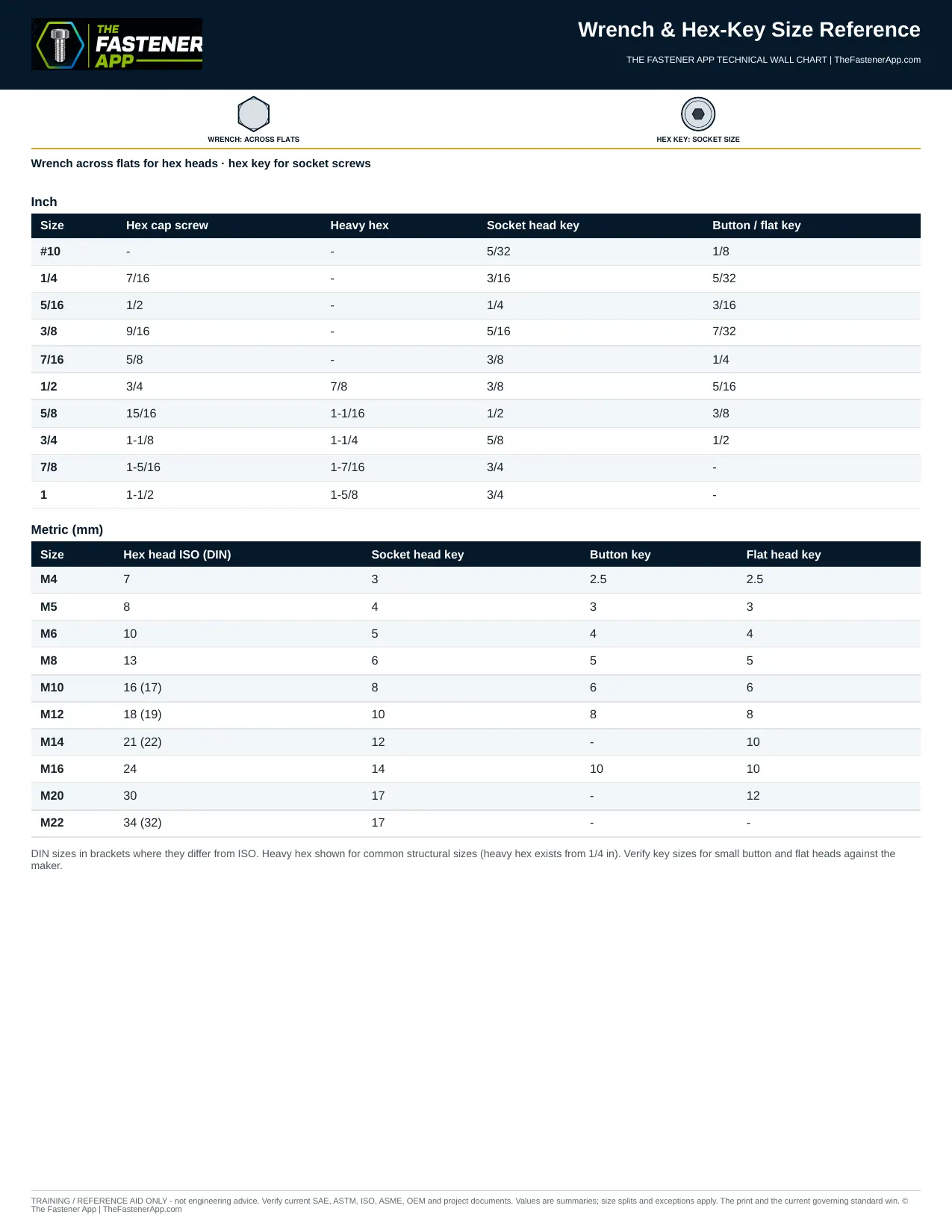
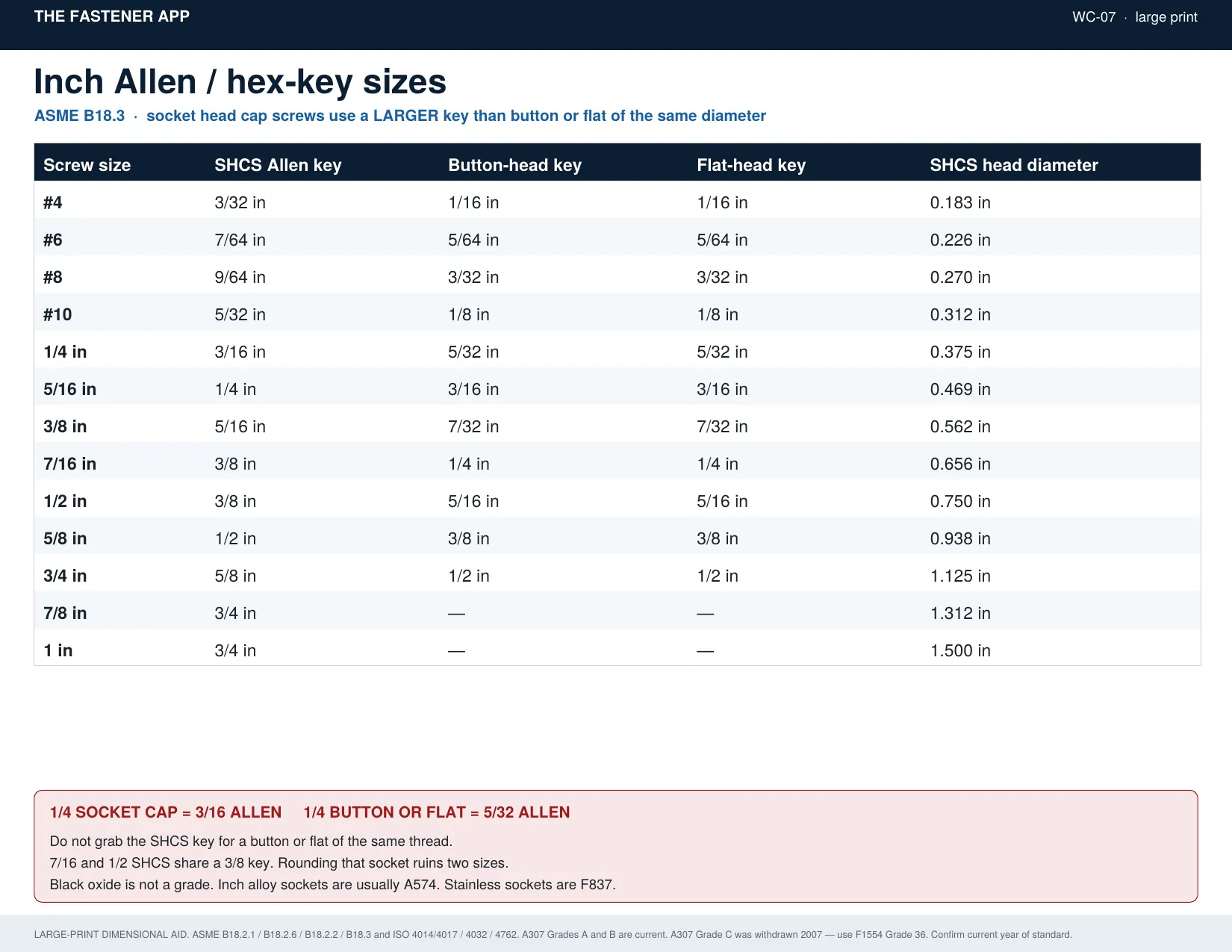
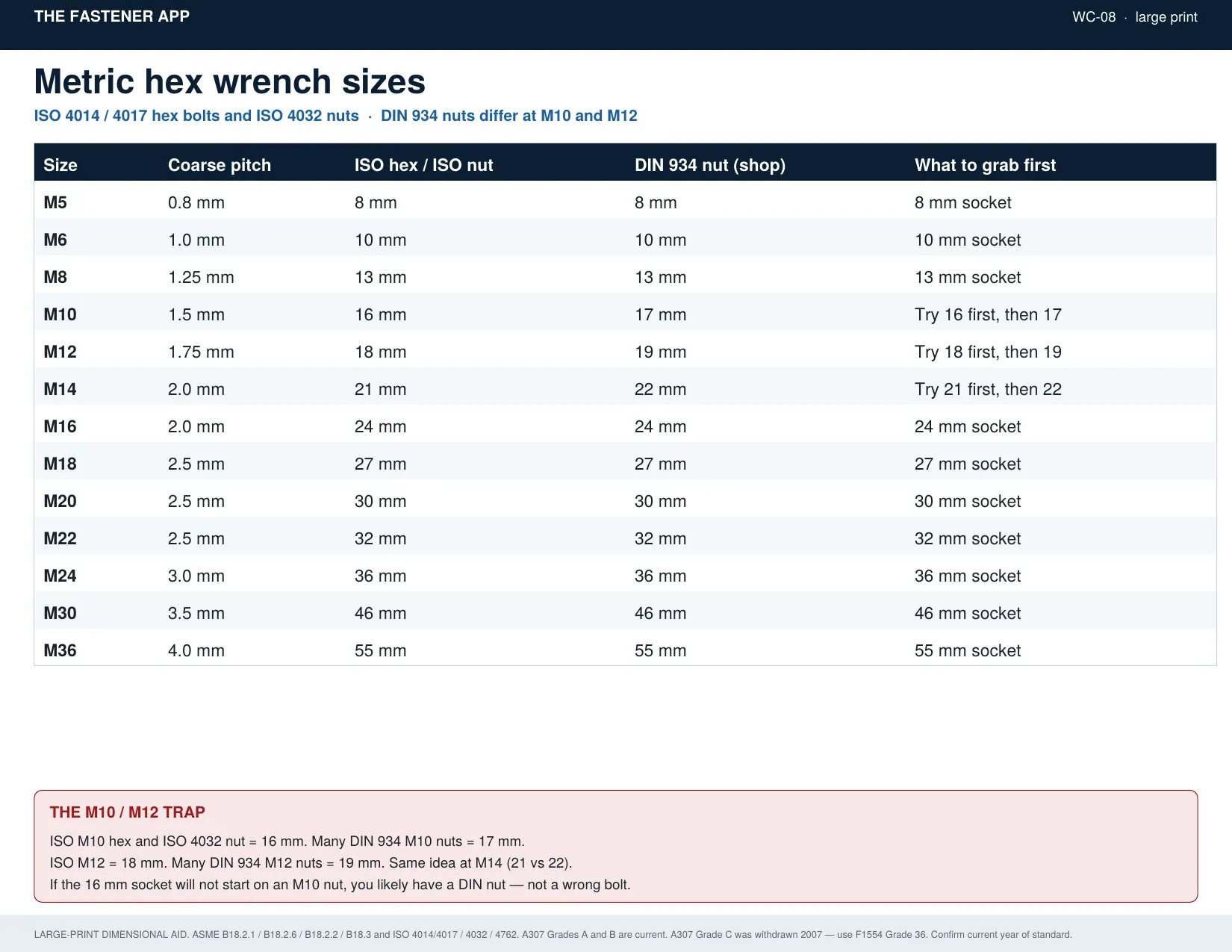
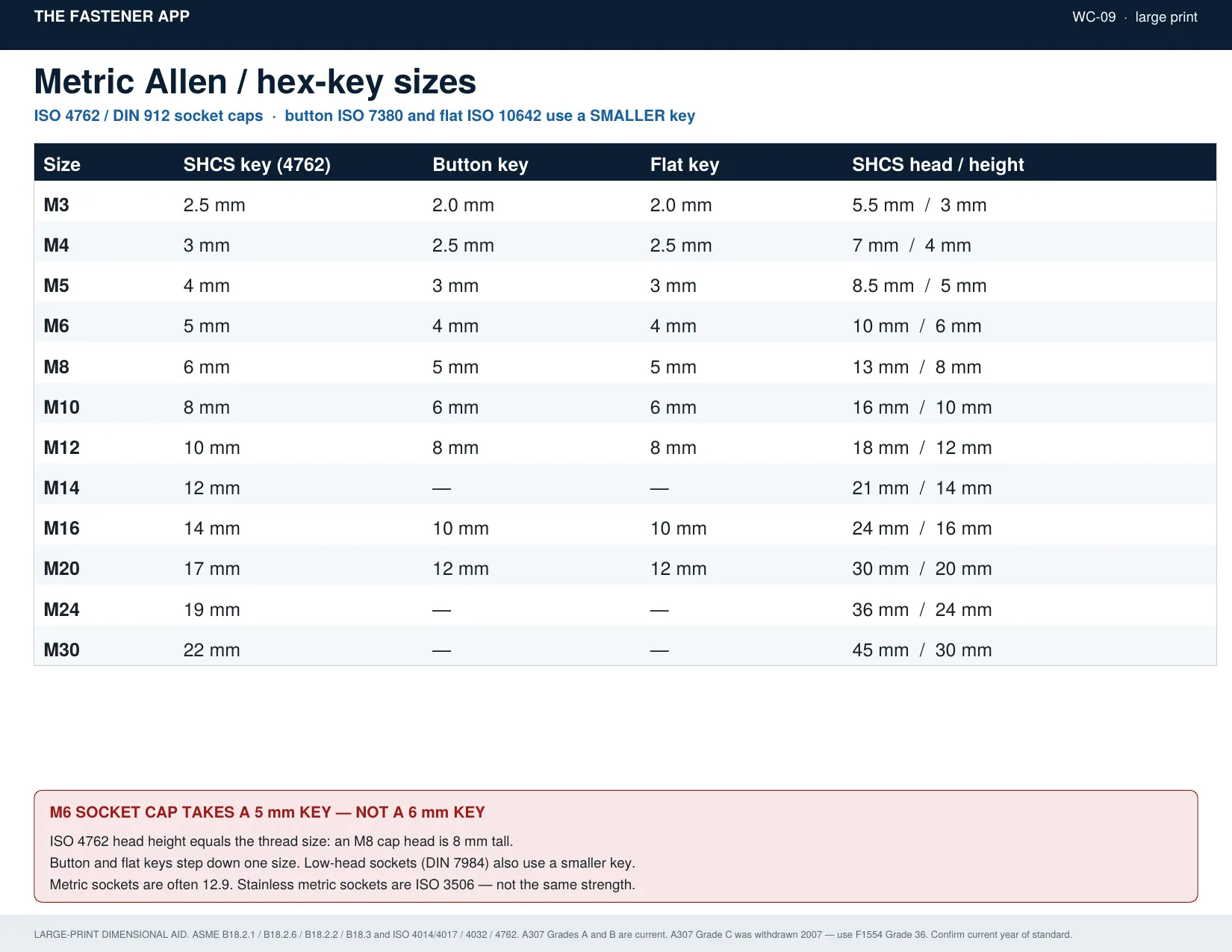
Wrench & Hex-Key Size Reference
Printable shop wall chart: Wrench & Hex-Key Size Reference. Free letter-size PDF to print and post at the counter; 25 x 36 inch poster version available.
 25 x 36 inch poster version →Report an error on this sheet
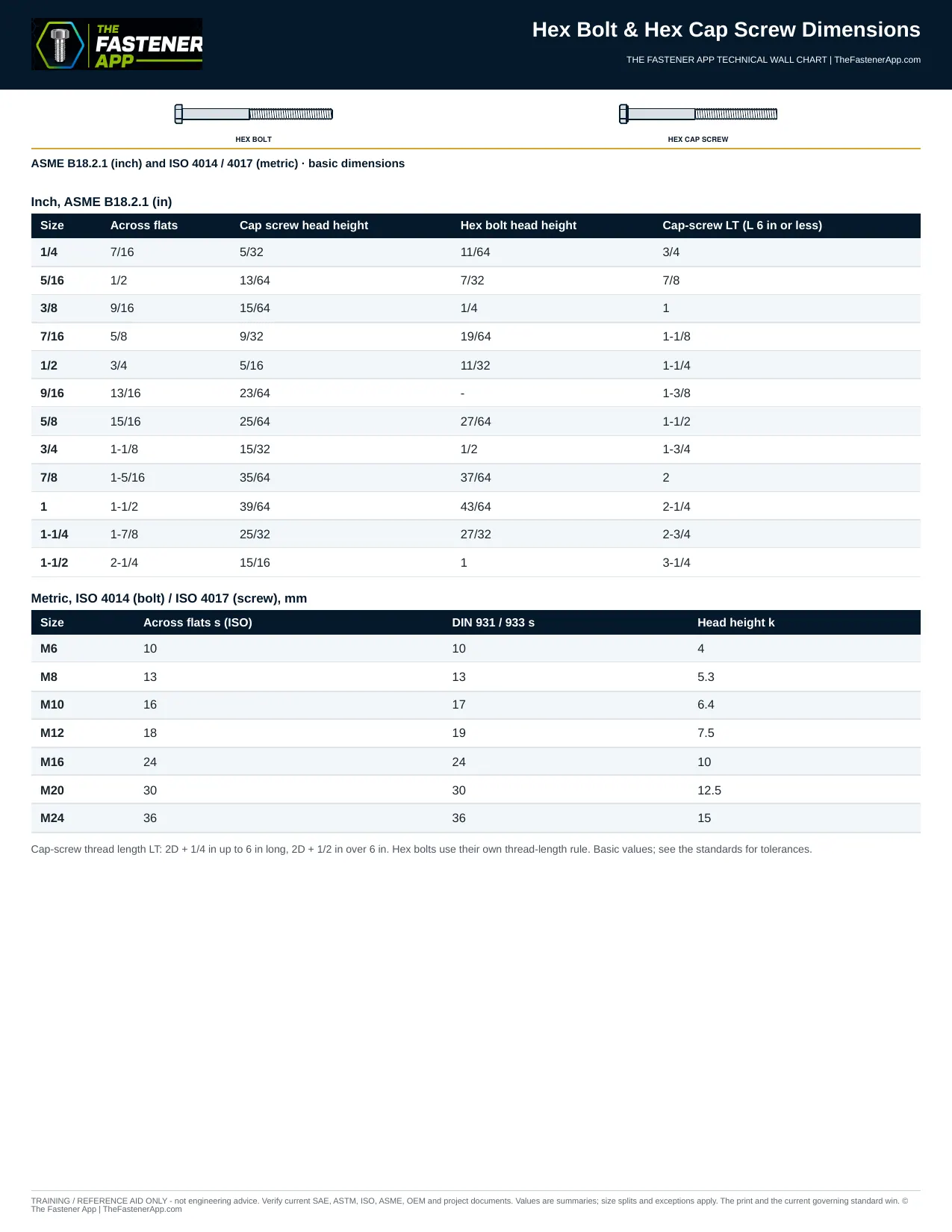
Hex Bolt & Hex Cap Screw Dimensions
Printable shop wall chart: Hex Bolt & Hex Cap Screw Dimensions. Free letter-size PDF to print and post at the counter; 25 x 36 inch poster version available.
 25 x 36 inch poster version →Report an error on this sheet
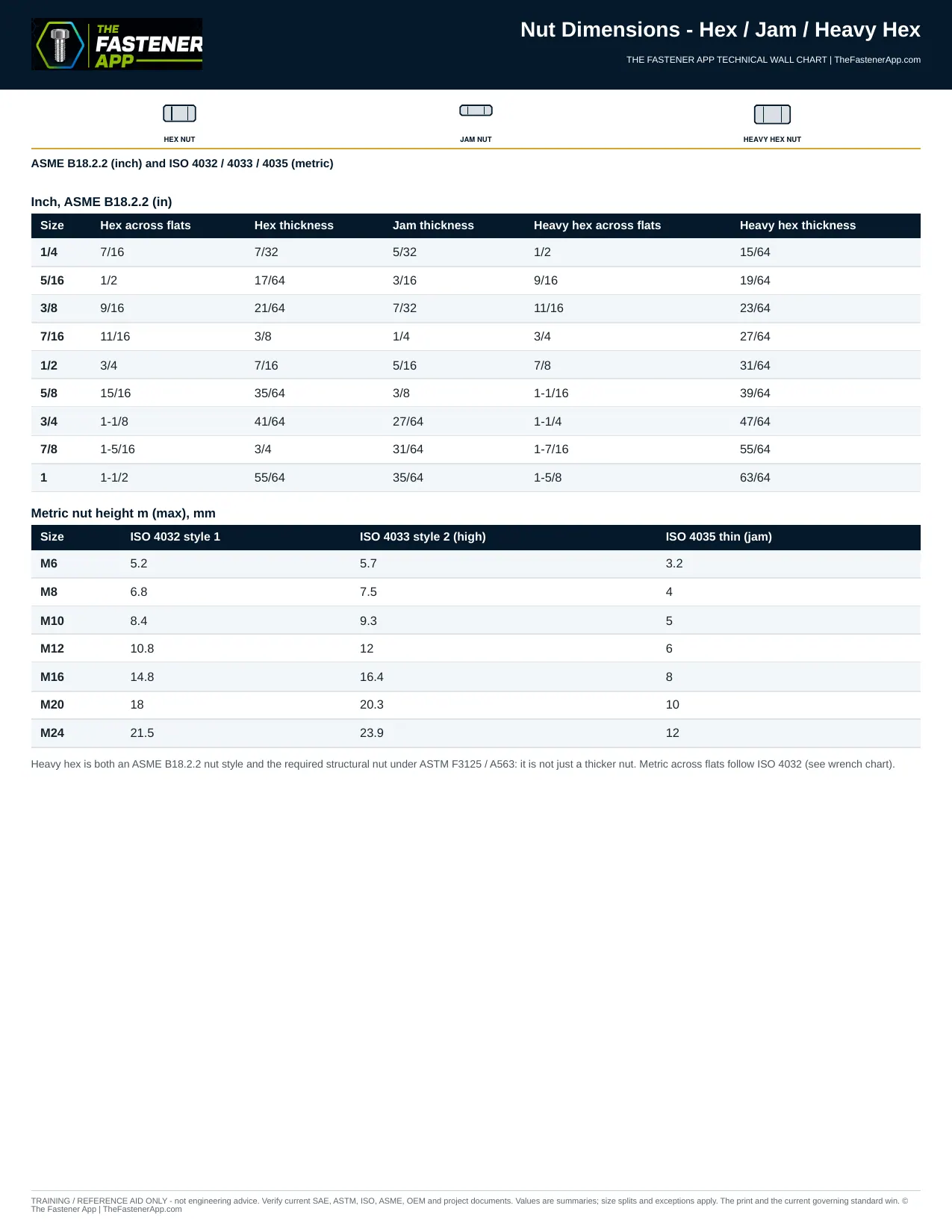
Nut Dimensions - Hex / Jam / Heavy Hex
Printable shop wall chart: Nut Dimensions - Hex / Jam / Heavy Hex. Free letter-size PDF to print and post at the counter; 25 x 36 inch poster version available.
 25 x 36 inch poster version →Report an error on this sheet
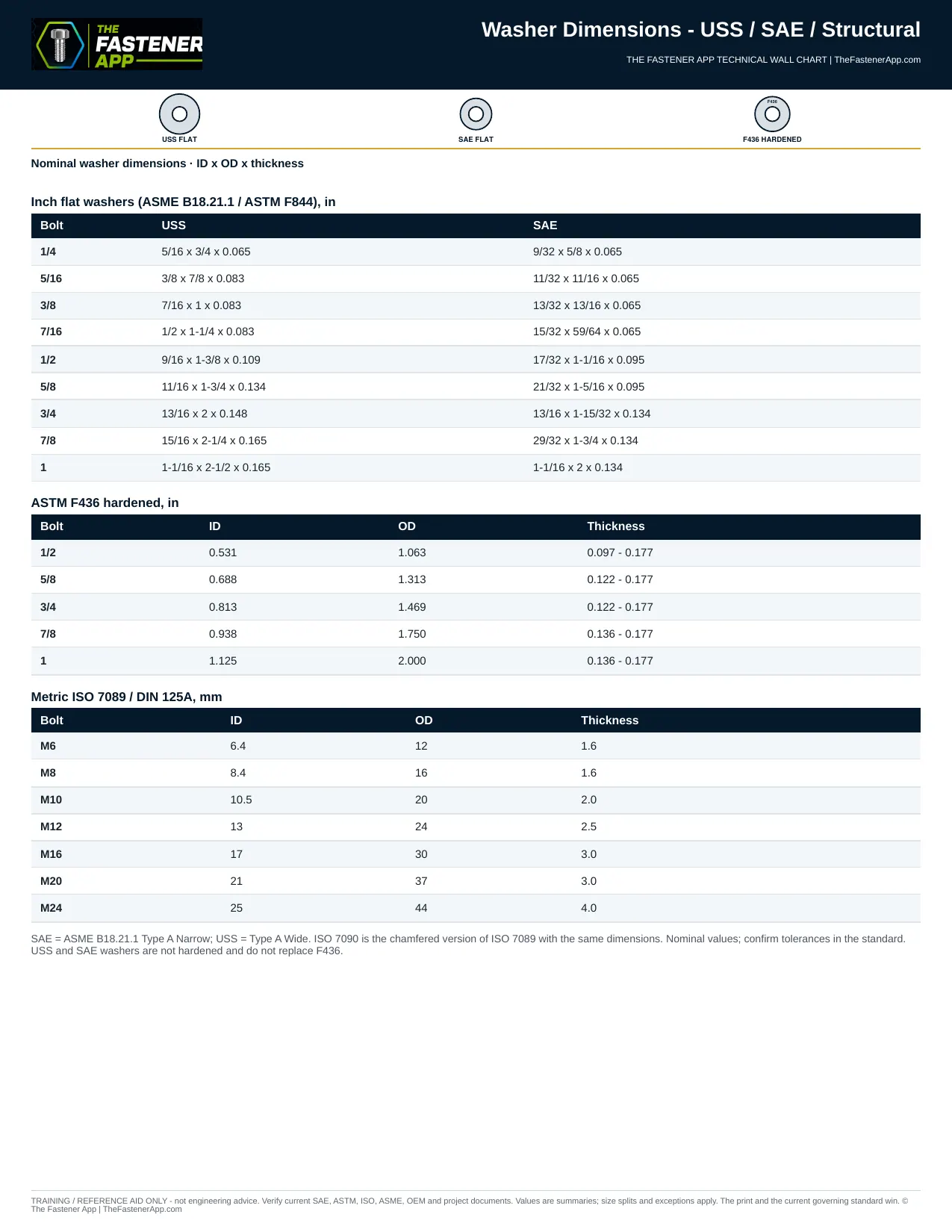
Washer Dimensions - USS / SAE / Structural
Printable shop wall chart: Washer Dimensions - USS / SAE / Structural. Free letter-size PDF to print and post at the counter; 25 x 36 inch poster version available.
 25 x 36 inch poster version →Report an error on this sheet
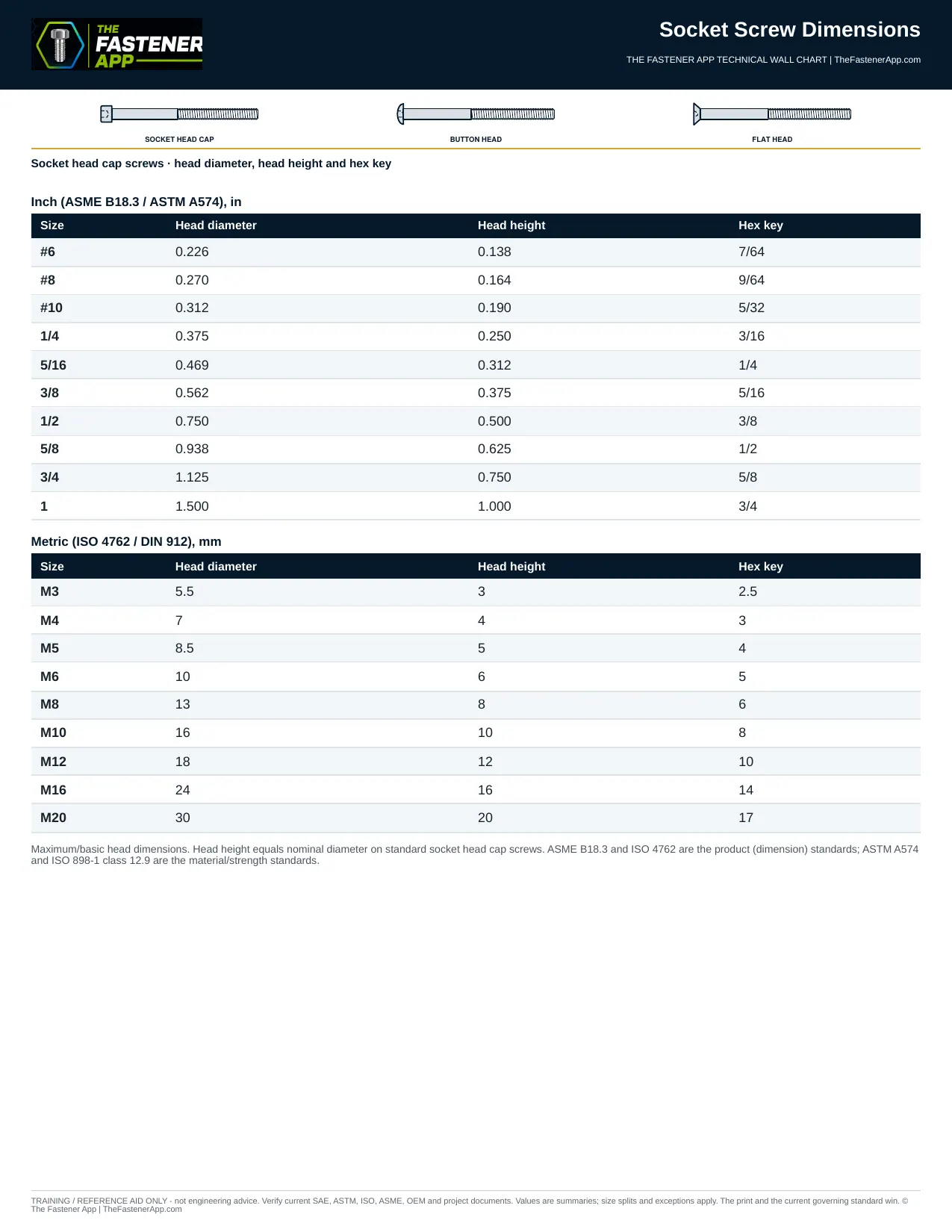
Socket Screw Dimensions
Printable shop wall chart: Socket Screw Dimensions. Free letter-size PDF to print and post at the counter; 25 x 36 inch poster version available.
 25 x 36 inch poster version →Report an error on this sheet
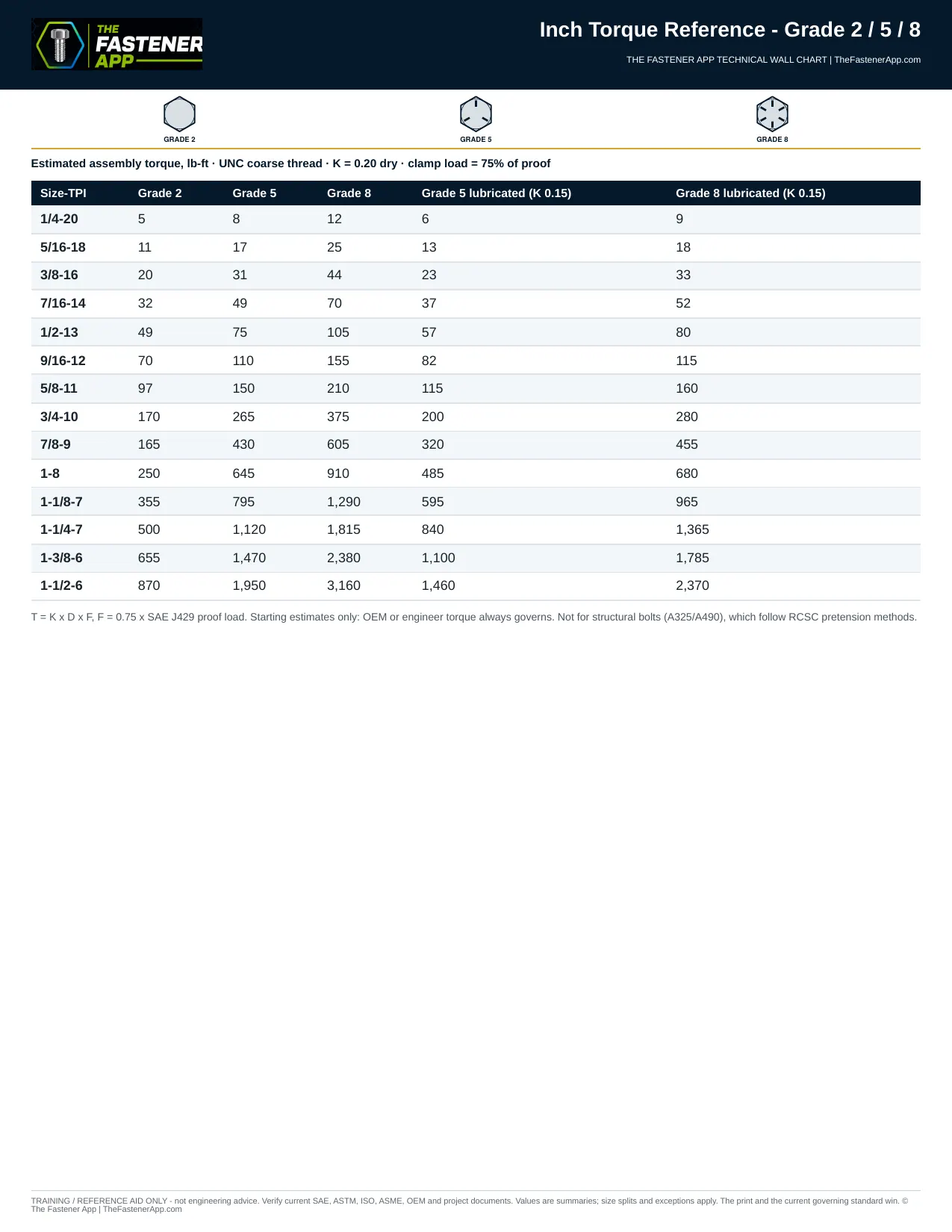
Inch Torque Reference - Grade 2 / 5 / 8
Printable shop wall chart: Inch Torque Reference - Grade 2 / 5 / 8. Free letter-size PDF to print and post at the counter; 25 x 36 inch poster version available.
 25 x 36 inch poster version →Report an error on this sheet
Metric Torque Reference - 8.8 / 10.9 / 12.9
Printable shop wall chart: Metric Torque Reference - 8.8 / 10.9 / 12.9. Free letter-size PDF to print and post at the counter; 25 x 36 inch poster version available.
 25 x 36 inch poster version →Report an error on this sheet
Coatings & Corrosion Selection
Printable shop wall chart: Coatings & Corrosion Selection. Free letter-size PDF to print and post at the counter; 25 x 36 inch poster version available.
 25 x 36 inch poster version →Report an error on this sheet
Stainless / Marine / Corrosion Selection
Printable shop wall chart: Stainless / Marine / Corrosion Selection. Free letter-size PDF to print and post at the counter; 25 x 36 inch poster version available.
 25 x 36 inch poster version →Report an error on this sheet
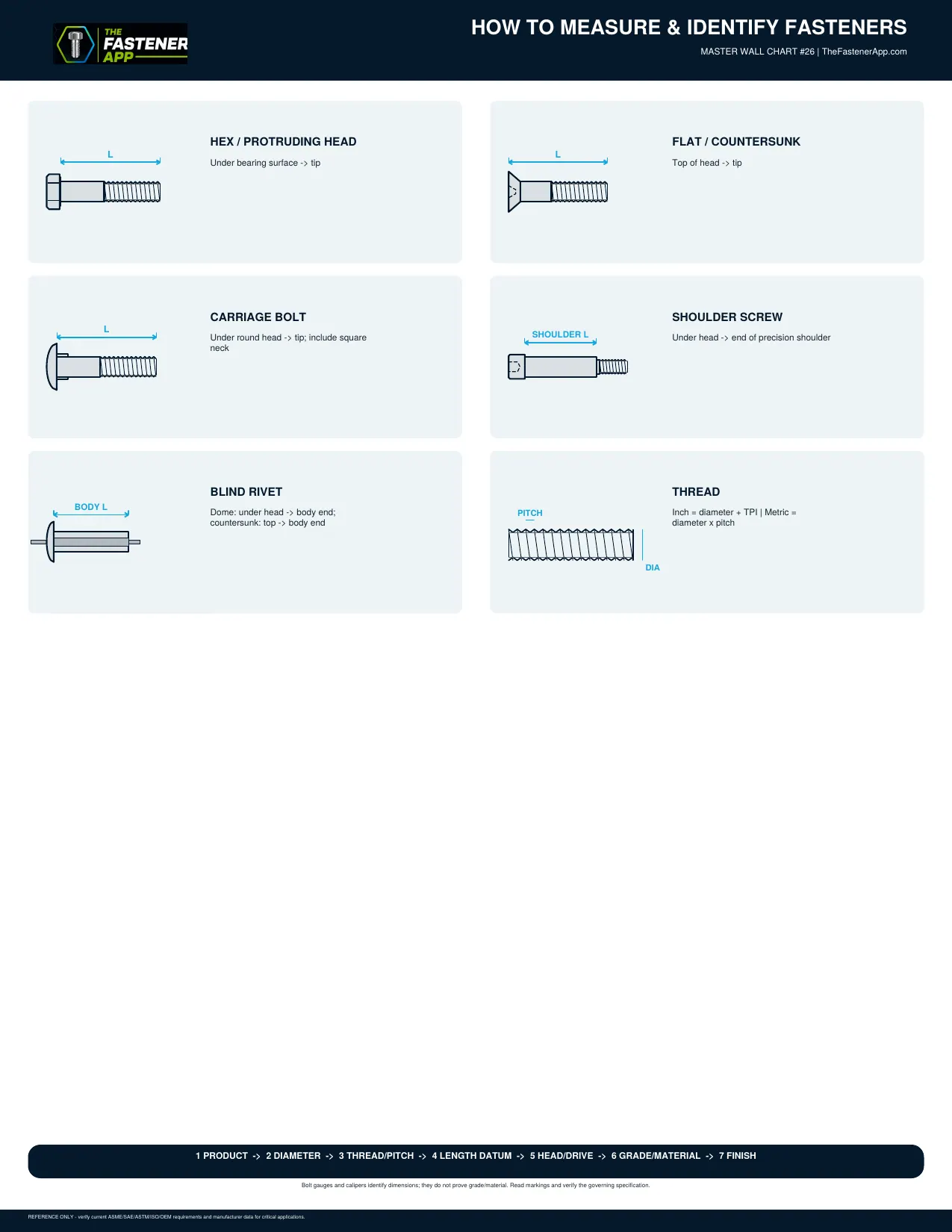
HOW TO MEASURE & IDENTIFY FASTENERS
Printable shop wall chart: HOW TO MEASURE & IDENTIFY FASTENERS. Free letter-size PDF to print and post at the counter; 25 x 36 inch poster version available.
 25 x 36 inch poster version →Report an error on this sheet
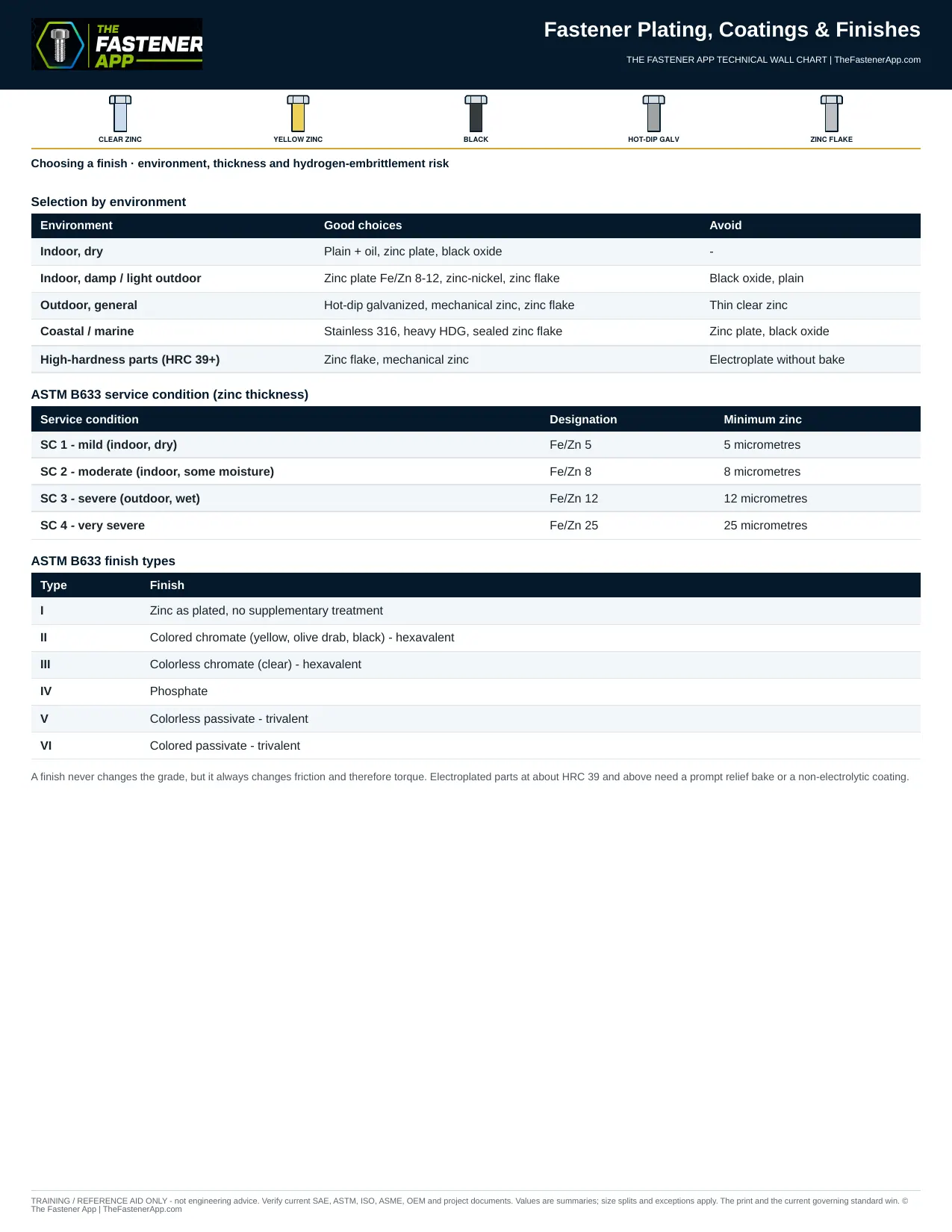
#27 FASTENER PLATING, COATINGS & FINISHES
Printable shop wall chart: #27 FASTENER PLATING, COATINGS & FINISHES. Free letter-size PDF to print and post at the counter; 25 x 36 inch poster version available.
 25 x 36 inch poster version →Report an error on this sheet
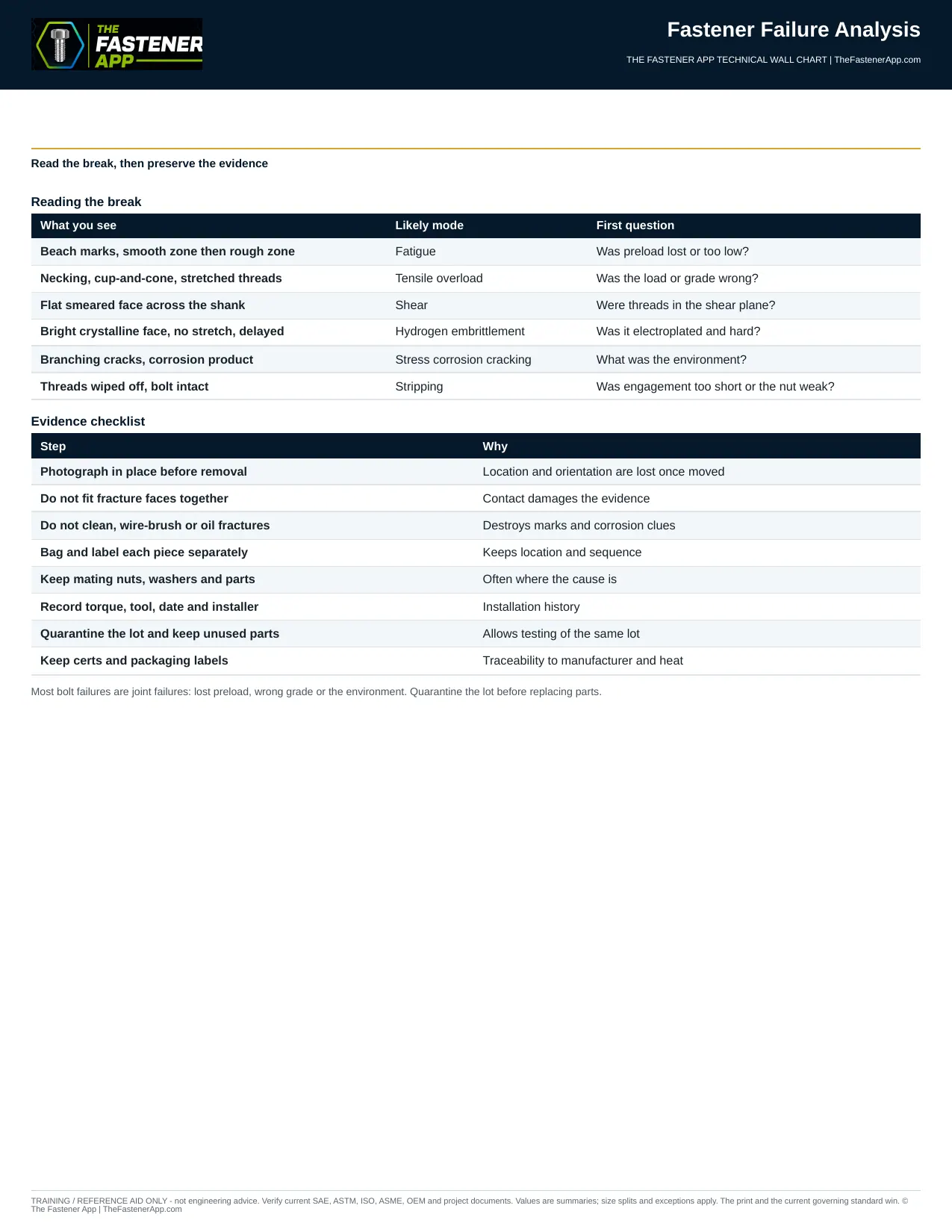
#28 FASTENER FAILURE ANALYSIS
Printable shop wall chart: #28 FASTENER FAILURE ANALYSIS. Free letter-size PDF to print and post at the counter; 25 x 36 inch poster version available.
 25 x 36 inch poster version →Report an error on this sheet
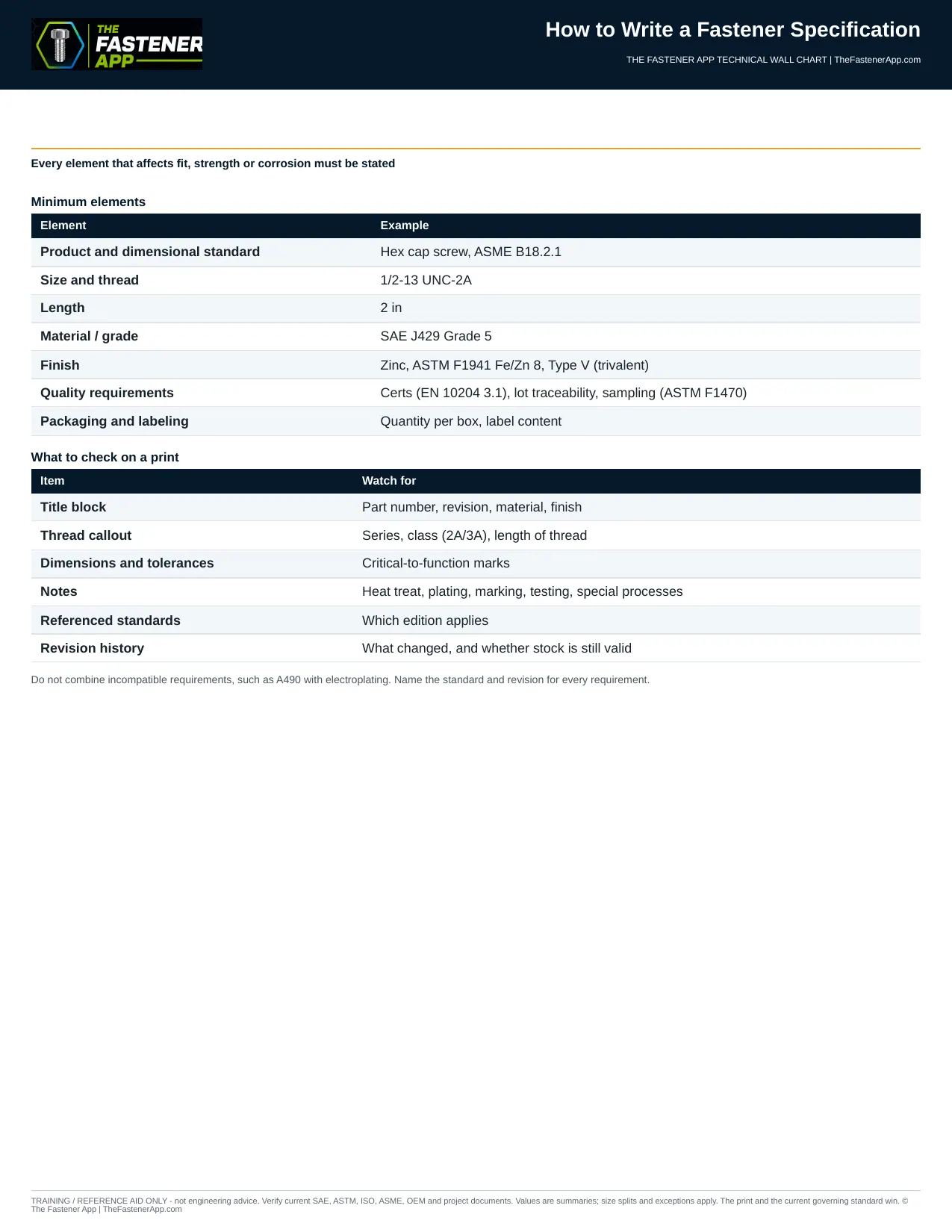
#29 HOW TO WRITE A FASTENER SPECIFICATION
Printable shop wall chart: #29 HOW TO WRITE A FASTENER SPECIFICATION. Free letter-size PDF to print and post at the counter; 25 x 36 inch poster version available.
 25 x 36 inch poster version →Report an error on this sheet
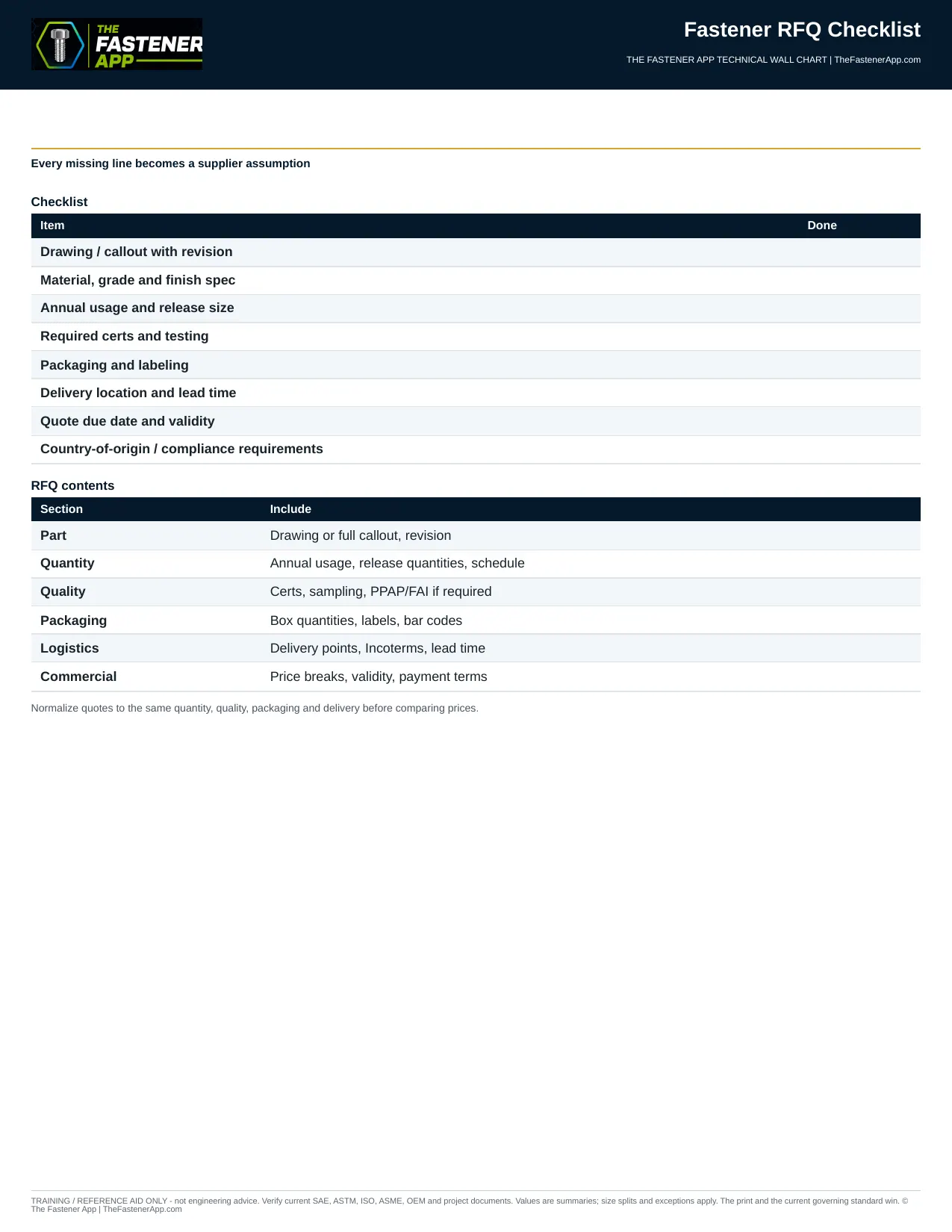
#30 FASTENER RFQ CHECKLIST
Printable shop wall chart: #30 FASTENER RFQ CHECKLIST. Free letter-size PDF to print and post at the counter; 25 x 36 inch poster version available.
 25 x 36 inch poster version →Report an error on this sheet
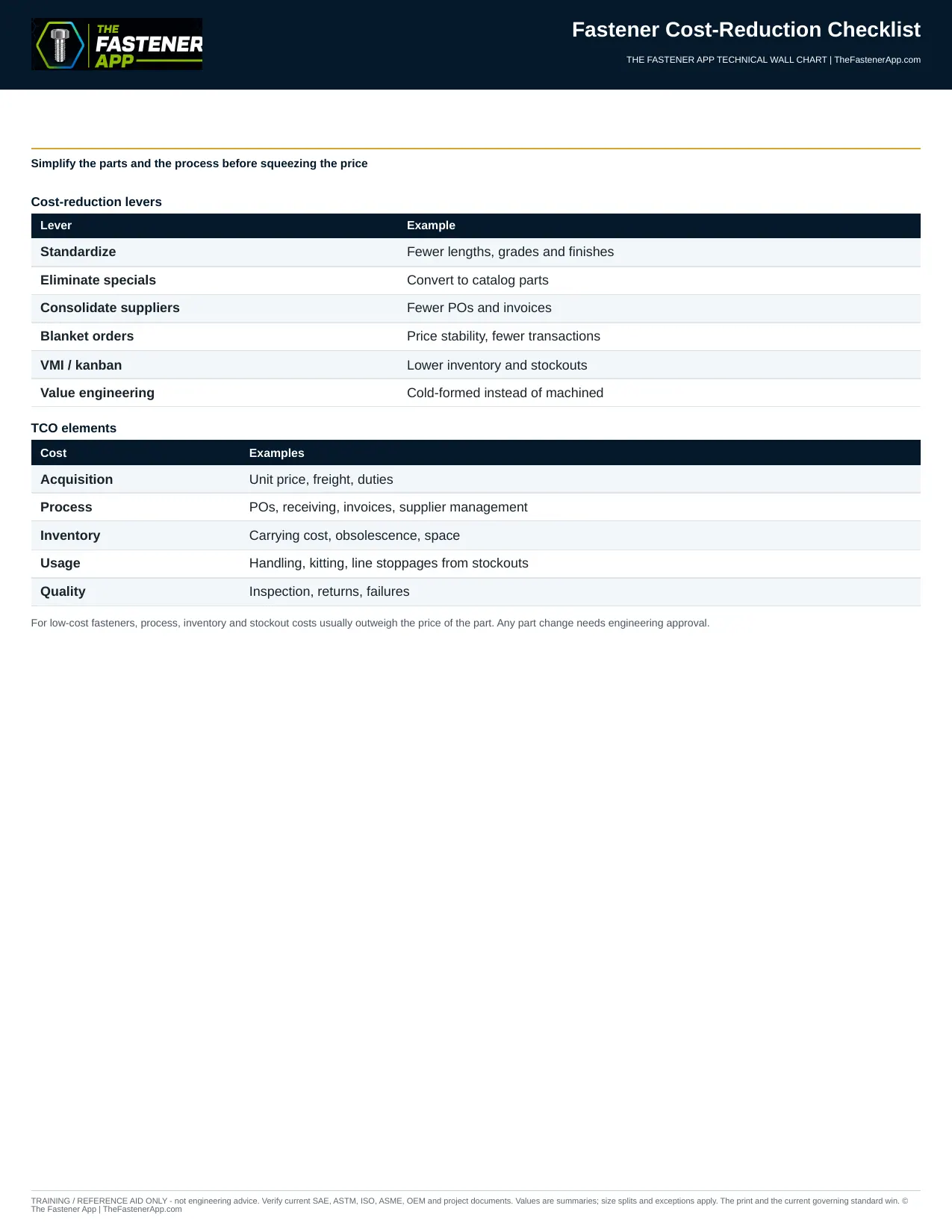
#31 FASTENER COST-REDUCTION CHECKLIST
Printable shop wall chart: #31 FASTENER COST-REDUCTION CHECKLIST. Free letter-size PDF to print and post at the counter; 25 x 36 inch poster version available.
 25 x 36 inch poster version →Report an error on this sheet
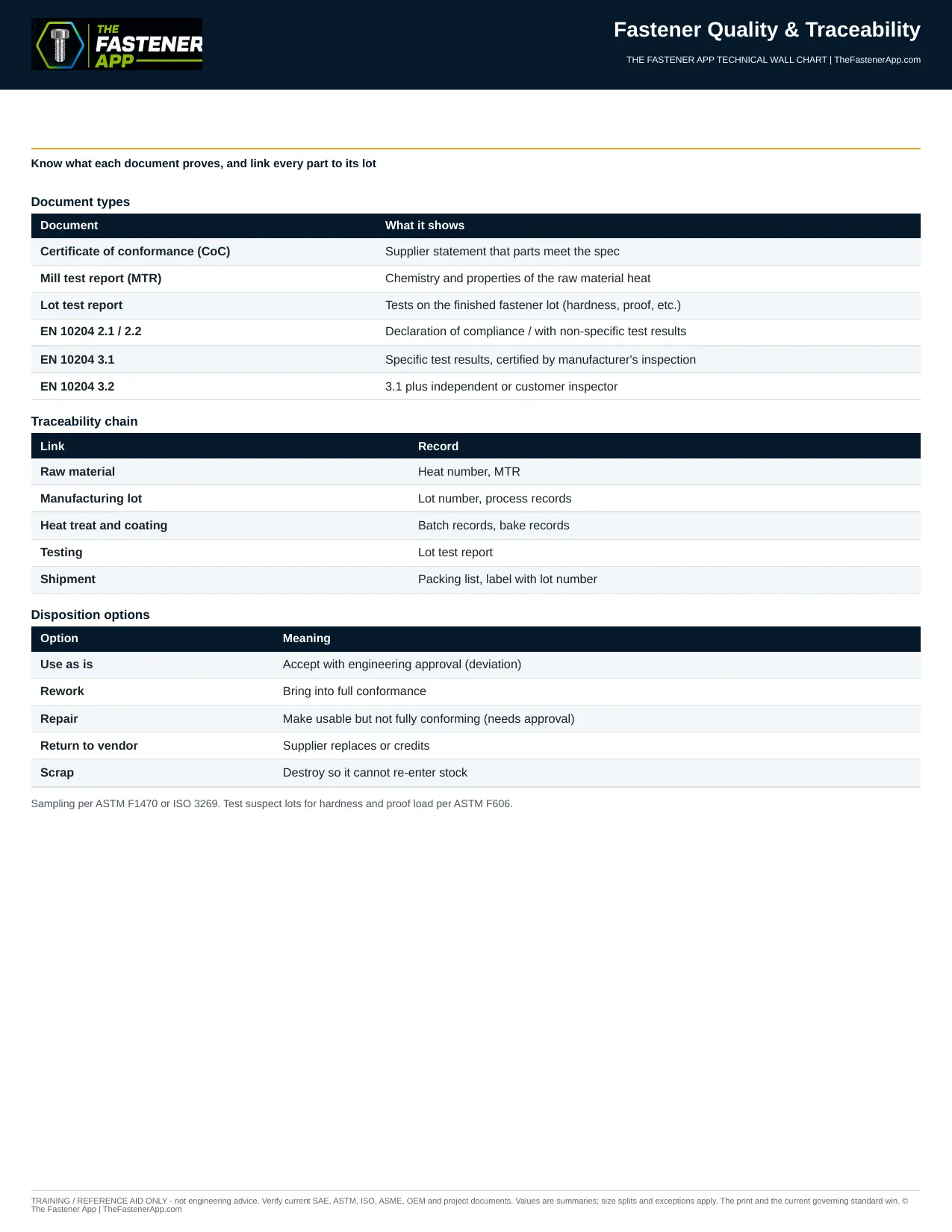
#32 FASTENER QUALITY & TRACEABILITY
Printable shop wall chart: #32 FASTENER QUALITY & TRACEABILITY. Free letter-size PDF to print and post at the counter; 25 x 36 inch poster version available.
 25 x 36 inch poster version →Report an error on this sheet
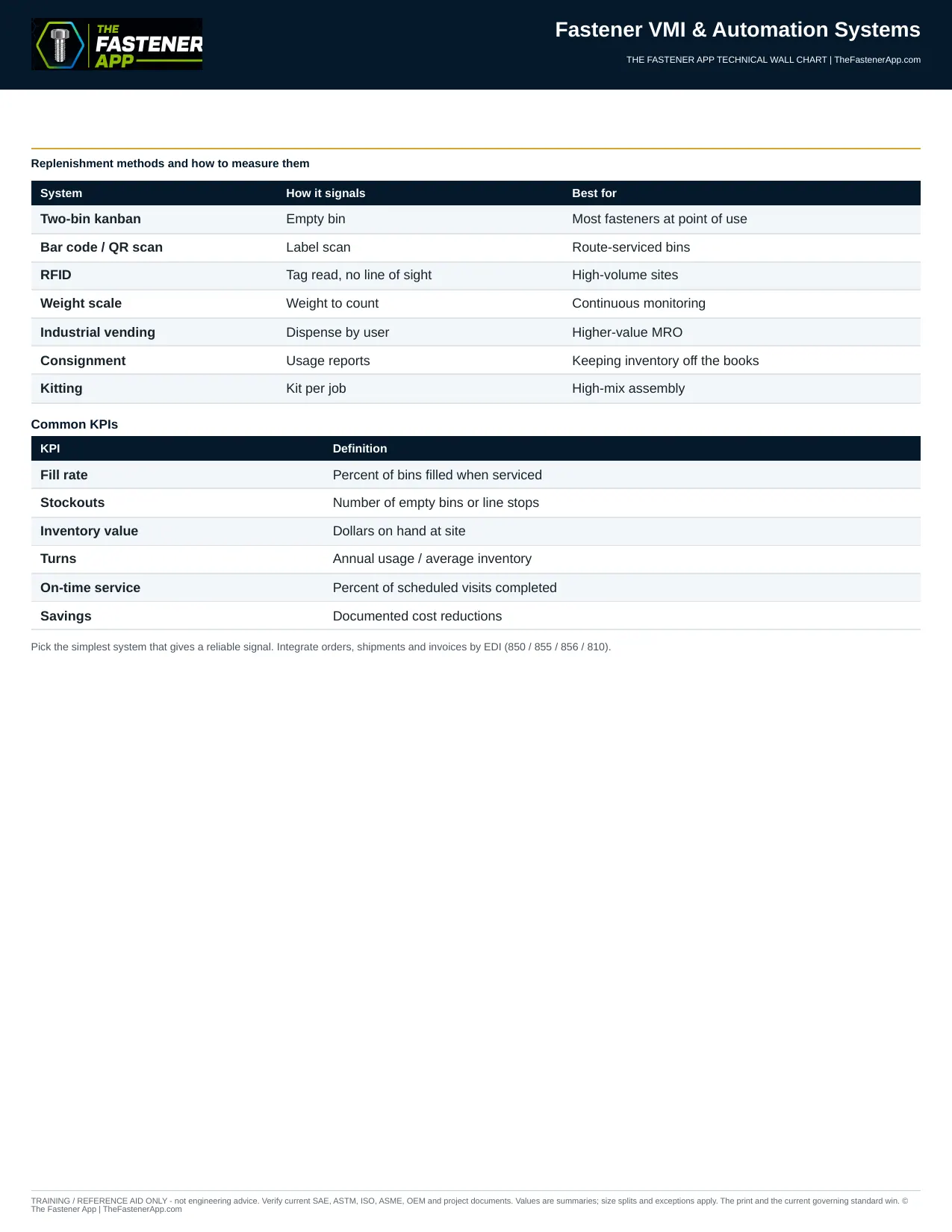
#33 FASTENER VMI / AUTOMATION SYSTEMS
Printable shop wall chart: #33 FASTENER VMI / AUTOMATION SYSTEMS. Free letter-size PDF to print and post at the counter; 25 x 36 inch poster version available.
 25 x 36 inch poster version →Report an error on this sheet
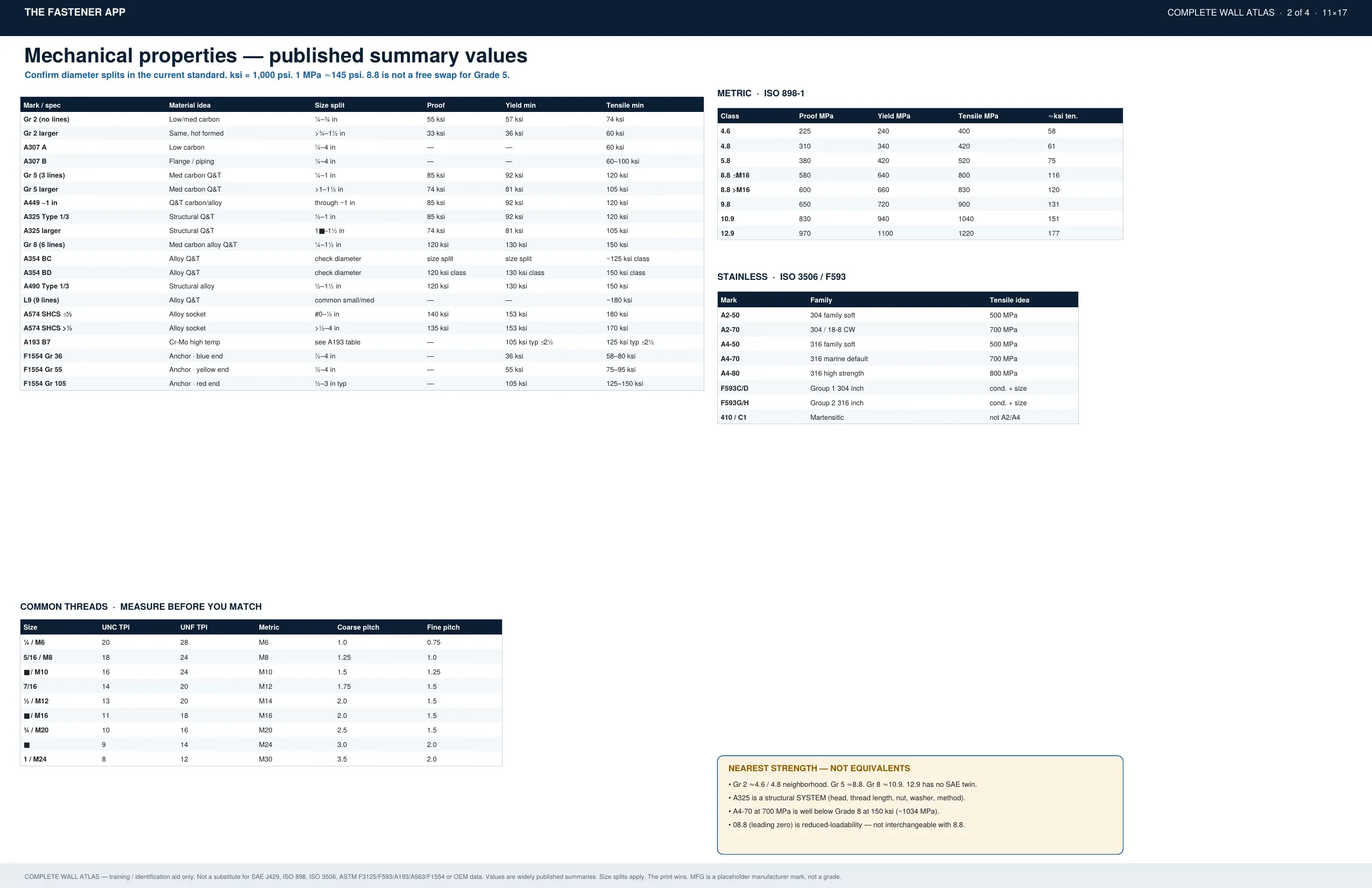
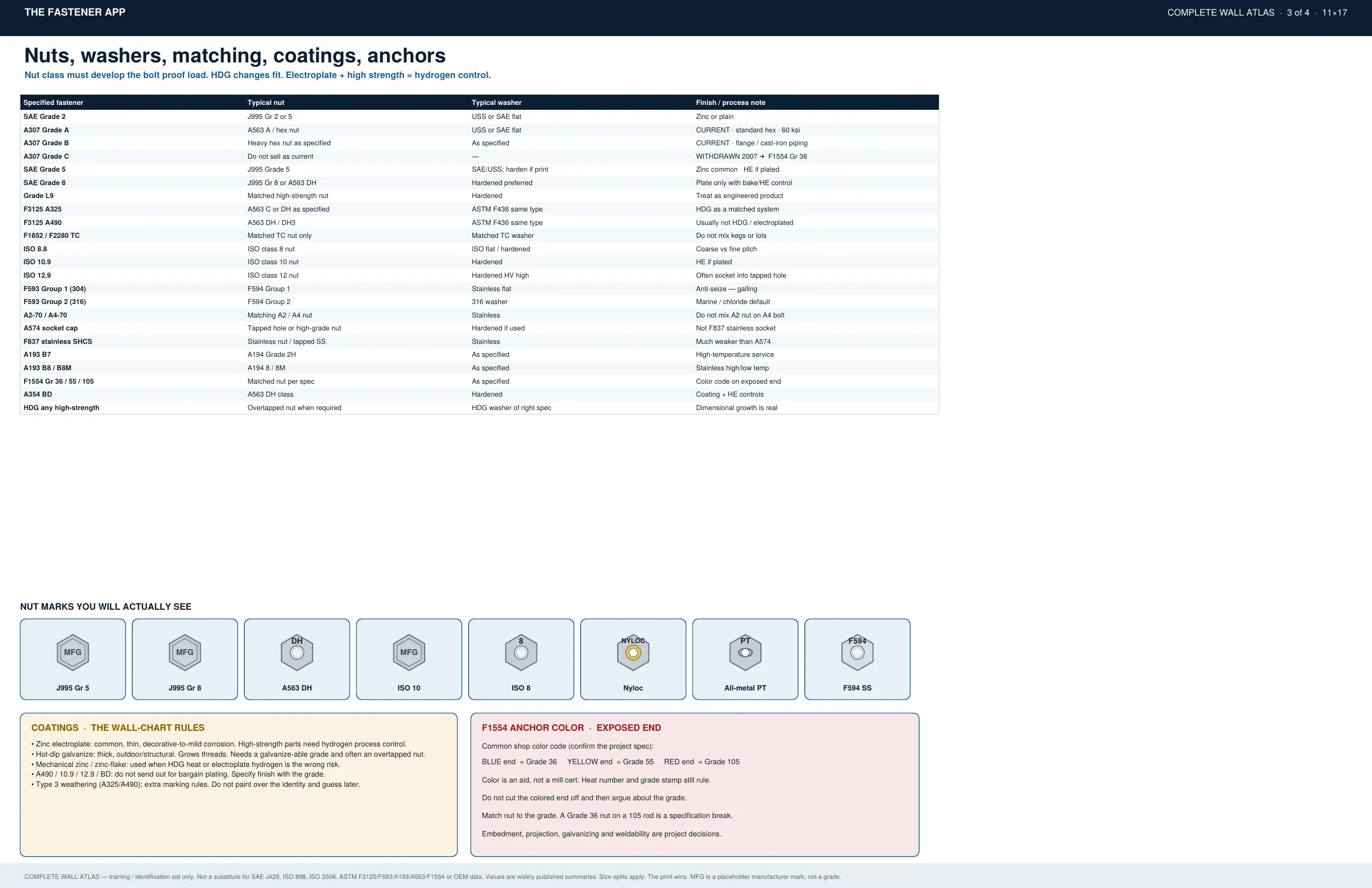
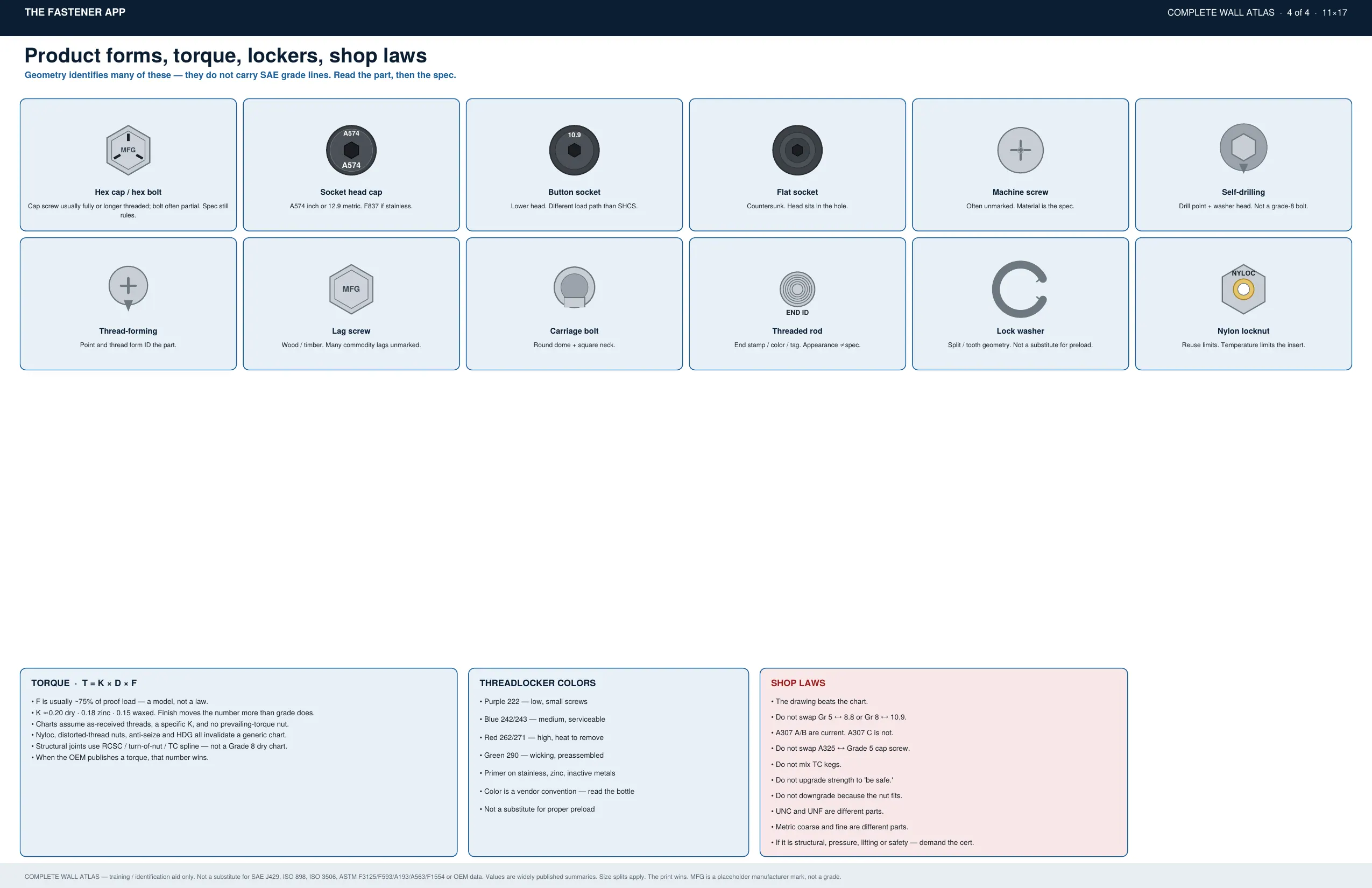
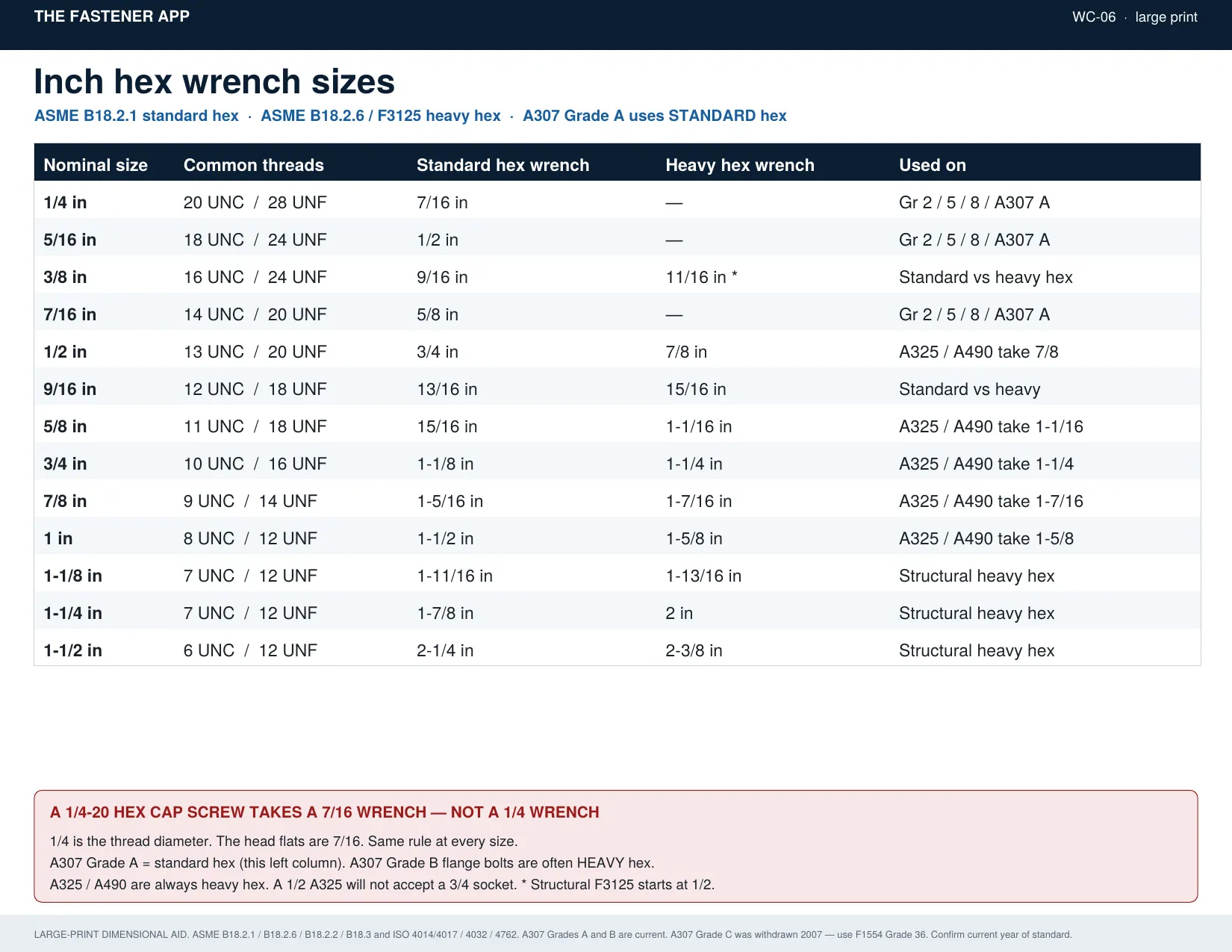
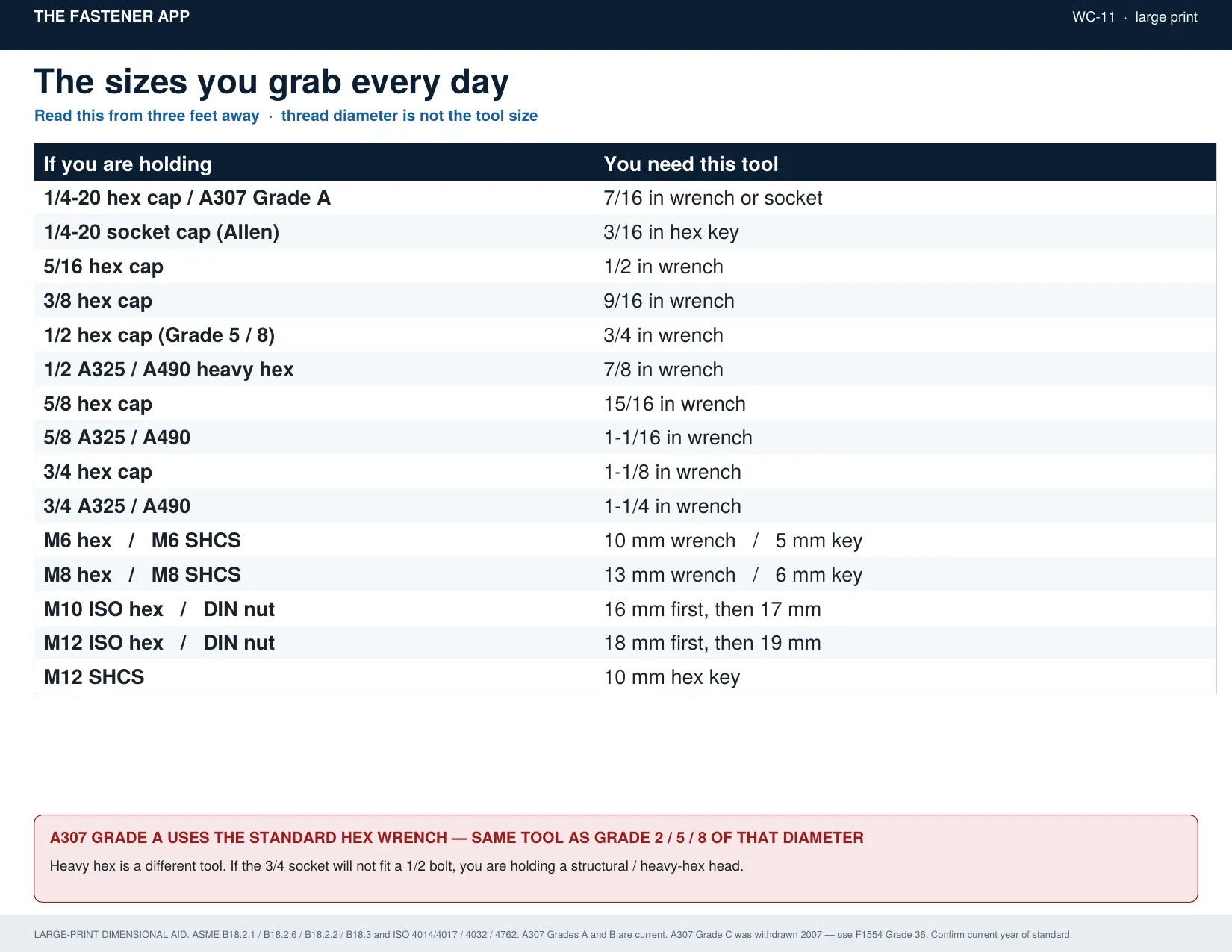
Wall Chart Atlas (All Charts, 14 Pages)
The complete shop wall-chart atlas in one printable file — matching, markings, strength, threads and selection charts, letter size.
 Report an error on this sheet
Measure & Identify
How to measure and identify every common fastener — bolts, screws, rivets, rod, U-bolts, nuts, washers and threads.
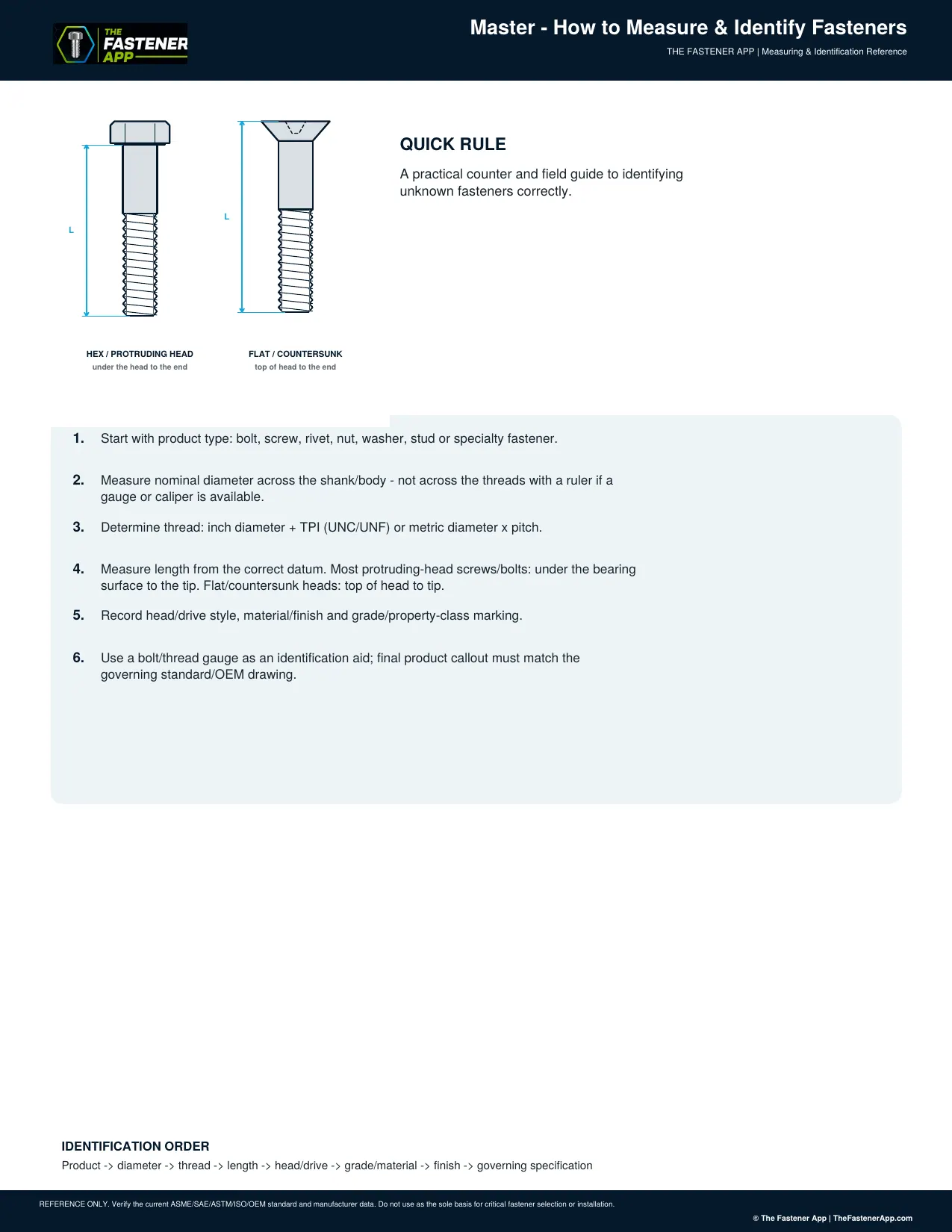
Master - How to Measure & Identify Fasteners
A practical counter and field guide to identifying unknown fasteners correctly.
 Report an error on this sheet
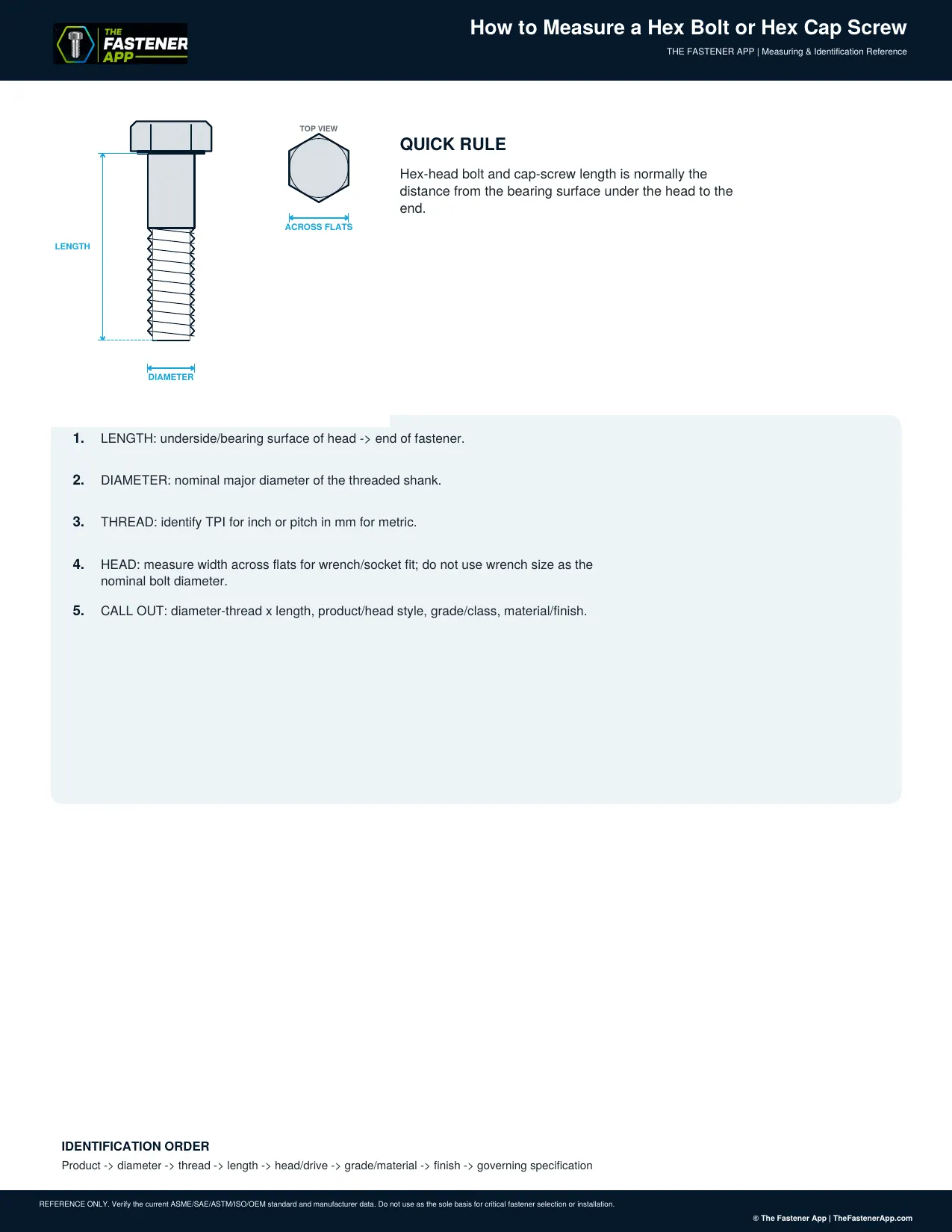
How to Measure a Hex Bolt or Hex Cap Screw
Hex-head bolt and cap-screw length is normally the distance from the bearing surface under the head to the
 Report an error on this sheet
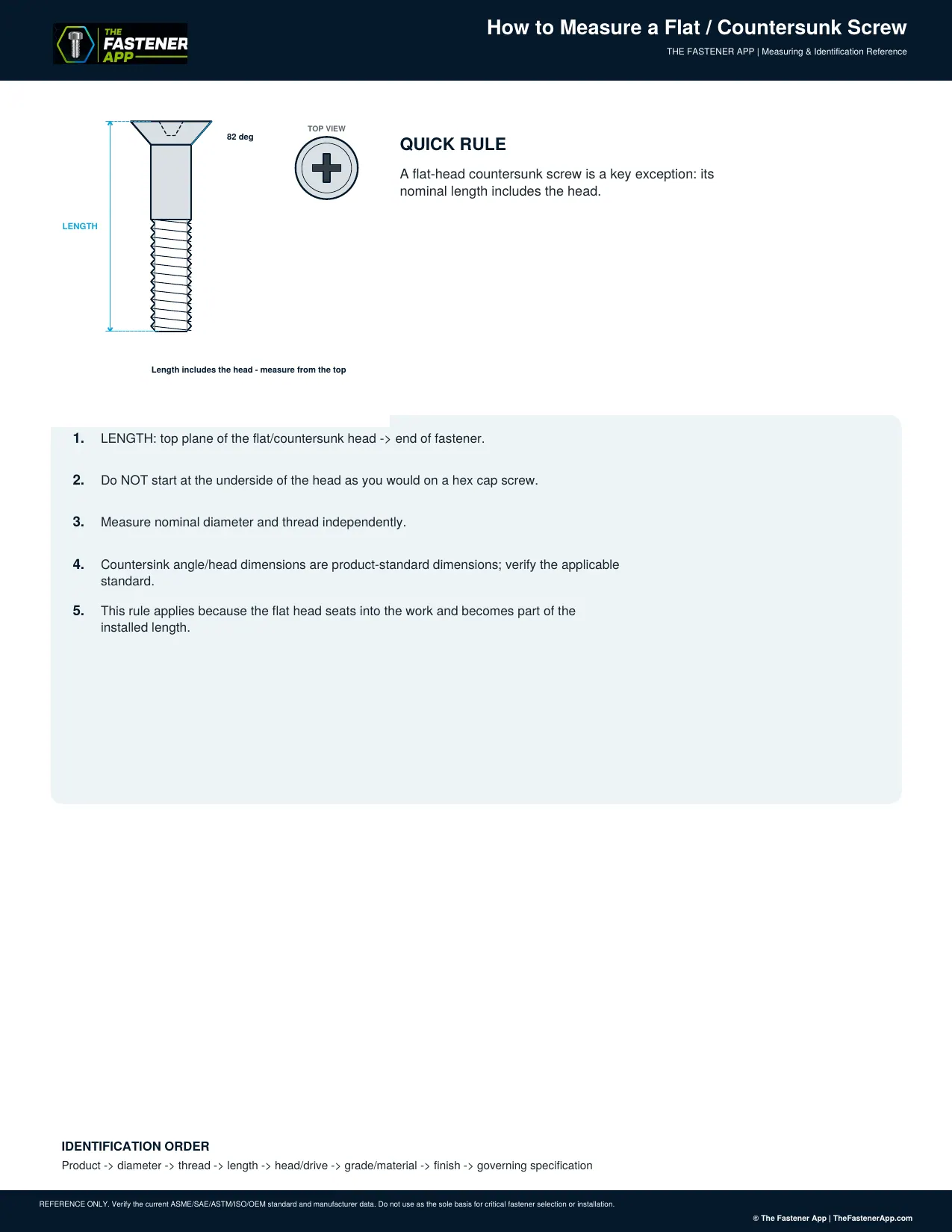
How to Measure a Flat / Countersunk Screw
A flat-head countersunk screw is a key exception: its nominal length includes the head.
 Report an error on this sheet
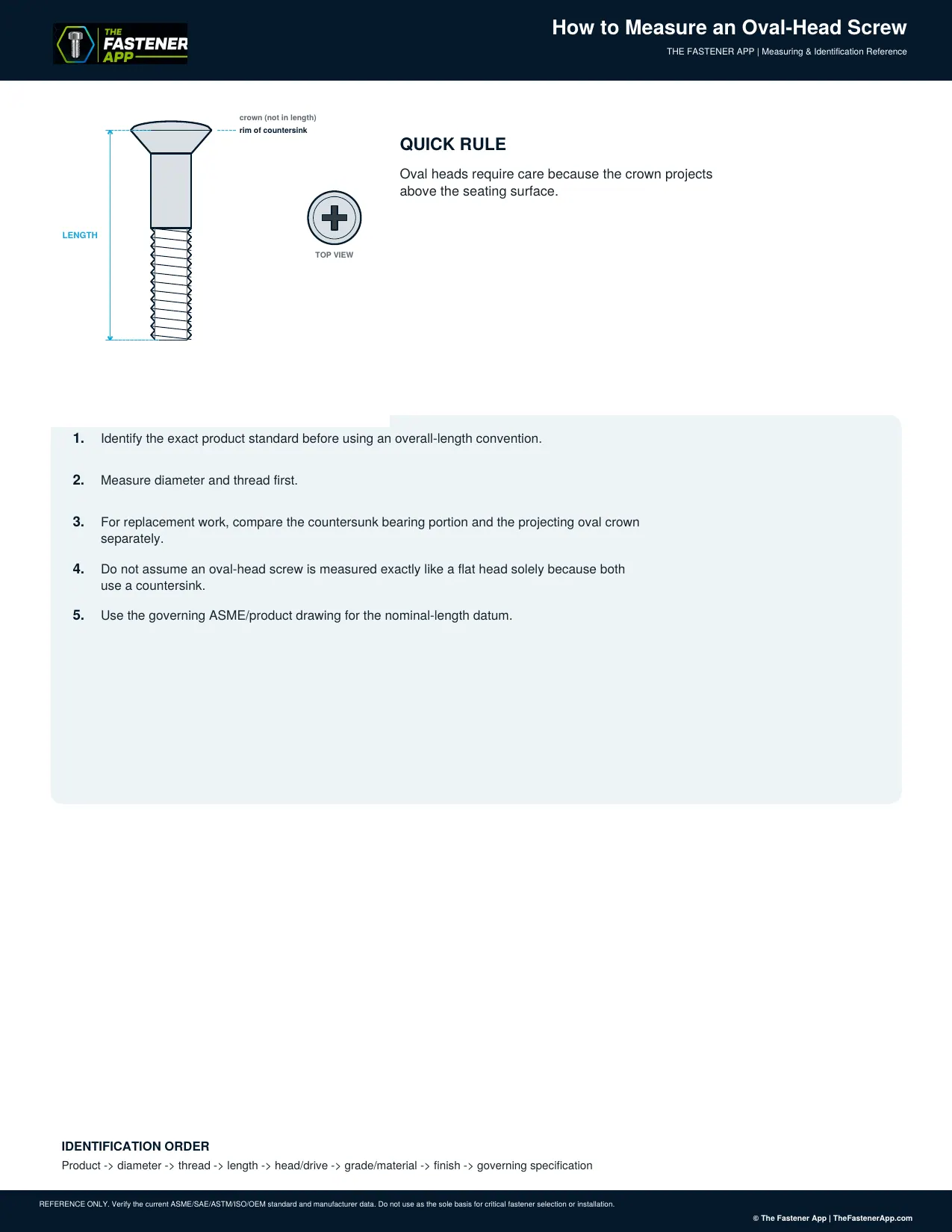
How to Measure an Oval-Head Screw
Oval heads require care because the crown projects above the seating surface.
 Report an error on this sheet
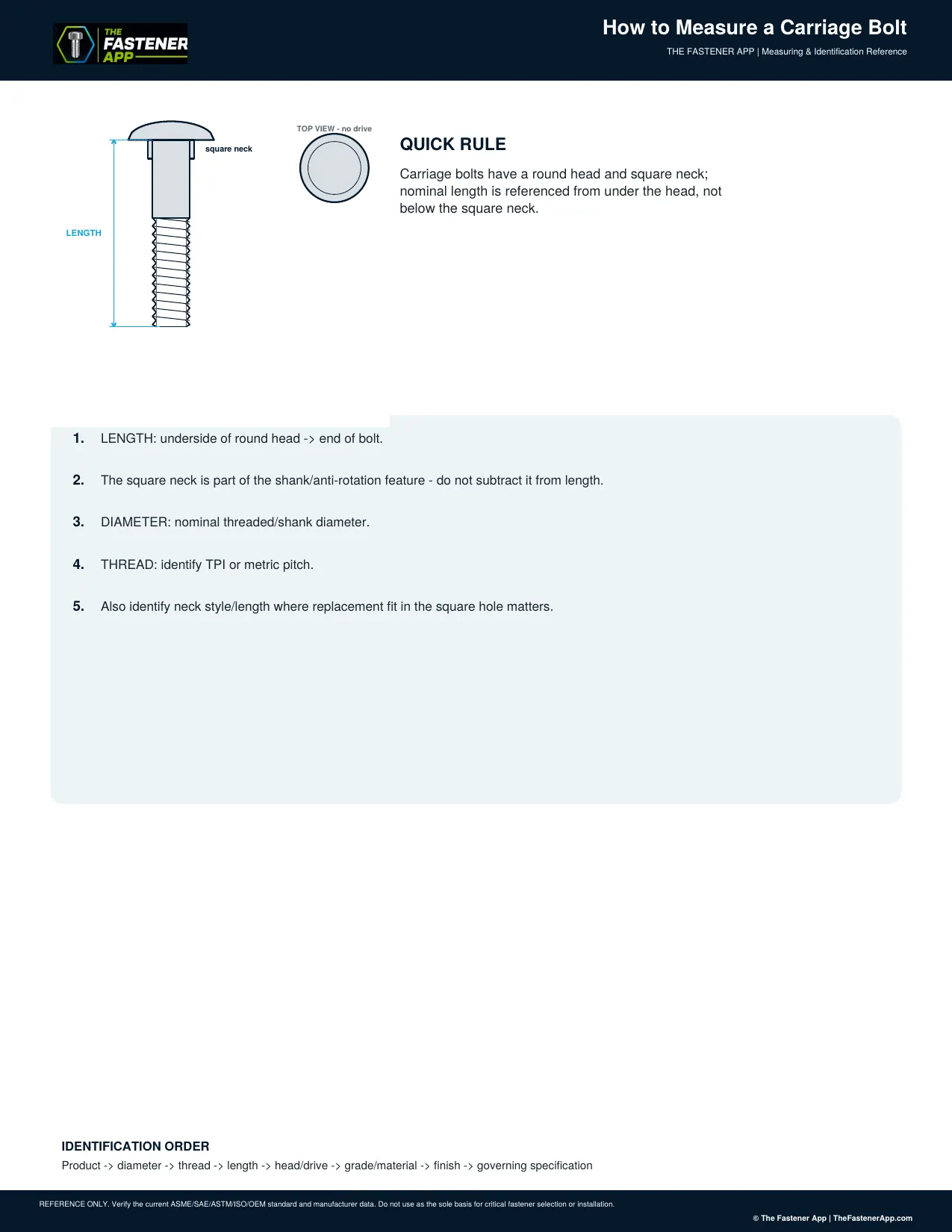
How to Measure a Carriage Bolt
Carriage bolts have a round head and square neck; nominal length is referenced from under the head, not
 Report an error on this sheet
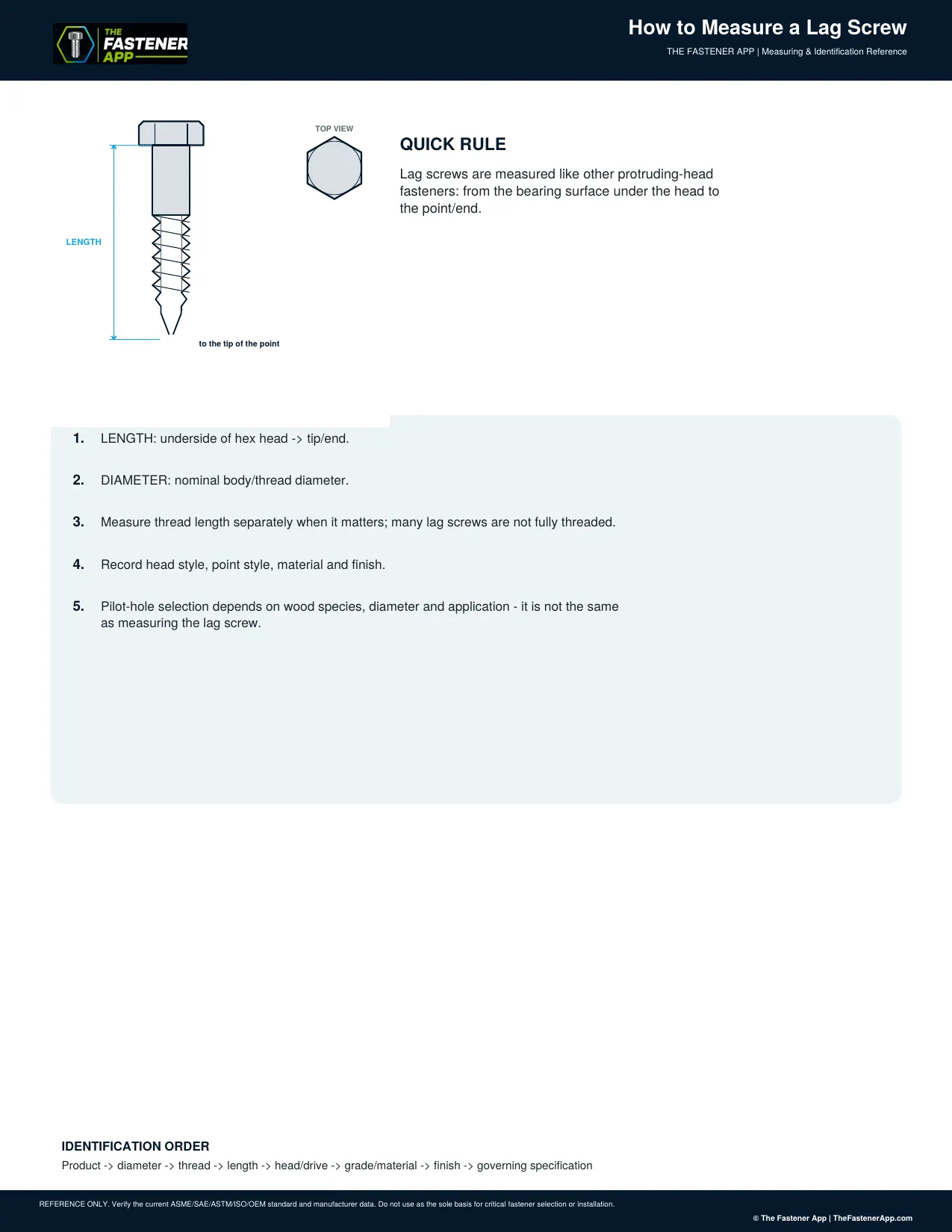
How to Measure a Lag Screw
Lag screws are measured like other protruding-head fasteners: from the bearing surface under the head to
 Report an error on this sheet
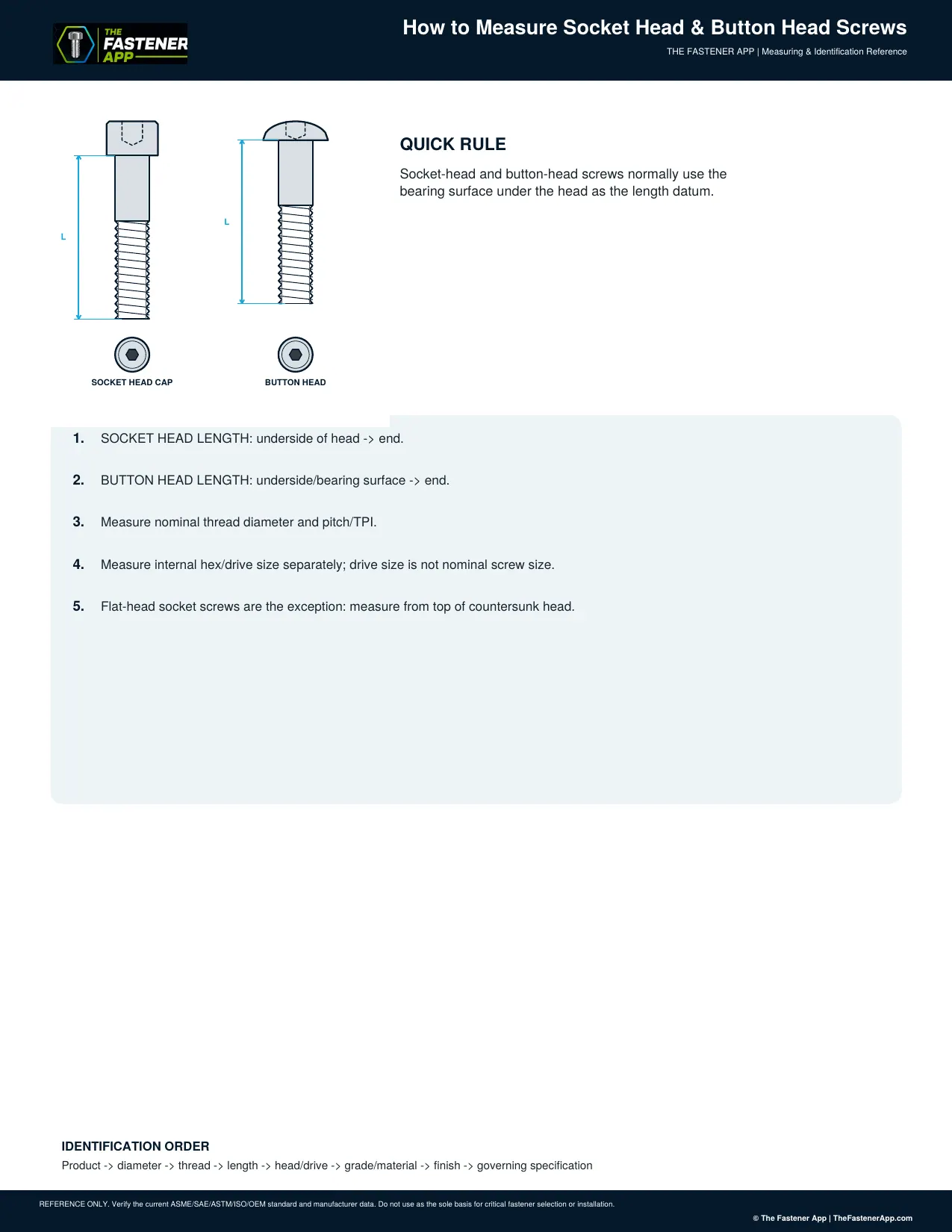
How to Measure Socket Head & Button Head Screws
Socket-head and button-head screws normally use the bearing surface under the head as the length datum.
 Report an error on this sheet
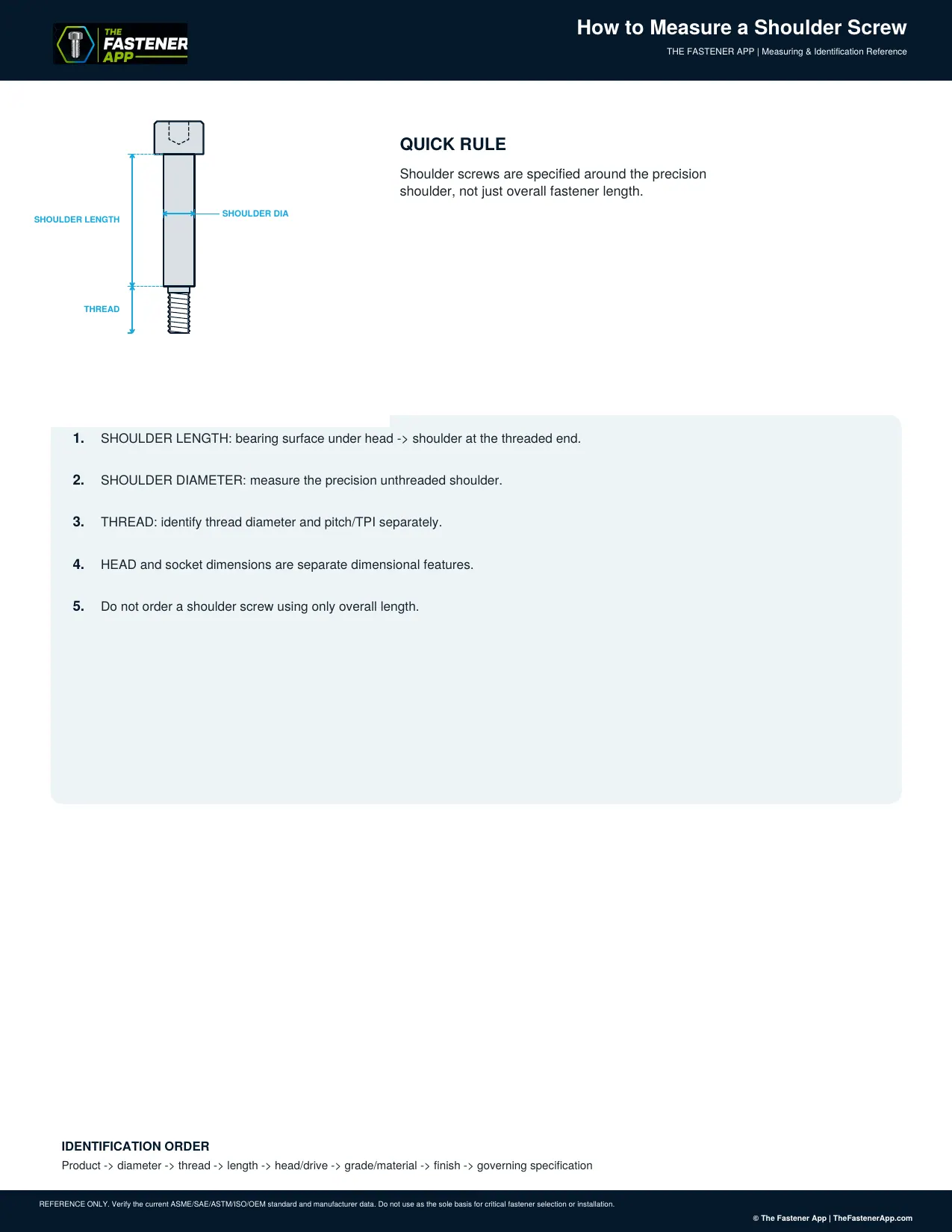
How to Measure a Shoulder Screw
Shoulder screws are specified around the precision shoulder, not just overall fastener length.
 Report an error on this sheet
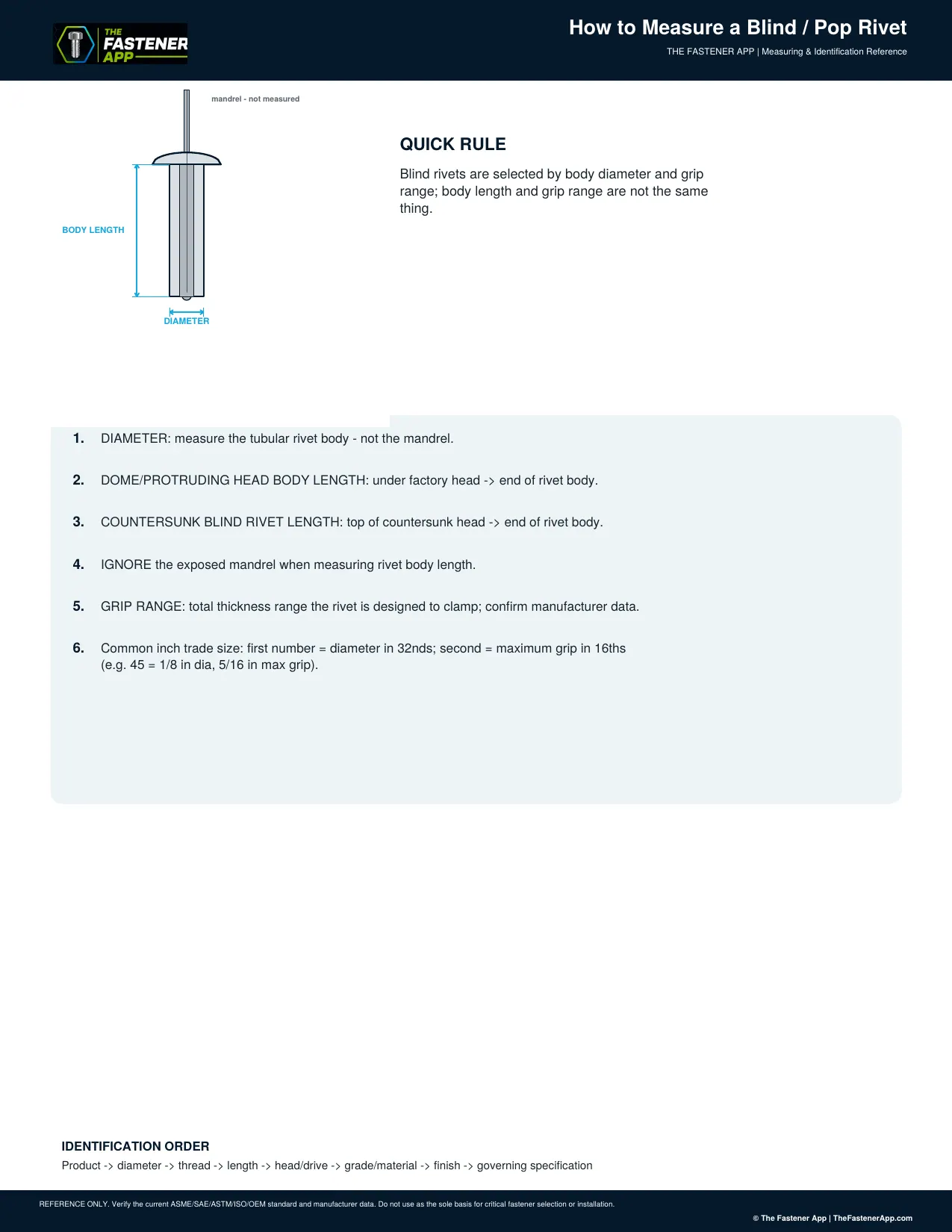
How to Measure a Blind / Pop Rivet
Blind rivets are selected by body diameter and grip range; body length and grip range are not the same
 Report an error on this sheet
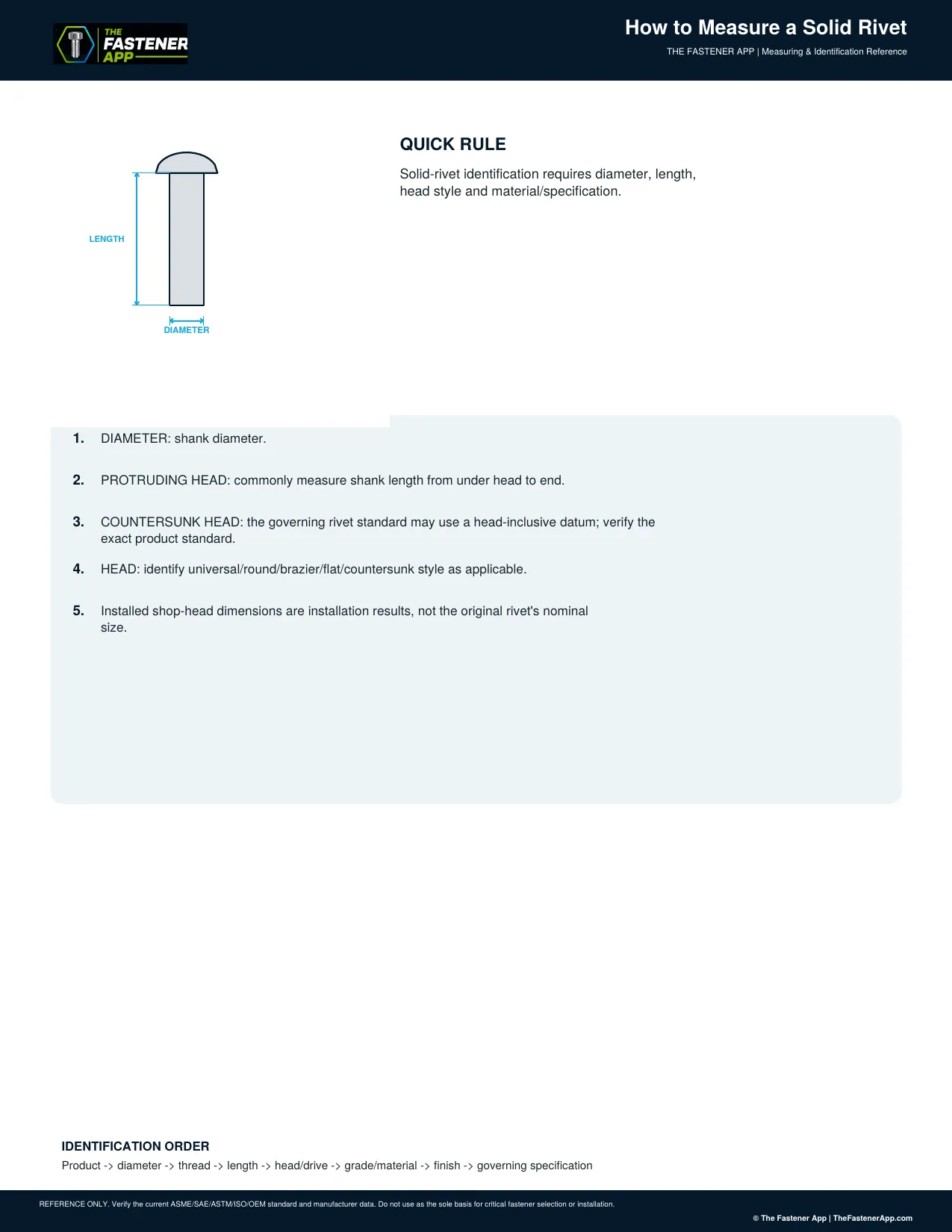
How to Measure a Solid Rivet
Solid-rivet identification requires diameter, length, head style and material/specification.
 Report an error on this sheet
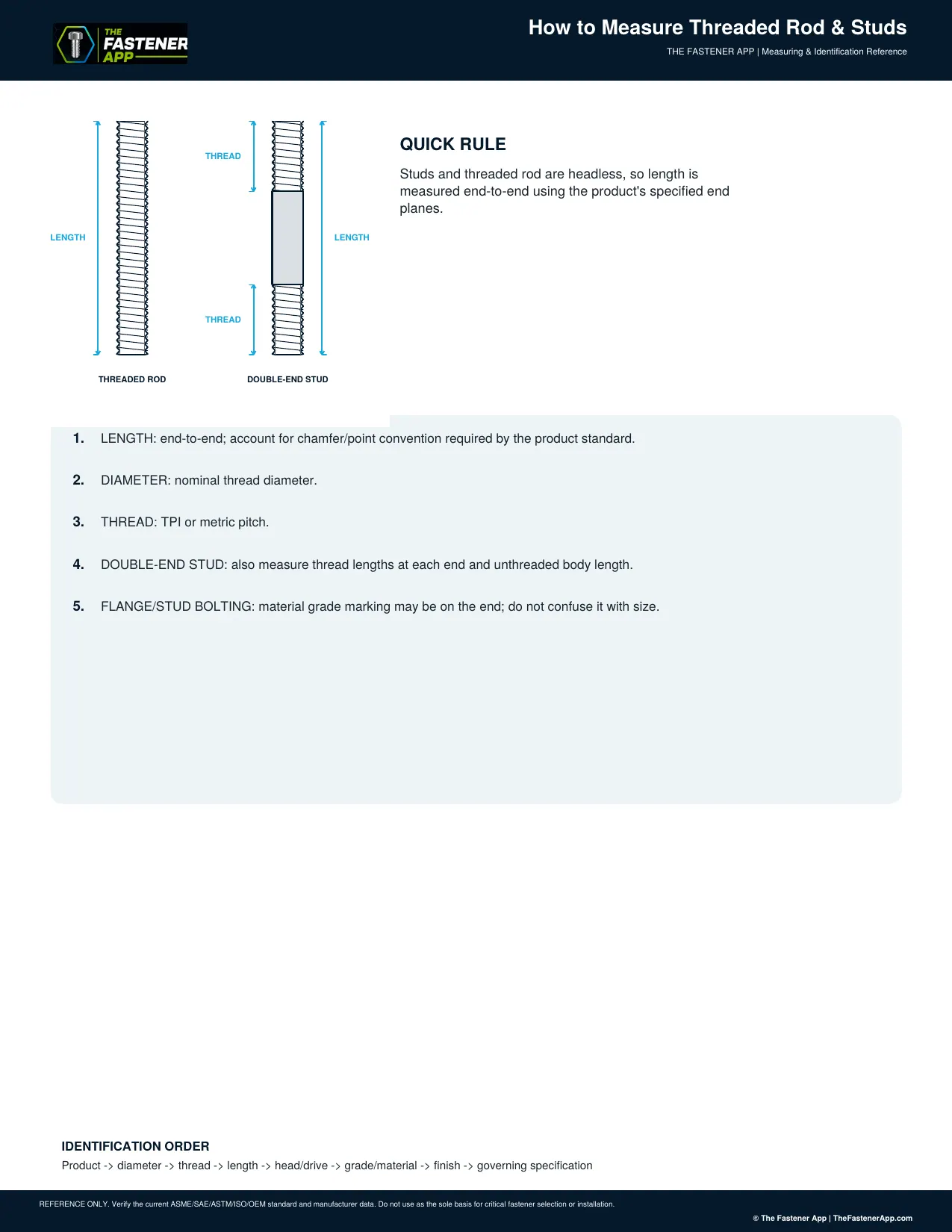
How to Measure Threaded Rod & Studs
Studs and threaded rod are headless, so length is measured end-to-end using the product's specified end
 Report an error on this sheet
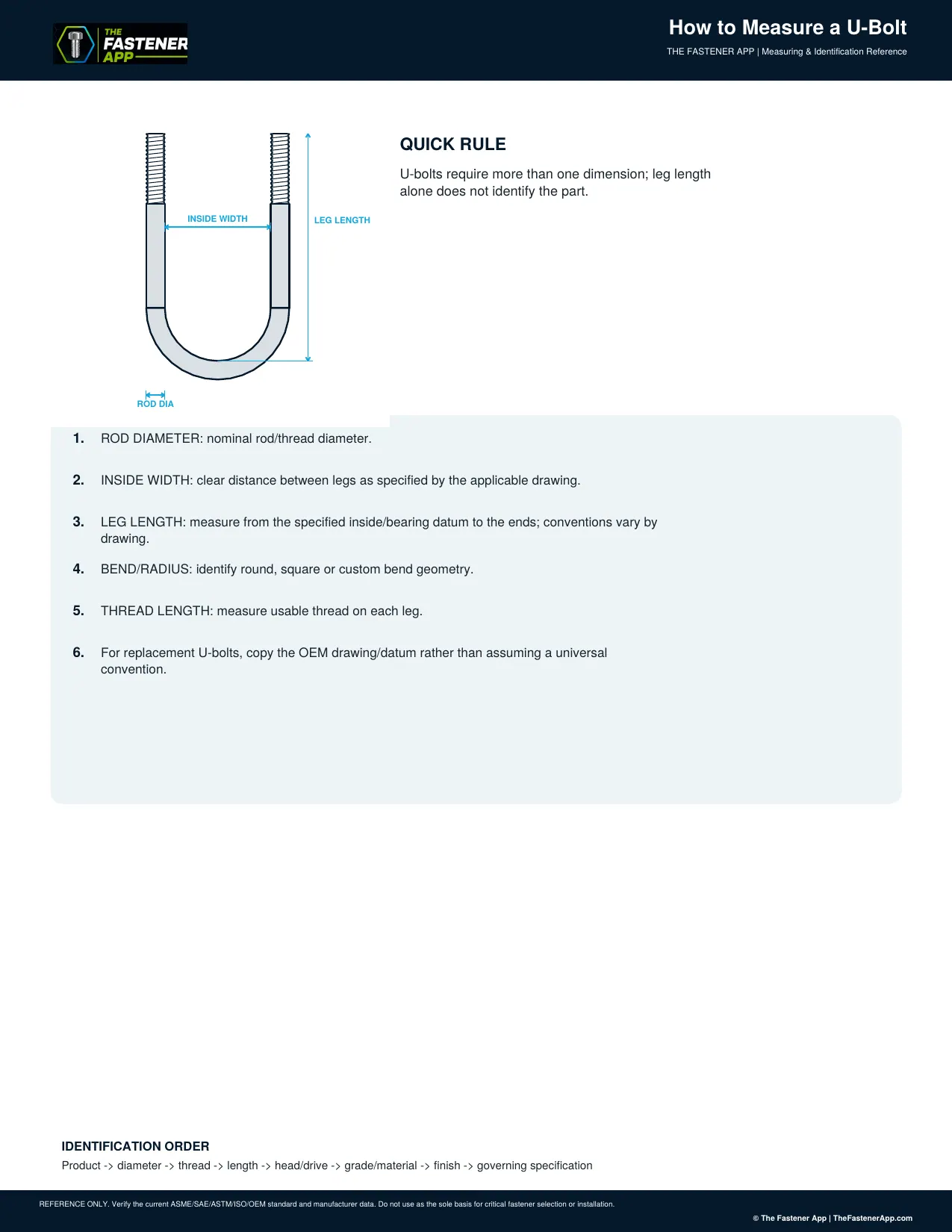
How to Measure a U-Bolt
U-bolts require more than one dimension; leg length alone does not identify the part.
 Report an error on this sheet
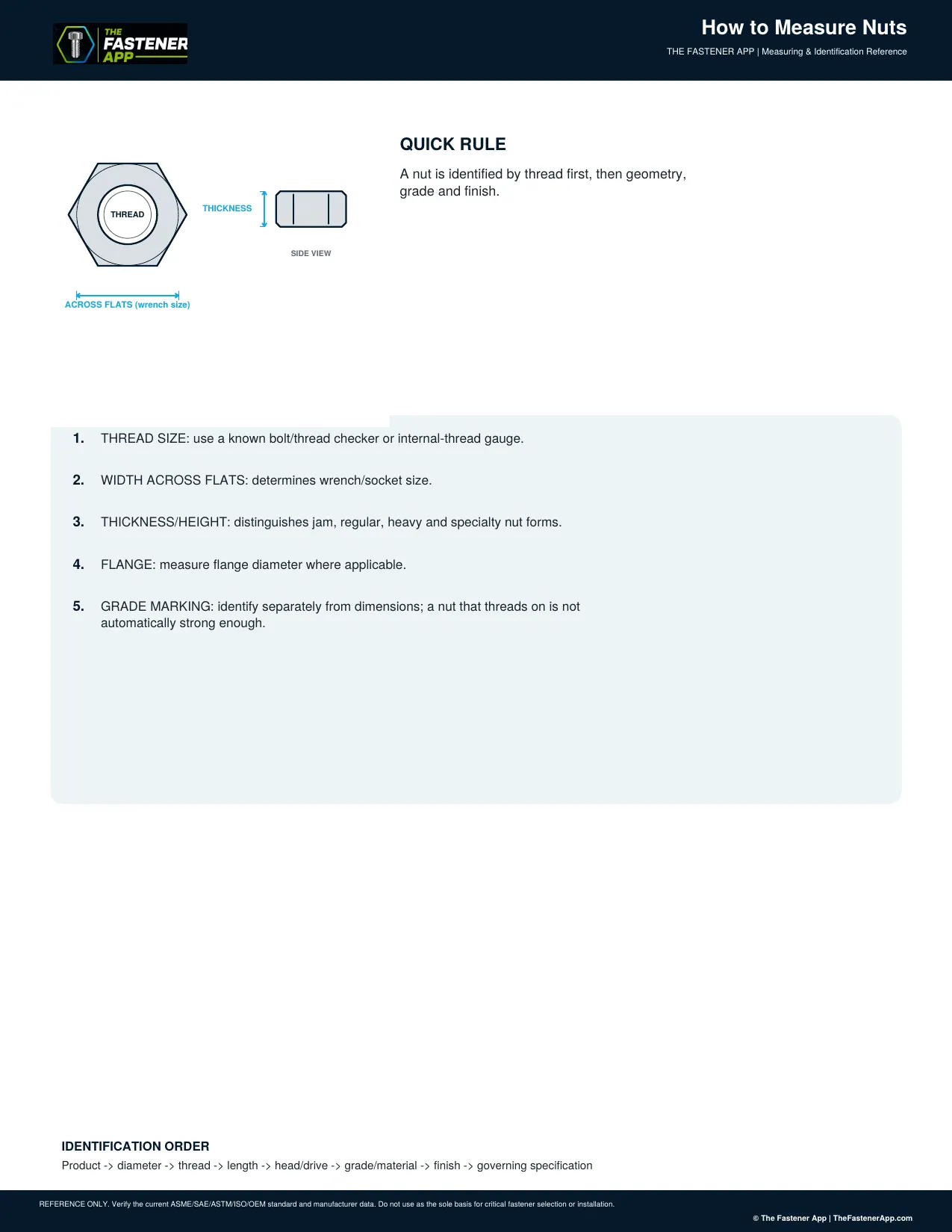
How to Measure Nuts
A nut is identified by thread first, then geometry,
 Report an error on this sheet
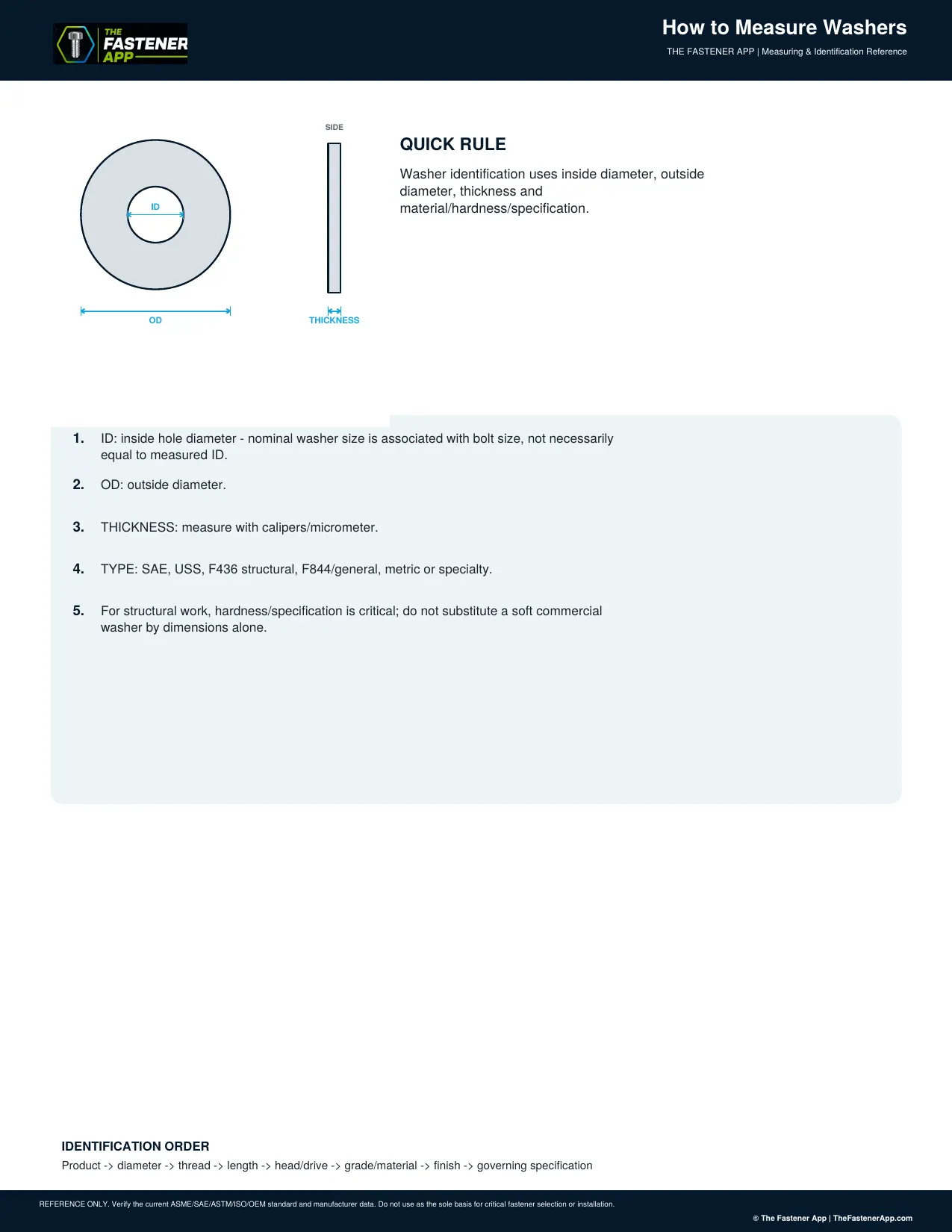
How to Measure Washers
Washer identification uses inside diameter, outside
 Report an error on this sheet
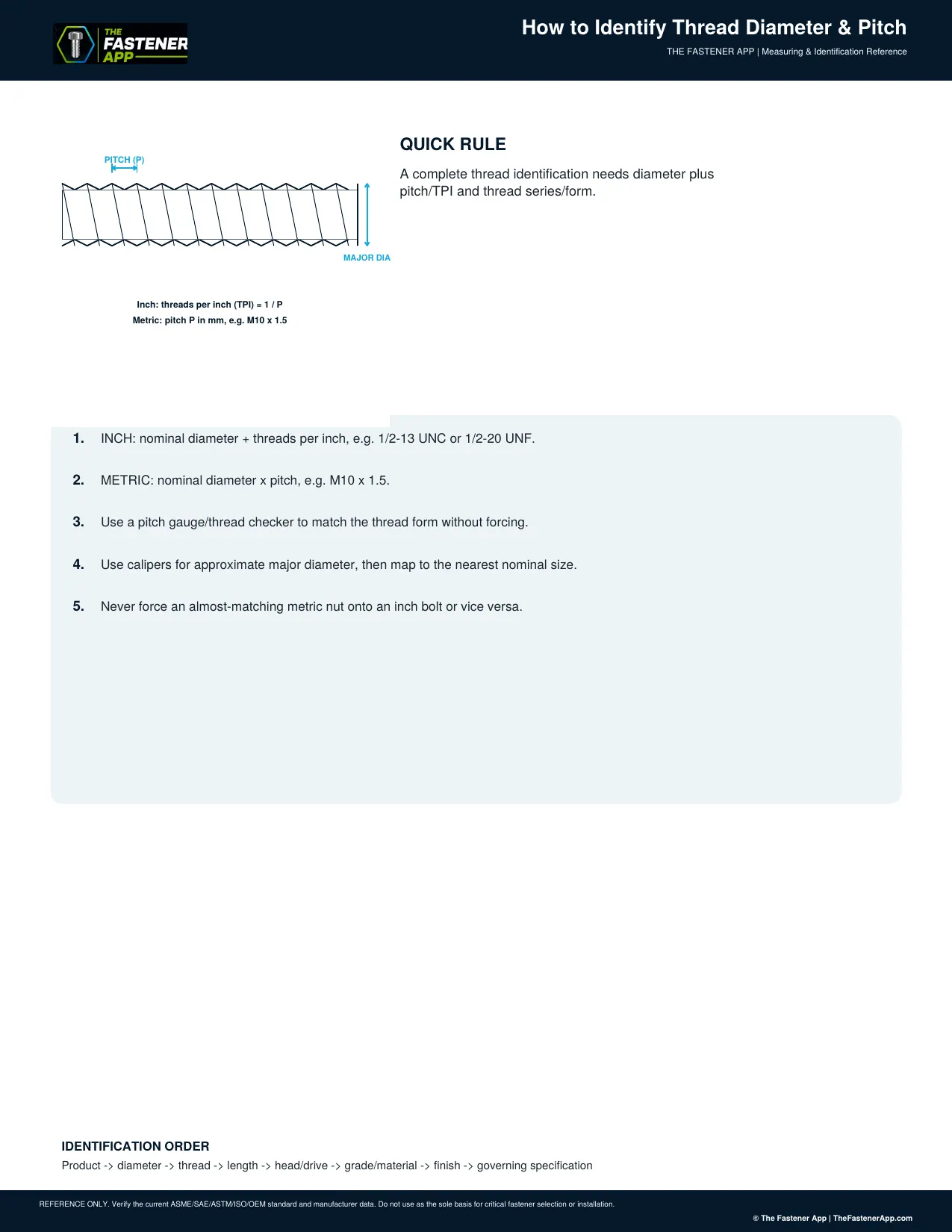
How to Identify Thread Diameter & Pitch
A complete thread identification needs diameter plus pitch/TPI and thread series/form.
 Report an error on this sheet
How to Use a Bolt Gauge / Thread Checker
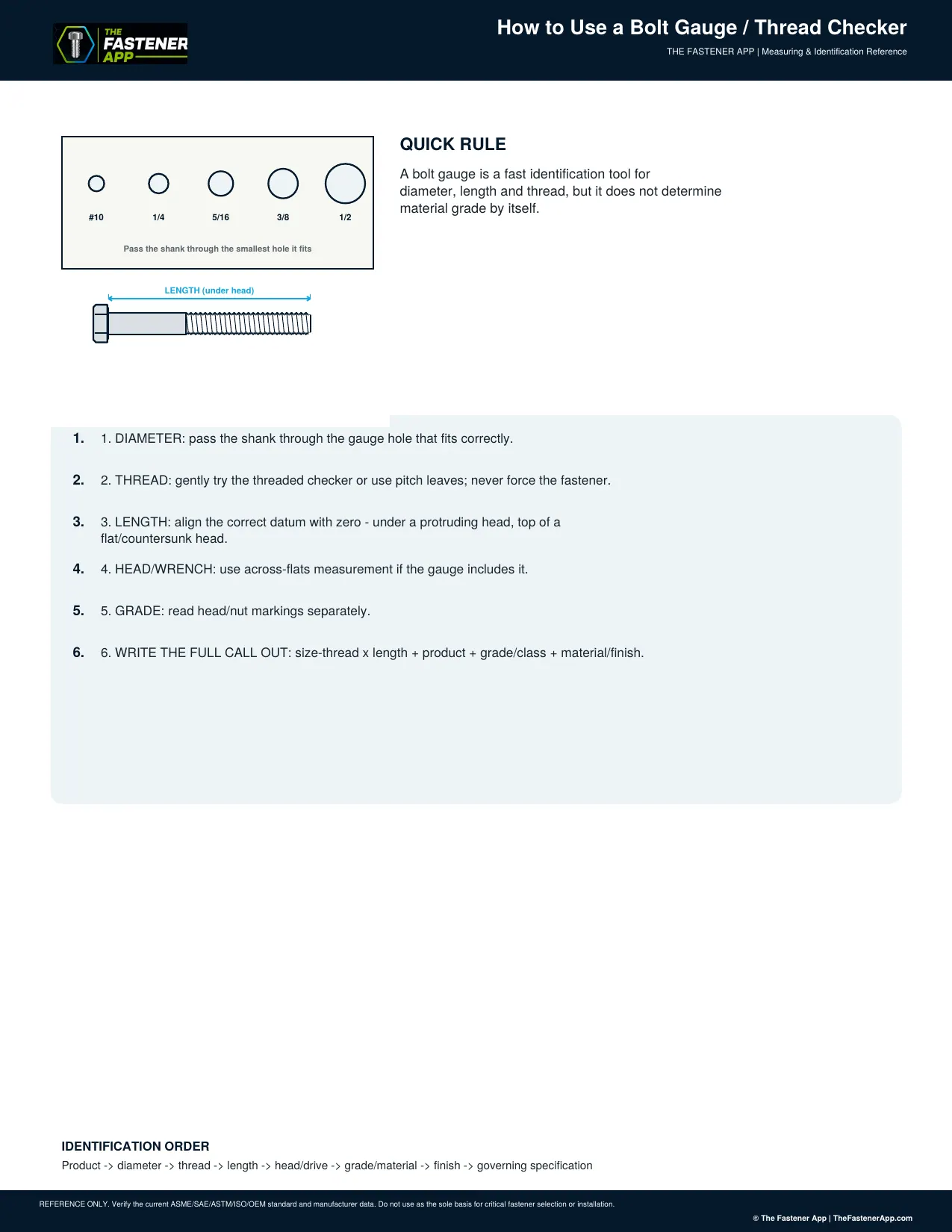
A bolt gauge is a fast identification tool for diameter, length and thread, but it does not determine material grade by itself.
 Report an error on this sheet
How to Use Calipers to Identify an Unknown Fastener
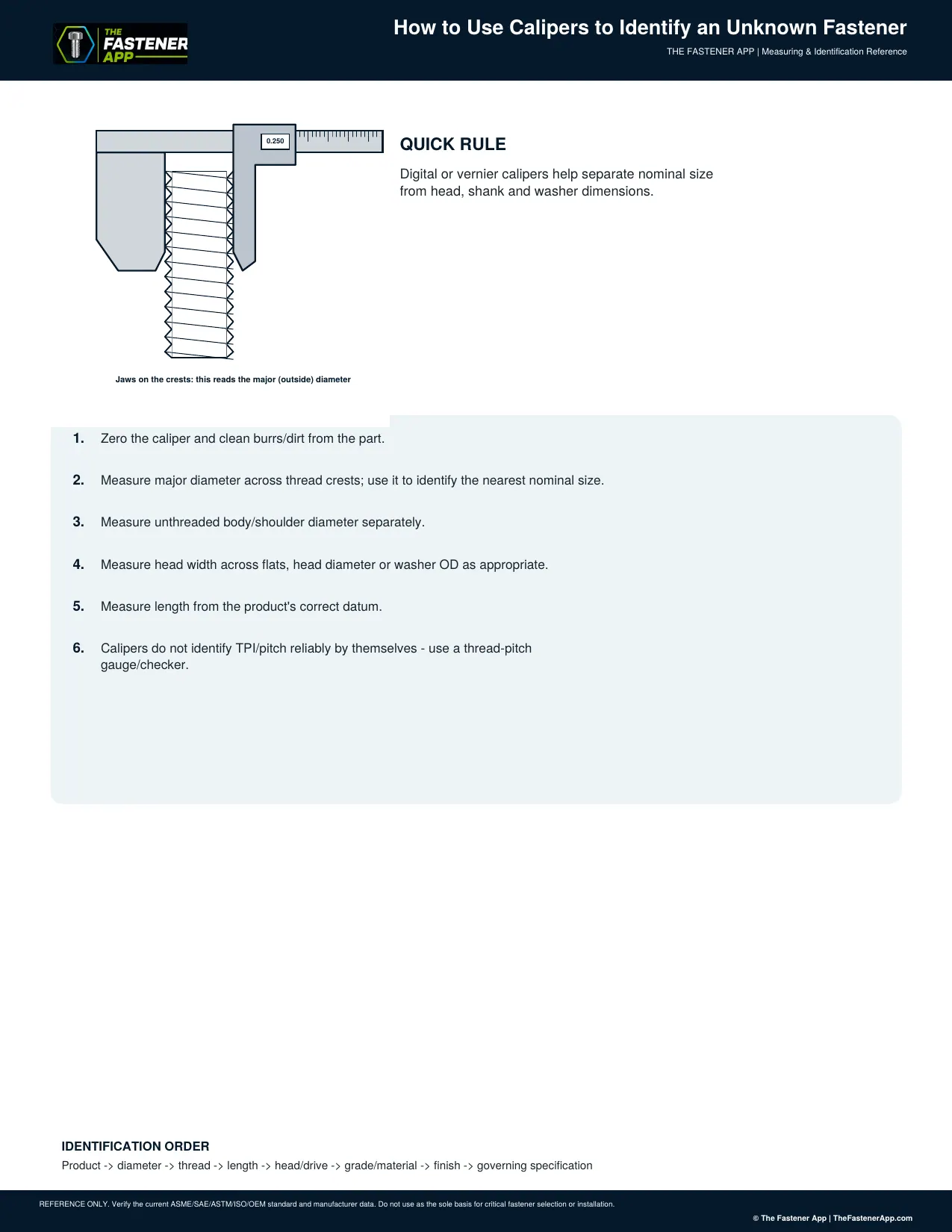
Digital or vernier calipers help separate nominal size from head, shank and washer dimensions.
 Report an error on this sheet
Plating, Coatings & Finishes
Zinc, galvanizing, zinc-flake, black oxide, cadmium, nickel and PTFE — what each finish does and how to specify it.
Coatings & Finishes - Master Selection Guide
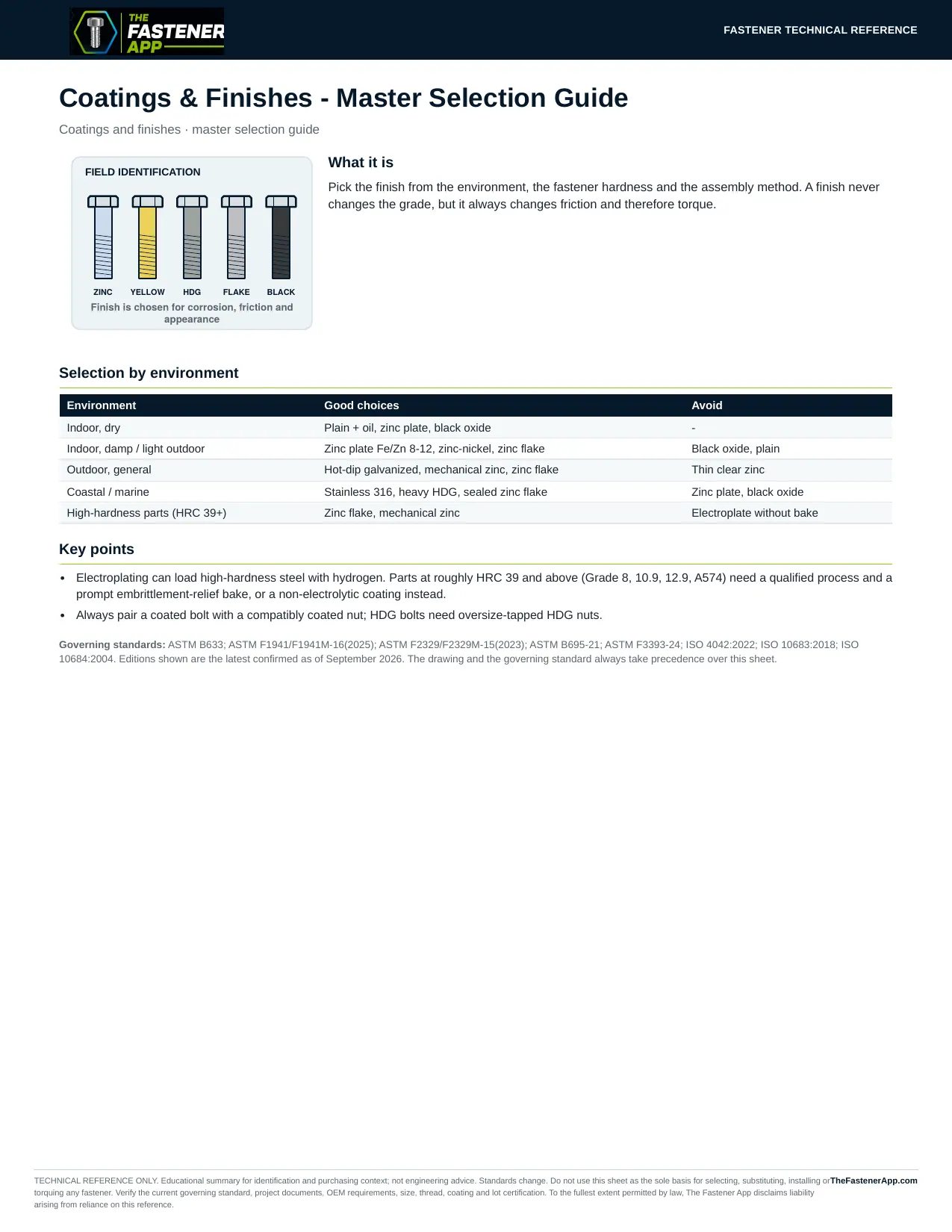
Pick the finish from the environment, the fastener hardness and the assembly method. A finish never changes the grade, but it always changes friction and therefore torque.
 Report an error on this sheet
Plain / Bare Steel
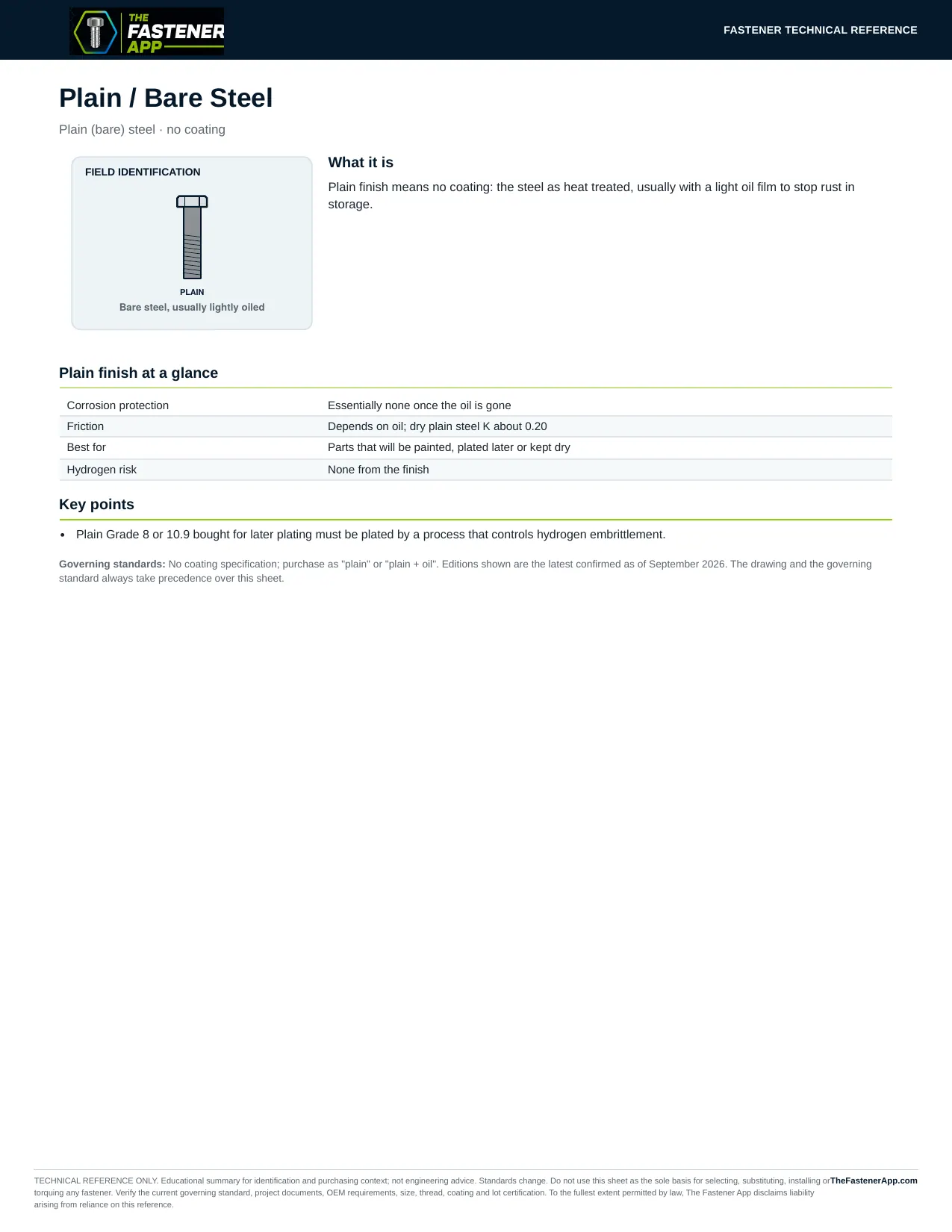
Plain finish means no coating: the steel as heat treated, usually with a light oil film to stop rust in storage.
 Report an error on this sheet
Black Oxide
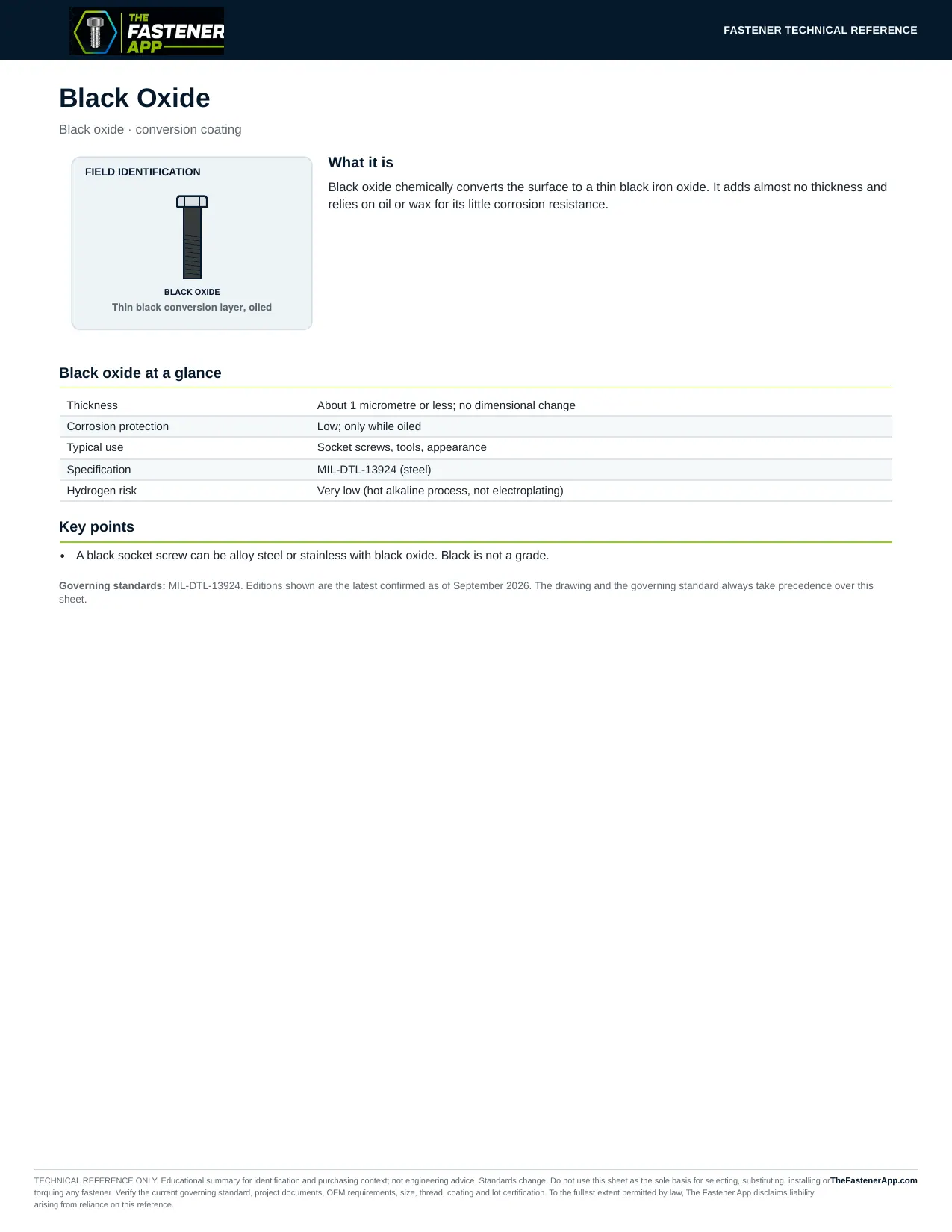
Black oxide chemically converts the surface to a thin black iron oxide. It adds almost no thickness and relies on oil or wax for its little corrosion resistance.
 Report an error on this sheet
Zinc Electroplating - Overview
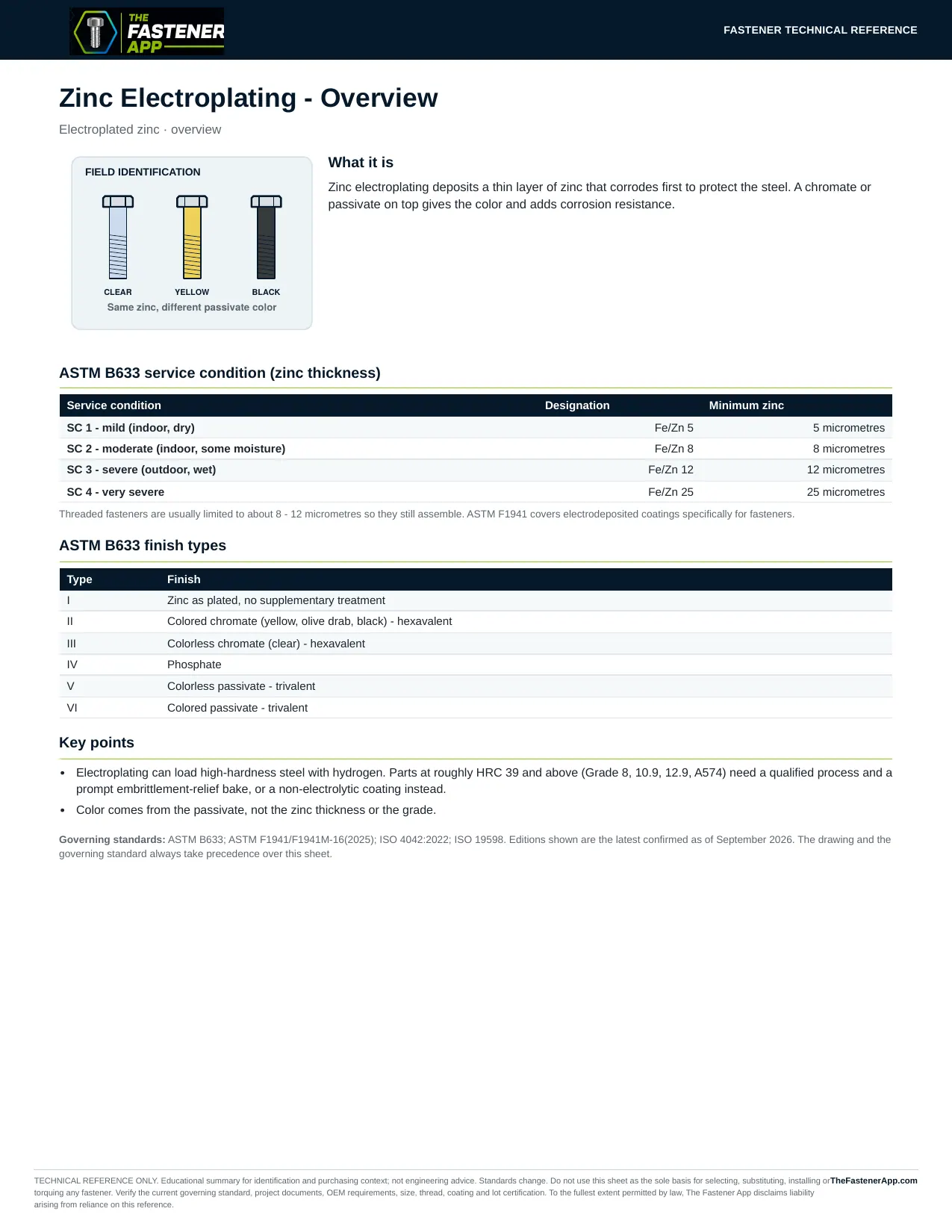
Zinc electroplating deposits a thin layer of zinc that corrodes first to protect the steel. A chromate or passivate on top gives the color and adds corrosion resistance.
 Report an error on this sheet
Clear Zinc / Clear Chromate
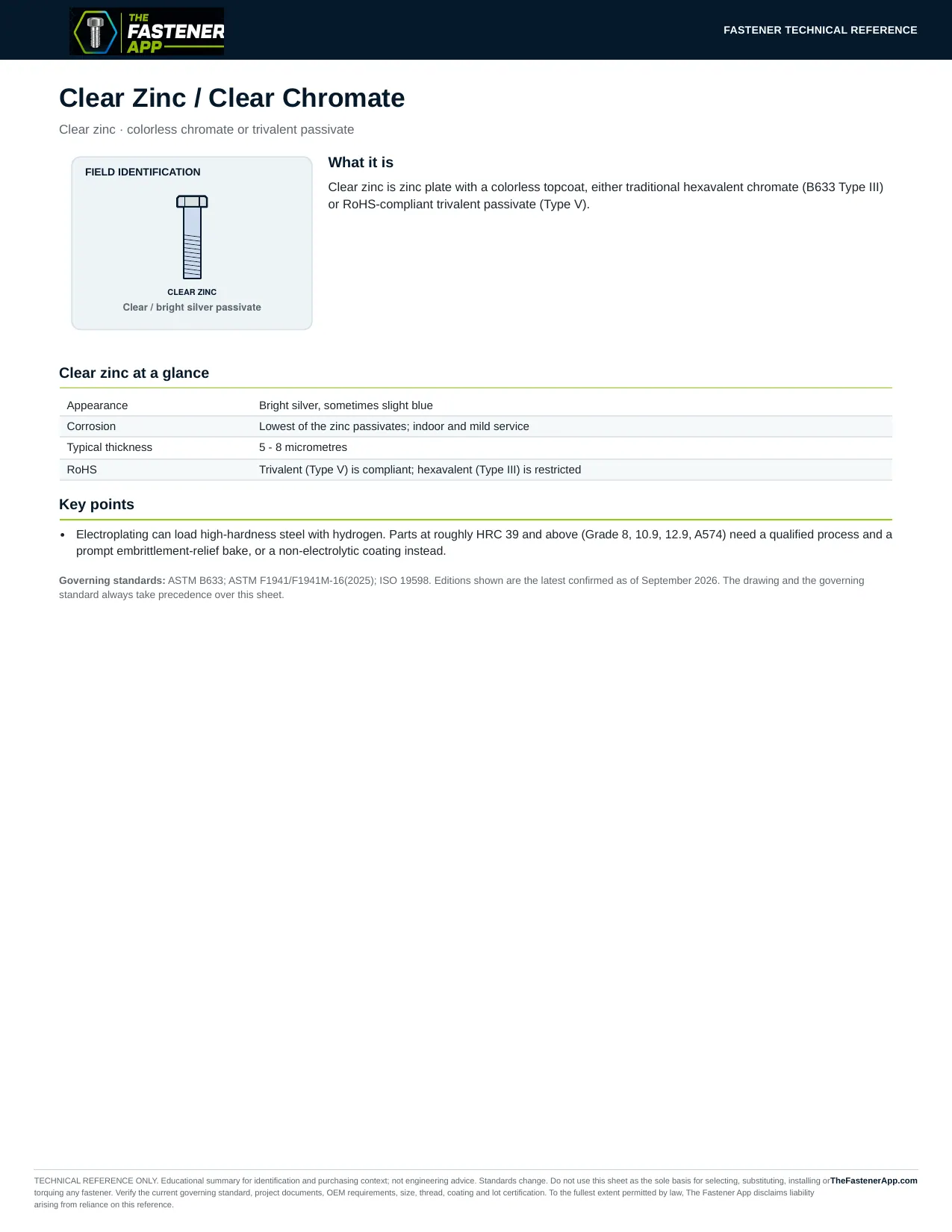
Clear zinc is zinc plate with a colorless topcoat, either traditional hexavalent chromate (B633 Type III) or RoHS-compliant trivalent passivate (Type V).
 Report an error on this sheet
Blue-Bright Zinc
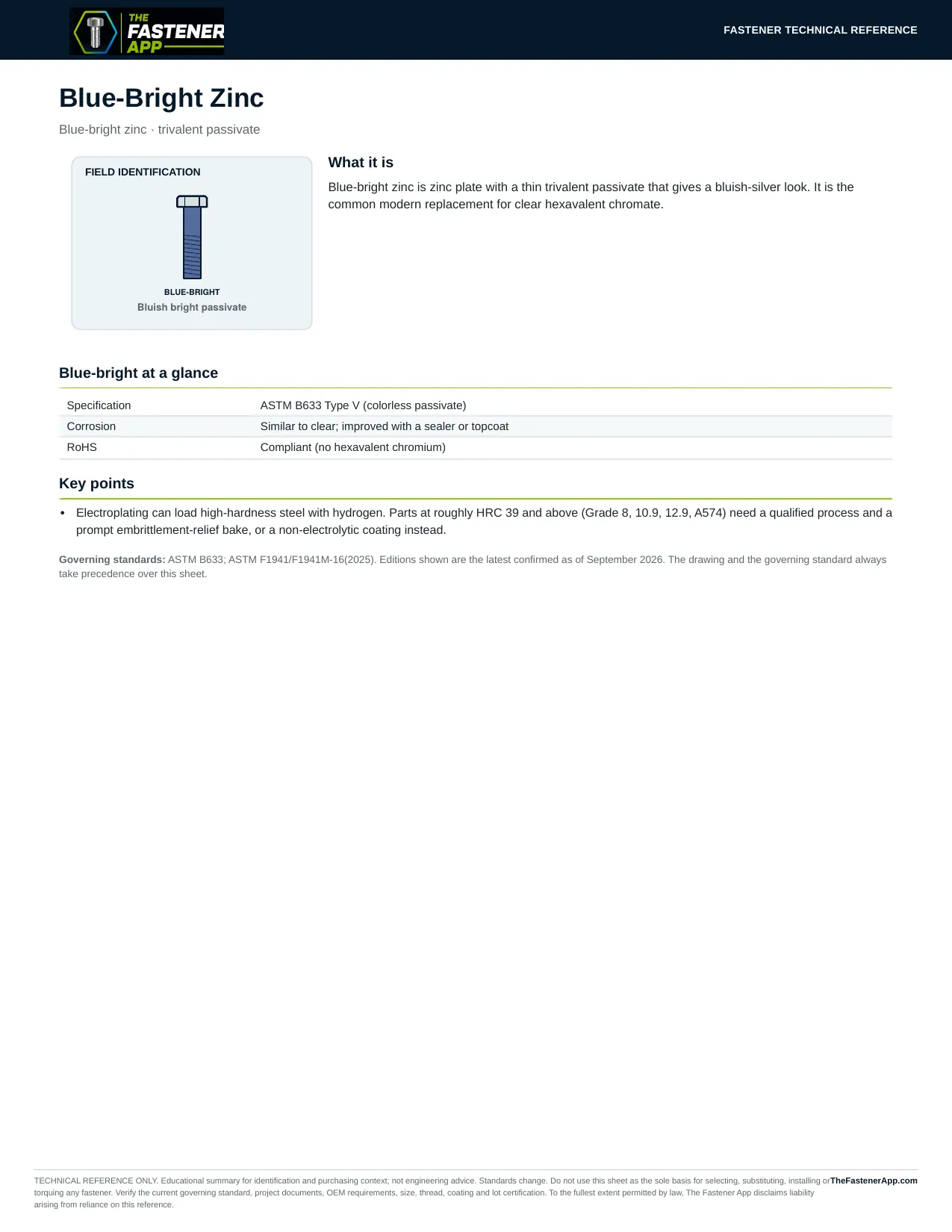
Blue-bright zinc is zinc plate with a thin trivalent passivate that gives a bluish-silver look. It is the common modern replacement for clear hexavalent chromate.
 Report an error on this sheet
Yellow Zinc / Dichromate
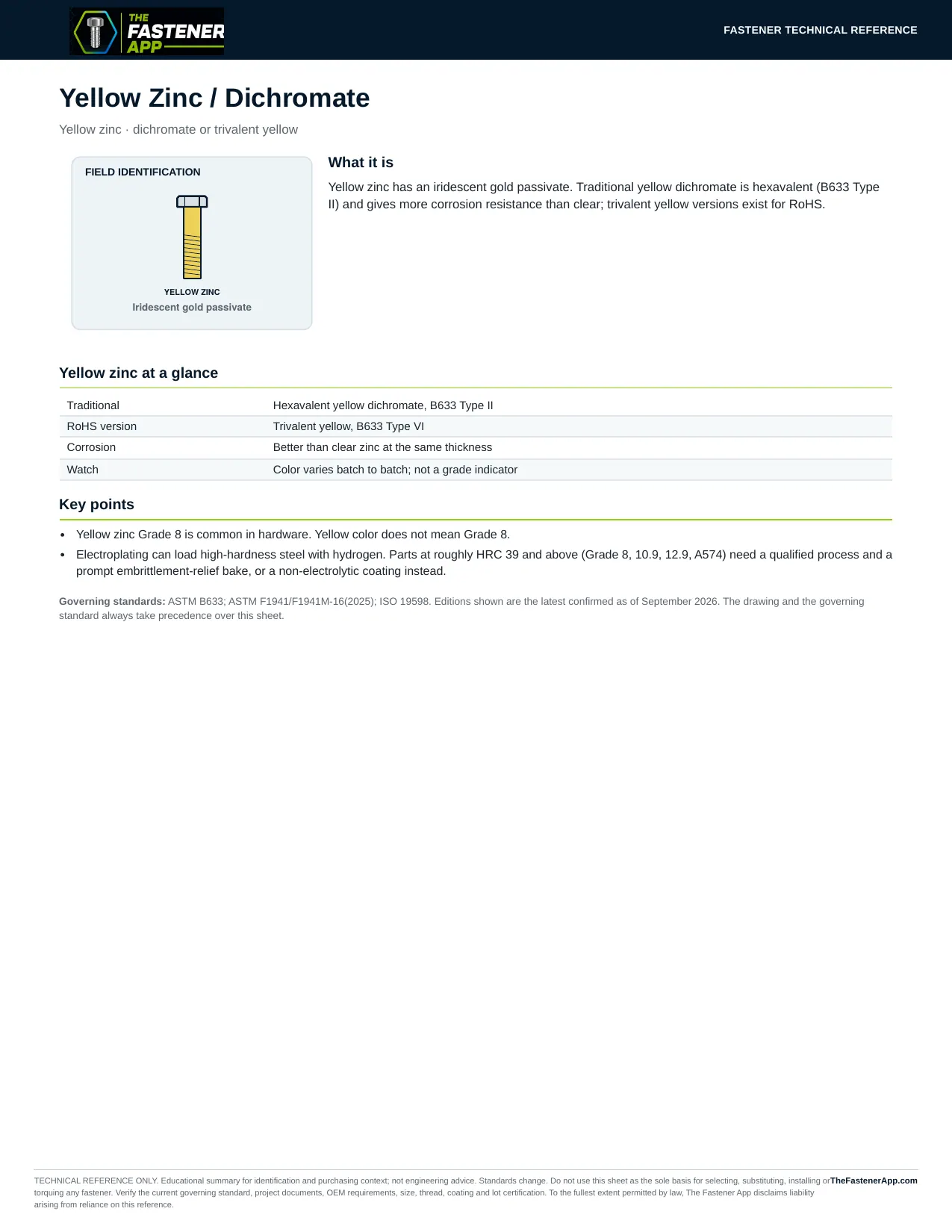
Yellow zinc has an iridescent gold passivate. Traditional yellow dichromate is hexavalent (B633 Type II) and gives more corrosion resistance than clear; trivalent yellow versions exist for RoHS.
 Report an error on this sheet
Olive Drab Chromate
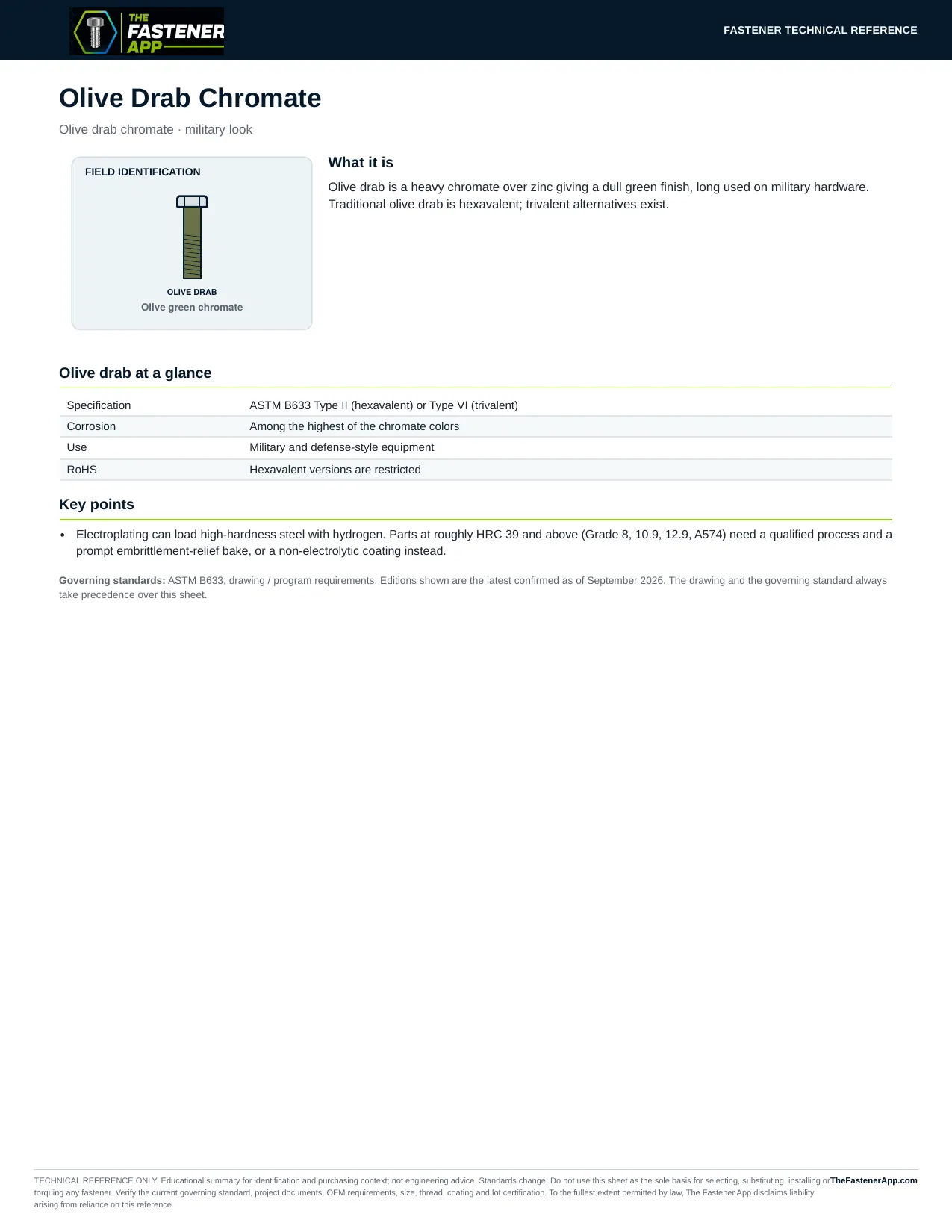
Olive drab is a heavy chromate over zinc giving a dull green finish, long used on military hardware. Traditional olive drab is hexavalent; trivalent alternatives exist.
 Report an error on this sheet
Black Zinc
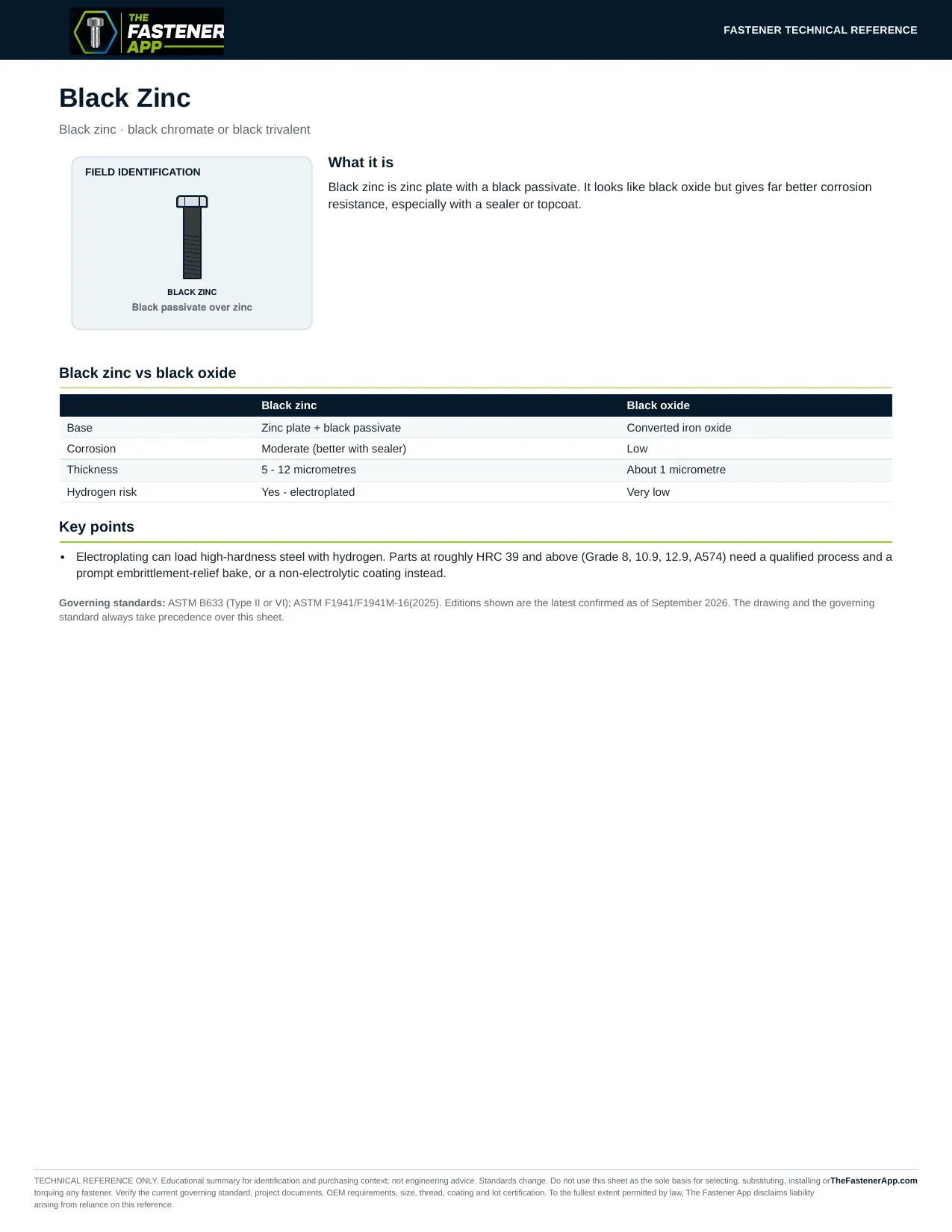
Black zinc is zinc plate with a black passivate. It looks like black oxide but gives far better corrosion resistance, especially with a sealer or topcoat.
 Report an error on this sheet
Trivalent vs Hexavalent Chromate
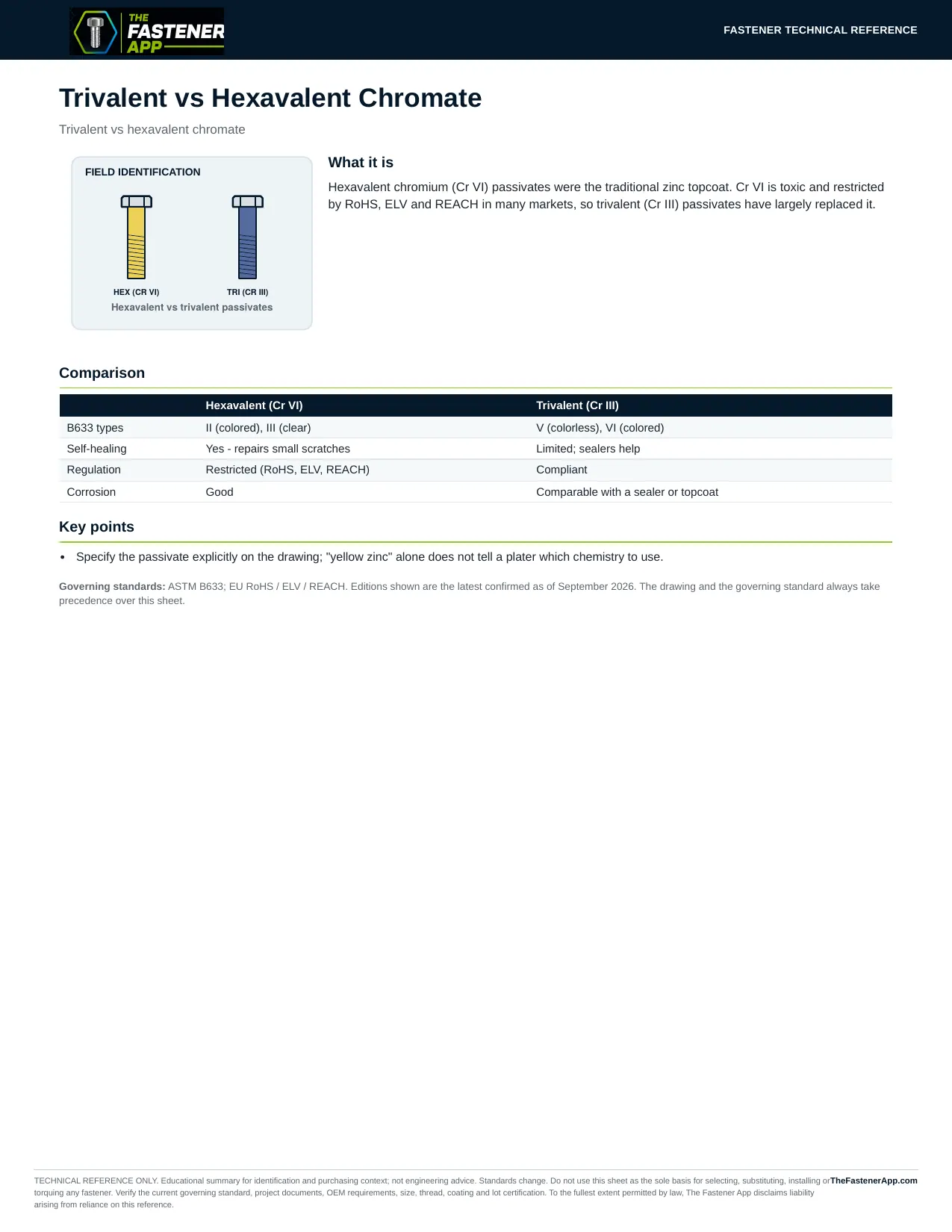
Hexavalent chromium (Cr VI) passivates were the traditional zinc topcoat. Cr VI is toxic and restricted by RoHS, ELV and REACH in many markets, so trivalent (Cr III) passivates have largely replaced it.
 Report an error on this sheet
Zinc-Nickel
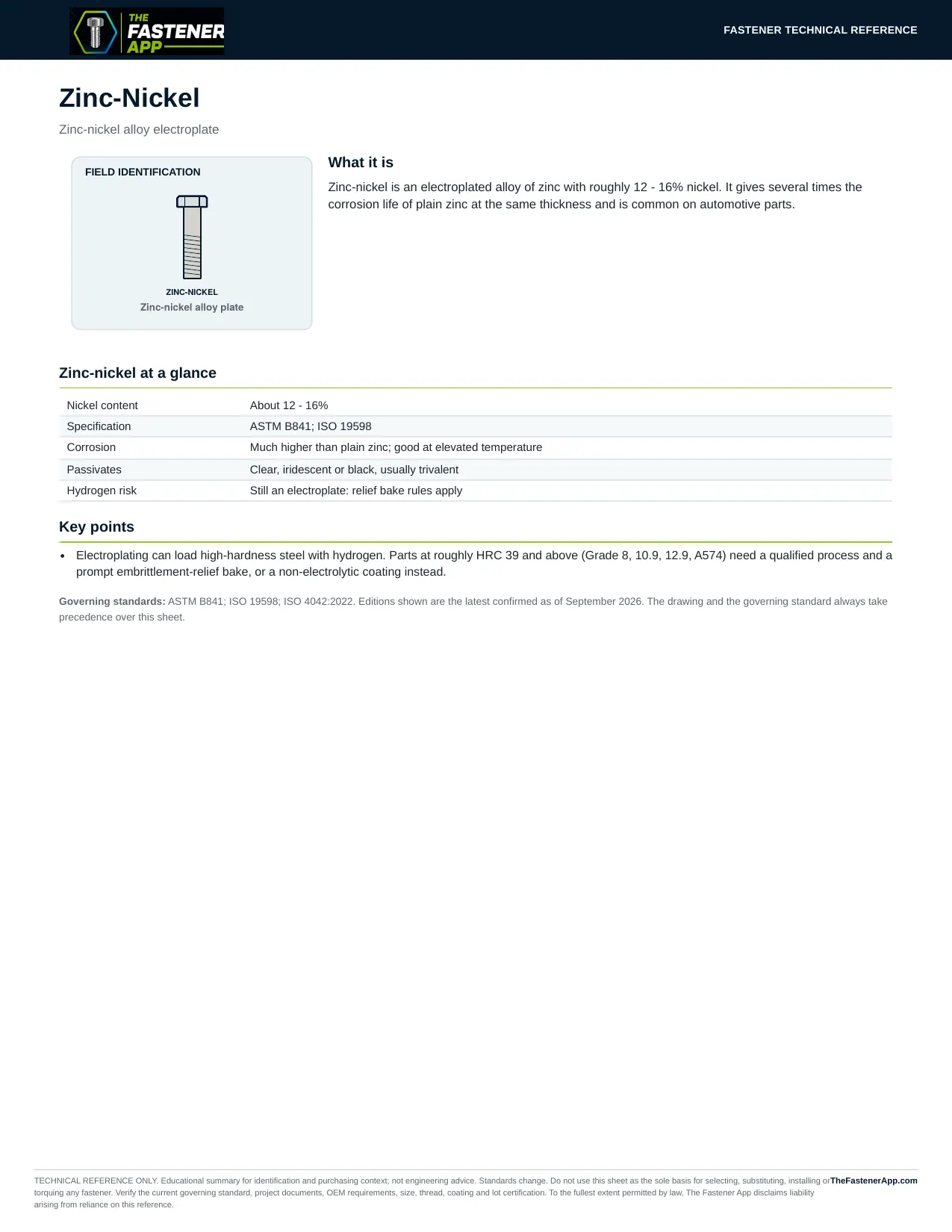
Zinc-nickel is an electroplated alloy of zinc with roughly 12 - 16% nickel. It gives several times the corrosion life of plain zinc at the same thickness and is common on automotive parts.
 Report an error on this sheet
Zinc-Iron and Zinc-Cobalt
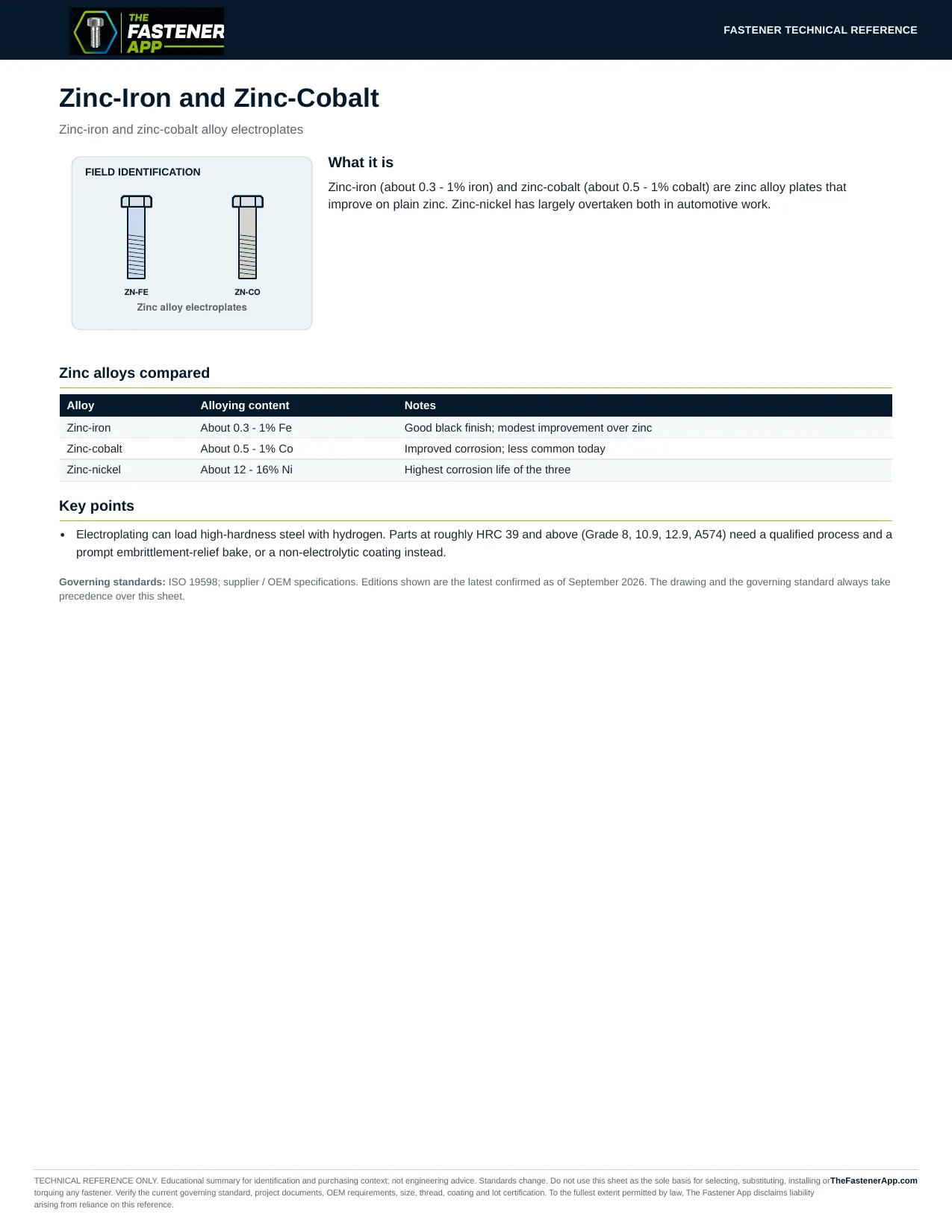
Zinc-iron (about 0.3 - 1% iron) and zinc-cobalt (about 0.5 - 1% cobalt) are zinc alloy plates that improve on plain zinc. Zinc-nickel has largely overtaken both in automotive work.
 Report an error on this sheet
Cadmium Plating
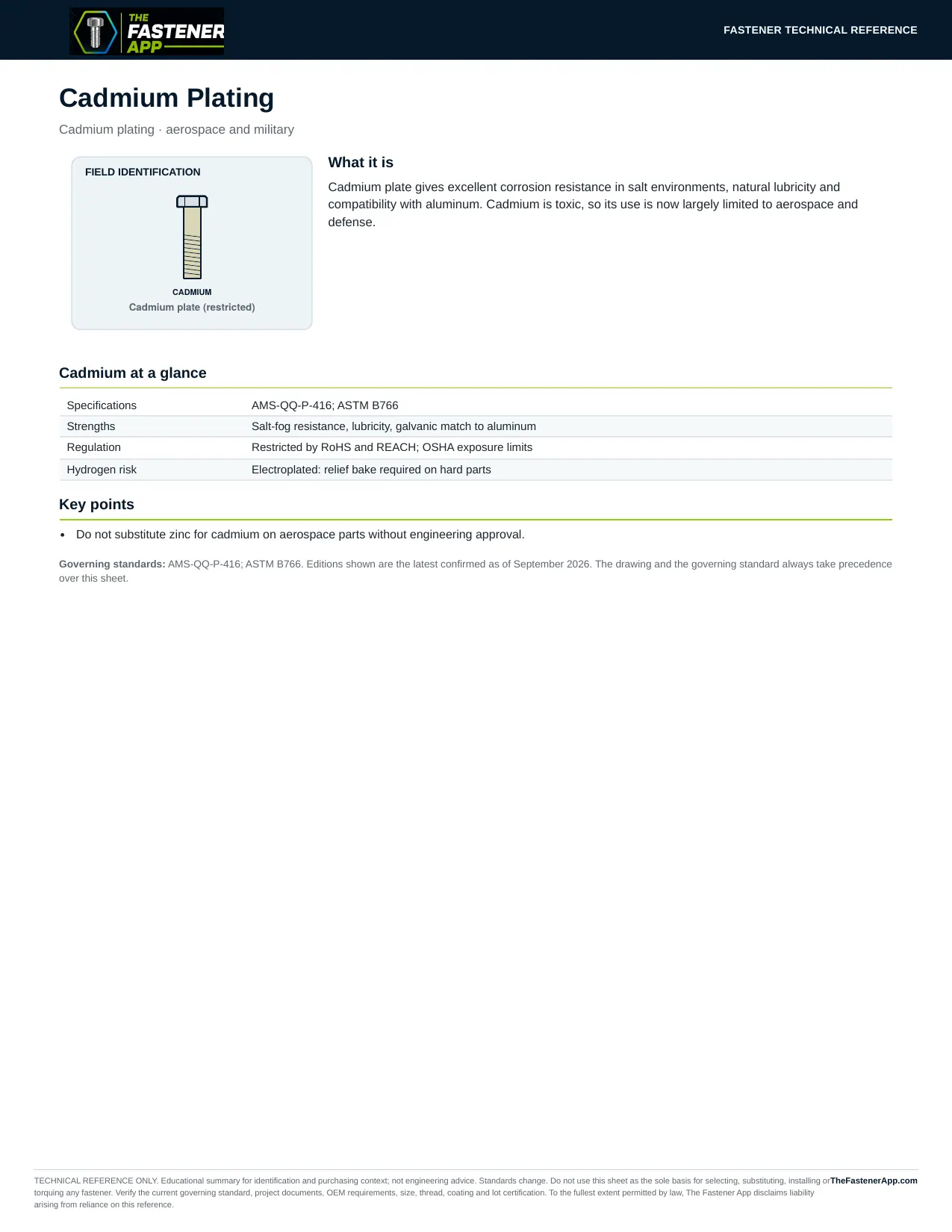
Cadmium plate gives excellent corrosion resistance in salt environments, natural lubricity and compatibility with aluminum. Cadmium is toxic, so its use is now largely limited to aerospace and defense.
 Report an error on this sheet
Hot-Dip Galvanizing
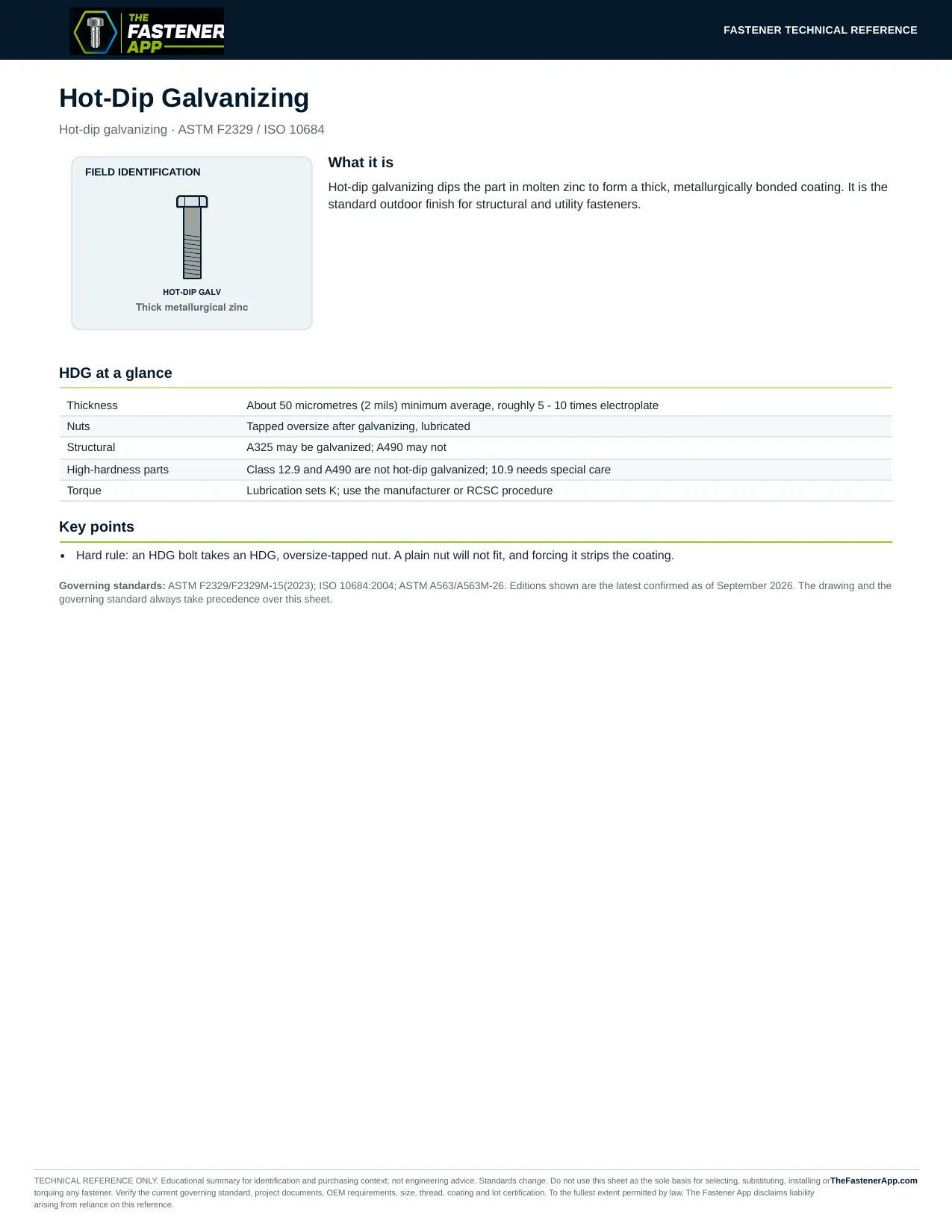
Hot-dip galvanizing dips the part in molten zinc to form a thick, metallurgically bonded coating. It is the standard outdoor finish for structural and utility fasteners.
 Report an error on this sheet
Mechanical Galvanizing
Mechanical galvanizing tumbles parts with zinc powder and glass beads so the zinc is cold-welded onto the surface. There is no electrolytic bath.
 Report an error on this sheet
Phosphate and Oil
Phosphate coating (zinc or manganese phosphate) is a crystalline conversion layer that holds oil. It gives a dark finish, a good paint base and consistent friction, but little corrosion protection on its own.
 Report an error on this sheet
Zinc-Flake - ASTM F3393 Overview
Zinc-flake systems are zinc (and often aluminum) flakes in a binder, applied by dip-spin or spray and cured. They are thin, non-electrolytic and give high salt-spray resistance.
 Report an error on this sheet
GEOMET Coating Systems
GEOMET is a chromium-free zinc/aluminum flake coating family. It replaced DACROMET in most applications.
 Report an error on this sheet
DACROMET Coating Systems
DACROMET is the original zinc/aluminum flake coating. Classic DACROMET contains hexavalent chromium, so it does not meet F3393 or RoHS and has largely been replaced by GEOMET.
 Report an error on this sheet
Magni Coating Systems
Magni systems pair a zinc/aluminum basecoat with an organic or inorganic topcoat. They are widely used on automotive fasteners.
 Report an error on this sheet
DELTA-PROTEKT / DELTA-TONE Systems
DELTA-PROTEKT is the current Doerken zinc-flake system (basecoats with topcoats such as the VH and VL series). DELTA-TONE is the earlier product line.
 Report an error on this sheet
Zintek / Techseal Systems
Zintek is a zinc-flake basecoat family and Techseal is its matching topcoat range, used in automotive and industrial coating.
 Report an error on this sheet
PTFE / Fluoropolymer-Coated Fasteners
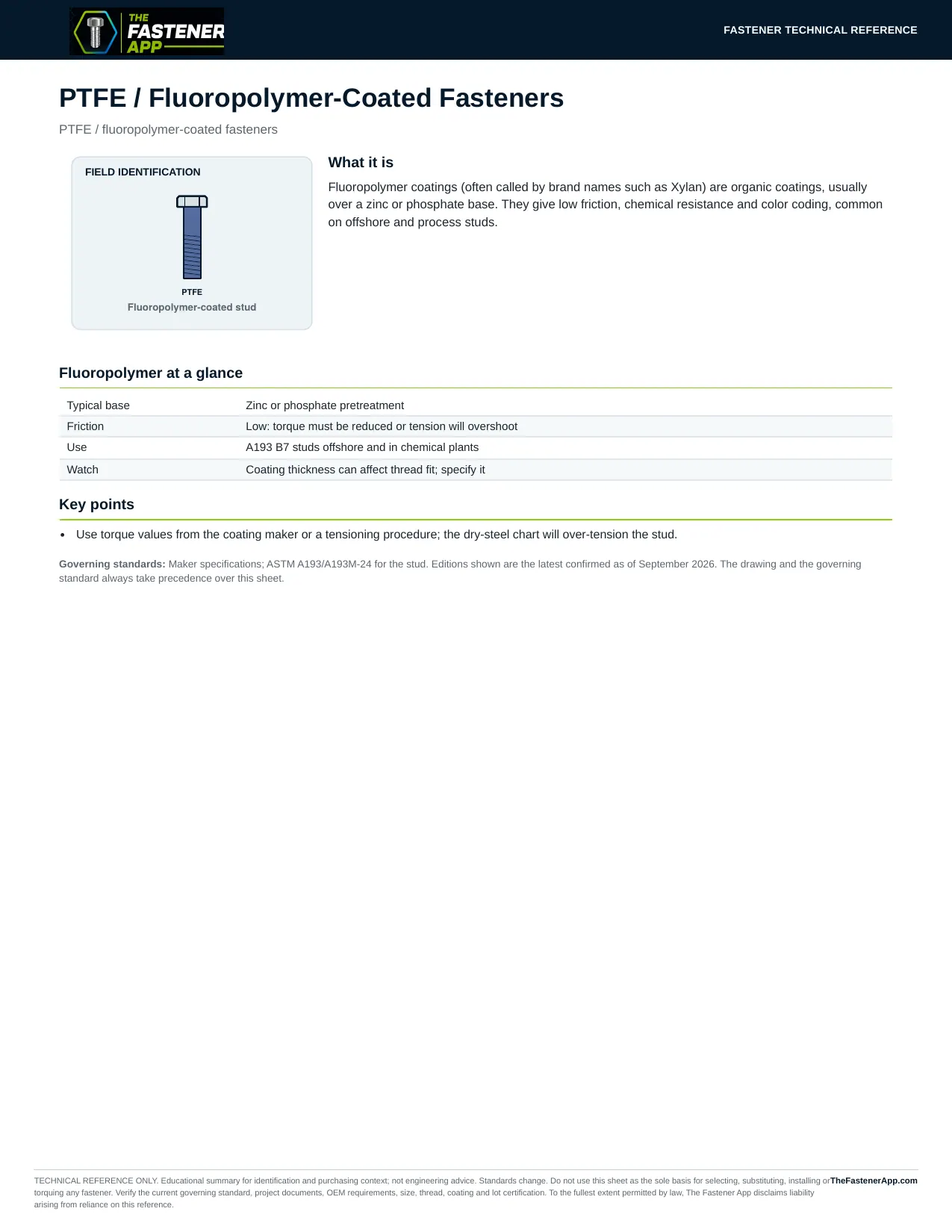
Fluoropolymer coatings (often called by brand names such as Xylan) are organic coatings, usually over a zinc or phosphate base. They give low friction, chemical resistance and color coding, common on offshore and process studs.
 Report an error on this sheet
Electroless Nickel
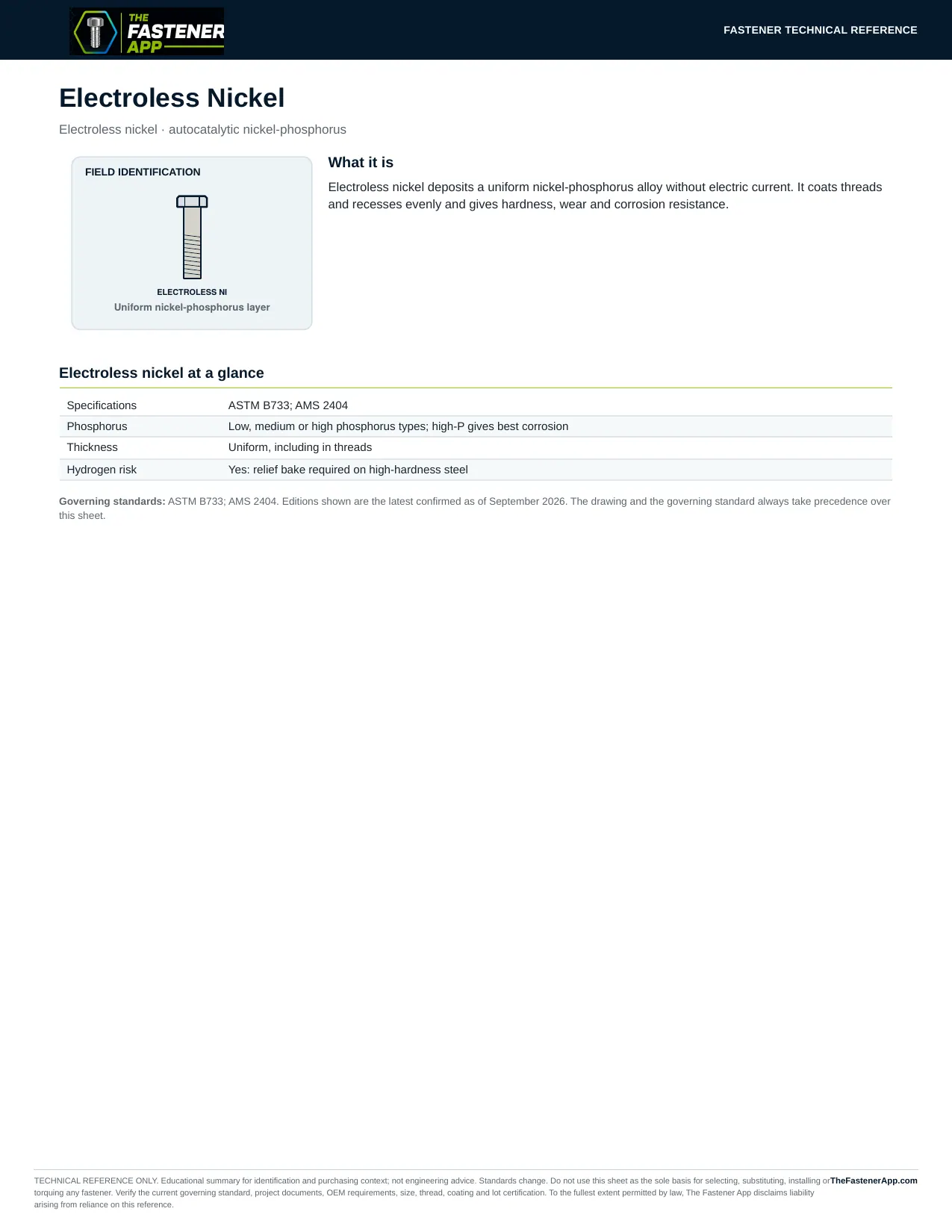
Electroless nickel deposits a uniform nickel-phosphorus alloy without electric current. It coats threads and recesses evenly and gives hardness, wear and corrosion resistance.
 Report an error on this sheet
Coating Failure Troubleshooting
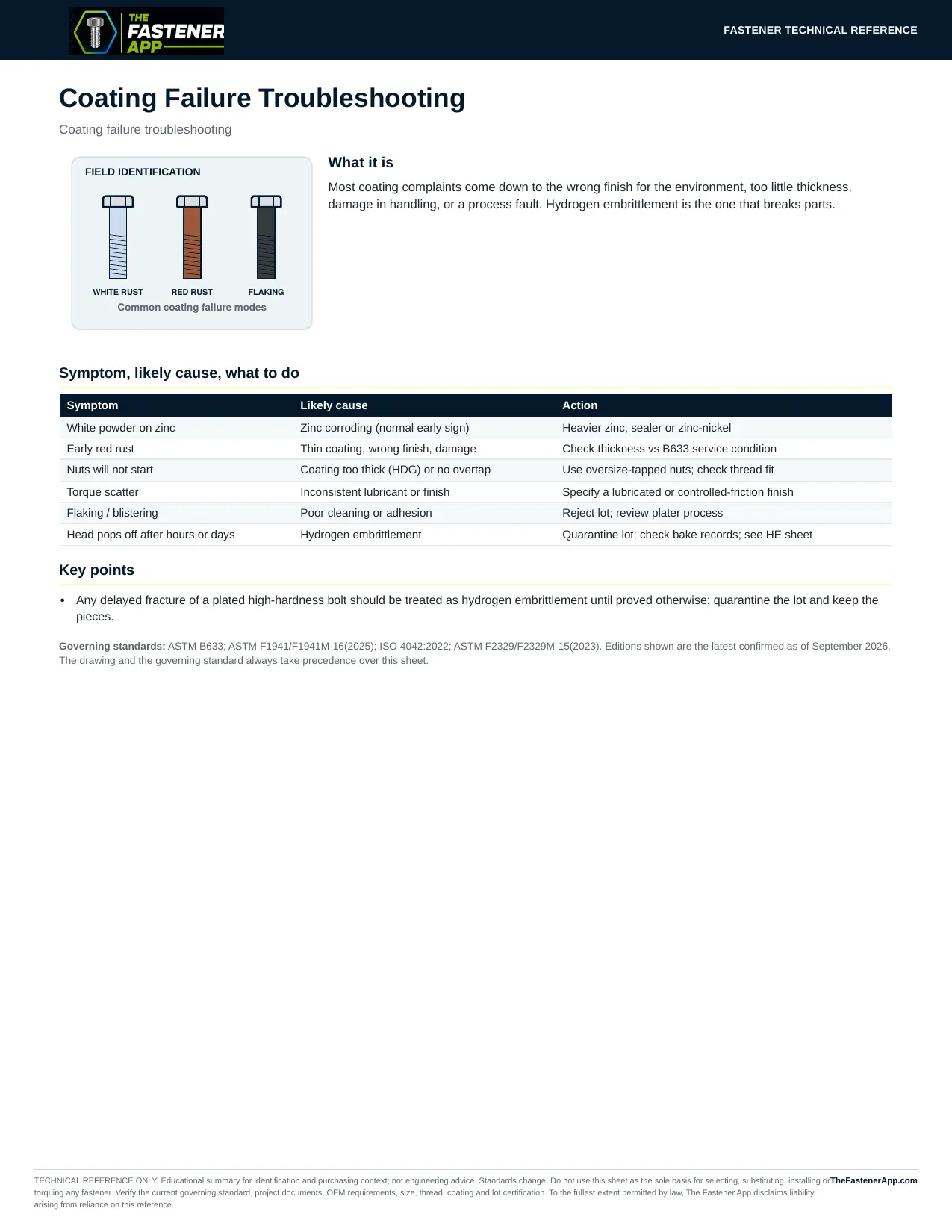
Most coating complaints come down to the wrong finish for the environment, too little thickness, damage in handling, or a process fault. Hydrogen embrittlement is the one that breaks parts.
 Report an error on this sheet
Engineering & Failure Analysis
Why fasteners fail — fatigue, overload, shear, stripping, loosening, hydrogen embrittlement, corrosion and galling.
Fastener Failure Analysis - Master Guide
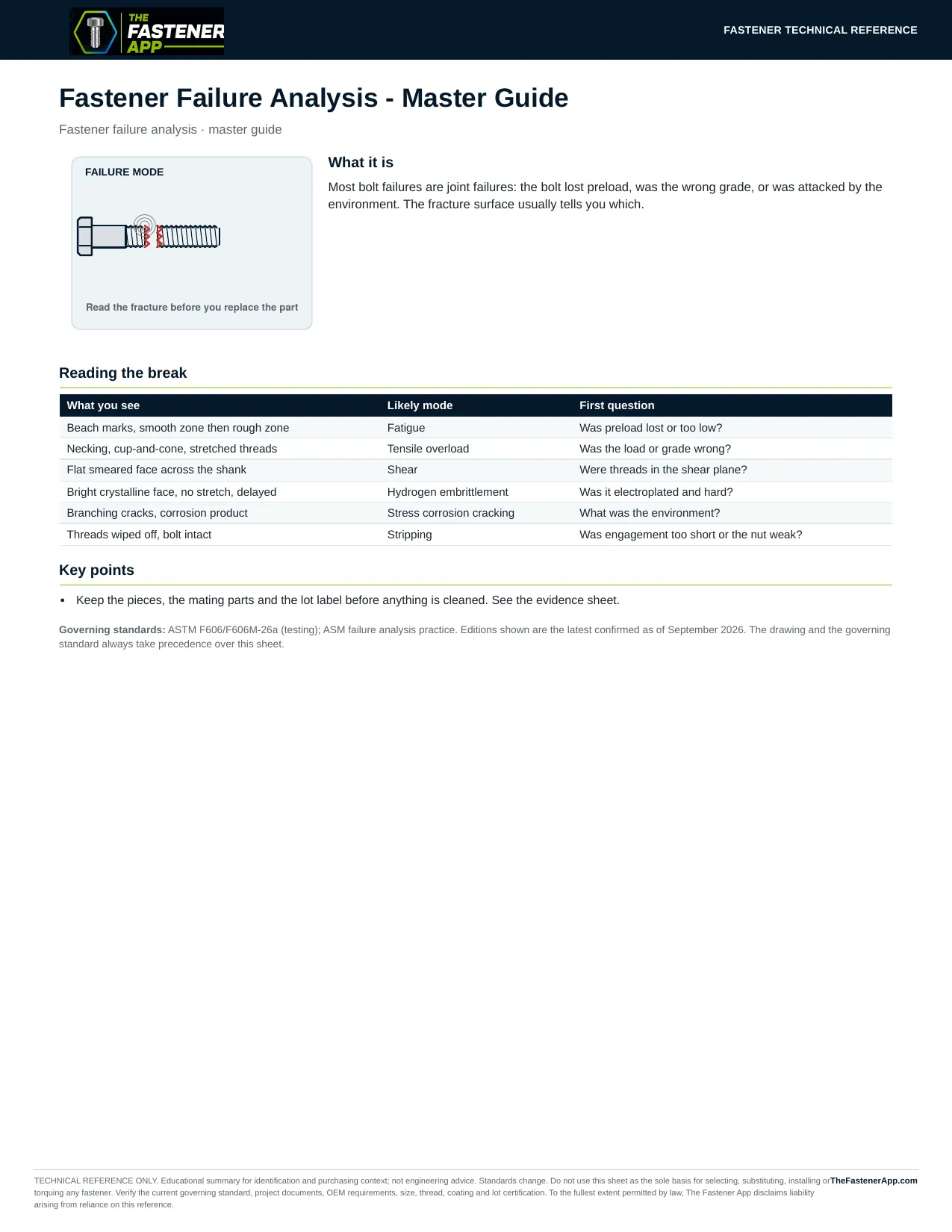
Most bolt failures are joint failures: the bolt lost preload, was the wrong grade, or was attacked by the environment. The fracture surface usually tells you which.
 Report an error on this sheet
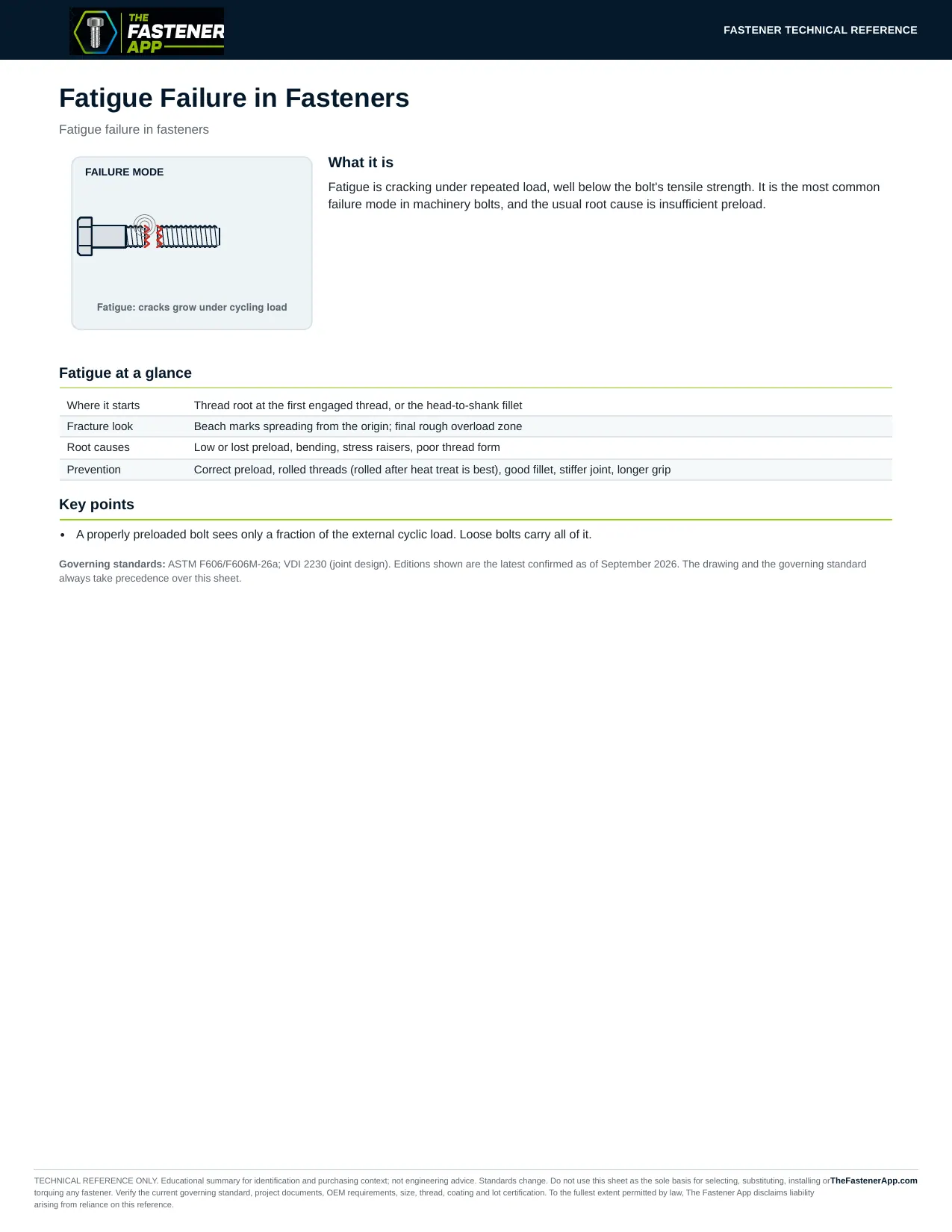
Fatigue Failure in Fasteners
Fatigue is cracking under repeated load, well below the bolt's tensile strength. It is the most common failure mode in machinery bolts, and the usual root cause is insufficient preload.
 Report an error on this sheet
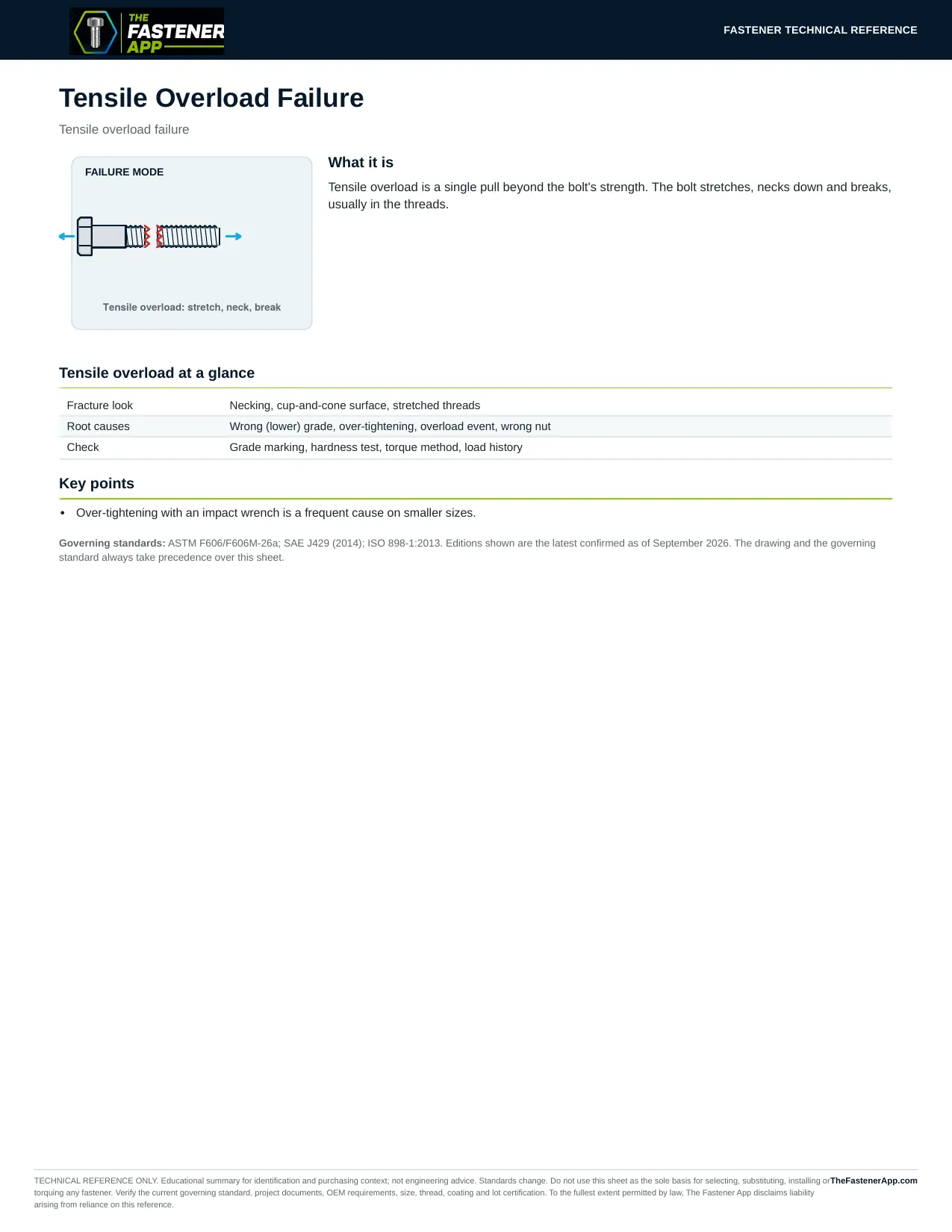
Tensile Overload Failure
Tensile overload is a single pull beyond the bolt's strength. The bolt stretches, necks down and breaks, usually in the threads.
 Report an error on this sheet
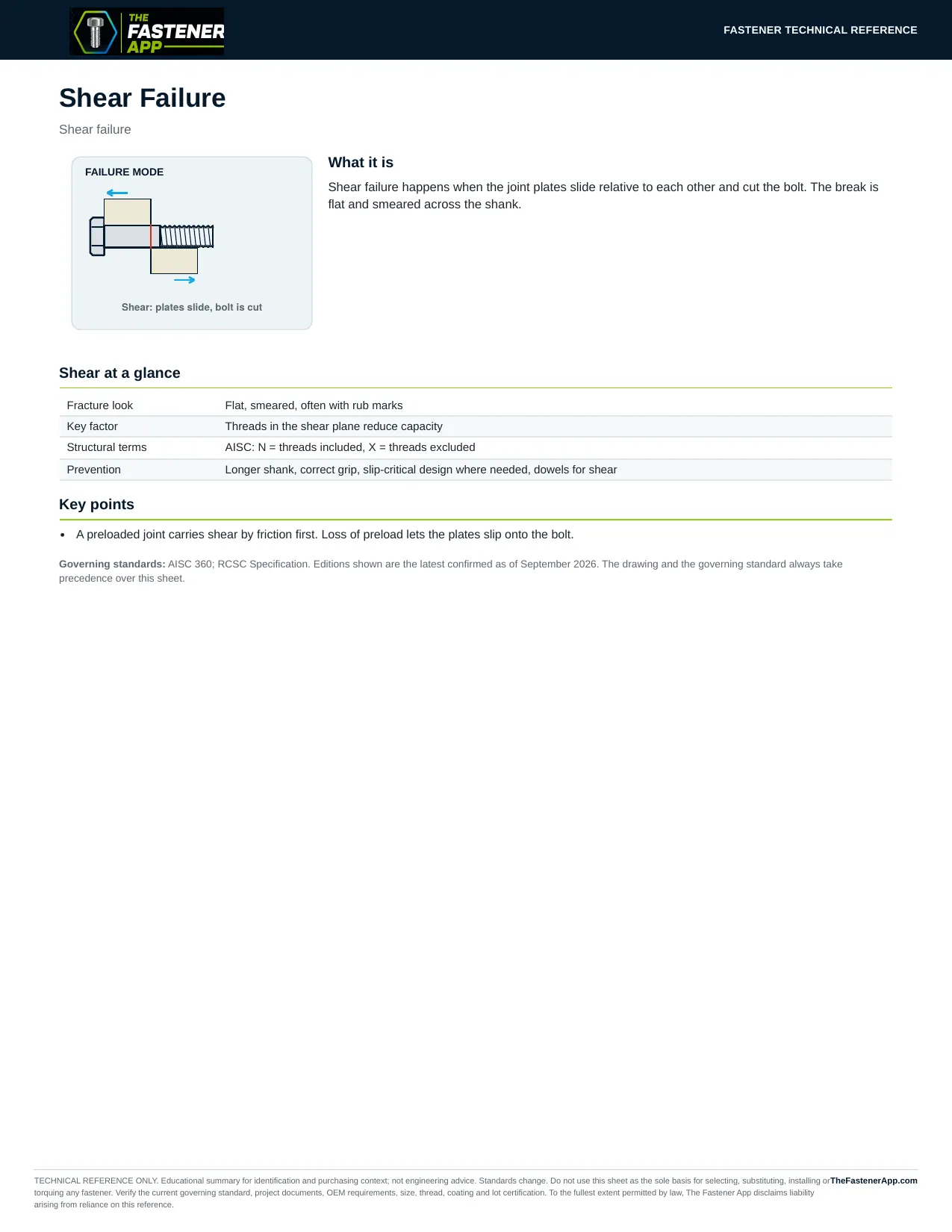
Shear Failure
Shear failure happens when the joint plates slide relative to each other and cut the bolt. The break is flat and smeared across the shank.
 Report an error on this sheet
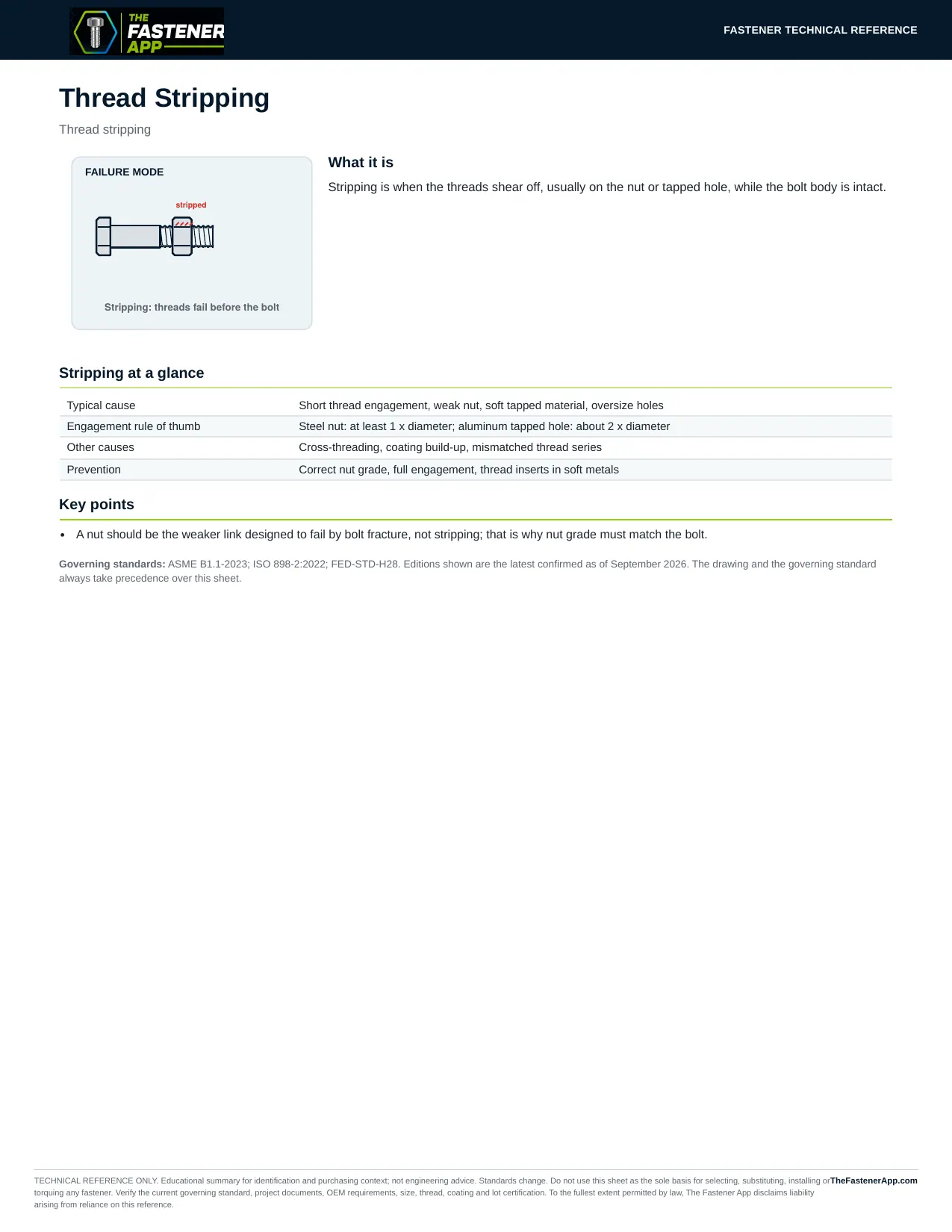
Thread Stripping
Stripping is when the threads shear off, usually on the nut or tapped hole, while the bolt body is intact.
 Report an error on this sheet
Torque / Preload Failure
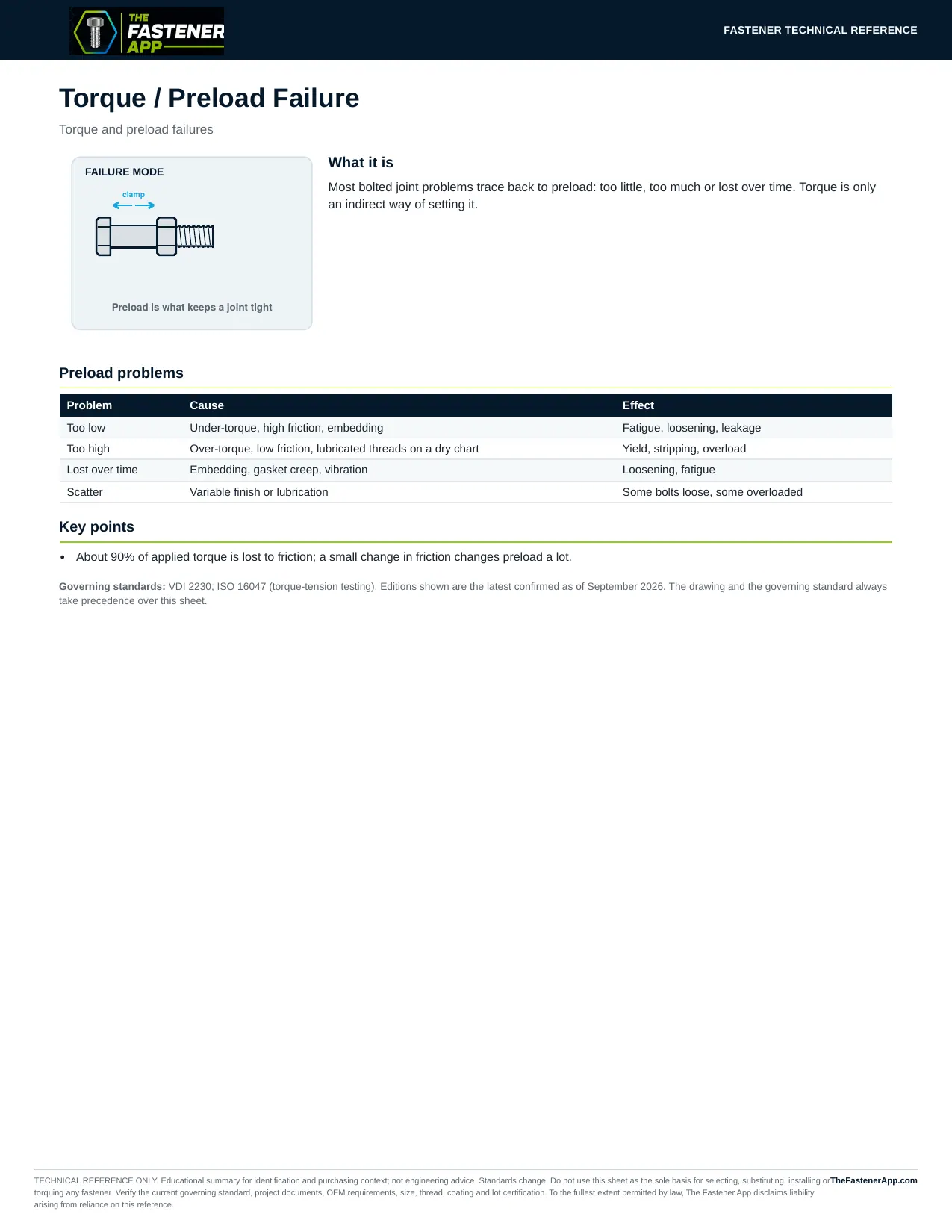
Most bolted joint problems trace back to preload: too little, too much or lost over time. Torque is only an indirect way of setting it.
 Report an error on this sheet
Vibration Loosening
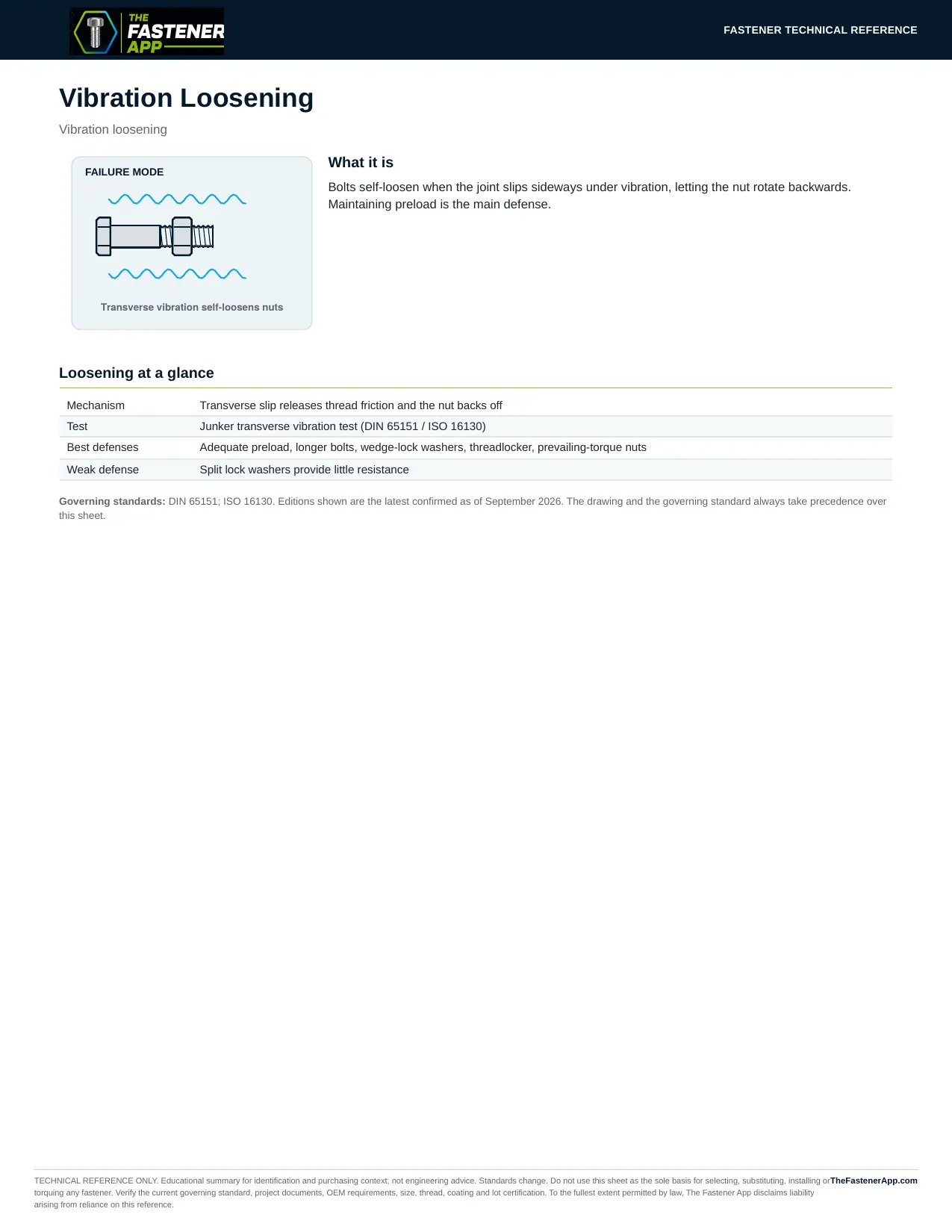
Bolts self-loosen when the joint slips sideways under vibration, letting the nut rotate backwards. Maintaining preload is the main defense.
 Report an error on this sheet
Hydrogen Embrittlement Failure
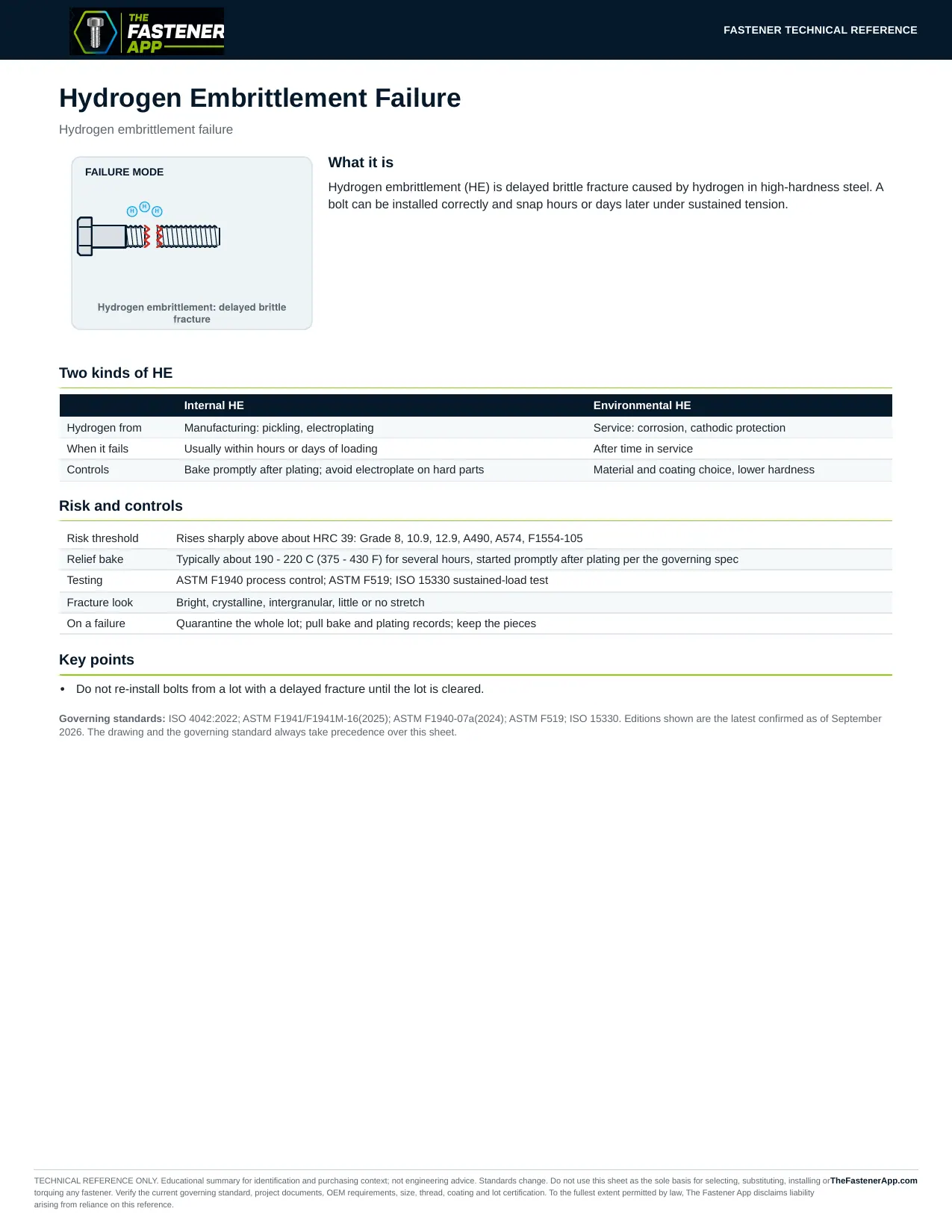
Hydrogen embrittlement (HE) is delayed brittle fracture caused by hydrogen in high-hardness steel. A bolt can be installed correctly and snap hours or days later under sustained tension.
 Report an error on this sheet
Stress-Corrosion Cracking
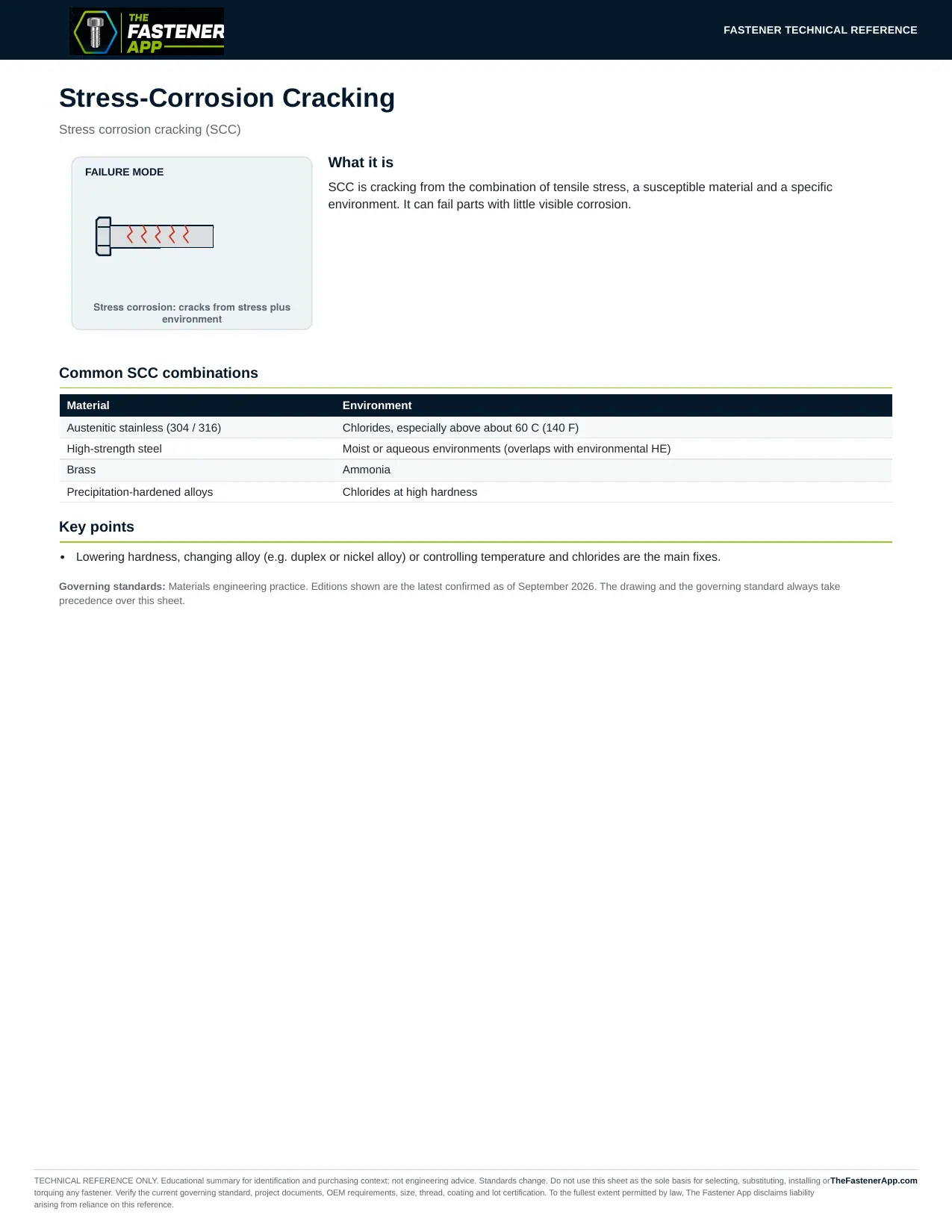
SCC is cracking from the combination of tensile stress, a susceptible material and a specific environment. It can fail parts with little visible corrosion.
 Report an error on this sheet
Galling and Seizure
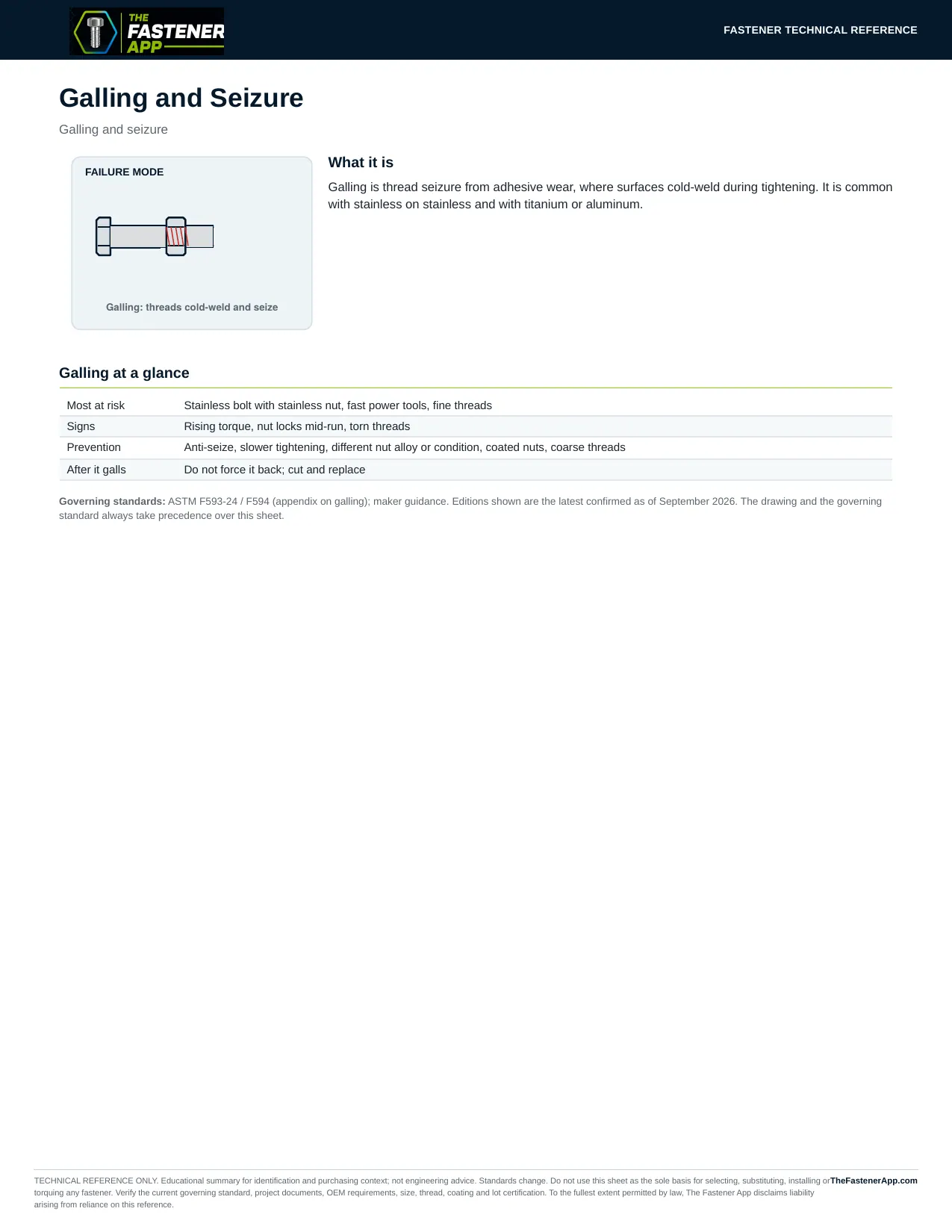
Galling is thread seizure from adhesive wear, where surfaces cold-weld during tightening. It is common with stainless on stainless and with titanium or aluminum.
 Report an error on this sheet
Corrosion Failure
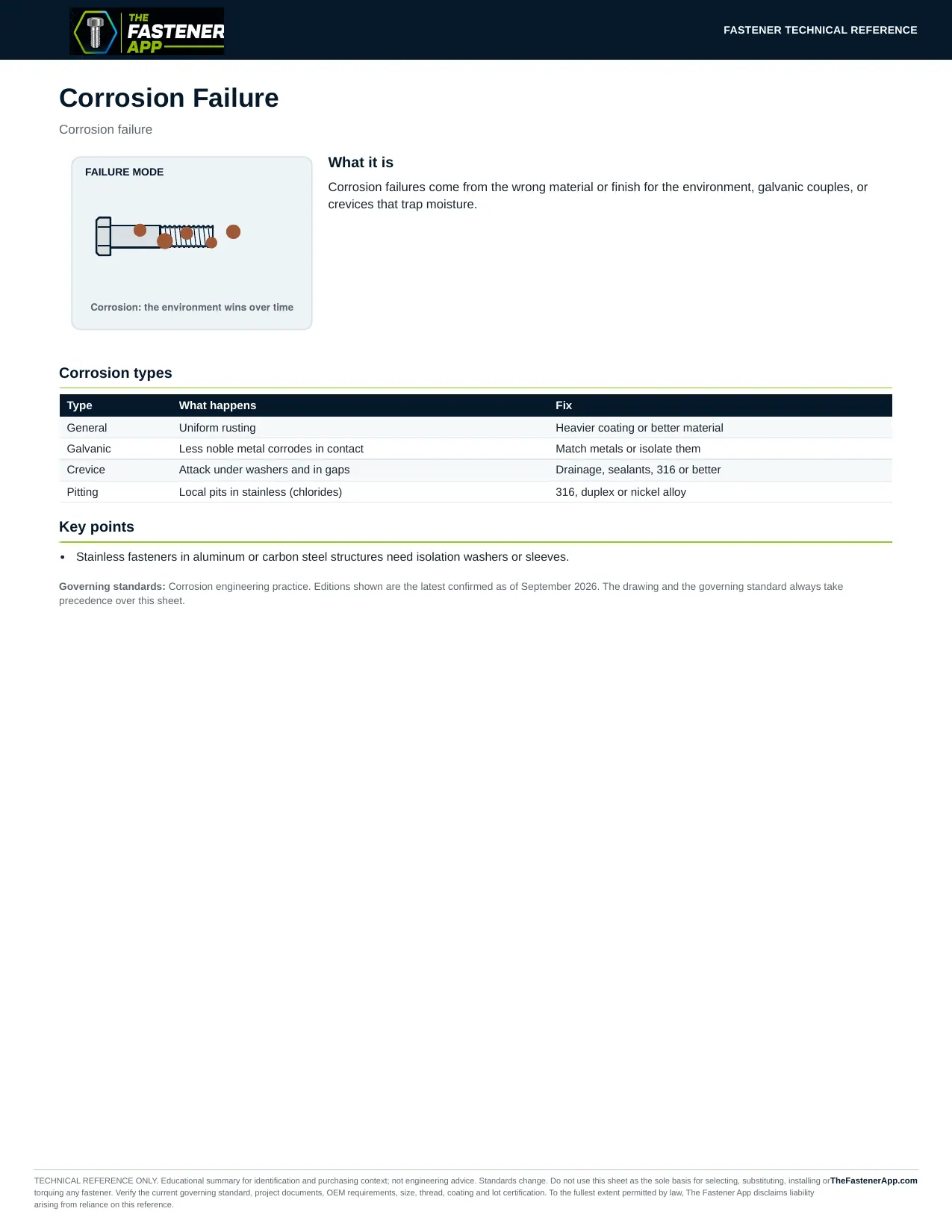
Corrosion failures come from the wrong material or finish for the environment, galvanic couples, or crevices that trap moisture.
 Report an error on this sheet
Heat Treatment and Hardness Problems
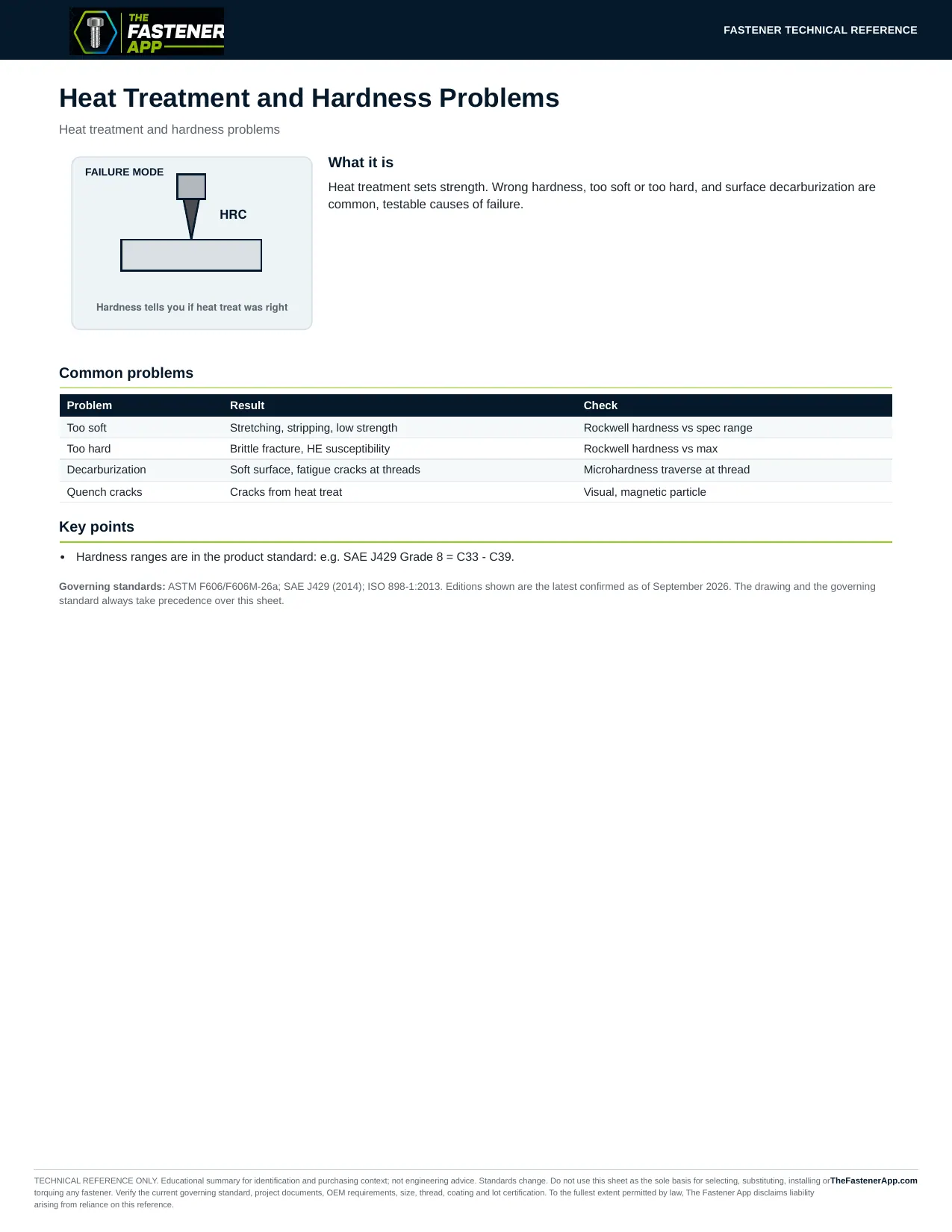
Heat treatment sets strength. Wrong hardness, too soft or too hard, and surface decarburization are common, testable causes of failure.
 Report an error on this sheet
Plating / Coating Failure in Fasteners
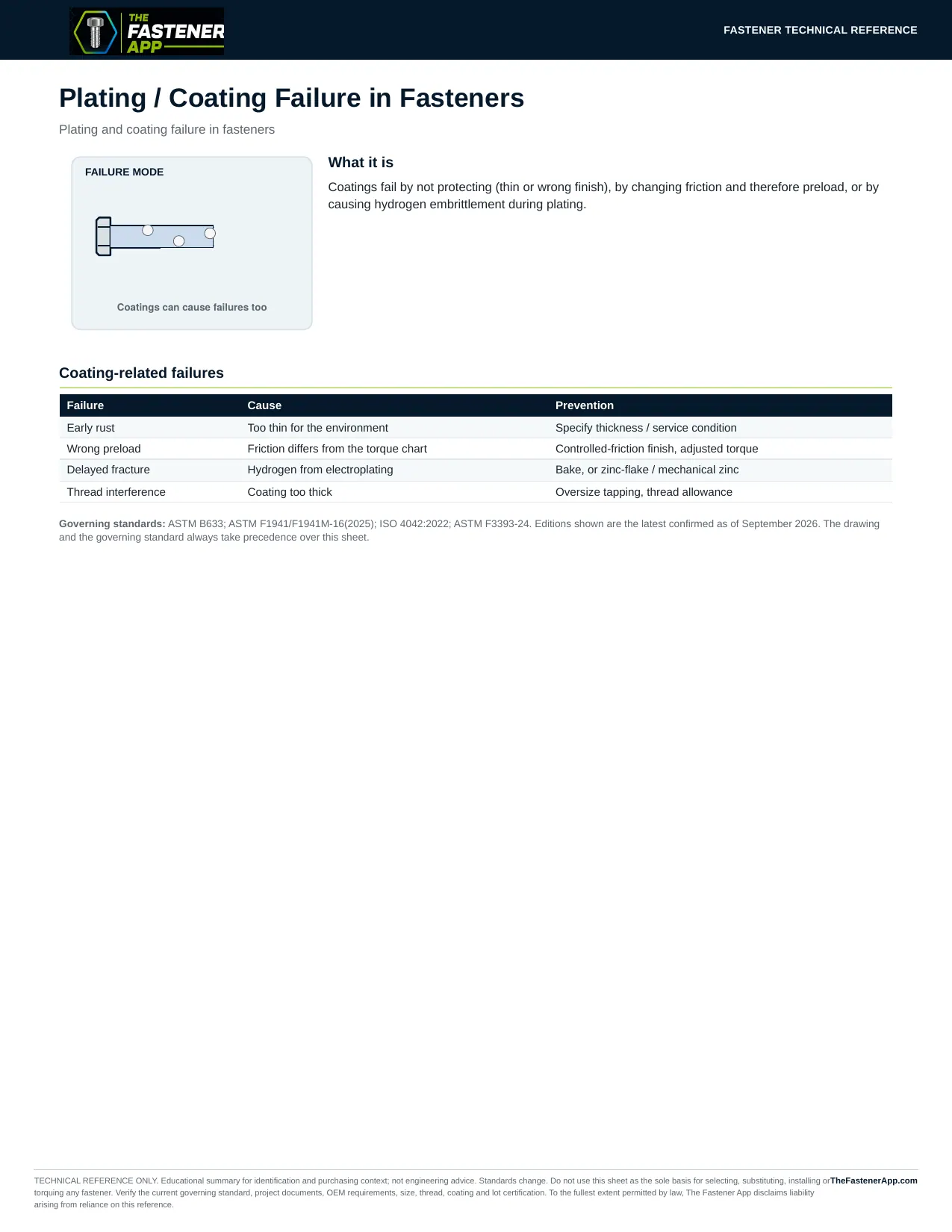
Coatings fail by not protecting (thin or wrong finish), by changing friction and therefore preload, or by causing hydrogen embrittlement during plating.
 Report an error on this sheet
How to Preserve Evidence After a Fastener Failure
What you do in the first hour decides whether the cause can ever be proved. Protect the pieces, record the scene and quarantine the lot.
 Report an error on this sheet
Specification & Engineering Control
How to write and read a fastener specification, build a part number, and control substitutions and changes.
How to Write a Fastener Specification
A fastener specification must let any qualified supplier ship exactly the same part. Every element that affects fit, strength or corrosion has to be stated.
 Report an error on this sheet
How to Read a Fastener Print
A fastener drawing defines geometry, tolerances, material, finish and notes. Most errors come from missed notes and revision levels, not from dimensions.
 Report an error on this sheet
How to Build a Fastener Part Number
A structured part number encodes the key attributes so people and systems can read it. Consistency matters more than any particular scheme.
 Report an error on this sheet
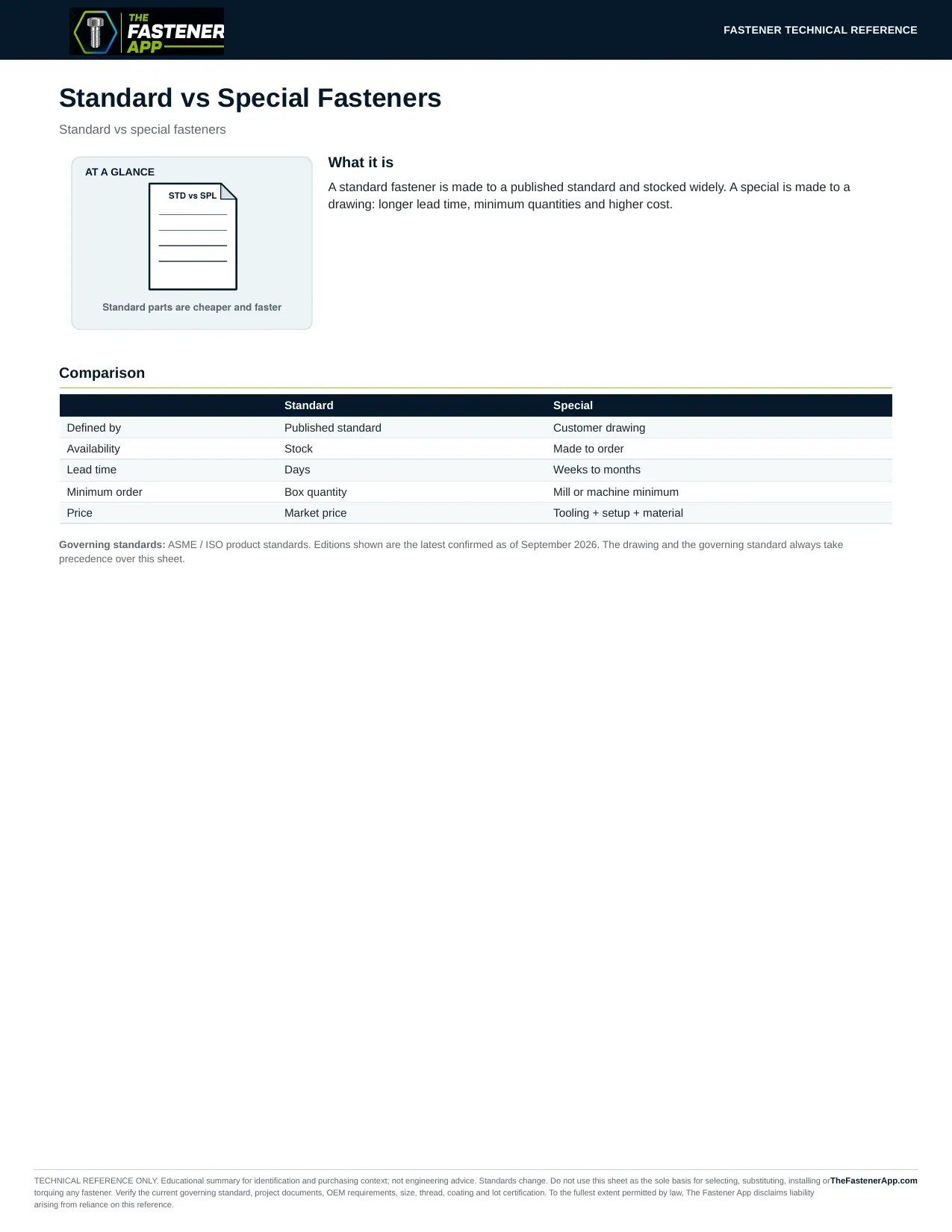
Standard vs Special Fasteners
A standard fastener is made to a published standard and stocked widely. A special is made to a drawing: longer lead time, minimum quantities and higher cost.
 Report an error on this sheet
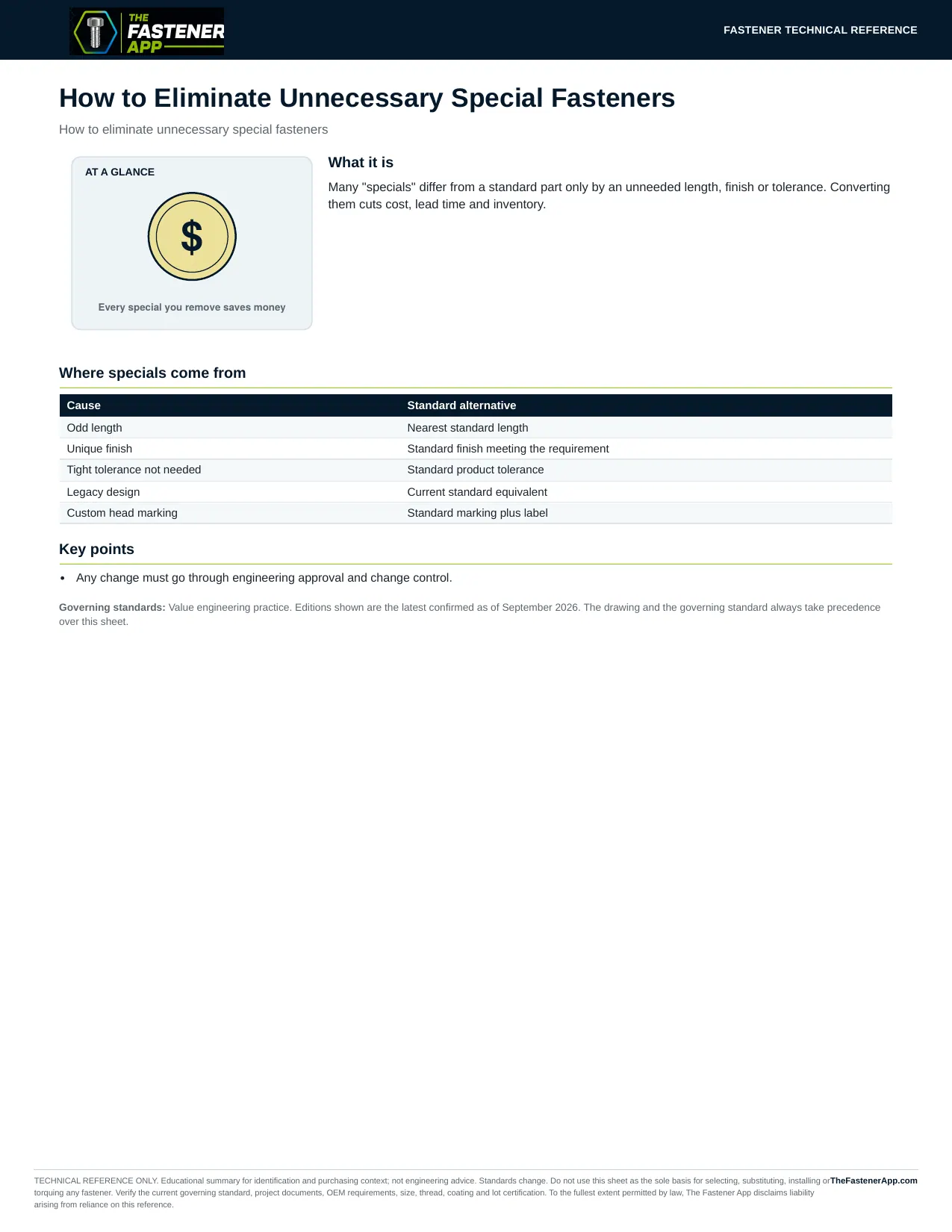
How to Eliminate Unnecessary Special Fasteners
Many "specials" differ from a standard part only by an unneeded length, finish or tolerance. Converting them cuts cost, lead time and inventory.
 Report an error on this sheet
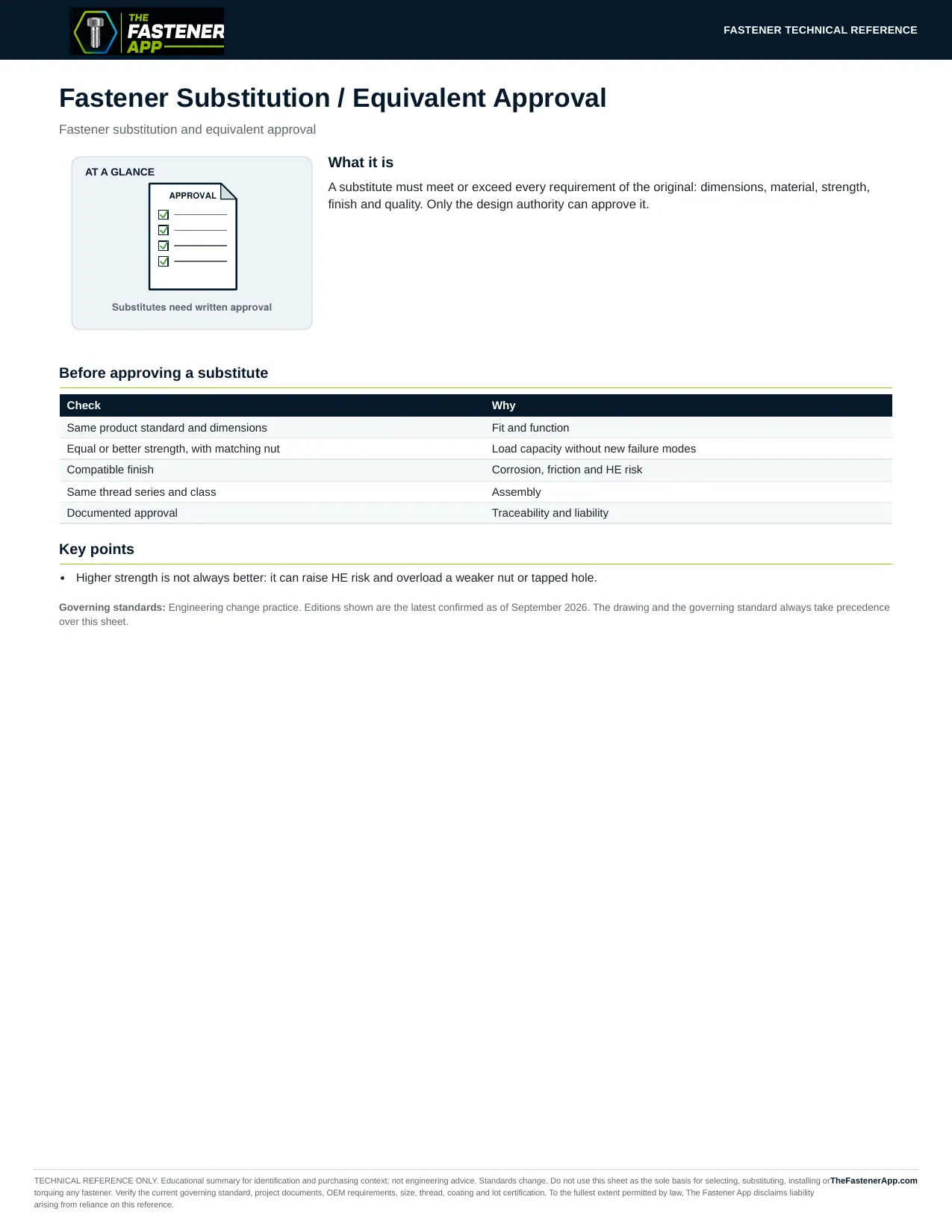
Fastener Substitution / Equivalent Approval
A substitute must meet or exceed every requirement of the original: dimensions, material, strength, finish and quality. Only the design authority can approve it.
 Report an error on this sheet
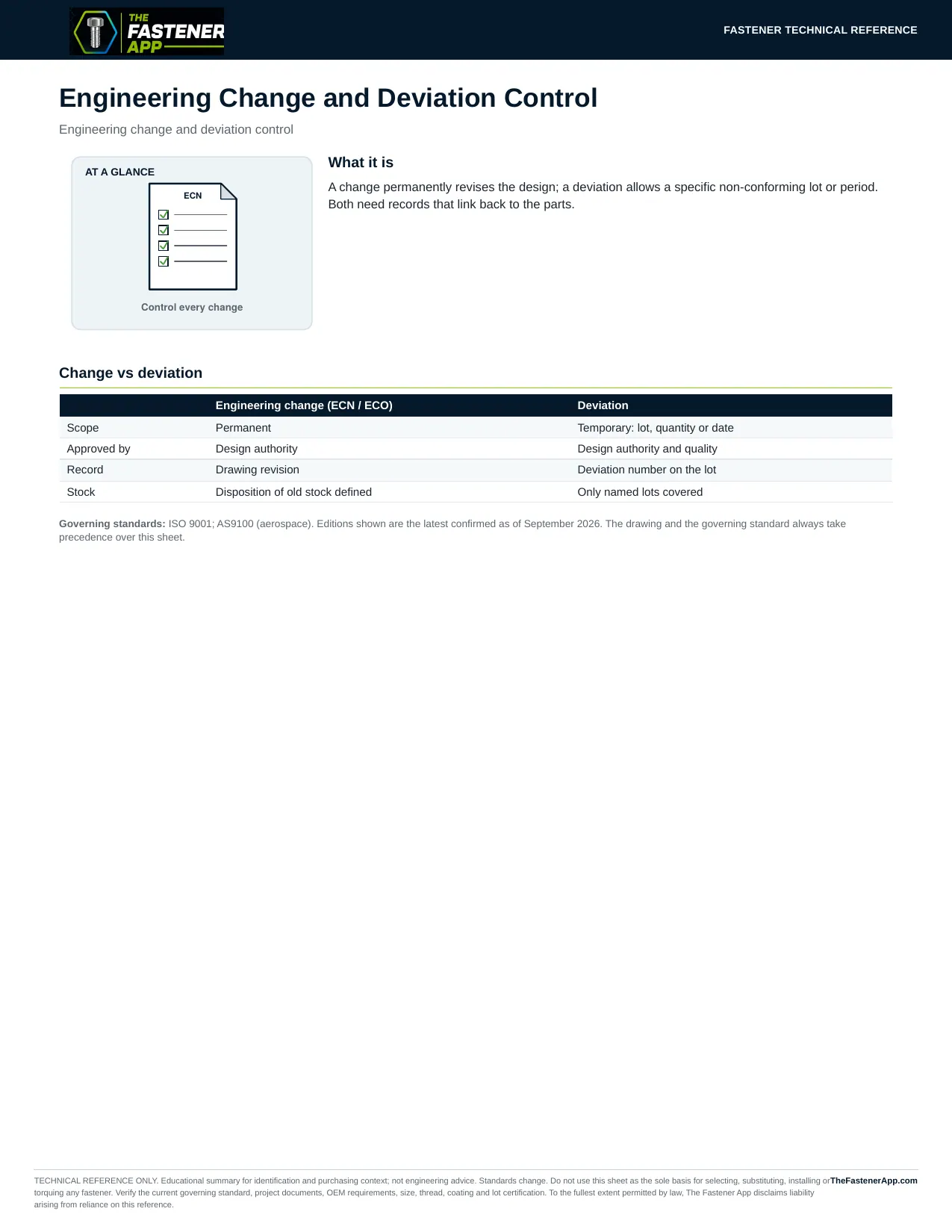
Engineering Change and Deviation Control
A change permanently revises the design; a deviation allows a specific non-conforming lot or period. Both need records that link back to the parts.
 Report an error on this sheet
Procurement & Cost Reduction
RFQs, quote comparison, total cost of ownership, blanket orders, MOQ/EOQ and supplier strategy.
How to Prepare a Fastener RFQ
A request for quote should define the part, the quantities and the quality requirements so every supplier prices the same thing.
 Report an error on this sheet
Fastener RFQ Checklist
Use this list before sending an RFQ; every missing line becomes a supplier assumption.
 Report an error on this sheet
How to Compare Fastener Quotes
The lowest unit price is not always the lowest cost. Normalize quotes to the same quantity, quality, packaging and delivery before comparing.
 Report an error on this sheet
Fastener Total Cost of Ownership
Total cost of ownership adds everything it costs to have the right fastener at the point of use: buying, stocking, handling, stockouts and quality problems.
 Report an error on this sheet
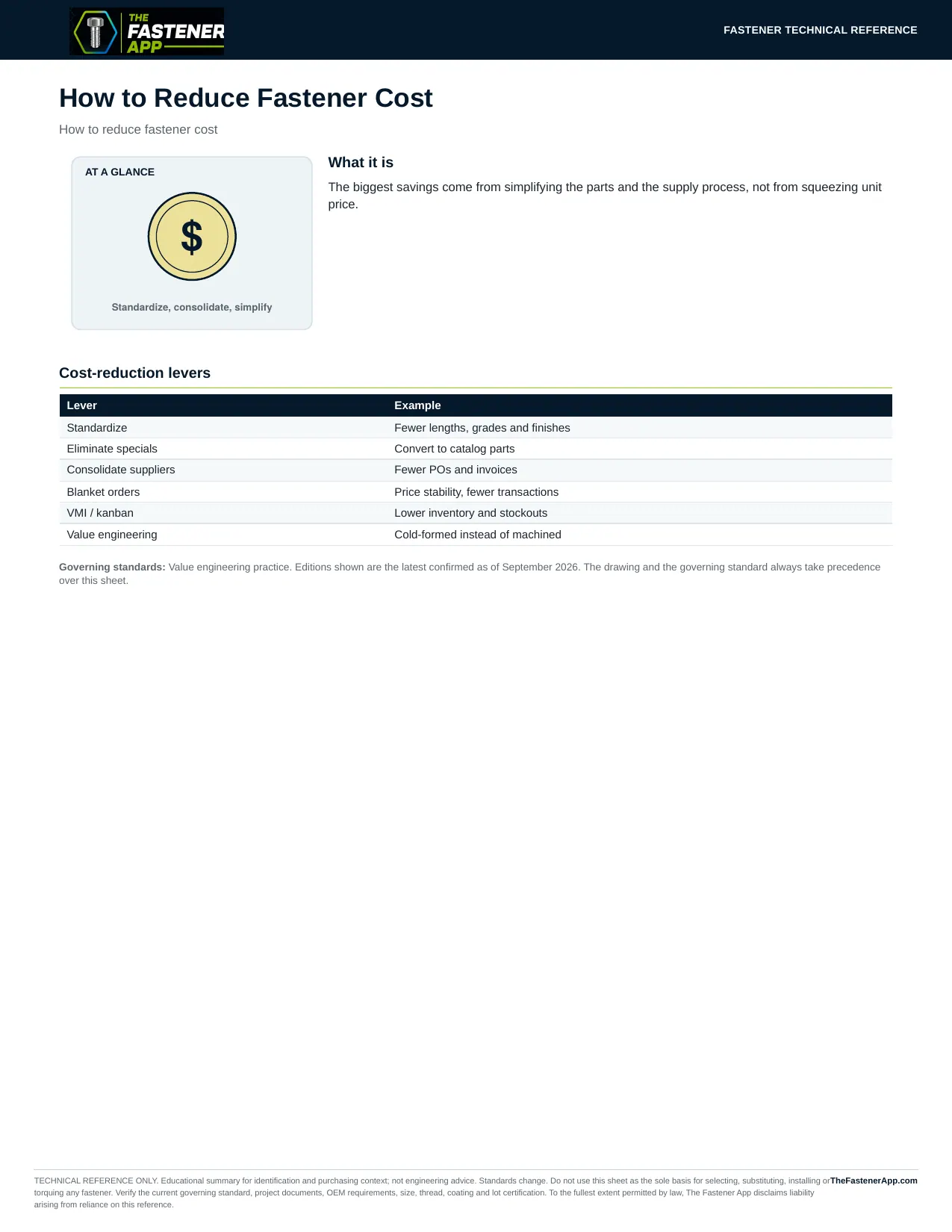
How to Reduce Fastener Cost
The biggest savings come from simplifying the parts and the supply process, not from squeezing unit price.
 Report an error on this sheet
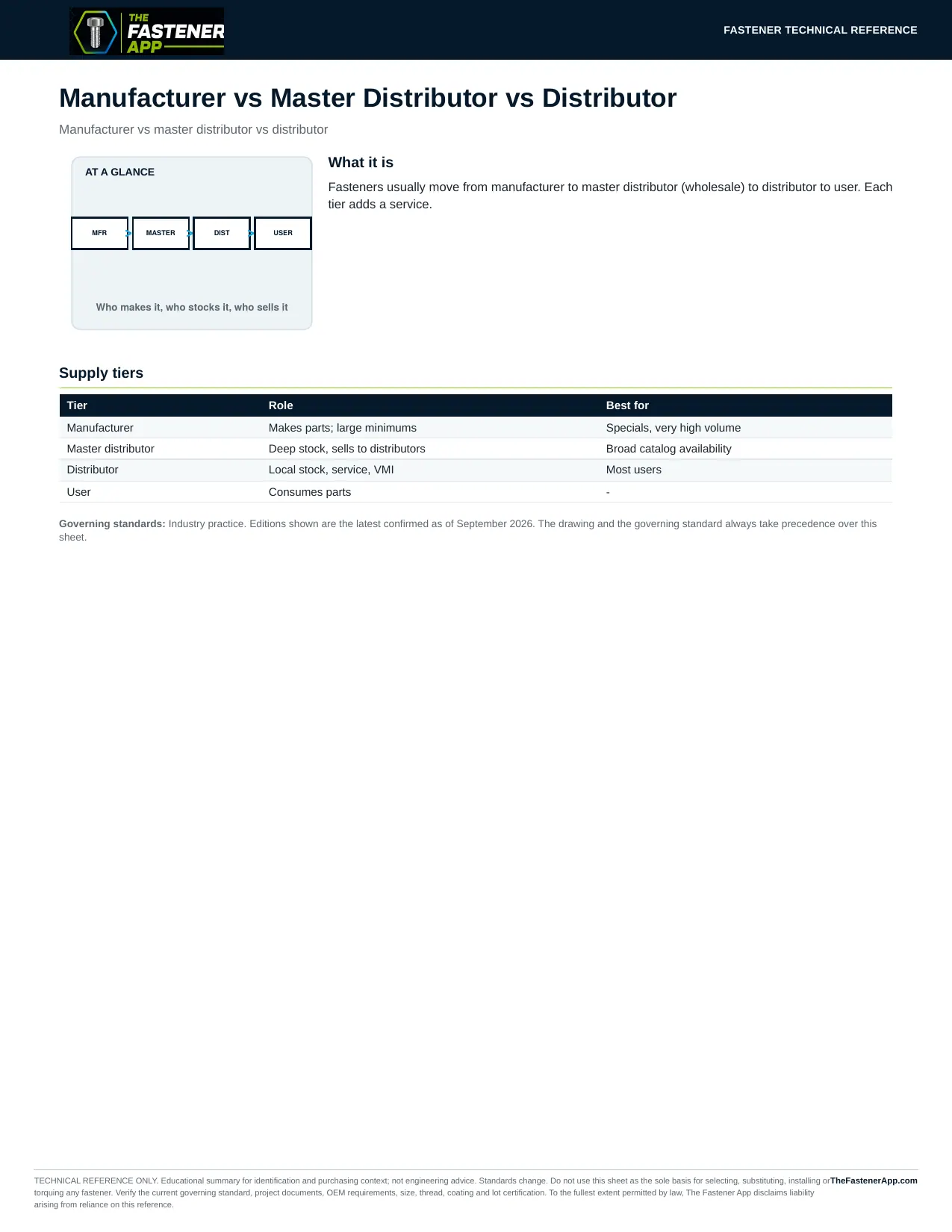
Manufacturer vs Master Distributor vs Distributor
Fasteners usually move from manufacturer to master distributor (wholesale) to distributor to user. Each tier adds a service.
 Report an error on this sheet
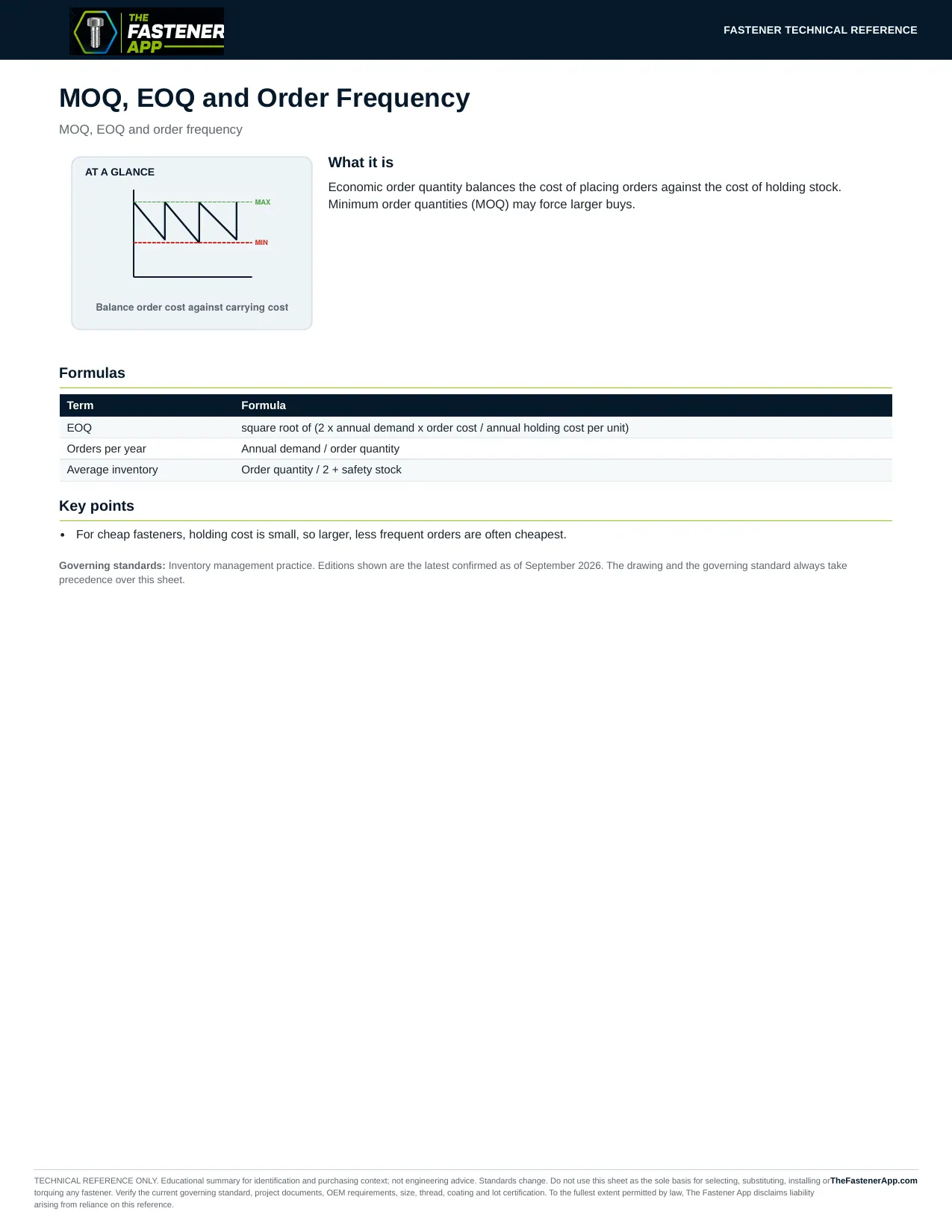
MOQ, EOQ and Order Frequency
Economic order quantity balances the cost of placing orders against the cost of holding stock. Minimum order quantities (MOQ) may force larger buys.
 Report an error on this sheet
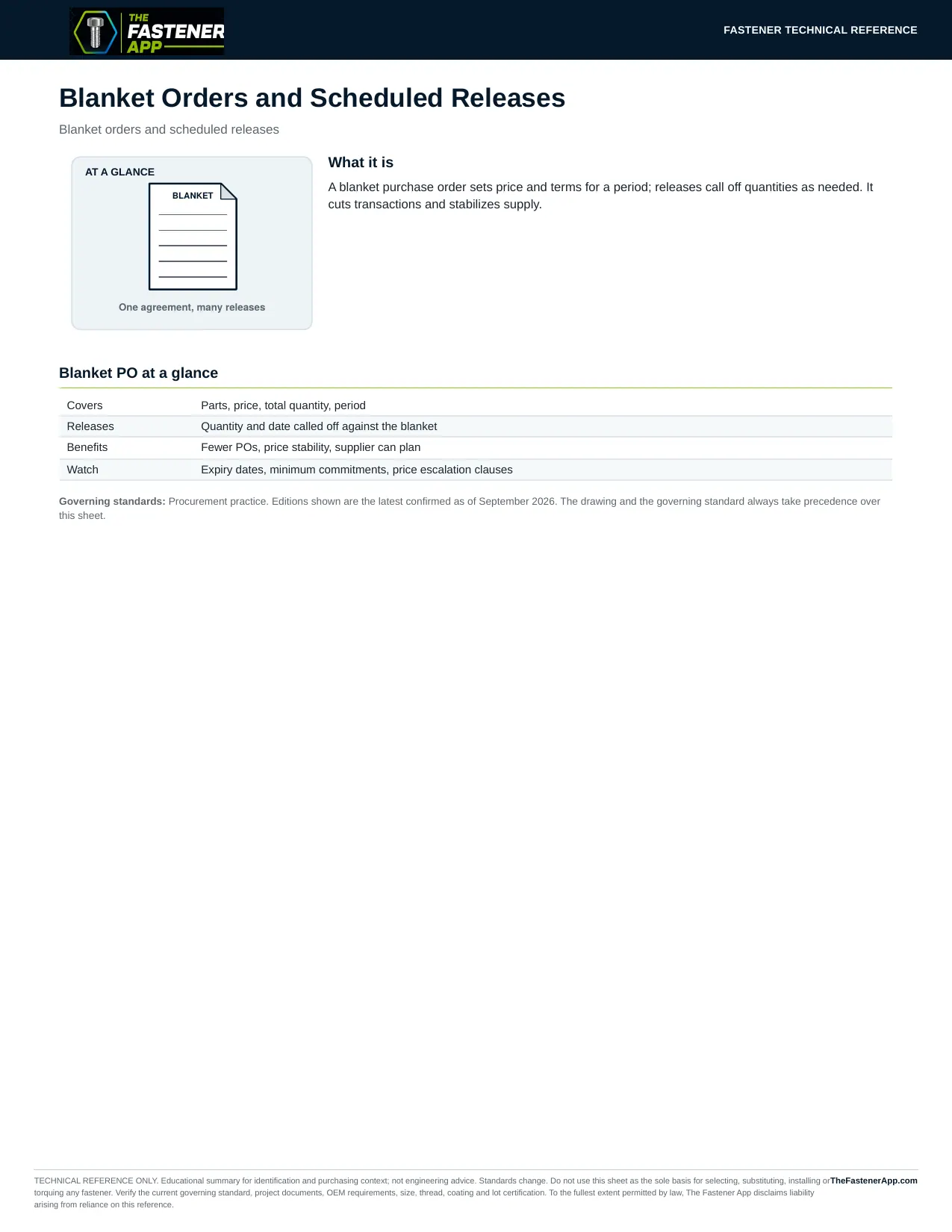
Blanket Orders and Scheduled Releases
A blanket purchase order sets price and terms for a period; releases call off quantities as needed. It cuts transactions and stabilizes supply.
 Report an error on this sheet
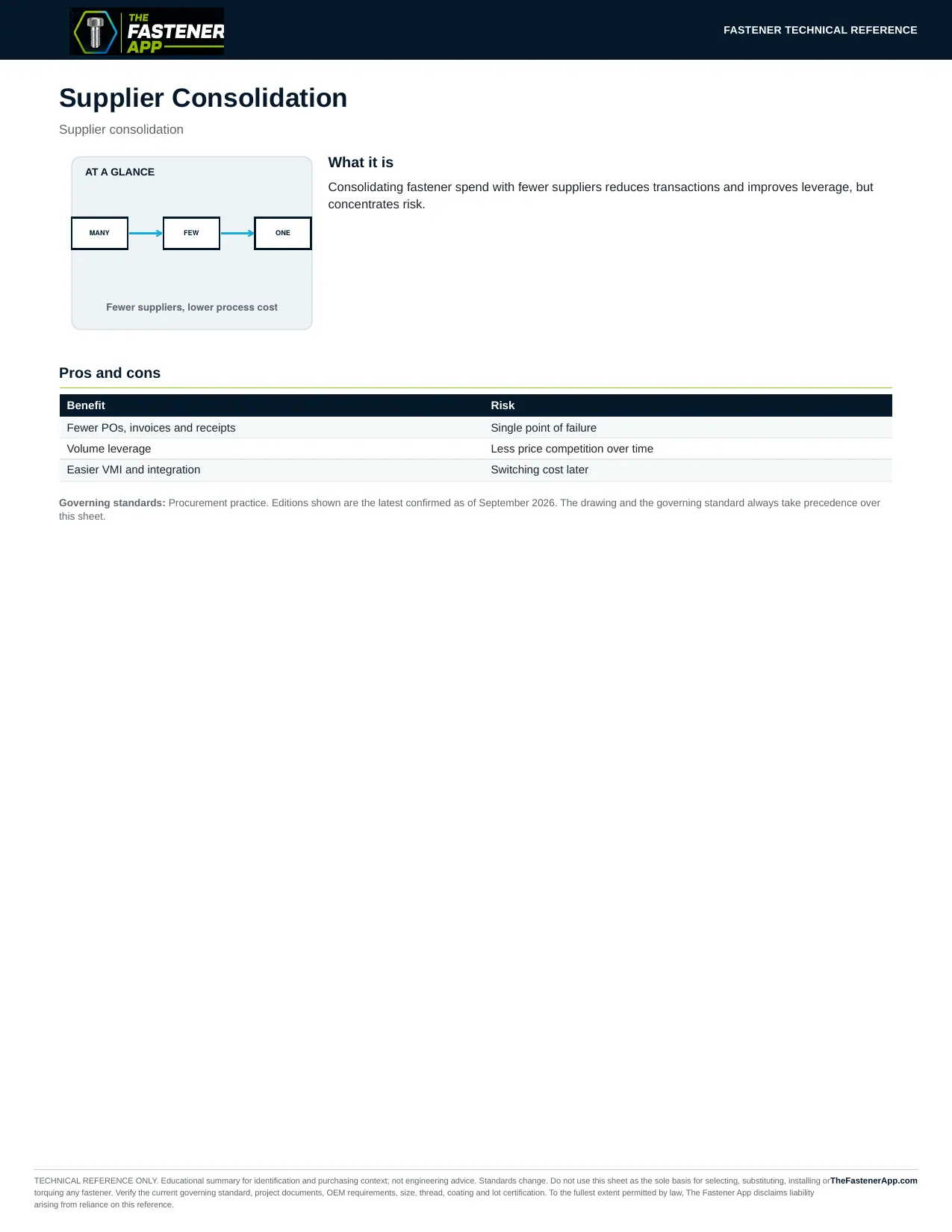
Supplier Consolidation
Consolidating fastener spend with fewer suppliers reduces transactions and improves leverage, but concentrates risk.
 Report an error on this sheet
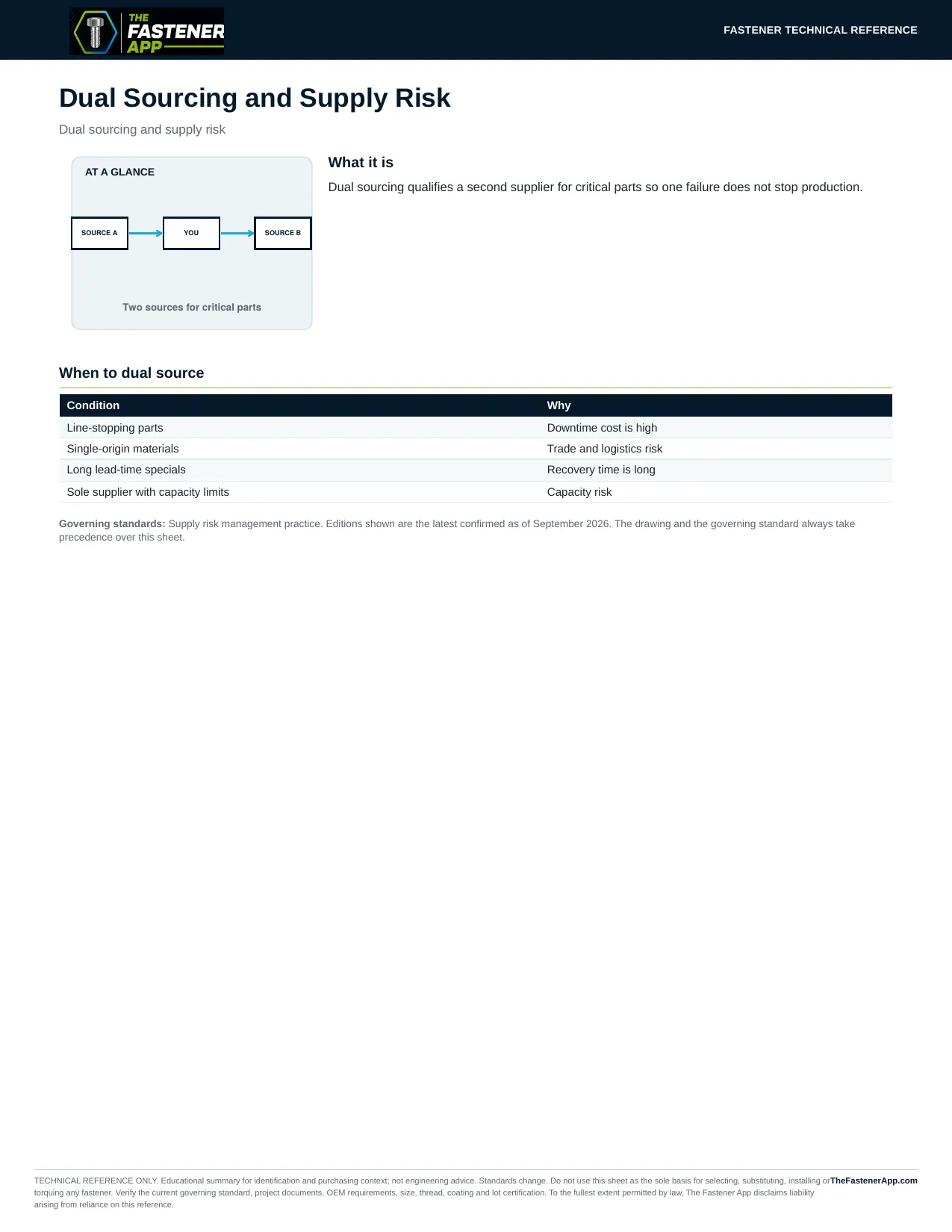
Dual Sourcing and Supply Risk
Dual sourcing qualifies a second supplier for critical parts so one failure does not stop production.
 Report an error on this sheet
Quality, Compliance & Traceability
Incoming inspection, certs and MTRs, lot traceability, PPAP, FAI, 8D and counterfeit controls.
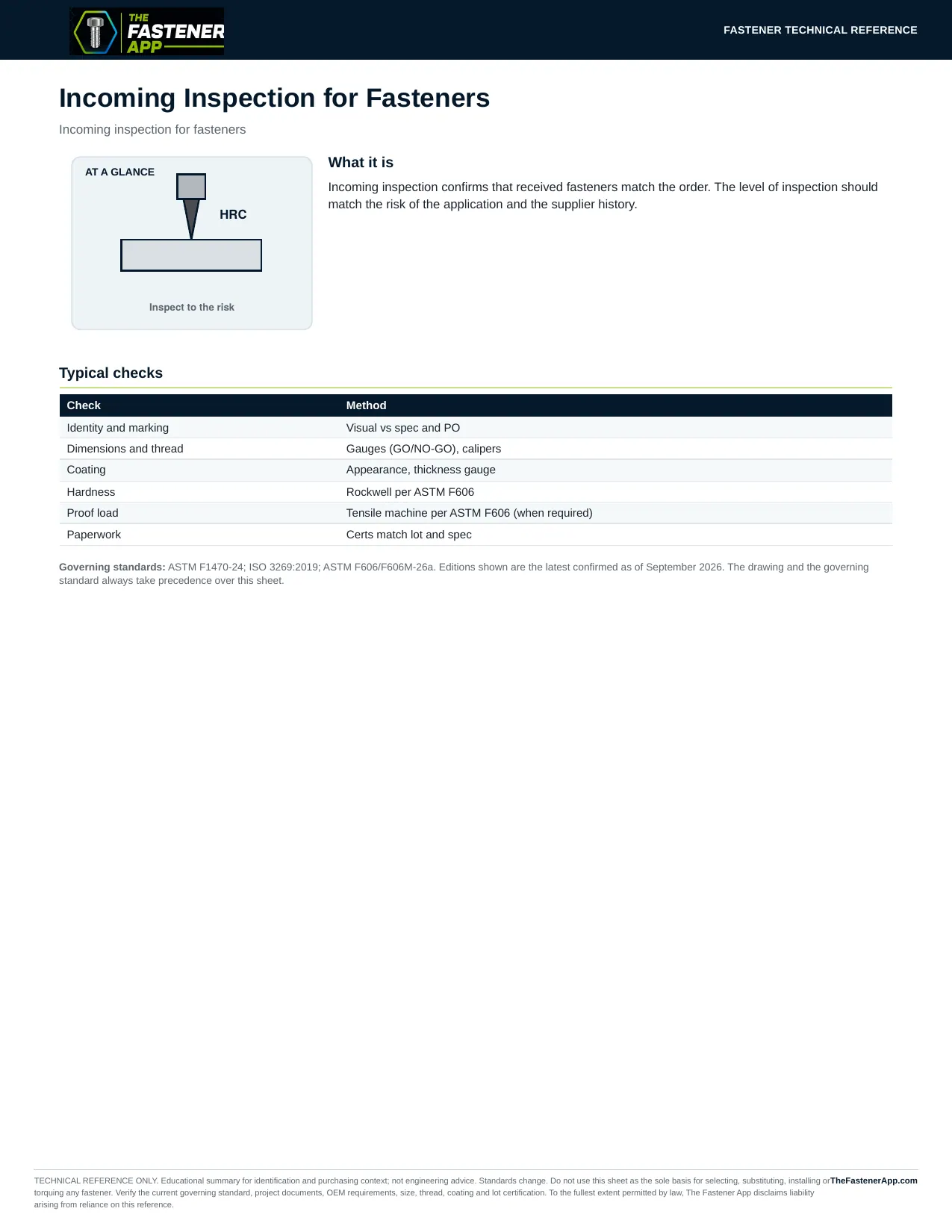
Incoming Inspection for Fasteners
Incoming inspection confirms that received fasteners match the order. The level of inspection should match the risk of the application and the supplier history.
 Report an error on this sheet
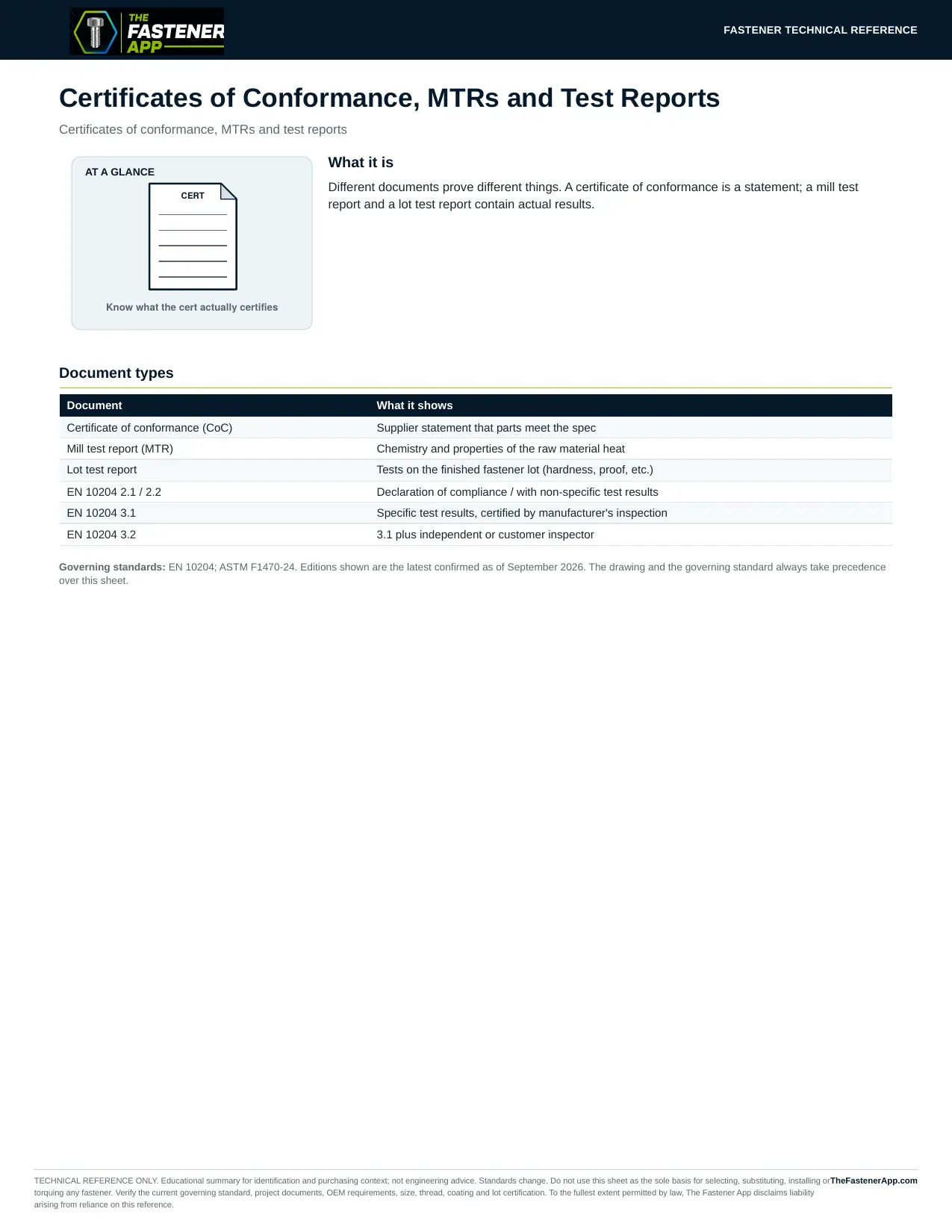
Certificates of Conformance, MTRs and Test Reports
Different documents prove different things. A certificate of conformance is a statement; a mill test report and a lot test report contain actual results.
 Report an error on this sheet
Lot Traceability
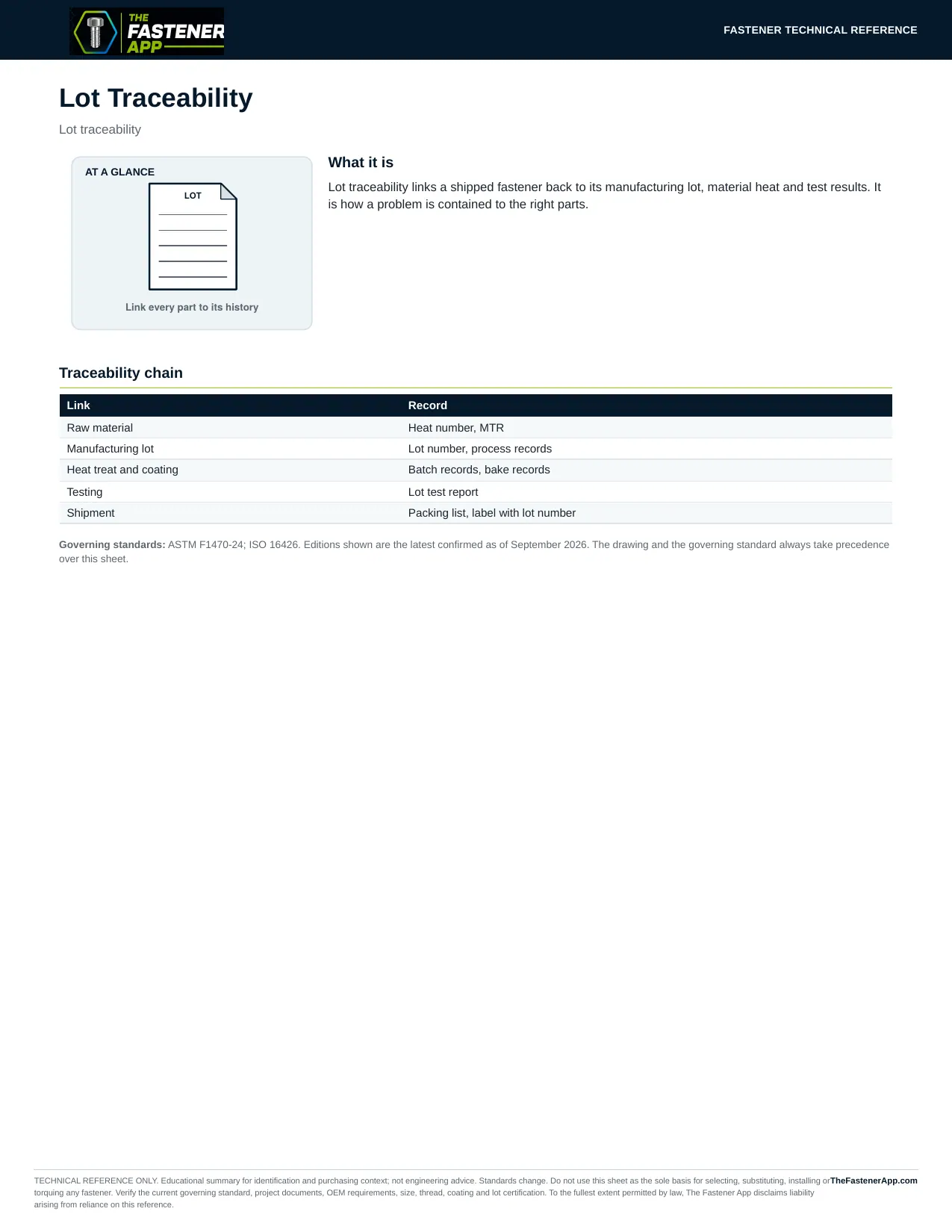
Lot traceability links a shipped fastener back to its manufacturing lot, material heat and test results. It is how a problem is contained to the right parts.
 Report an error on this sheet
PPAP for Fasteners
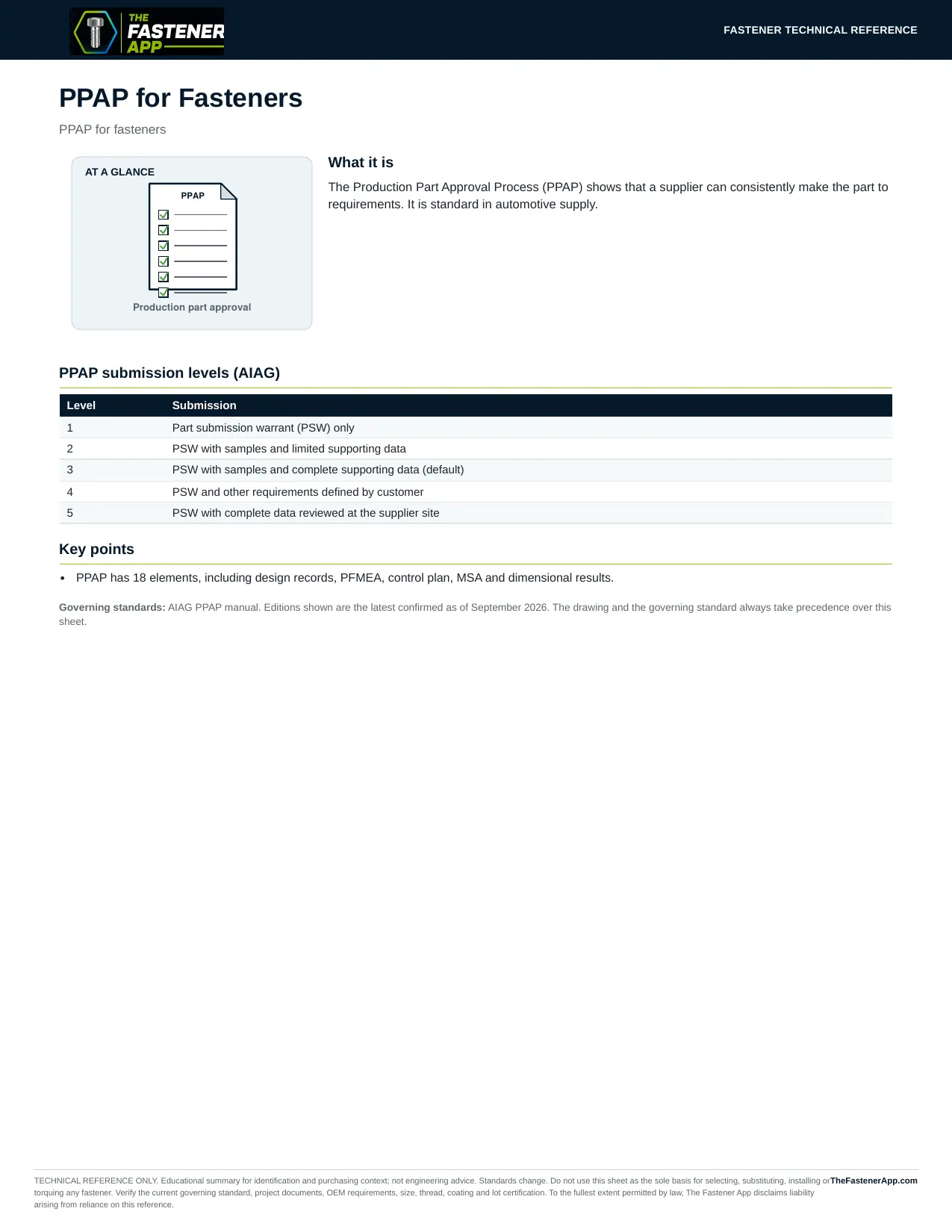
The Production Part Approval Process (PPAP) shows that a supplier can consistently make the part to requirements. It is standard in automotive supply.
 Report an error on this sheet
FAI - First Article Inspection for Fasteners
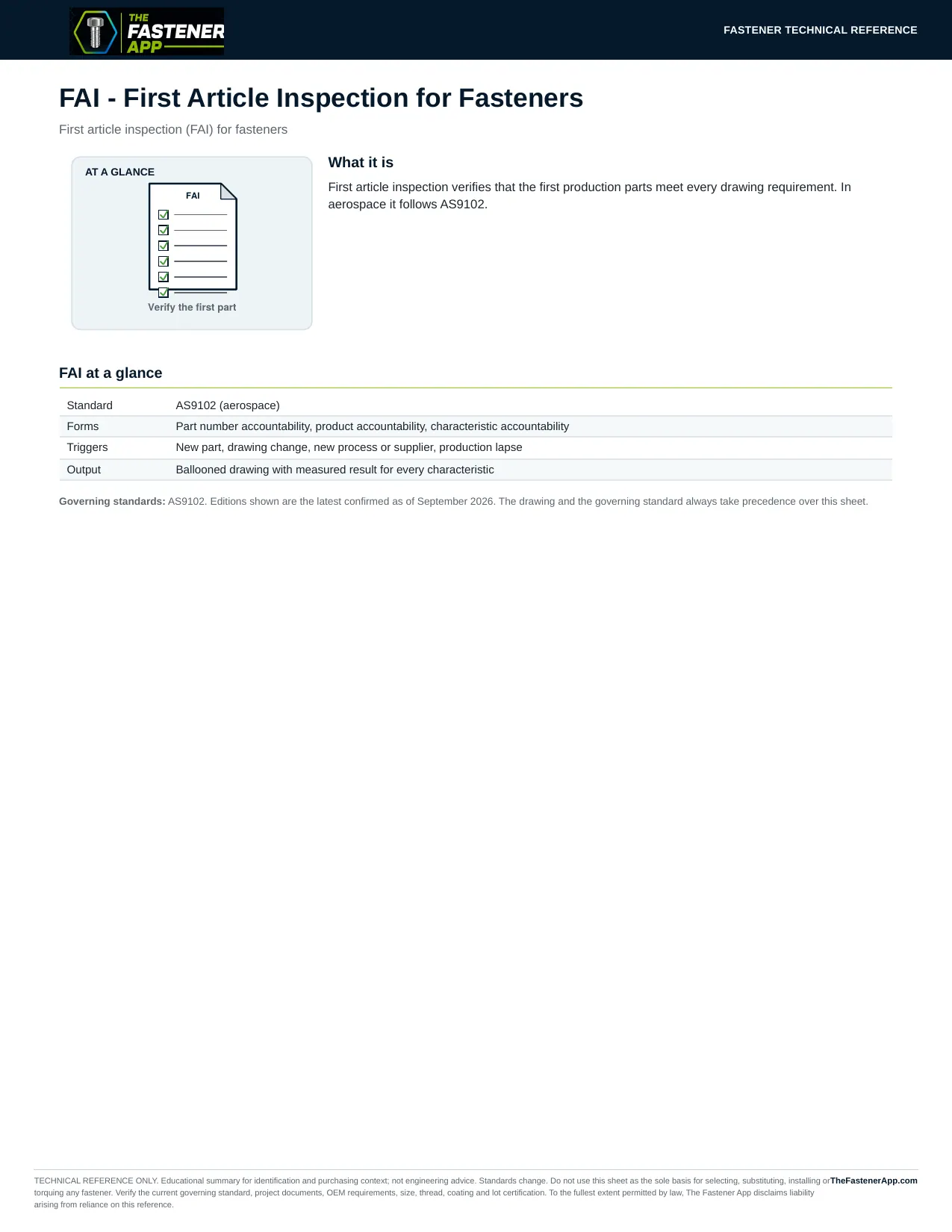
First article inspection verifies that the first production parts meet every drawing requirement. In aerospace it follows AS9102.
 Report an error on this sheet
SCAR and 8D Corrective Action
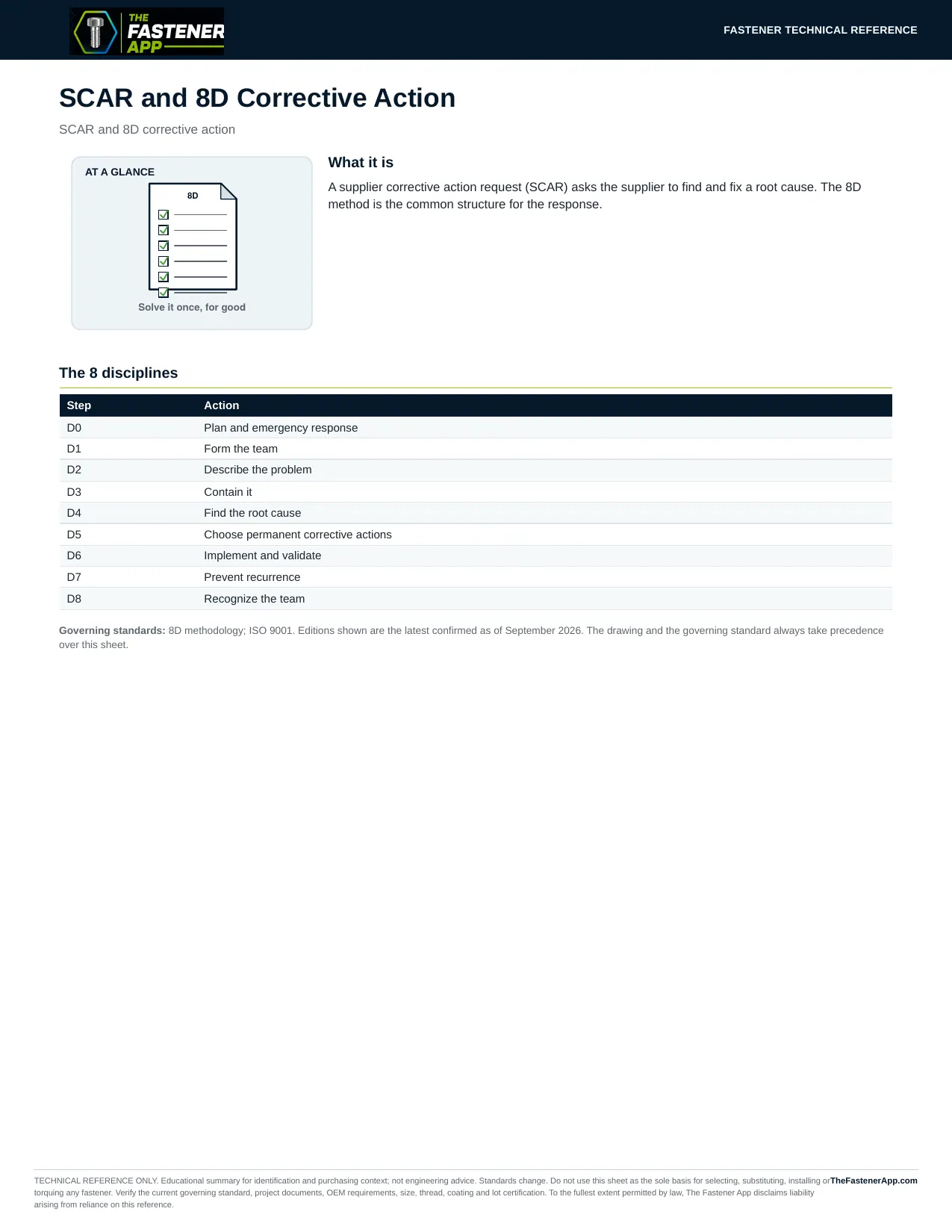
A supplier corrective action request (SCAR) asks the supplier to find and fix a root cause. The 8D method is the common structure for the response.
 Report an error on this sheet
Nonconforming Material Disposition
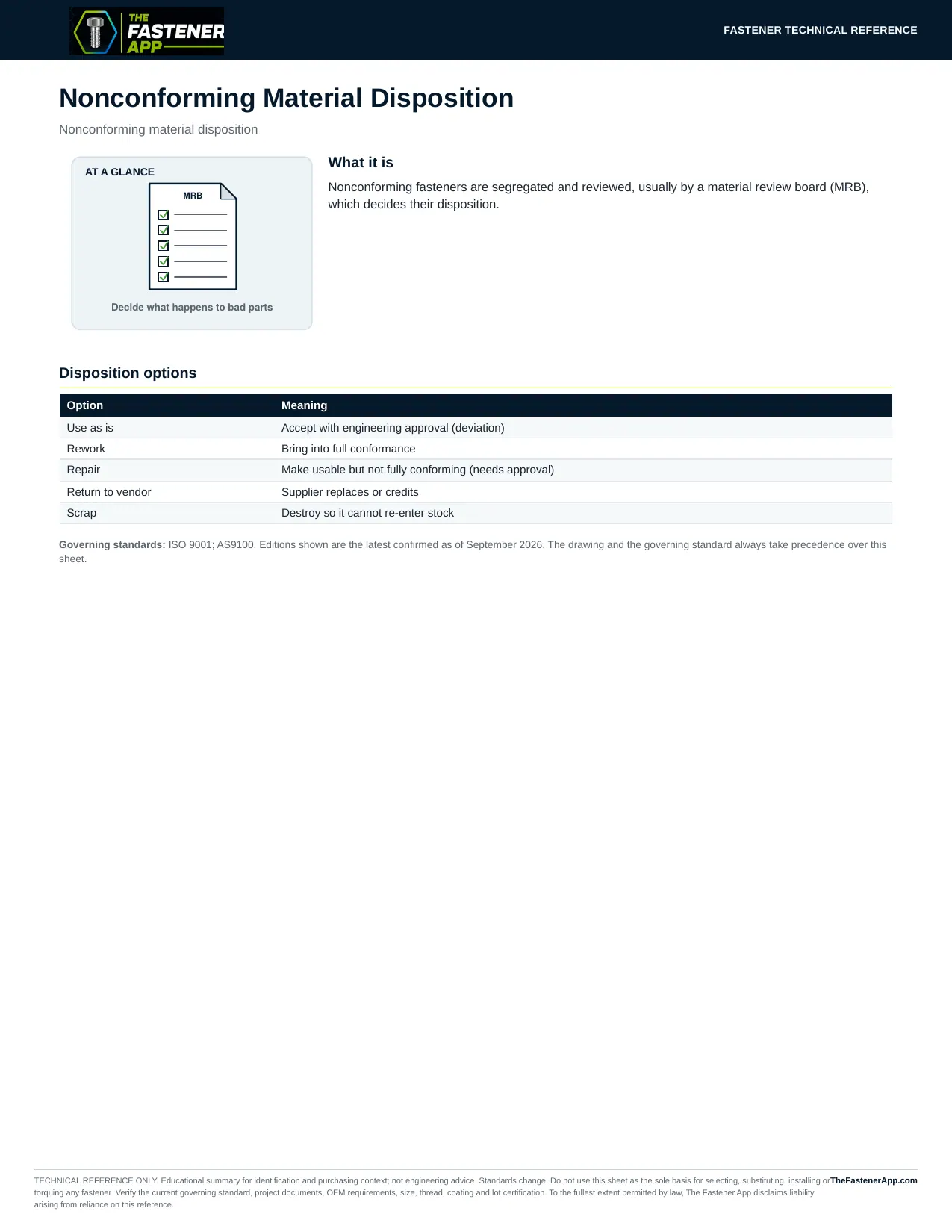
Nonconforming fasteners are segregated and reviewed, usually by a material review board (MRB), which decides their disposition.
 Report an error on this sheet
Scrap Authorization for Fasteners
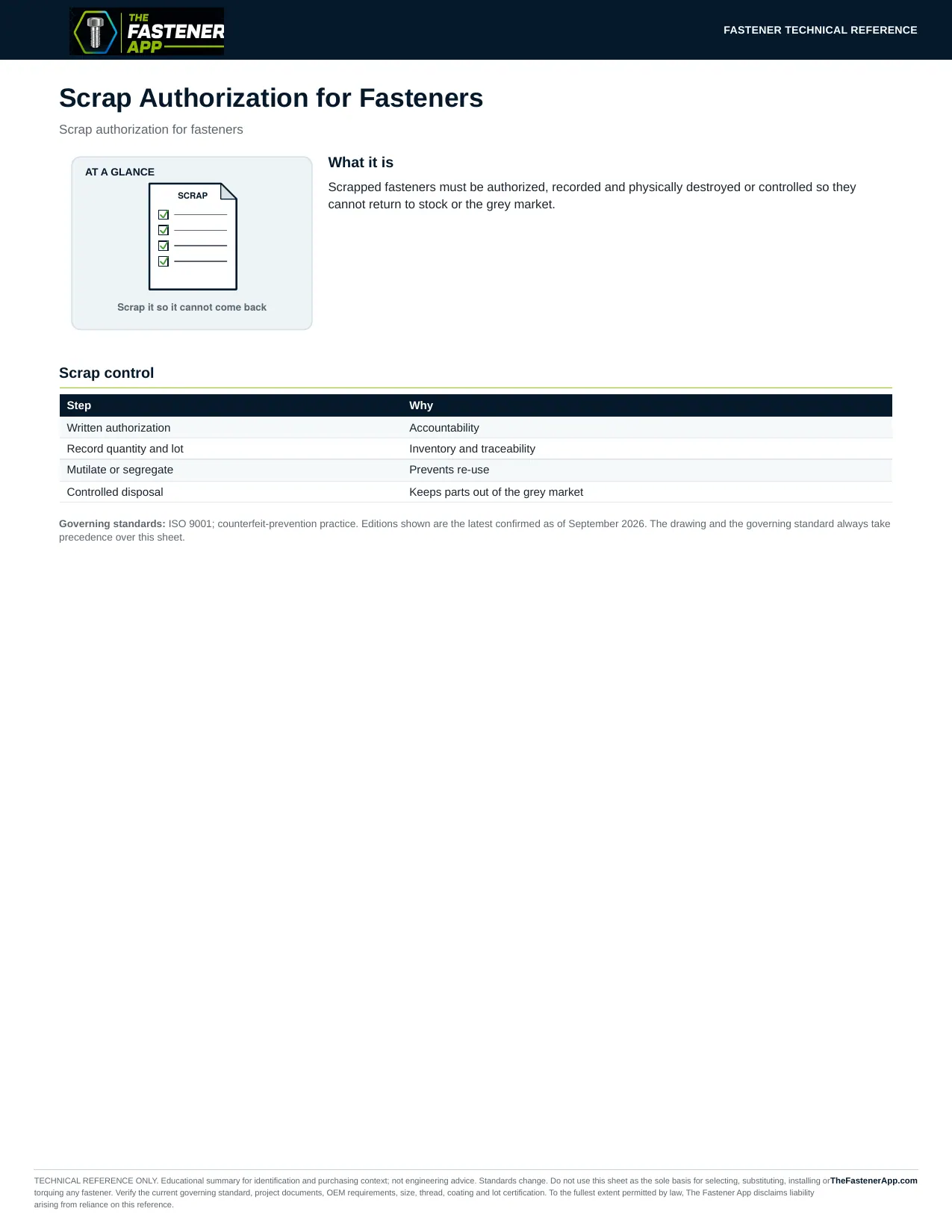
Scrapped fasteners must be authorized, recorded and physically destroyed or controlled so they cannot return to stock or the grey market.
 Report an error on this sheet
Use-As-Is / Deviation Authorization
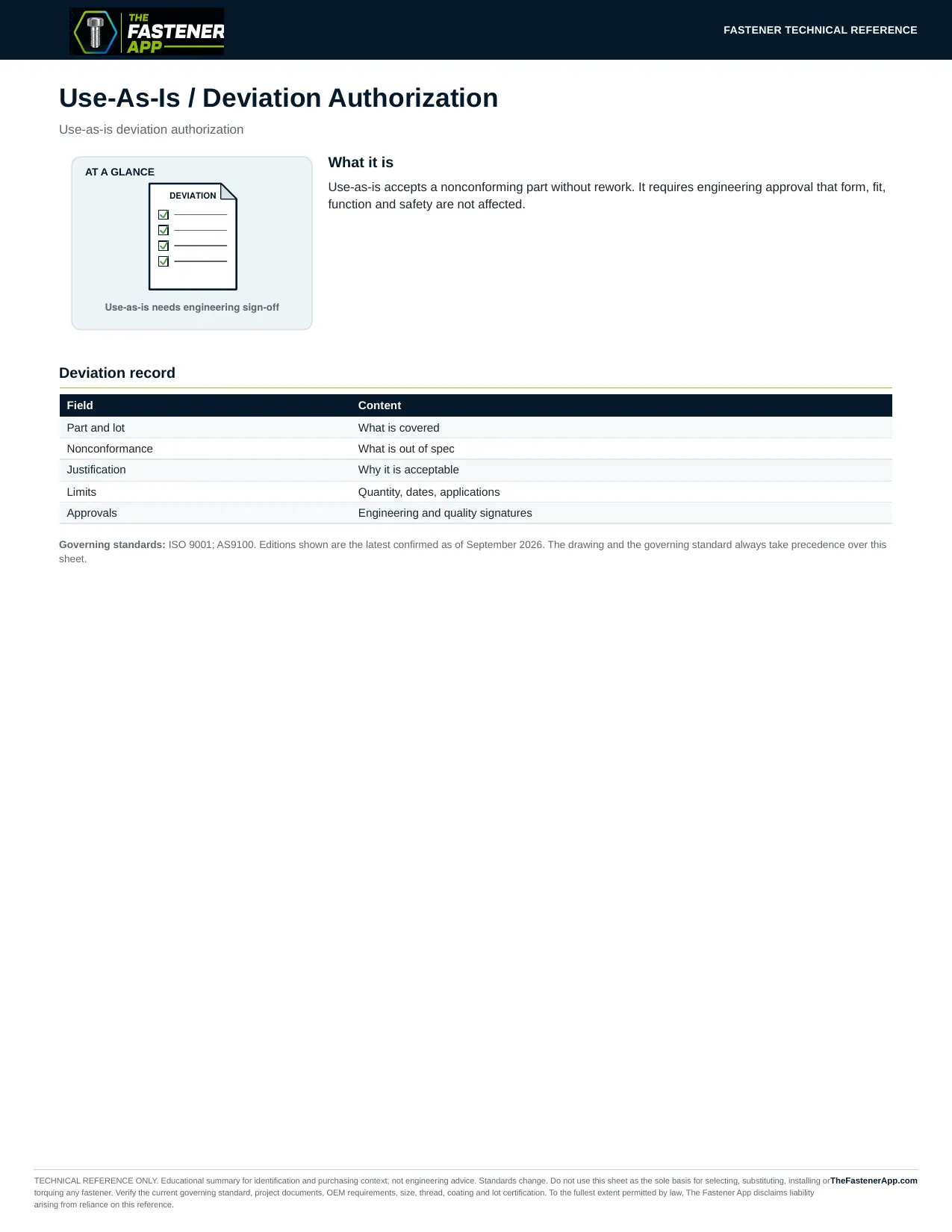
Use-as-is accepts a nonconforming part without rework. It requires engineering approval that form, fit, function and safety are not affected.
 Report an error on this sheet
Fastener Counterfeit and Traceability Controls
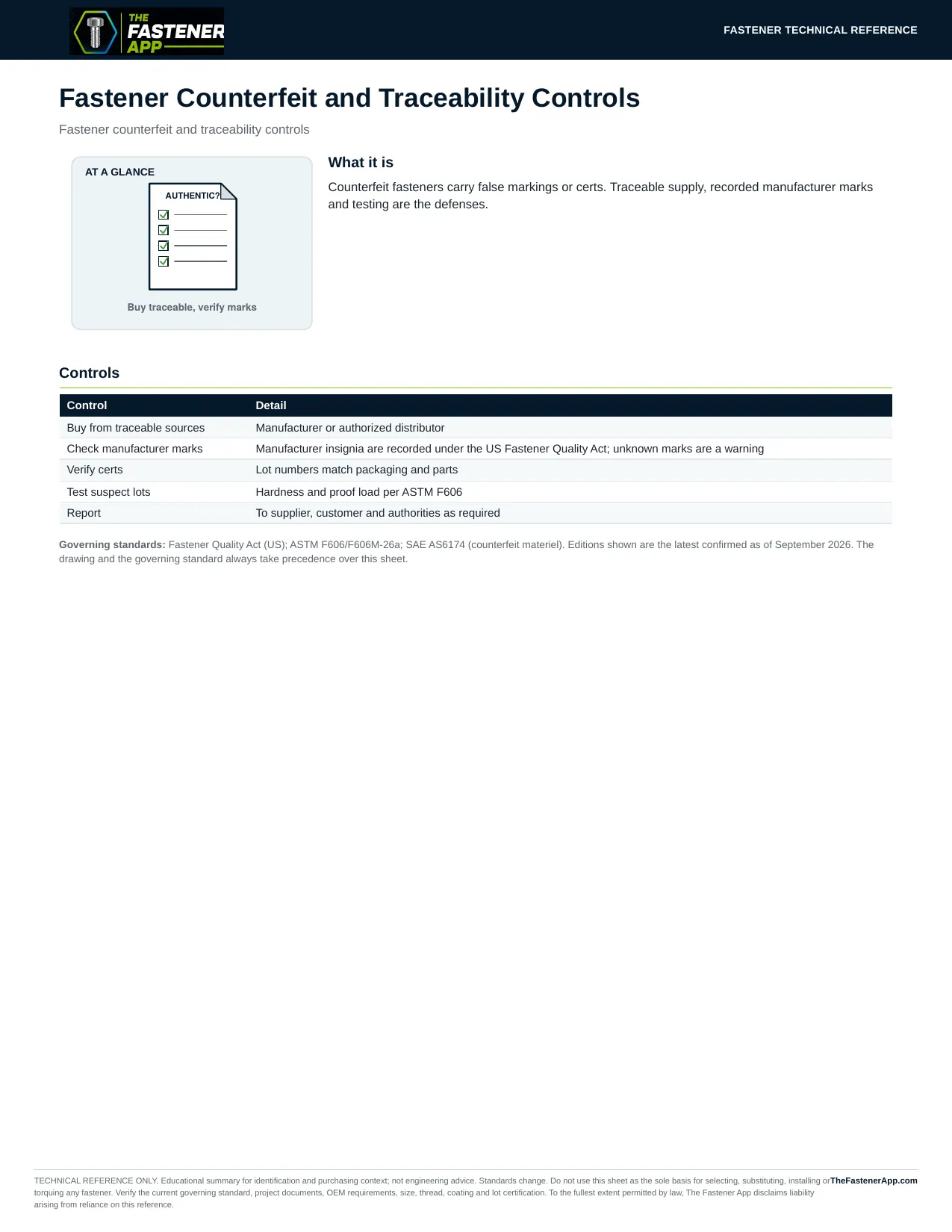
Counterfeit fasteners carry false markings or certs. Traceable supply, recorded manufacturer marks and testing are the defenses.
 Report an error on this sheet
Inventory, VMI & Automation
VMI, consignment, kanban, barcode/RFID, vending, kitting, min-max and ERP integration.
VMI - Vendor Managed Inventory Overview
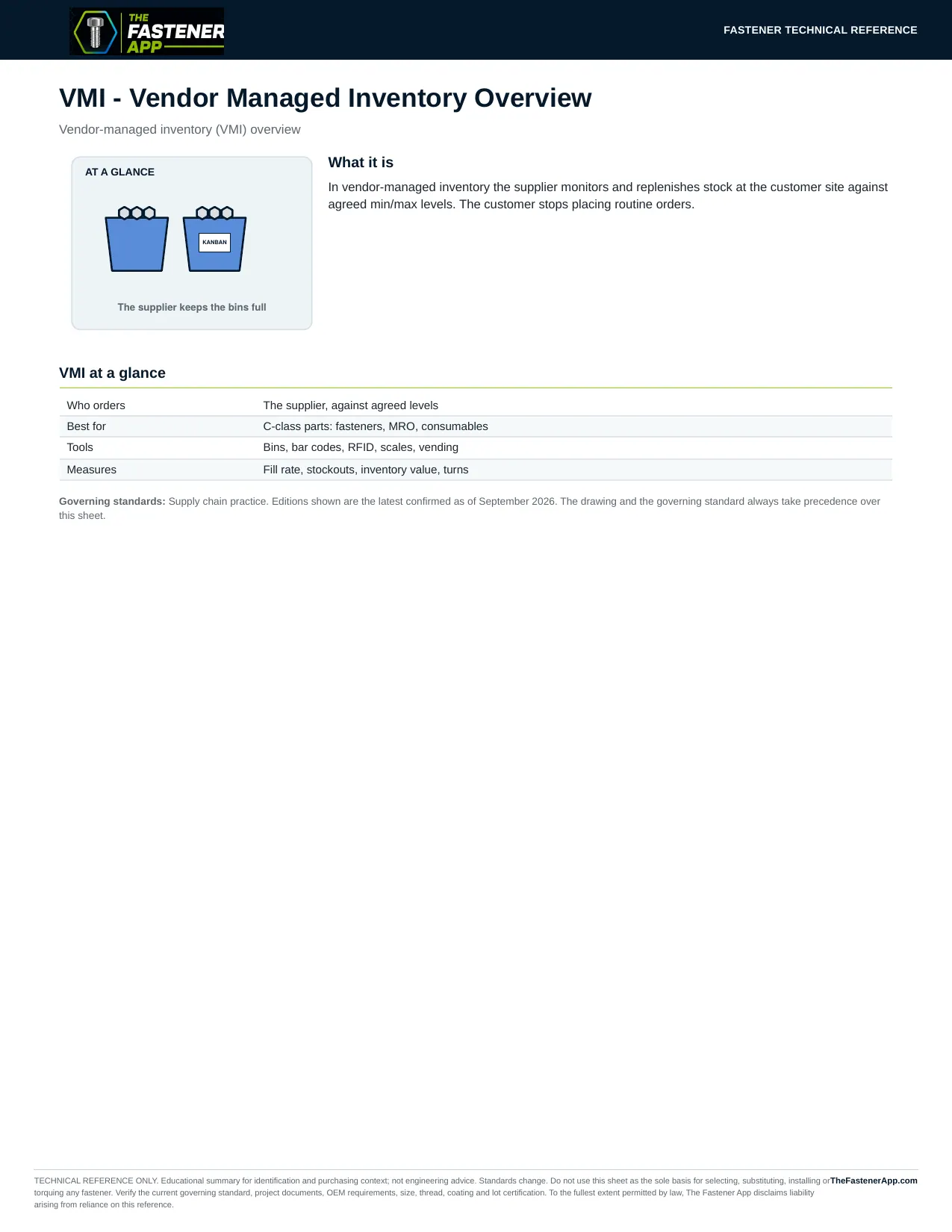
In vendor-managed inventory the supplier monitors and replenishes stock at the customer site against agreed min/max levels. The customer stops placing routine orders.
 Report an error on this sheet
Consignment Inventory
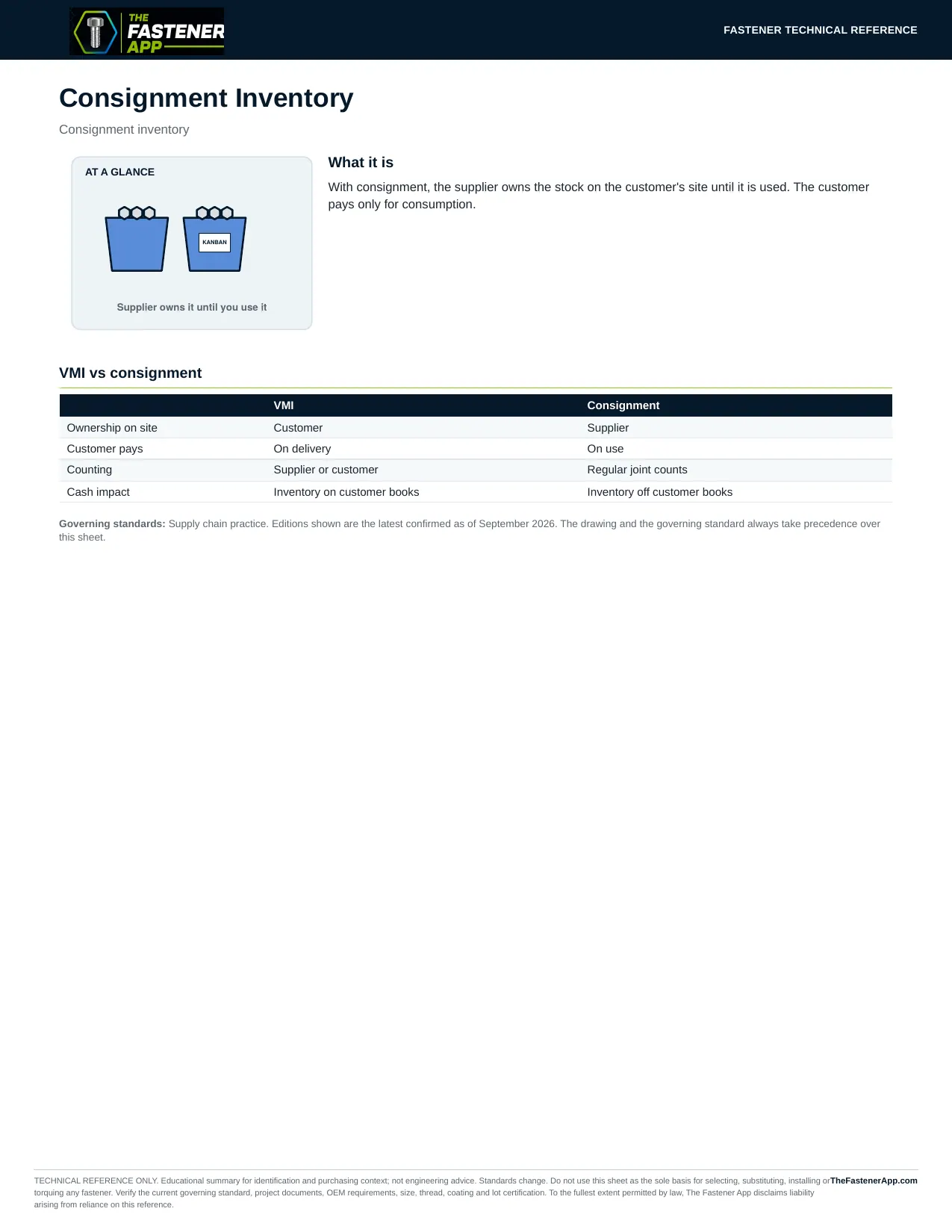
With consignment, the supplier owns the stock on the customer's site until it is used. The customer pays only for consumption.
 Report an error on this sheet
Two-Bin / Kanban Fastener Replenishment
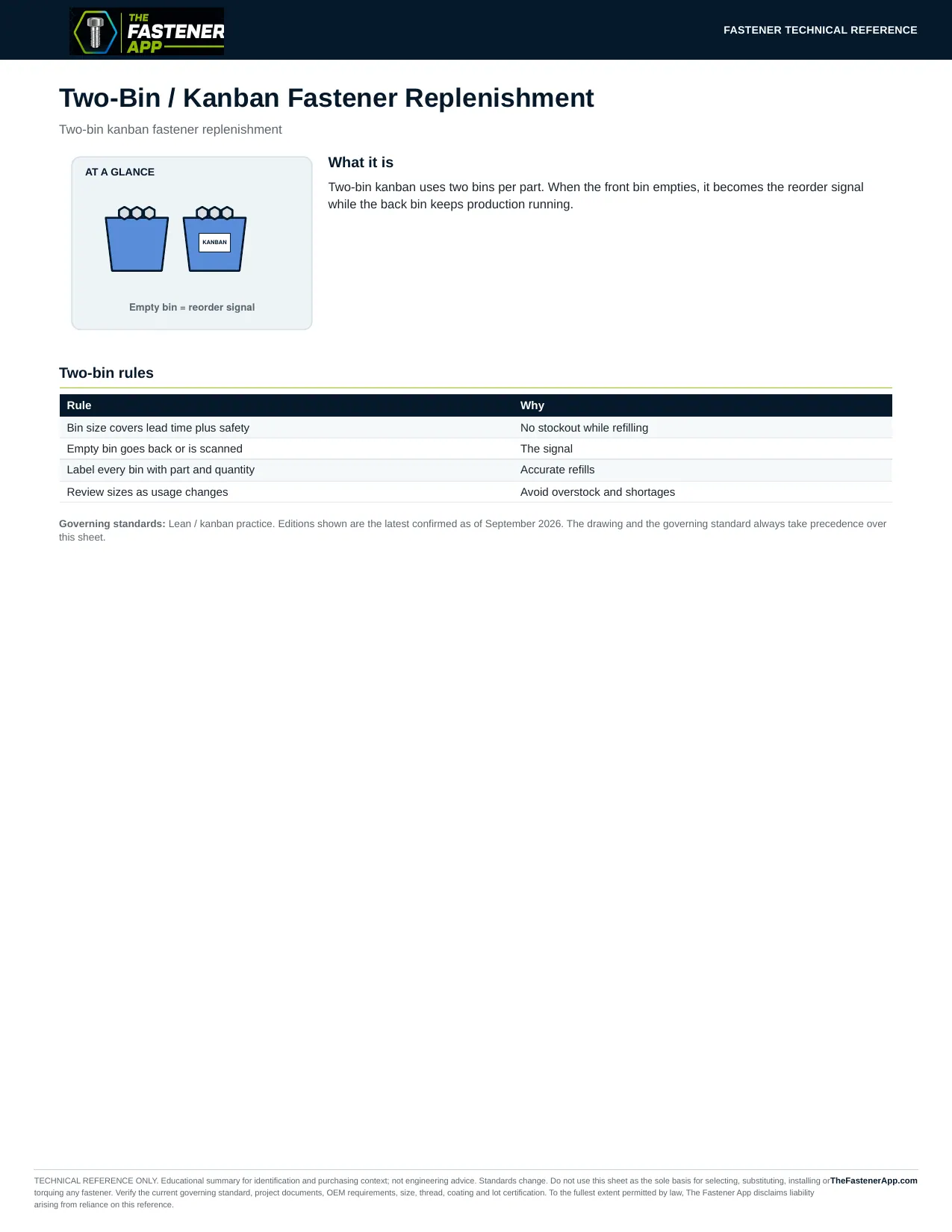
Two-bin kanban uses two bins per part. When the front bin empties, it becomes the reorder signal while the back bin keeps production running.
 Report an error on this sheet
Barcode and QR Replenishment
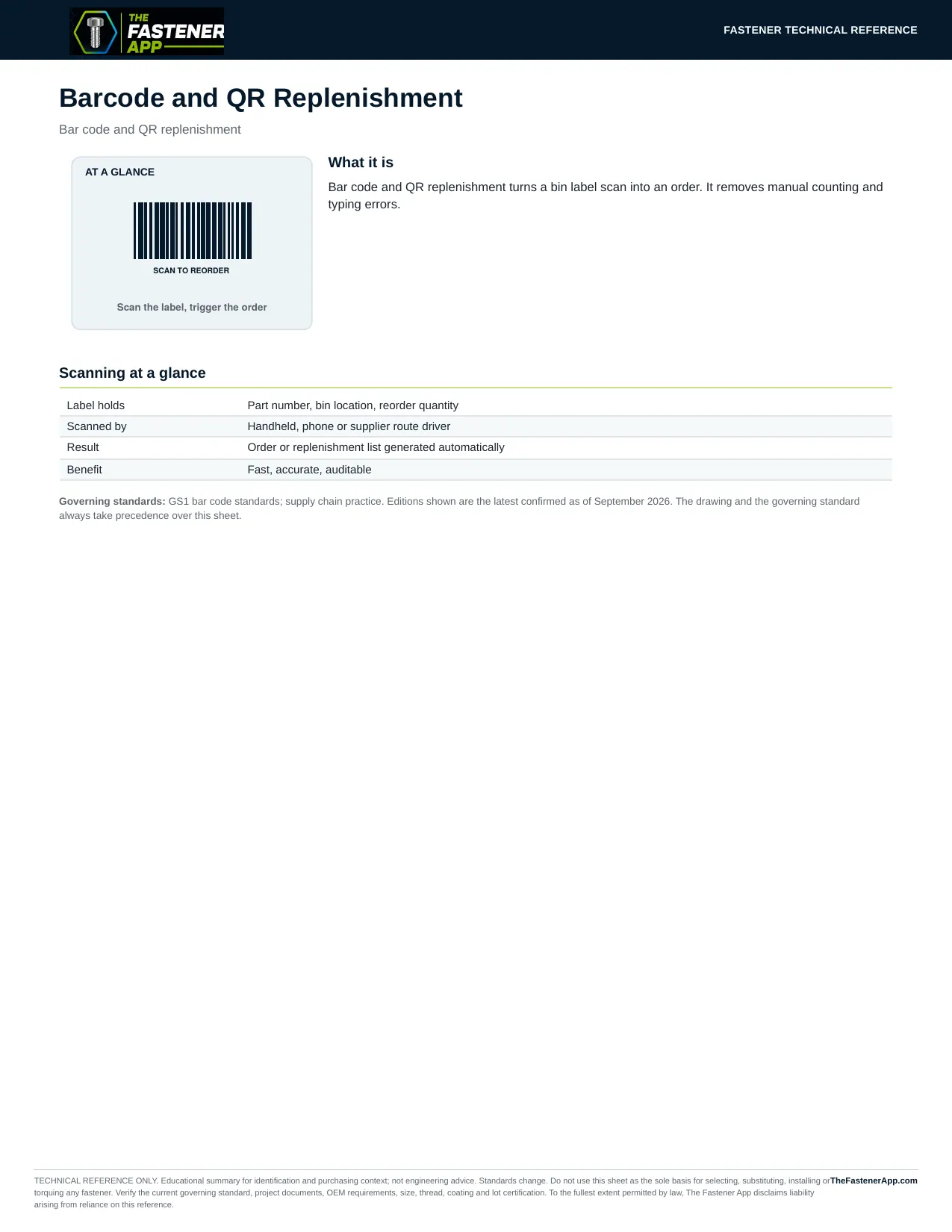
Bar code and QR replenishment turns a bin label scan into an order. It removes manual counting and typing errors.
 Report an error on this sheet
RFID Fastener Inventory Systems
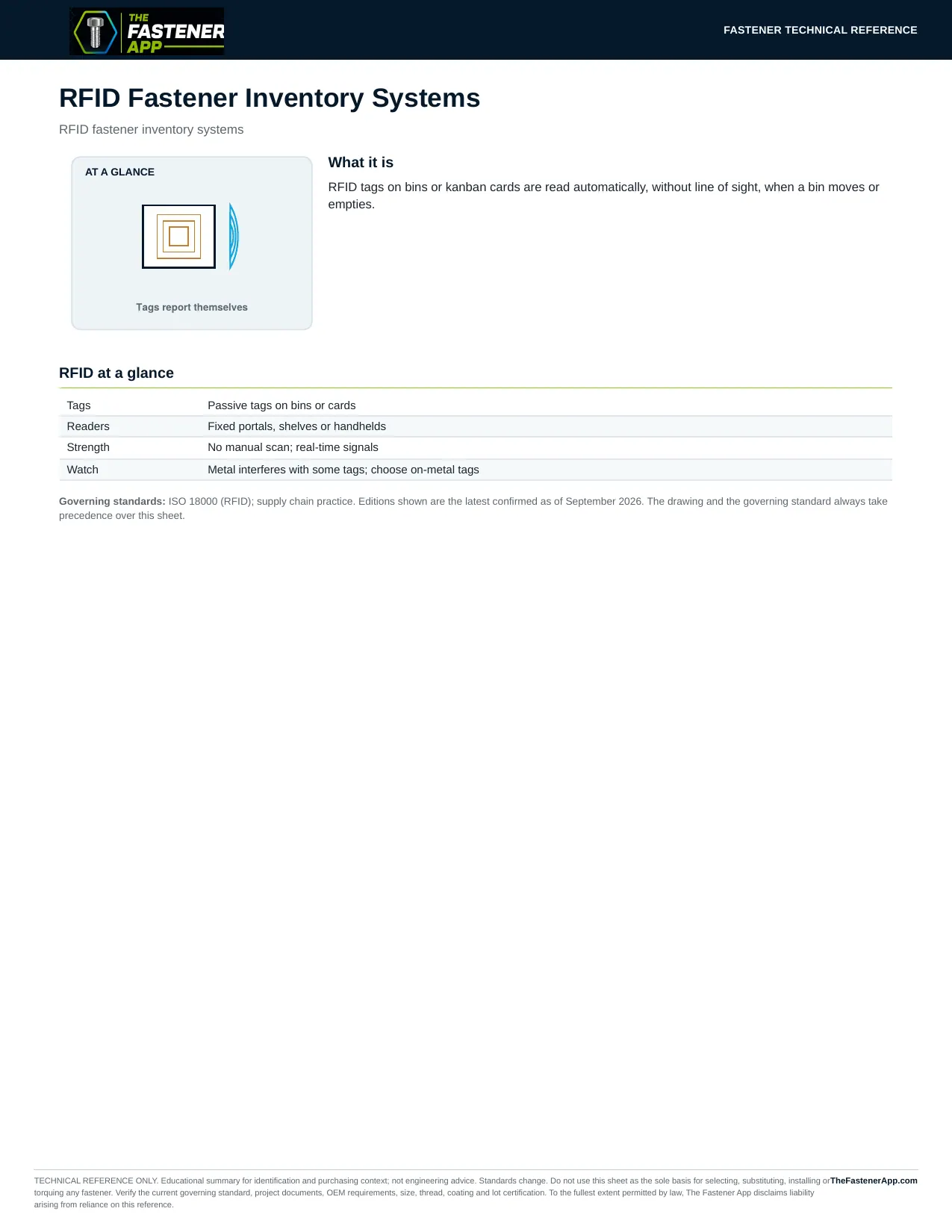
RFID tags on bins or kanban cards are read automatically, without line of sight, when a bin moves or empties.
 Report an error on this sheet
Smart Weight-Sensor Scale Inventory
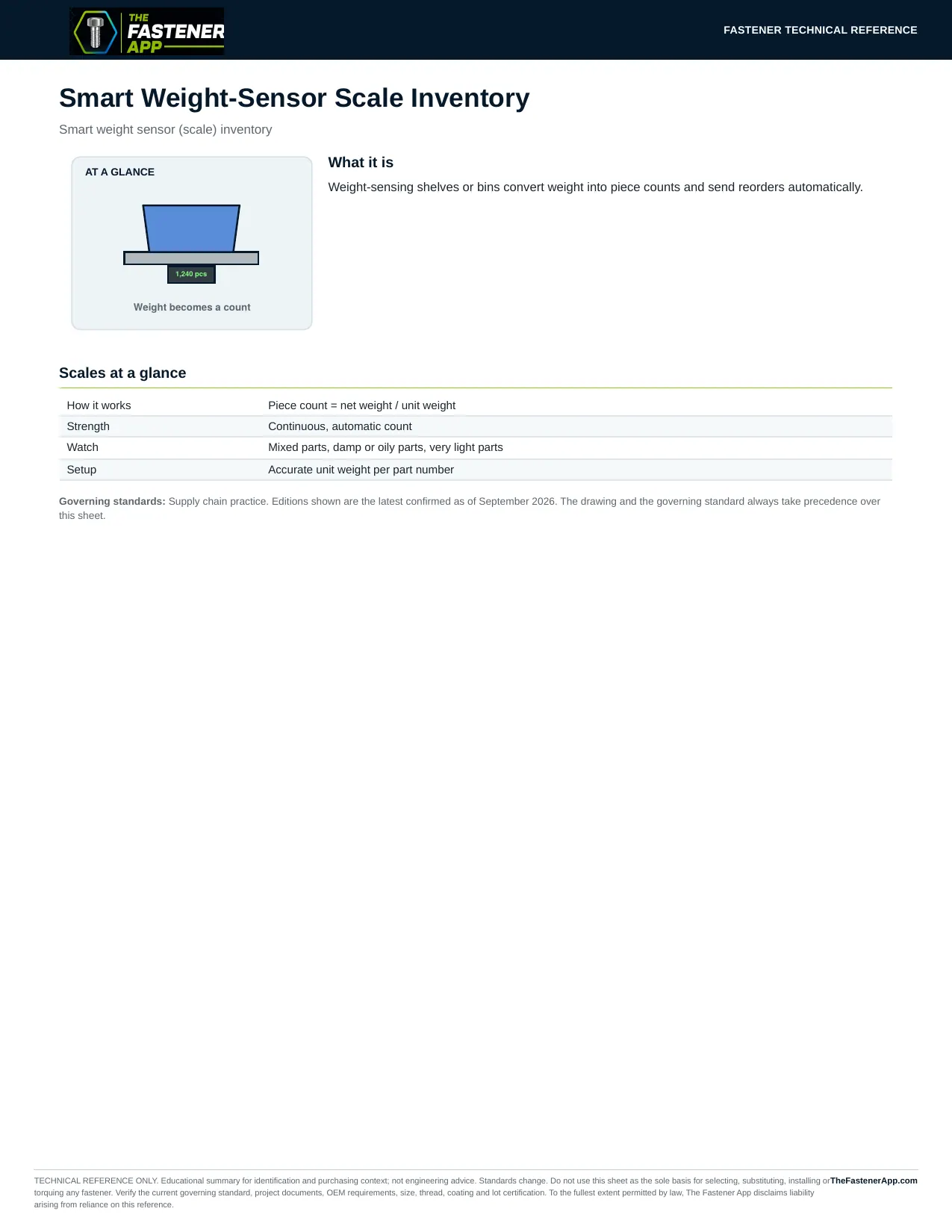
Weight-sensing shelves or bins convert weight into piece counts and send reorders automatically.
 Report an error on this sheet
Industrial Vending for MRO
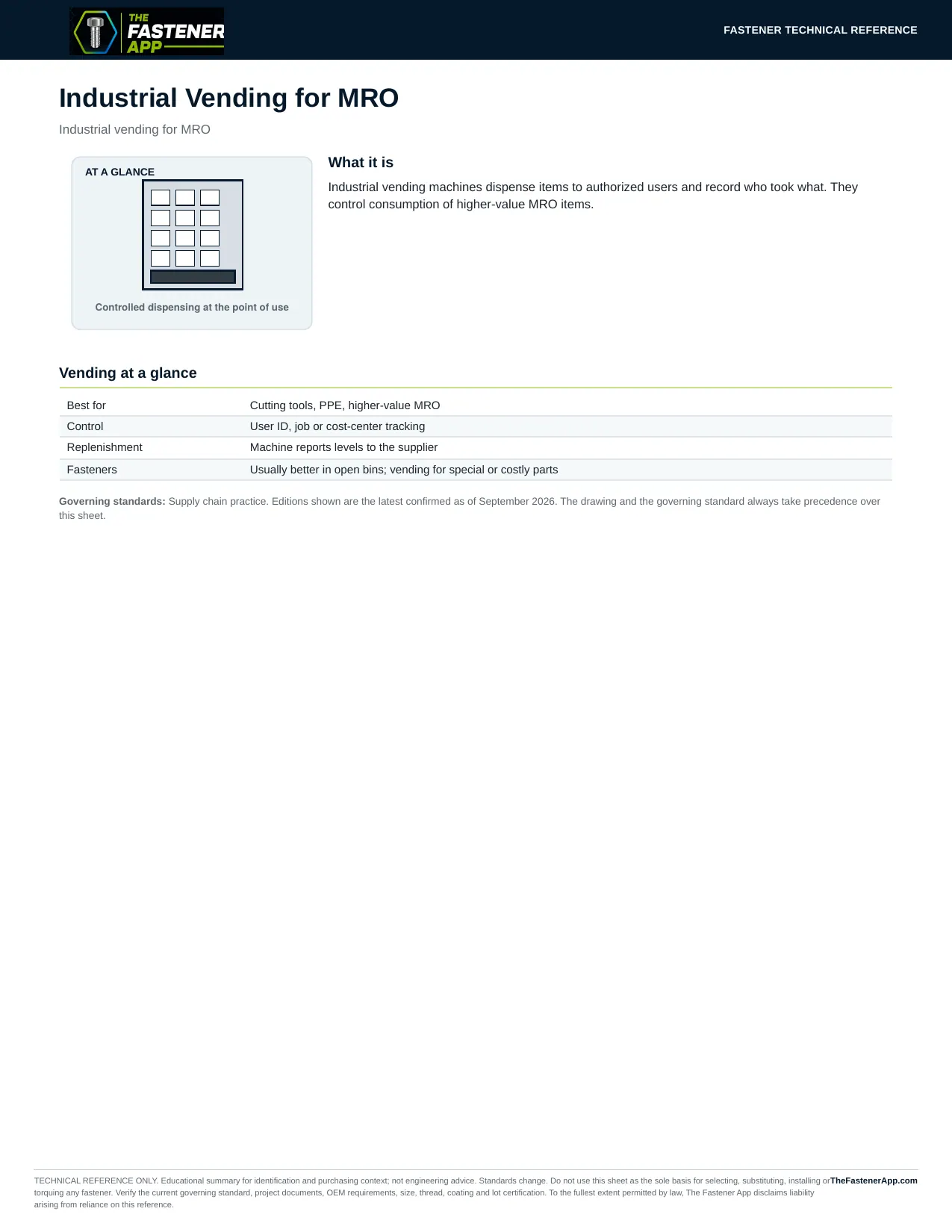
Industrial vending machines dispense items to authorized users and record who took what. They control consumption of higher-value MRO items.
 Report an error on this sheet
Point-of-Use Fastener Inventory
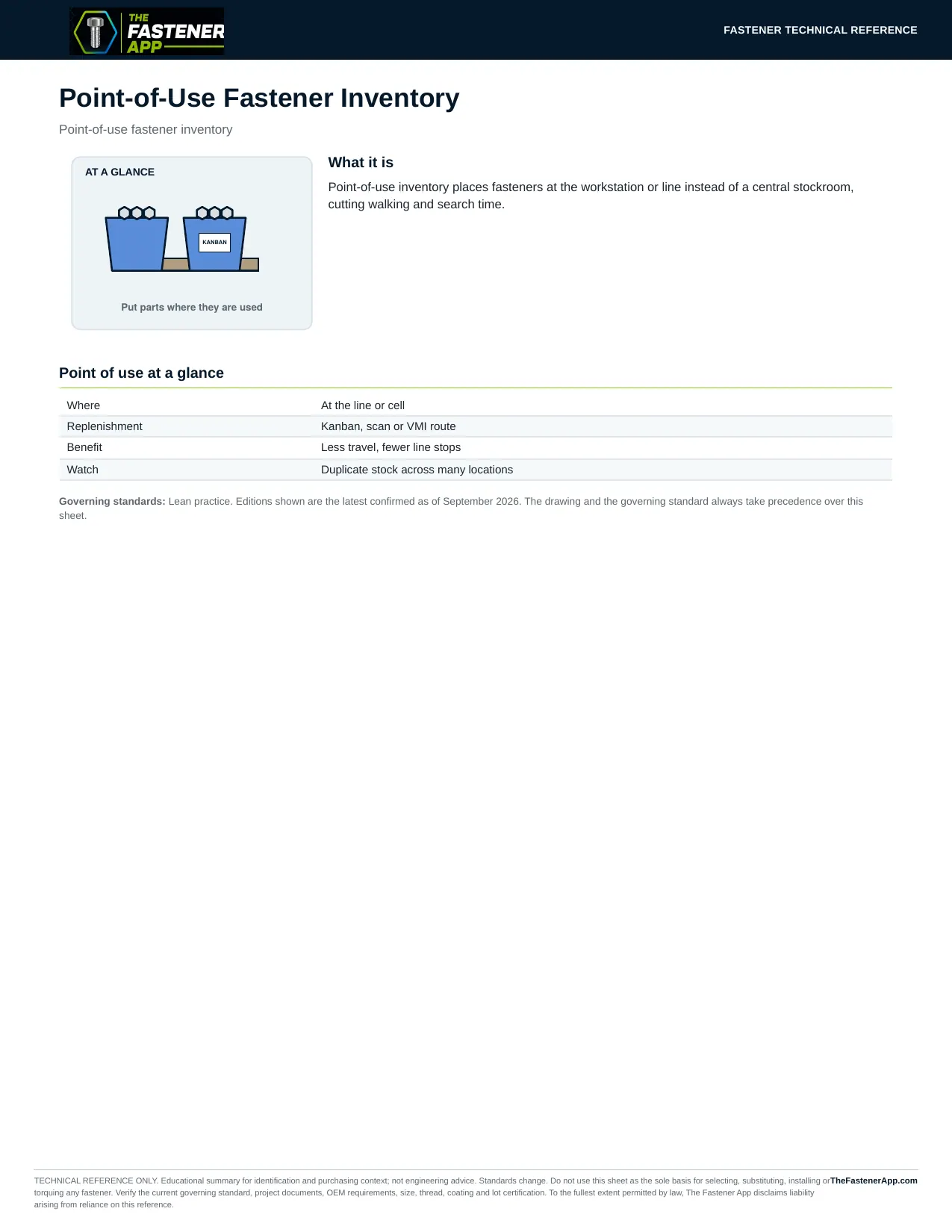
Point-of-use inventory places fasteners at the workstation or line instead of a central stockroom, cutting walking and search time.
 Report an error on this sheet
Crib Management for MRO Fasteners
A tool crib or stockroom holds shared MRO stock under control. Crib management applies location, labeling and replenishment discipline.
 Report an error on this sheet
In-Plant Store / Fastener Store
An in-plant store is a supplier-operated stockroom on the customer's site, staffed and replenished by the supplier.
 Report an error on this sheet
Kitting and Line-Side Delivery
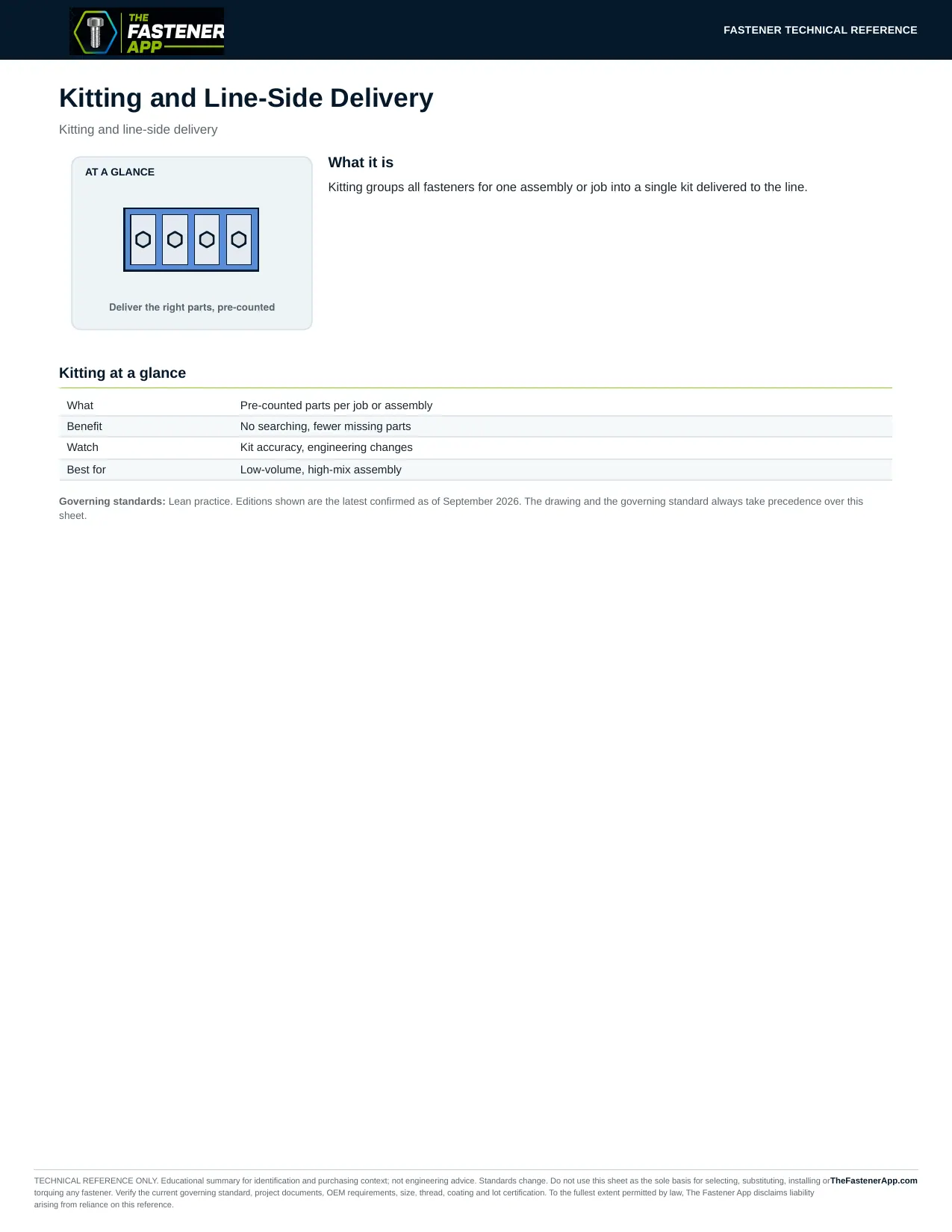
Kitting groups all fasteners for one assembly or job into a single kit delivered to the line.
 Report an error on this sheet
ERP Integration for Fastener VMI
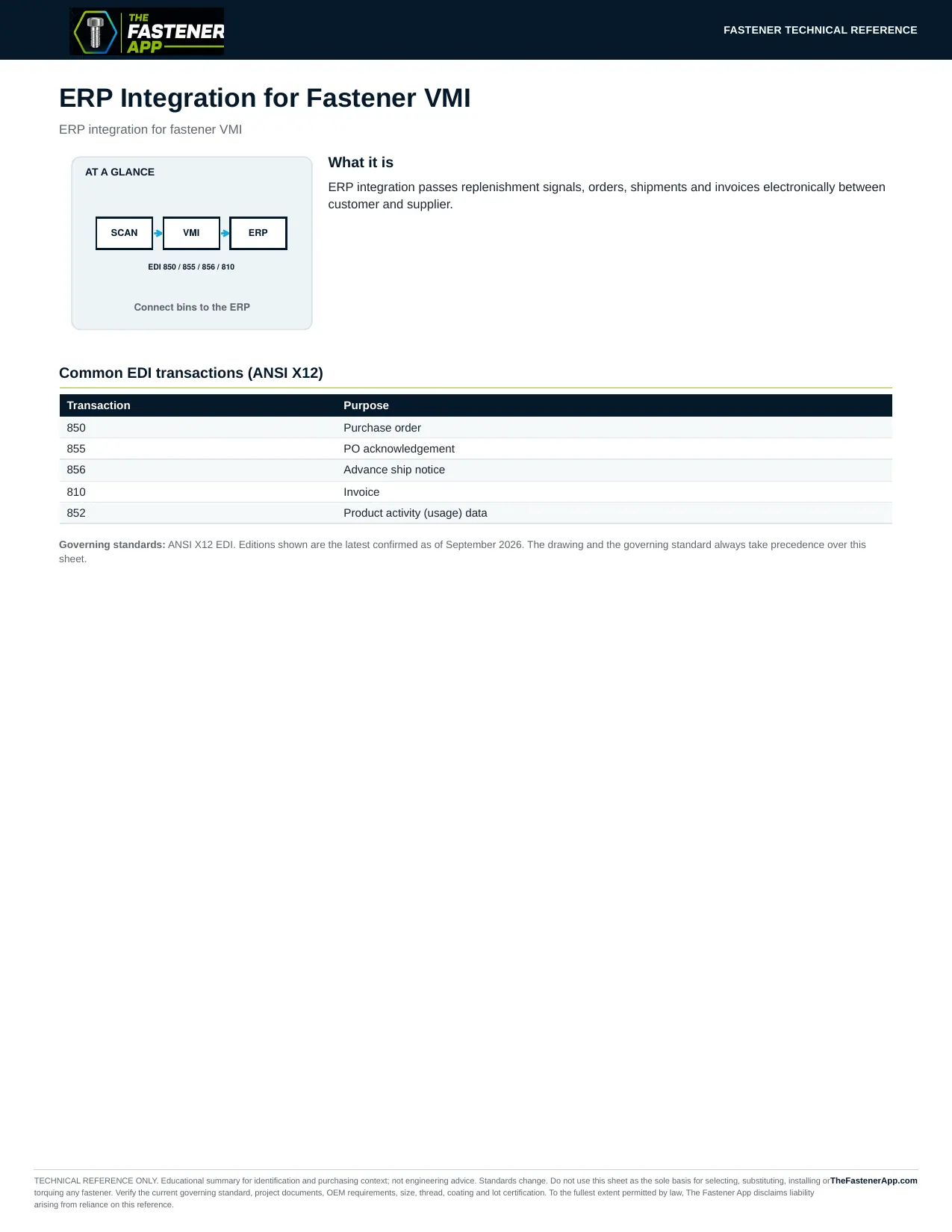
ERP integration passes replenishment signals, orders, shipments and invoices electronically between customer and supplier.
 Report an error on this sheet
Min/Max and Safety Stock for Fasteners
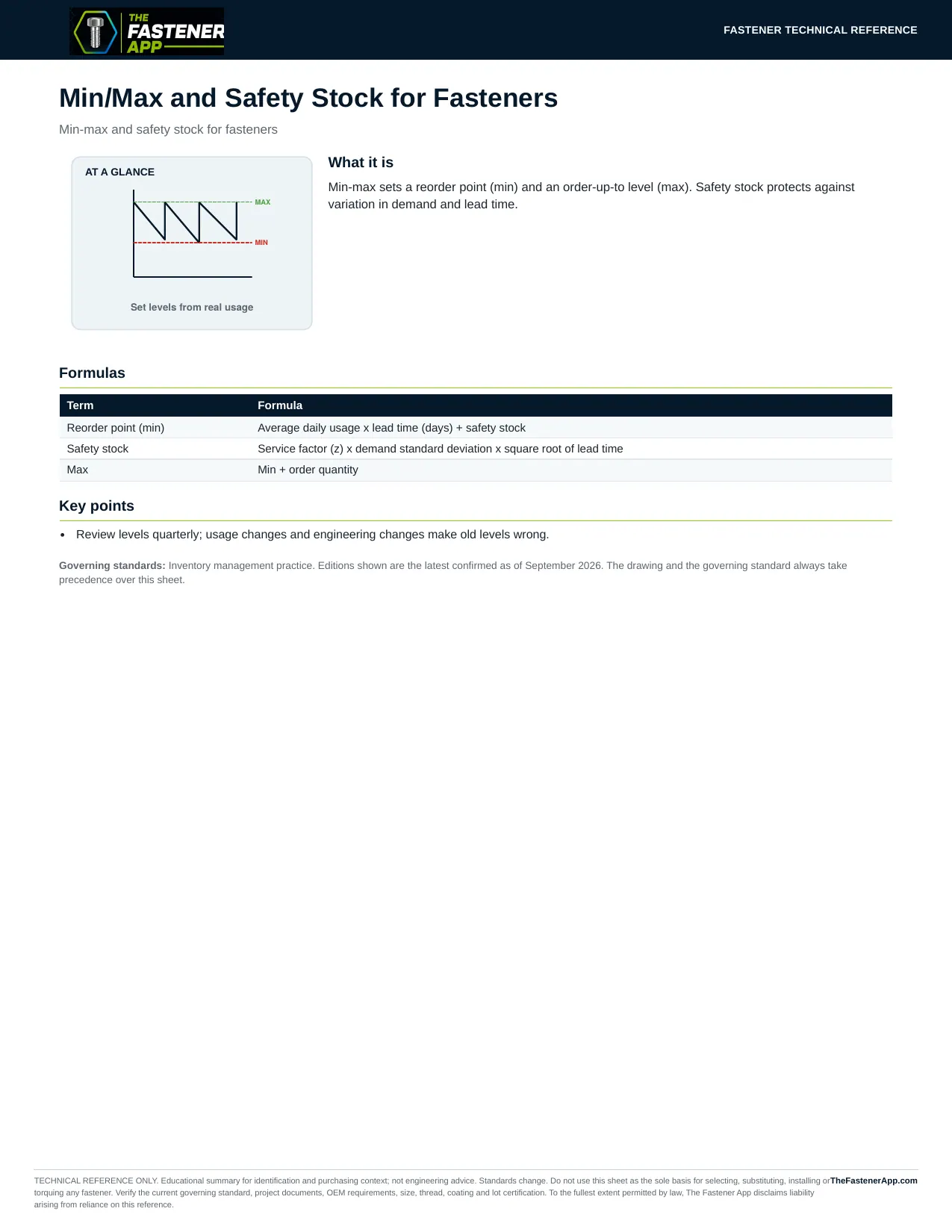
Min-max sets a reorder point (min) and an order-up-to level (max). Safety stock protects against variation in demand and lead time.
 Report an error on this sheet
VMI KPIs and Scorecard
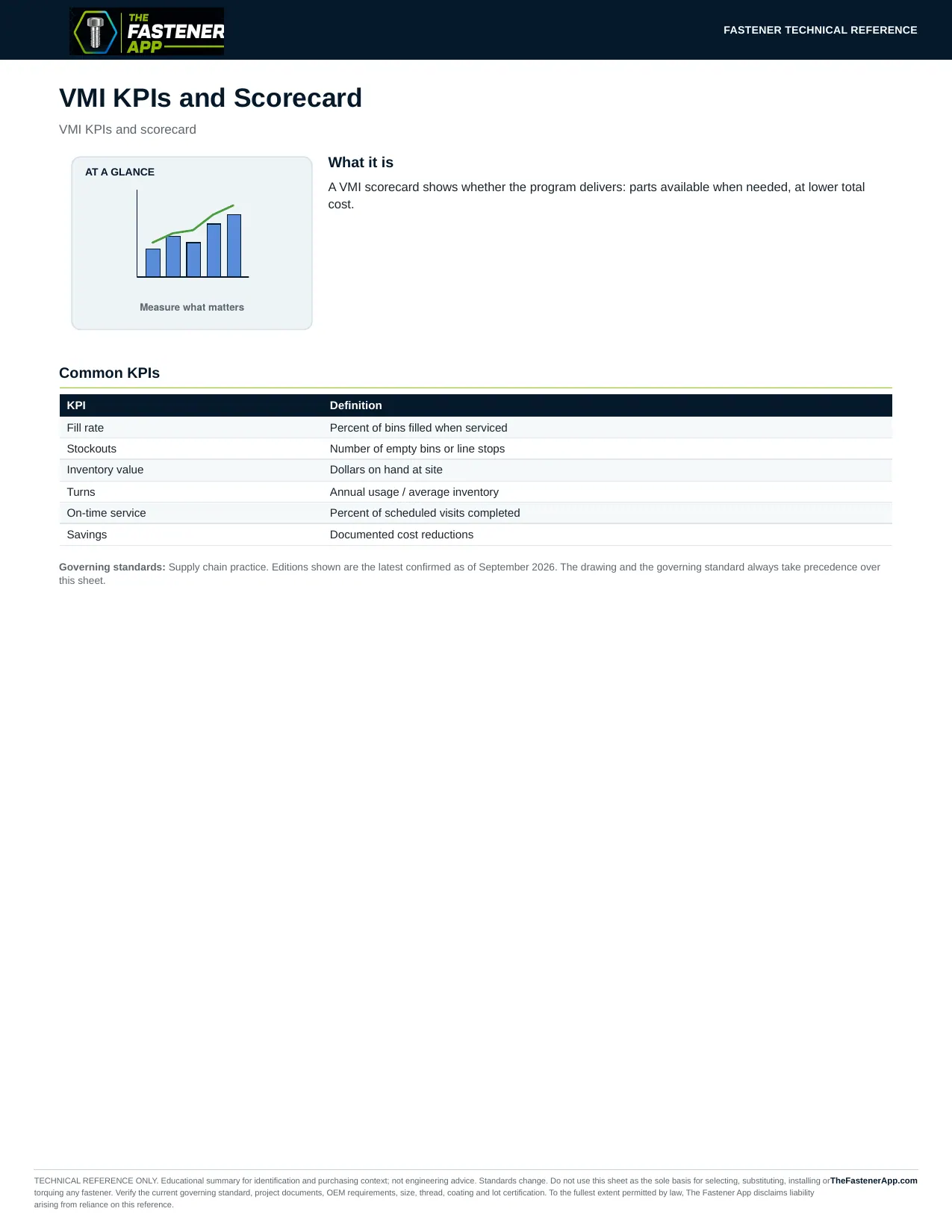
A VMI scorecard shows whether the program delivers: parts available when needed, at lower total cost.
 Report an error on this sheet