Fastener Failure Analysis - Master Guide
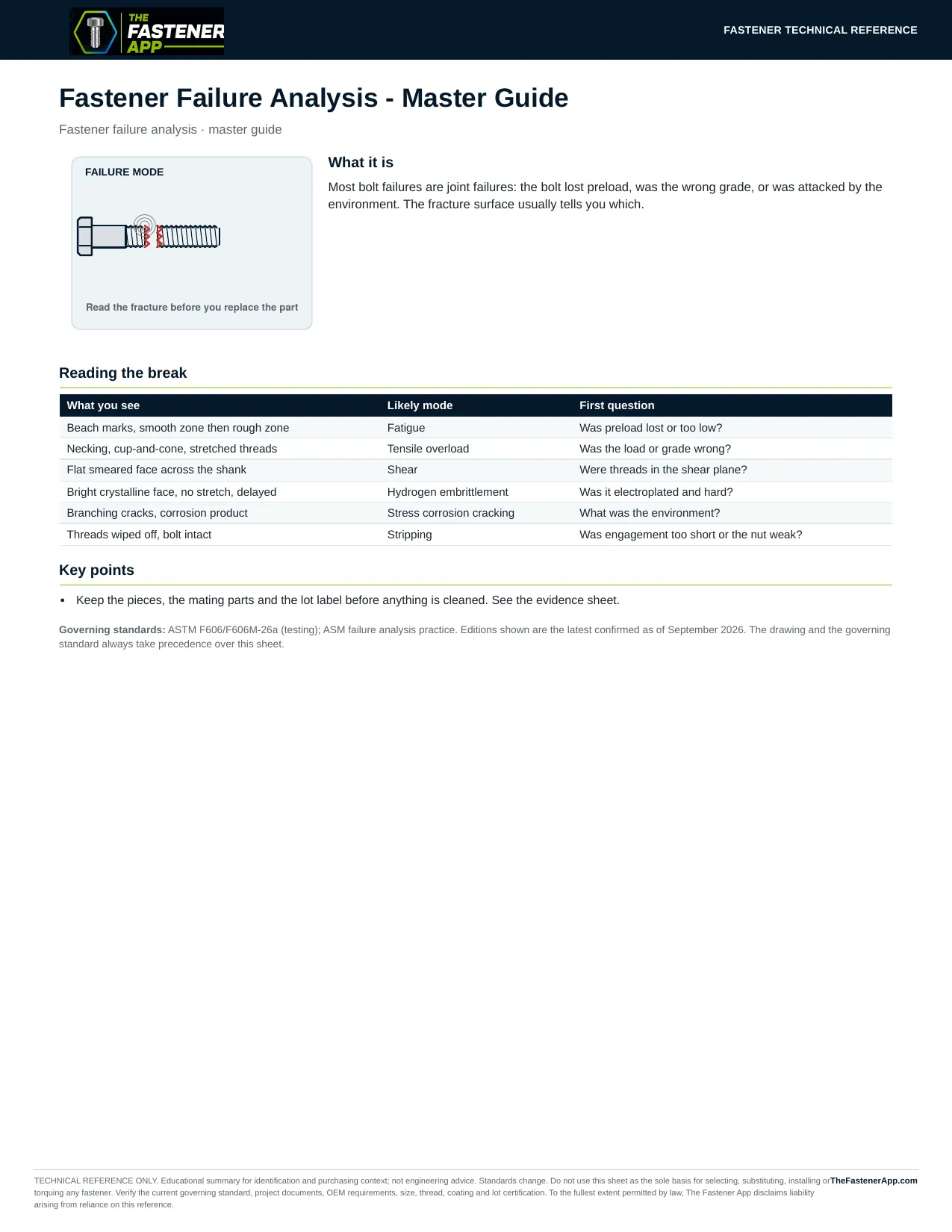
Most bolt failures are joint failures: the bolt lost preload, was the wrong grade, or was attacked by the environment. The fracture surface usually tells you which.
Reading the break
| What you see | Likely mode | First question |
|---|---|---|
| Beach marks, smooth zone then rough zone | Fatigue | Was preload lost or too low? |
| Necking, cup-and-cone, stretched threads | Tensile overload | Was the load or grade wrong? |
| Flat smeared face across the shank | Shear | Were threads in the shear plane? |
| Bright crystalline face, no stretch, delayed | Hydrogen embrittlement | Was it electroplated and hard? |
| Branching cracks, corrosion product | Stress corrosion cracking | What was the environment? |
| Threads wiped off, bolt intact | Stripping | Was engagement too short or the nut weak? |
These tables carry the same figures as the printed sheet below.
The printed sheet
See an error on this sheet?
Tell us what is wrong.
Text version of this sheet
Fastener failure analysis · master guide
FAILURE MODE
What it is
Most bolt failures are joint failures: the bolt lost preload, was the wrong grade, or was attacked by the
environment. The fracture surface usually tells you which.
Read the fracture before you replace the part
Reading the break
What you see
Likely mode
First question
Beach marks, smooth zone then rough zone
Fatigue
Was preload lost or too low?
Necking, cup-and-cone, stretched threads
Tensile overload
Was the load or grade wrong?
Flat smeared face across the shank
Shear
Were threads in the shear plane?
Bright crystalline face, no stretch, delayed
Hydrogen embrittlement
Was it electroplated and hard?
Branching cracks, corrosion product
Stress corrosion cracking
What was the environment?
Threads wiped off, bolt intact
Stripping
Was engagement too short or the nut weak?
Key points
Keep the pieces, the mating parts and the lot label before anything is cleaned. See the evidence sheet.
Governing standards: ASTM F606/F606M-26a (testing); ASM failure analysis practice. Editions shown are the latest confirmed as of September 2026. The drawing and the governing
standard always take precedence over this sheet.
torquing any fastener. Verify the current governing standard, project documents, OEM requirements, size, thread, coating and lot certification. To the fullest extent permitted by law, The Fastener App disclaims liability
arising from reliance on this reference.
Fastener Guide reference FG-DB981D · thefastenerapp.com/fastener-guide/failure-analysis/fastener-failure-analysis-master-guide · © The Fastener App. Reference only — verify the current governing standard, drawing and manufacturer data before specifying or installing.