Torque / Preload Failure
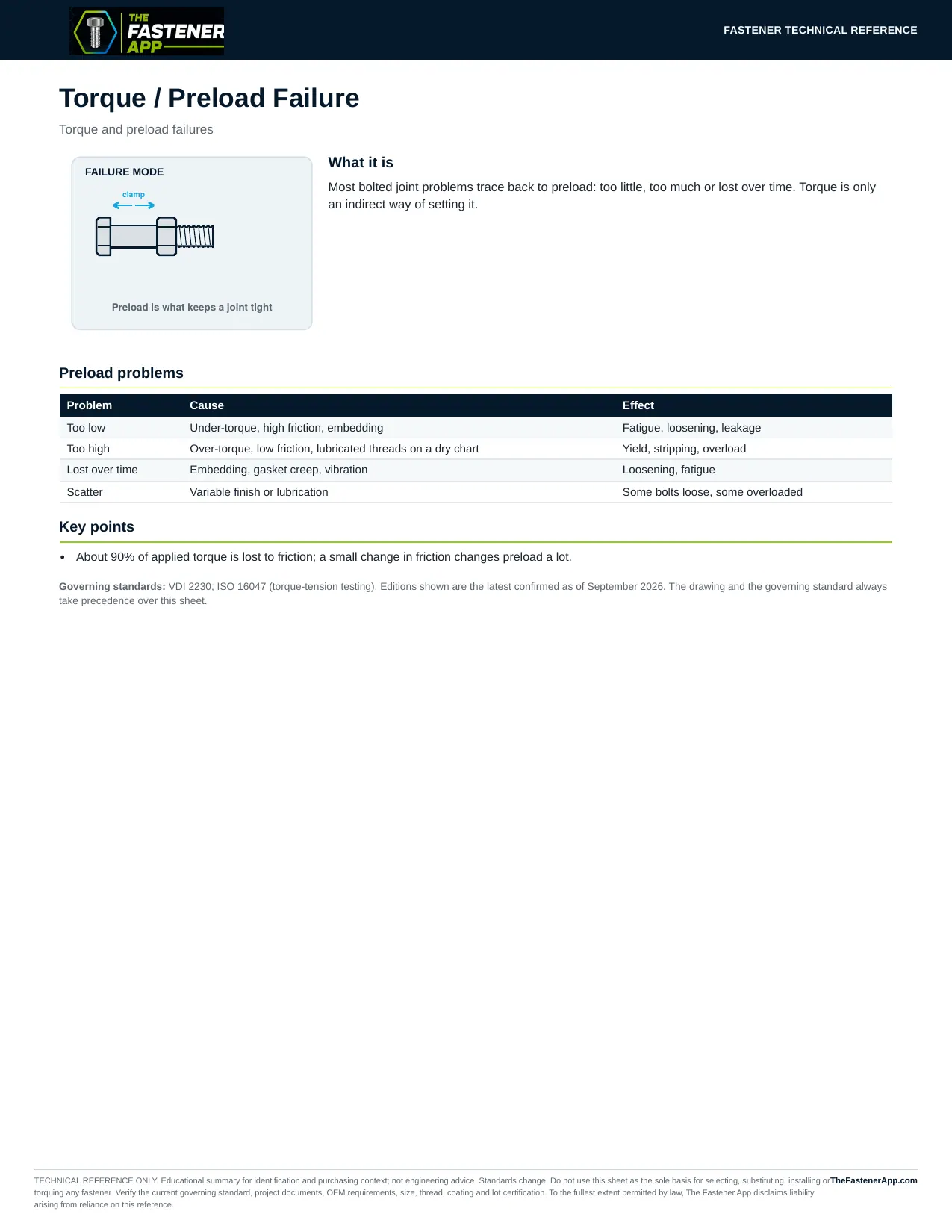
Most bolted joint problems trace back to preload: too little, too much or lost over time. Torque is only an indirect way of setting it.
Preload problems
| Problem | Cause | Effect |
|---|---|---|
| Too low | Under-torque, high friction, embedding | Fatigue, loosening, leakage |
| Too high | Over-torque, low friction, lubricated threads on a dry chart | Yield, stripping, overload |
| Lost over time | Embedding, gasket creep, vibration | Loosening, fatigue |
| Scatter | Variable finish or lubrication | Some bolts loose, some overloaded |
These tables carry the same figures as the printed sheet below.
The printed sheet
See an error on this sheet?
Tell us what is wrong.
Text version of this sheet
Torque and preload failures
What it is
FAILURE MODE
Most bolted joint problems trace back to preload: too little, too much or lost over time. Torque is only
an indirect way of setting it.
clamp
Preload is what keeps a joint tight
Preload problems
Problem
Cause
Effect
Too low
Under-torque, high friction, embedding
Fatigue, loosening, leakage
Too high
Over-torque, low friction, lubricated threads on a dry chart
Yield, stripping, overload
Lost over time
Embedding, gasket creep, vibration
Loosening, fatigue
Scatter
Variable finish or lubrication
Some bolts loose, some overloaded
Key points
About 90% of applied torque is lost to friction; a small change in friction changes preload a lot.
Governing standards: VDI 2230; ISO 16047 (torque-tension testing). Editions shown are the latest confirmed as of September 2026. The drawing and the governing standard always
take precedence over this sheet.
torquing any fastener. Verify the current governing standard, project documents, OEM requirements, size, thread, coating and lot certification. To the fullest extent permitted by law, The Fastener App disclaims liability
arising from reliance on this reference.
Fastener Guide reference FG-EA6F57 · thefastenerapp.com/fastener-guide/failure-analysis/torque-preload-failure · © The Fastener App. Reference only — verify the current governing standard, drawing and manufacturer data before specifying or installing.