Self-Drilling Screws
Self-drilling screws have a drill point that makes its own hole, then forms a thread, in one operation. Point size must match the steel thickness.
Point size vs steel thickness (approximate)
| Point | Typical drilling range |
|---|---|
| #2 | about 0.035 - 0.100 in |
| #3 | about 0.036 - 0.140 in |
| #4 | about 0.175 - 0.250 in |
| #5 | about 0.250 - 0.500 in |
Ranges vary by manufacturer and diameter. Check the maker chart.
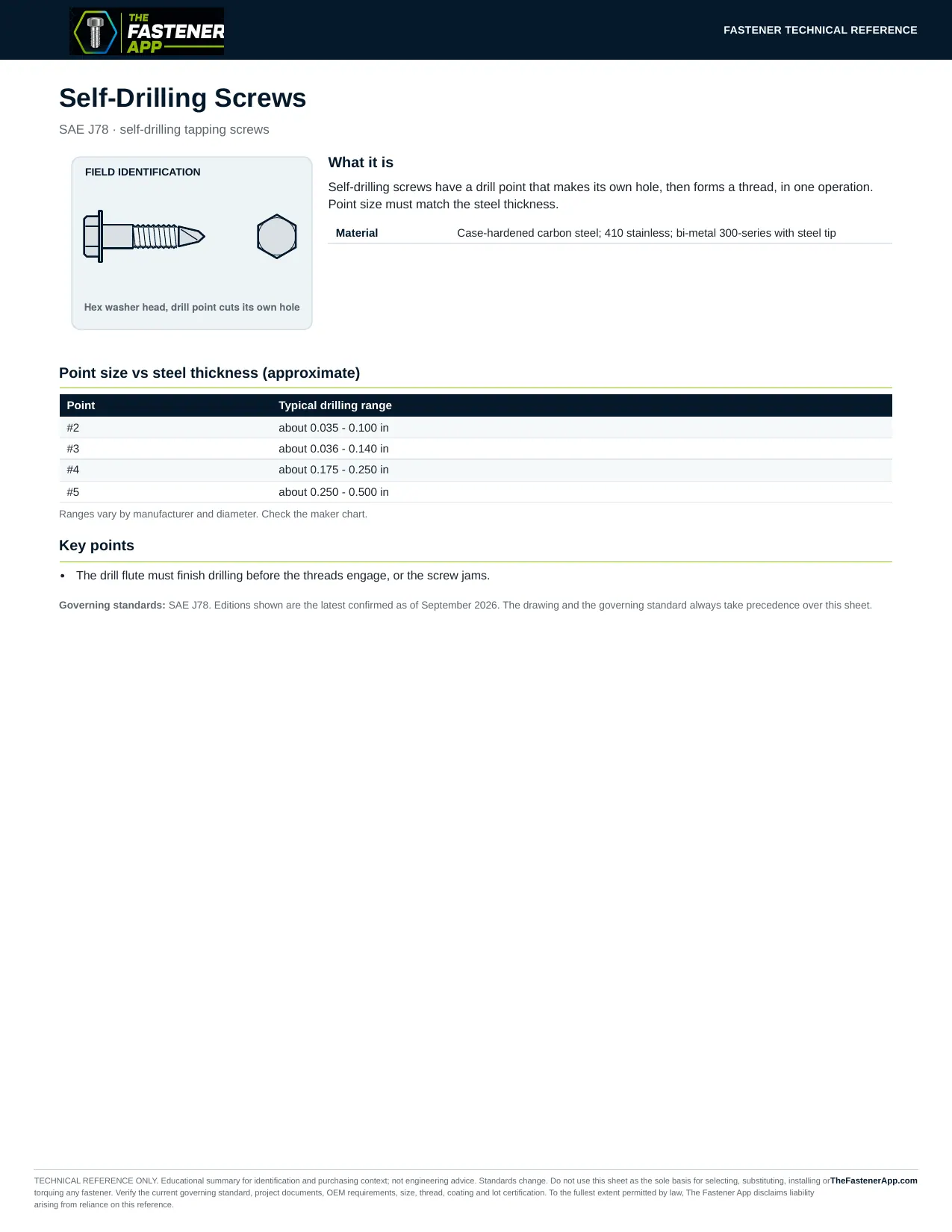
These tables carry the same figures as the printed sheet below.
The printed sheet
See an error on this sheet?
Tell us what is wrong.
Text version of this sheet
SAE J78 · self-drilling tapping screws
What it is
FIELD IDENTIFICATION
Self-drilling screws have a drill point that makes its own hole, then forms a thread, in one operation.
Point size must match the steel thickness.
Material
Case-hardened carbon steel; 410 stainless; bi-metal 300-series with steel tip
Hex washer head, drill point cuts its own hole
Point size vs steel thickness (approximate)
Point
Typical drilling range
#2
about 0.035 - 0.100 in
#3
about 0.036 - 0.140 in
#4
about 0.175 - 0.250 in
#5
about 0.250 - 0.500 in
Ranges vary by manufacturer and diameter. Check the maker chart.
Key points
The drill flute must finish drilling before the threads engage, or the screw jams.
Governing standards: SAE J78. Editions shown are the latest confirmed as of September 2026. The drawing and the governing standard always take precedence over this sheet.
torquing any fastener. Verify the current governing standard, project documents, OEM requirements, size, thread, coating and lot certification. To the fullest extent permitted by law, The Fastener App disclaims liability
arising from reliance on this reference.
Fastener Guide reference FG-61473F · thefastenerapp.com/fastener-guide/technical-reference/self-drilling-screws · © The Fastener App. Reference only — verify the current governing standard, drawing and manufacturer data before specifying or installing.